

A job description that is only reviewed during hiring can quickly stop reflecting the role. A practical approach to keeping track of job descriptions is to review each one at least once a year, and sooner when duties or workplace needs change. Roles with frequent shifts in responsibility may need several reviews a year.
When teams are busy, updates can easily slip, and scattered files make them harder to manage. Current descriptions give managers and employees a shared picture of responsibilities, expectations, and how the work is changing. This guide explains why descriptions become outdated, how to make reviews manageable, and how to keep the latest version easy to find. It also shows how to build reviews into existing routines, so updates don’t depend on someone remembering at the last minute. The aim isn’t constant rewriting; it’s a reliable process for catching meaningful changes before the next hiring or performance conversation.
Key Takeaways
- Build description reviews into existing performance and planning conversations, and revisit them when role responsibilities shift.
- Compare each description with the work employees actually do, so hiring materials and expectations stay aligned.
- Keep a finalized version in a shared, accessible location and establish a clear process for sending updates to HR.
- Make requirements relevant to essential duties, focus on outcomes and accountabilities, and avoid language that could imply bias.
1. Time and effort involved in updating descriptions
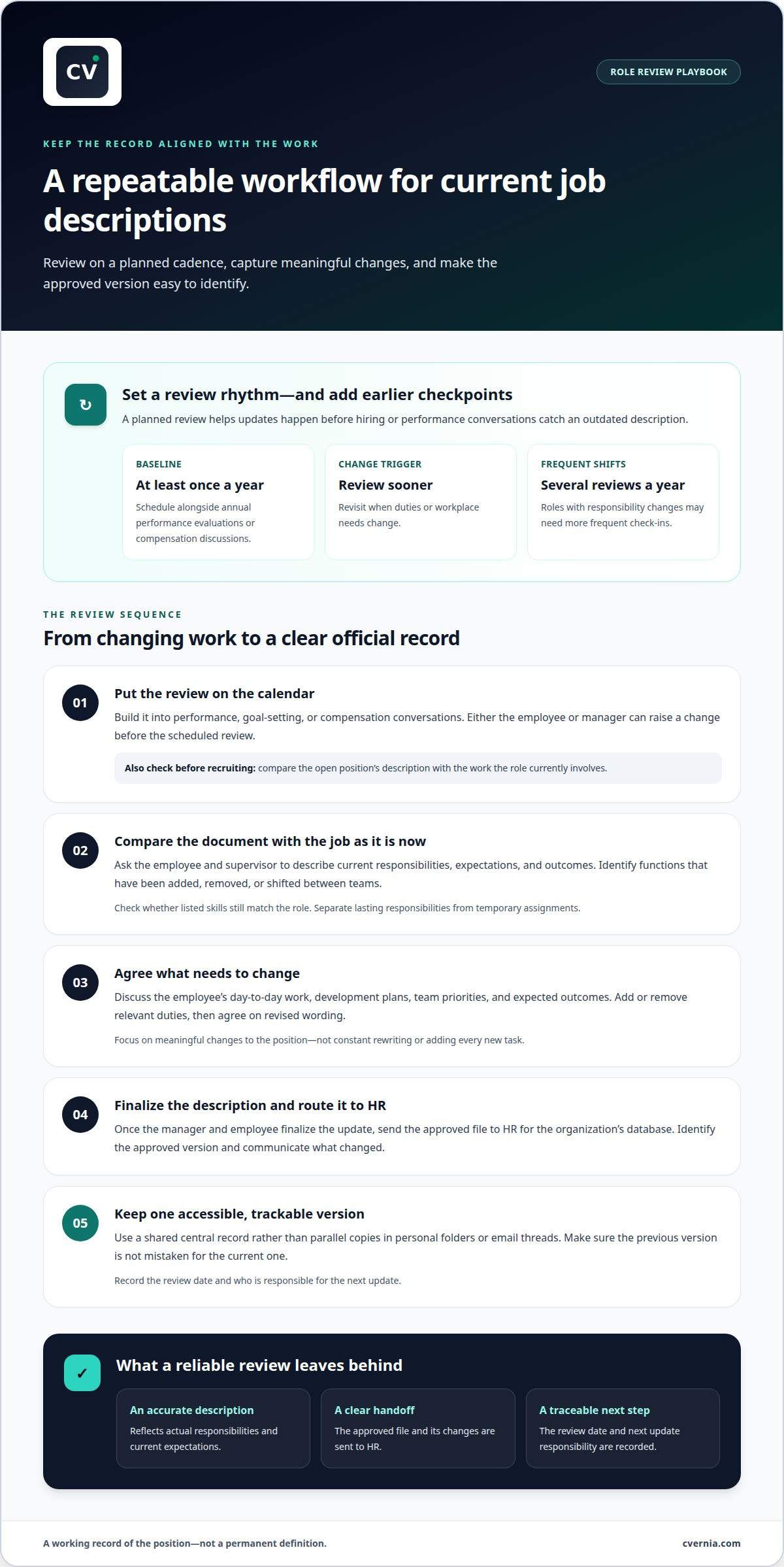
A practical way to keep track of job descriptions is to schedule reviews alongside annual performance evaluations or compensation discussions. This gives managers and employees a planned opportunity to compare each position with its current responsibilities, skills, and expectations. If the role is stable, they can confirm that the description still fits. If duties have shifted, document the changes and assign someone to revise it.
At Baylor, managers schedule position-description discussions alongside goal-setting during the summer performance review process. Either the employee or manager can initiate a review, so a new responsibility need not wait until the annual discussion. For example, if an annual plan adds or removes a fundamental function, update the position description. Roles with frequently changing tasks may need review several times a year.
Focus each update on work that has changed. First, discuss the employee’s current responsibilities and development plans. Then compare those duties with the existing description, identify what to add or remove, and agree on revised wording. A review calendar makes keeping track of job descriptions easier by giving each update a clear place in the workflow. It also helps distinguish lasting changes from temporary assignments.
Use each review to check that the listed skills and expectations still match the role. The U.S. Department of Labor explains that job titles alone don’t determine exempt status; specific job duties and salary must meet regulatory requirements. When duties or expectations change, document the update and route classification or compensation questions through the appropriate HR process.
Before recruiting for an open position, compare its description with the work the role currently involves. Schedule the review, discuss changes, revise the relevant sections, and send the final version to HR. This keeps recruiting materials aligned with the position and gives the next review a clear starting point.
2. Job descriptions become outdated
A job description reflects a position at a particular point in time, not every future version of it. As teams change their processes, employees may take on new responsibilities, stop handling old tasks, or use different tools. For example, a role that once focused on preparing reports manually may now involve reviewing automated reports and explaining findings to colleagues.
Priorities can also shift between teams. If customer support begins handling a new stage of onboarding, the responsibilities of support and onboarding positions may overlap or change. A description that still reflects the old division of work can confuse employees, managers, and applicants. Compare the document with current workflows whenever a process or team structure changes.
New skills can reshape a role, too. A position may begin to require regular analysis, coordination across departments, or work with a new system. Don’t simply add every new task to the document. Identify the responsibilities that define the position, then revise the description to reflect its current purpose and the skills needed to do the work.
Recruiting provides another important checkpoint. Before advertising an open position, HR professionals should compare its job description with the role as it exists now. If the work has changed since the last hire, update the document before using it to guide recruiting. This helps avoid outdated duties and makes current expectations clear.
Employees also need to understand that position descriptions can change as work evolves. Managers can explain this during role discussions and share updates when responsibilities shift. For instance, if a new client handoff becomes part of someone’s regular work, discuss the change and revise the relevant description. Treat the document as a working record, not a permanent definition of the role.
Managers should explain that position descriptions may change. Make this part of ongoing conversations about responsibilities, rather than letting employees assume the document will stay fixed. When revising a description, clarify that it reflects the position’s current scope and may be reviewed again as the work changes. Clear communication helps employees understand updates as part of an evolving role.
3. Keeping job descriptions accessible and up to date
Keep one approved version of each position description in a shared, trackable location. A central HR database can serve as the official record, while employees and supervisors use it to discuss role expectations. Avoid parallel copies in personal folders or email threads. Anyone opening a description should be able to tell whether it reflects the current position.
Start each review by comparing the document with the job as it is now. Ask the employee and supervisor to describe the work, including functions added or removed since the previous version. For example, if someone now coordinates a process that another team used to handle, describe that responsibility clearly. The updated description should reflect the actual role, not an outdated assumption.
Make the review collaborative. Employees can explain how their day-to-day work differs from the written description, while supervisors clarify expected outcomes and priorities. Discuss how the position serves the team and whether development plans have changed its focus. This input helps distinguish lasting responsibilities from temporary assignments, keeping the document useful for performance conversations and future planning.
Once the manager and employee finalize the description, send it to HR for the organization’s database. Set a clear handoff by identifying the approved file, communicating what changed, and ensuring the previous version is no longer mistaken for the current one. Record the review date and who is responsible for the next update. These details make changes easier to trace and questions about role expectations easier to answer.
Organize descriptions by department and position title, then give relevant employees and managers access. Use consistent file names to distinguish approved documents from drafts. When recruiting begins, HR and the hiring manager can retrieve the current description and use it as the basis for the job announcement. A reliable system supports recruiting, onboarding, and development without making employees search old messages.
4. What are common mistakes when maintaining job descriptions?
A common mistake is listing qualifications without connecting them to the work. Knowledge, skills, and abilities should each be supported by one or more essential job functions. For example, if a description requires advanced spreadsheet skills, identify the regular job function that uses them. This clarifies the requirement and explains why it belongs in the description.
Apply the same test to education, certifications, experience, and physical requirements. Each should be supported by essential job functions, rather than copied from an old document or added as a preference. If a role requires a certification, describe the function that depends on it. If lifting is listed, connect it to an actual responsibility. Unsupported requirements can create barriers without clarifying the work.
Another mistake is describing activities without explaining their results. A list such as “attend meetings, prepare reports, answer requests” names tasks but says little about the position’s outcomes or accountability. Clarify what the work is meant to achieve. For example, explain how reports support team decisions or help monitor a process, rather than simply saying “prepare reports.” A job description should communicate the role’s purpose, not serve as a procedural manual.
Review the wording for assumptions about personal characteristics. Avoid language that suggests a preference based on gender, age, race, religion, or family status. Replace descriptions of an ideal personality with job-related expectations. For example, specify the communication or coordination the role requires, rather than asking for someone “young and energetic.” Keep the focus on the work and relevant qualifications.
Before using a description for recruiting, check each requirement against its essential function and each task against the role’s intended outcomes. Applicants can then use the stated requirements to shape their materials. For support aligning experience with a specific opening, explore tailored CV and cover letter creation.
A final review can check whether the description makes clear what the position is accountable for and what its work is meant to achieve. Education, certification, experience, and physical requirements should be supported by essential job functions. The description should explain outcomes, responsibilities, and accountabilities, not merely list tasks and duties.
CVernia: Application Tracking Dashboard
CVernia helps you manage your job search when you’re applying for roles with changing or closely matched requirements. Its Application Tracking Dashboard organizes application details, while CV Compatibility & ATS Analysis helps you assess how your CV aligns with a specific job description. This is useful when tailoring materials for several openings and keeping each version connected to the right role.
CVernia’s Career Application Management Platform brings application tracking and interview preparation together in one place. Use it to stay organized throughout your job search and keep role requirements and tailored CV versions aligned with the positions you’re pursuing. It supports your applications, rather than maintaining an employer’s internal job-description records.
Contact CVernia to learn how its tools can support your application workflow.
Make your next application more intentional
Keeping track of job descriptions matters beyond an employer’s internal records. As an applicant, you can use each description to understand a role and decide how to present relevant experience. Let its requirements guide a focused application, with materials tailored to the opportunity in front of you.
CVernia supports job seekers with a Career Application Management Platform, Tailored CV & Cover Letter Creation, and CV Compatibility & ATS Analysis. Use these tools to organize your applications and prepare materials that reflect the roles you’re pursuing.
Take the next step at your own pace. Contact CVernia to discuss your needs and explore how its platform can support your job search. A clear, considered approach can help you move forward with greater confidence.
Frequently Asked Questions
What is the best way to organize and track job descriptions?
Keep one controlled record for each position, with a named owner and clear approval status. Add a change log noting what changed, who approved it, and why, such as a revised reporting line or new responsibility. This gives HR and managers context when questions arise and prevents draft wording from being mistaken for an approved description.
How often should job descriptions be reviewed and updated?
Review each description at least annually, then revisit it sooner when a change affects the role’s core work. A new reporting structure, changed service process, or revised team responsibility can prompt a targeted review. Keep the annual check as a backstop, even if no changes seem necessary, so updates don’t rely solely on managers noticing a shift.


