

Your resume doesn't need more experience; it needs a translator. It's incredibly frustrating to spend hours perfecting your CV only to feel like it's disappearing into a digital black hole. You know you're qualified, yet the silence from recruiters can feel personal. The reality of modern hiring is that your first audience is often a software system looking for specific **ats resume keywords **. If your document doesn't speak the same language as the job description, it won't matter how impressive your background is. It simply won't reach a human desk.
You can stop worrying about whether your skills count as keywords or if you're looking unprofessional by overstuffing your text. We'll show you how to identify and extract the exact terms recruiters are searching for in 2026. This guide provides a clear method to strategically place these keywords to boost your compatibility score without sacrificing the quality of your writing. We'll explore how to align your experience with recruiter expectations, ensuring your application moves past the bots and straight into the hands of a hiring manager.
Key Takeaways
- Decode the filtering logic used by modern Applicant Tracking Systems to ensure your qualifications are recognized by the software.
- Distinguish between essential hard skills and high-impact soft skills to move your application past automated ranking filters.
- Master a systematic approach to extracting high-frequency terms directly from the requirements and responsibilities sections of a job posting.
- Strategically place ats resume keywords in dedicated competency sections to boost your compatibility score without sacrificing readability.
- Leverage specialized ATS analysis tools to verify your document's alignment with real-world job descriptions before you submit your application.
Understanding ATS Resume Keywords: Why They Control Your Application in 2026
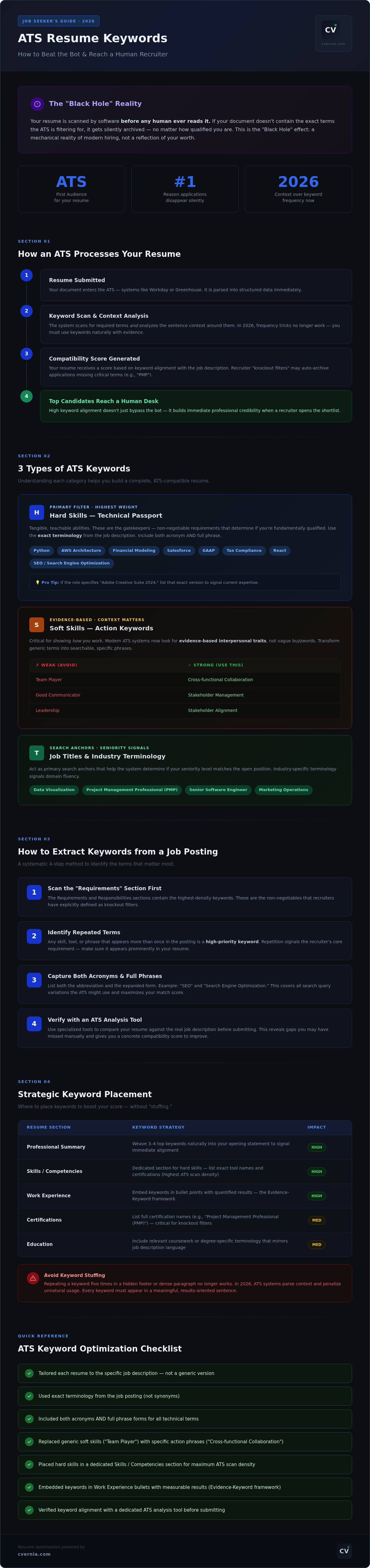
Think of your resume as a digital data packet. Before a human recruiter ever reads about your career achievements, an Applicant Tracking System (ATS) scans your document for specific signals. These signals are **ats resume keywords **. They are the professional identifiers, technical skills, and industry terms that recruiters use to filter thousands of applications into a manageable shortlist. In 2026, these keywords serve as the primary bridge of shared language between your experience and a company's specific requirements.
When your resume lacks these terms, you experience the "Black Hole" effect. This isn't just a metaphor for a slow response; it's a mechanical reality of modern hiring software. If a hiring manager at a company using Workday or Greenhouse searches for "Data Visualization," and your resume only mentions "Reporting," the system might never show your profile to a human. However, the 2026 hiring landscape has evolved. Modern systems now prioritize context over simple keyword frequency. It's no longer enough to repeat a word five times in a hidden footer. The software now parses your sentences to understand how you actually applied those skills to drive results.
What Counts as a Keyword?
Keywords generally fall into three distinct categories that help the ATS categorize your expertise. Hard skills are the most critical for initial automated filtering. These include technical proficiencies like "Python," "AWS Architecture," or "Financial Modeling." Soft skills are equally vital but require a more sophisticated approach in 2026. Systems now look for evidence-based interpersonal traits. Instead of using a generic term like "Team Player," use "Cross-functional Collaboration" or "Stakeholder Management" to show depth. Finally, job titles and industry-specific terminology act as primary search anchors. They help the system determine if your seniority level matches the open position.
The Role of Keywords in the 2026 Hiring Cycle
Keywords are the foundation of your overall compatibility score. Recruiters often set "knockout questions" or specific ranking filters based on these requirements. If a role requires "Project Management Professional (PMP)" and that keyword is missing, your application might be automatically archived. Building ats compliant resumes is the baseline for any modern job search. It ensures your application is visible when a recruiter opens their dashboard to review the top tier of candidates. High keyword alignment doesn't just bypass the bot; it builds immediate professional credibility by speaking the recruiter's language from the very first scan.
The Anatomy of High-Impact Keywords: Hard Skills vs. Soft Skills
Understanding which **ats resume keywords ** to prioritize is the next step in your optimization journey. Not all terms carry the same weight in a recruiter's search query. Hard skills act as the gatekeepers; they're the non-negotiable technical requirements that determine if you're fundamentally qualified for the role. Soft skills, however, provide the professional context that human recruiters crave once the system has validated your technical baseline. Success requires a strategic balance of both.
Hard Skills: Your Technical Passport
Hard skills are tangible, teachable abilities that are easily measured. For a software engineer, this might be "Java" or "React." For an accountant, it's "GAAP" or "Tax Compliance." When listing these, precision is paramount. Use the exact terminology found in the job description. If the posting asks for "SEO," don't just write "Search Engine Optimization." Including both the acronym and the full phrase is a smart strategy to cover all bases. If a role specifies version-specific expertise, such as "Adobe Creative Suite 2024," listing that exact year shows that your expertise is current. Industry-standard tools like "Salesforce" or "Python" should be listed clearly to satisfy initial automated filters.
Soft Skills: Proving Value with Action Keywords
Soft skills are often dismissed as fluff, but they're critical for showing how you work within a professional environment. The mistake most applicants make is using passive, overused terms. "Team player" is a weak keyword because it's vague and hard for a system to verify. In 2026, modern systems look for "Cross-functional Collaboration" or "Stakeholder Alignment." You can transform generic traits into searchable action verbs by focusing on the "Evidence-Keyword" framework. This involves linking a skill directly to a quantifiable result.
For instance, "Problem Solving" is a baseline trait that doesn't stand out. "Strategic Crisis Management" is a high-impact keyword. When you describe how you managed a crisis to save a project timeline, you provide the evidence the bot needs to rank you higher. If you're unsure if your current list hits the mark, a quick CV compatibility and ATS analysis can reveal exactly where your technical and transferable skills stand. Using certifications like "PMP" or "Google Analytics" also adds trust-signal keywords that give you an immediate advantage over candidates who only list the skill without the credential.
How to Extract ATS Keywords from a Job Description
Finding the right ats resume keywords requires a systematic approach to decoding the job description. Instead of guessing which skills matter most, follow these five steps to ensure your application is built on the right data:
- Step 1: Focus on the 'Requirements' and 'Responsibilities' sections first, as these contain the core technical anchors for the role.
- Step 2: Identify high-frequency terms that appear more than twice throughout the posting.
- Step 3: Look for 'hidden' keywords in the 'About the Company' section to align your profile with their specific culture and values.
- Step 4: Analyze the hierarchy by identifying which skills are listed at the top of the requirements list, as these are usually the primary deal-breakers.
- Step 5: Use a tailored cover letter generator to ensure these terms are consistent across your entire application package.
This structured method removes the guesswork and ensures your CV is indexed correctly by the hiring software. By treating the job description as a blueprint, you create a document that speaks directly to the recruiter's immediate needs.
Identifying Frequency and Emphasis
Pay close attention to the first three bullet points in the requirements list. These are usually the 'must-haves' that recruiters prioritize when setting up their filtering logic in 2026. Distinguish between 'Required' and 'Preferred' qualifications. While required skills are essential for the baseline score, preferred skills often act as the tie-breaker that moves you to the top of the pile. High keyword frequency signals to the ATS algorithm that your experience is a dense match for the specific needs of the role. The software calculates a relevance score based on how often and where these terms appear, so placement matters just as much as inclusion.
Mirroring the Employer's Language
Avoid the "Synonym Trap." You might prefer the term "Customer Success," but if the employer uses "Client Relations," use their exact phrasing. Modern software is smarter than it used to be, but matching their specific terminology removes any margin for error. This applies to spelling variations and industry-specific jargon too. If they use an acronym like "SaaS," include both the acronym and the full term "Software as a Service" to maximize your visibility across different search queries. Adapt your language to the company's culture. A startup might look for "Agile Methodologies" and "Growth Hacking," while a corporate environment might prioritize "Standard Operating Procedures" and "Regulatory Compliance." Matching their specific dialect shows that you already fit into their professional ecosystem.
Strategic Placement: Where to Put Keywords Without 'Stuffing'
Finding the right ats resume keywords is only half the battle. Your next challenge is placing them so they satisfy the algorithm without alienating the human recruiter who eventually reads your file. In 2026, keyword stuffing is a fast track to rejection. Modern systems detect unnatural word density; recruiters are trained to spot resumes that prioritize bots over people. Aim for a seamless integration where your expertise feels earned, not just listed.
Start with your Professional Summary. This section provides immediate impact by anchoring your identity with two or three primary keywords. Follow this with a dedicated 'Core Competencies' section. This area is an ATS goldmine because it allows for a high concentration of terms in a format that is incredibly easy for software to parse. Avoid 'white fonting' or hiding blocks of text in the margins. These black-hat tactics are easily flagged by 2026 software, often resulting in an automatic disqualification for deceptive practices.
Keywords in the Work Experience Section
The work experience section is where you prove your keywords aren't just empty claims. Use the 'Context-Action-Result' (CAR) method to weave technical terms into your bullet points naturally. Instead of just listing 'Project Management,' describe how you 'led a cross-functional team using Agile Project Management to reduce delivery times by 15%.' This approach satisfies the bot's need for the keyword while giving the recruiter the proof they need. Prioritize keywords in your most recent roles. This signals to the system that your proficiency is current and ready for immediate application.
The Skills Section: Clean and Scannable
Keep your skills section simple. Avoid complex tables or graphic skill bars; these often confuse older parsing engines and lead to missing data. Categorize your expertise into clear groups like 'Technical Proficiencies' and 'Leadership Competencies' to help the system understand your professional range. You should aim to list between five and eight specific skills per category to maintain a focused and professional profile. If you want to see exactly how your placement affects your visibility, use CVernia's CV Compatibility & ATS Analysis to visualize your document through the eyes of the bot.
Optimizing Your Strategy with CVernia's ATS Analysis
Mastering ats resume keywords manually is a great start, but technology offers a level of precision that manual review cannot match. CVernia's CV Compatibility & ATS Analysis allows you to upload your draft alongside a real job description to see exactly how the software parses your data. You'll receive a clear compatibility score that highlights missing terms and identifies formatting errors before you hit submit. This isn't about tricking a system. It's about ensuring your hard-earned experience is visible to the people who want to hire you. You can finally see your document through the "eyes" of the bot, identifying exactly which phrases are being indexed and which are being ignored.
Truthful Tailoring vs. Keyword Stuffing
We believe in professional integrity. CVernia never suggests inventing fake skills or qualifications to bypass a filter. Instead, our platform uses Truthful Tailoring to help you identify relevant experience you already have but might have overlooked. Perhaps you managed a complex budget but didn't use the specific term "Financial Oversight." Our system prompts you to highlight these existing strengths. This approach maintains your credibility during the human interview while satisfying the initial algorithm. It's a strategic advantage that doesn't compromise your values. Implementing a job search management system ensures that your career growth is built on a foundation of honest, high-impact results.
Version Management for Keyword Success
Every company has a unique professional dialect. You should never use the same keyword set for two different roles, even if the titles are identical. CVernia's dashboard acts as a centralized hub for managing multiple CV versions. You can track which specific "keyword versions" lead to interview invites, allowing you to refine your strategy over time. This data-driven approach removes the anxiety of high-volume searches by showing you exactly what works.
- Track every CV version tailored for specific ats resume keywords.
- Identify which skill clusters are triggering the most interview invites.
- Monitor your reapplication status to avoid sending redundant documents.
- Access Career Academy resources to deepen your understanding of modern hiring tech.
If you're targeting a dream company for the second time, our Smart Reapplication Detection is a game changer. It helps you adjust your keyword strategy when trying again by comparing your new CV against previous submissions. This ensures you're showing progression and fresh skills rather than repeating the same document that didn't get a "yes" the first time. Stay organized and efficient by seeing all your versions, notes, and compatibility scores in one place.
Master Your CV Visibility and Land the Interview
You've moved from the frustration of the digital black hole to a clear understanding of how to bridge the gap between your experience and hiring technology. By mastering the balance between technical hard skills and evidence-based soft skills, you've ensured your resume speaks the language of modern recruitment. Strategic placement means your document remains a professional narrative for humans while satisfying every requirement of the algorithm. You don't have to guess if your ats resume keywords are hitting the mark anymore. It's time to stop wondering and start seeing results.
Success in the 2026 job market requires both precision and organization. Our platform empowers you to refine your application with truthful tailoring that focuses on your real experience. You can manage every version of your CV from a centralized dashboard and save time using smart reapplication detection when targeting your dream companies. Stop leaving your career to chance and start applying with total confidence. Analyze your resume's ATS compatibility for free with CVernia and take the first step toward your next big role. Your next professional chapter is waiting; go out and claim it.
Frequently Asked Questions
Is it better to use acronyms or full phrases for ATS keywords?
Use both the acronym and the full phrase to maximize your visibility across different search queries. Recruiters often use these terms interchangeably when searching their candidate database. For instance, writing "Project Management Professional (PMP)" ensures you appear in results for both versions of the term. This strategy covers all bases and shows professional attention to detail while helping the software understand the full context of your expertise.
Can I get penalized for using too many keywords on my resume?
You will be penalized if the keyword density feels forced or if you use hidden text tactics. Modern software is designed to prioritize readability and context rather than just counting words. Instead of stuffing terms, focus on integrating them naturally into achievement-based bullet points. This approach builds trust with the human recruiter who eventually reviews your document after it passes the initial automated scan.
Do ATS systems read keywords in the header or footer of a resume?
Most systems fail to parse information correctly when it is placed in headers or footers. Keep your ats resume keywords within the main body of your document to ensure they are indexed properly. Placing critical skills in these marginal areas often leads to missing data in your candidate profile. This can significantly hurt your compatibility score and prevent your contact information from being correctly saved.
How many keywords should I aim to include for a single job application?
Aim for a 70% to 80% match of the skills found in the job description to be competitive. You don't need to include every single word from the posting to be successful. Focus on the top five to ten "must-have" requirements listed in the responsibilities section. Quality and relevance always outweigh sheer volume when it comes to automated filtering and ranking.
Does the order of keywords in my skills section matter to the ATS?
The hierarchy of your skills list often signals your primary level of expertise to the system. Place your most important and strongest skills at the beginning of each category. This structure helps the software and the recruiter quickly identify your core strengths. It's a simple way to influence how your professional profile is categorized and ranked against other applicants in the pool.
What happens if I apply with a resume that has zero keywords from the job description?
Your application will likely disappear into a digital graveyard without ever being seen by a person. Without ats resume keywords, the software has no way to link your experience to the specific needs of the role. This lack of alignment usually triggers an automatic rejection. You must speak the recruiter's language to ensure your CV reaches a human desk for a detailed review.
Can the ATS detect if I've just copied and pasted the entire job description?
Modern systems can easily detect large blocks of copied text from the original job description. This practice is a major red flag that suggests a lack of effort or professional honesty. Use the job posting as a guide to understand their needs, but always describe your achievements in your own unique voice. Truthful tailoring is always more effective than simple copying and pasting.
Should I include keywords for skills I only have a basic understanding of?
Include them only if you can realistically discuss them during a professional interview. You can categorize these under "Working Knowledge" or "Basic Proficiency" to stay honest about your current level. This allows you to include the keyword for search purposes while setting accurate expectations for the recruiter. Never claim expert status for a skill you've only just begun to learn or practice.


