
Remote roles often attract significantly more applicants than on-site positions, making a structured application workflow more important than ever. You've likely felt the frustration of the ATS "black hole" or the panic of realizing you sent the wrong file version to a dream company. It's exhausting to manage multiple interview timelines without a clear structure. We understand that behind every application is a professional ready to make their mark, and the current digital noise makes it harder than ever to be seen.
You can transform this chaotic process into a high-conversion system by refining your approach for the current hiring environment. This guide provides a professional framework that prioritizes strategic quality over mindless volume. CVernia's ATS Compatibility Score compares your CV with a specific job description and highlights opportunities to improve alignment while keeping your experience truthful..
Key Takeaways
- Adopt a systematic job application workflow to move away from the "spray and pray" method and focus on roles where you have the highest compatibility.
- Apply the 20-minute tailoring rule to ensure every submission is high-quality without spending hours on a single document.
- Master the technical requirements of modern Applicant Tracking Systems to ensure your CV passes the initial digital screening and reaches human recruiters.
- Build a visual application pipeline to manage multiple interview timelines and maintain psychological momentum during your search.
- Centralize your career documents and tracking in one command center to maintain version control and document every interaction with potential employers.
The Anatomy of a Modern Job Application Workflow
A modern job application workflow is a strategic, end-to-end lifecycle designed to find, tailor, submit, and track career opportunities. It transforms the often chaotic act of job hunting into a structured project that treats each submission as a high-value milestone. While the core of this process still centers on a standard business document, the digital infrastructure surrounding it has changed. You aren't merely sending a file; you're managing a complex data pipeline that requires precision, version control, and timely execution.
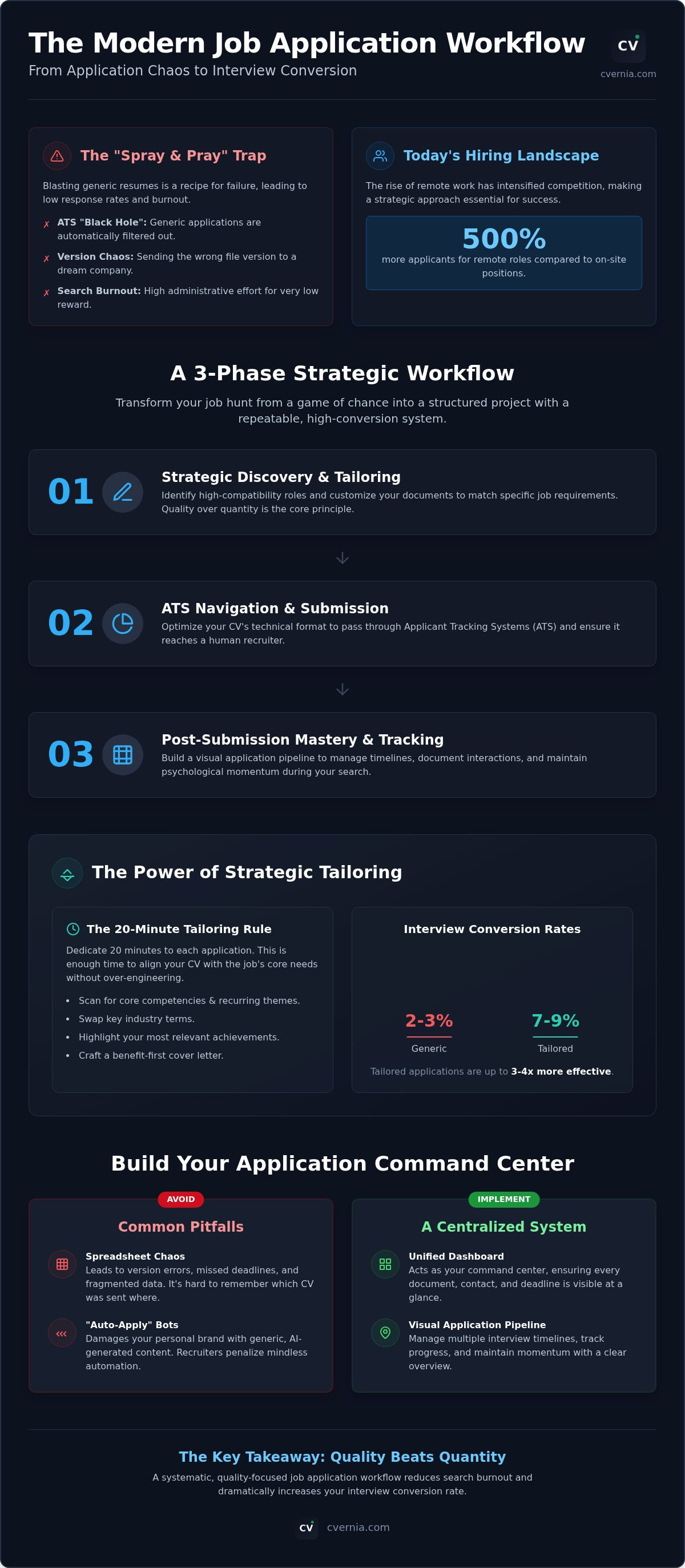
The "spray and pray" method, where candidates blast generic resumes to hundreds of listings, has become a recipe for failure. Recruiters now rely on sophisticated filtering to remove generic noise, prioritizing candidates who demonstrate clear alignment with the role's specific needs. Shifting to a quality-based strategy isn't just about better writing; it's about reclaiming your time. When you implement a repeatable job application workflow, you spend less energy on administrative busywork and more on high-impact tailoring. This shift is the most effective way to reduce search burnout while increasing your interview conversion rates.
From Spreadsheet Chaos to Centralized Control
Managing a complex search through static spreadsheets often leads to missed opportunities. Excel or Google Sheets struggle with version management, making it difficult to remember which CV variation you sent to which hiring manager. Fragmented data leads to errors, such as referencing the wrong job description during an initial screening call. A dedicated management platform acts as your command center, ensuring every document, contact, and deadline is visible at a glance. This centralized control allows you to move with professional confidence, knowing your data is accurate and your timeline is secure.
Why 'Auto-Apply' is a Strategic Risk
Relying on auto-apply bots or mass-submission tools creates a significant risk to your personal brand. Hiring teams are reporting increased fatigue from automated applications, and many companies now penalize candidates who submit generic, AI-generated fluff. You risk losing control over your data and how your professional story is told. Truthful representation and manual oversight always outperform automated volume. High-growth firms are looking for authenticity and specific skill alignment, qualities that are often stripped away by mindless automation. Staying in control ensures your reputation remains intact throughout the hiring process.
Phase 1: Strategic Discovery and Document Tailoring
Success in the modern market starts with selectivity. Before opening a document, you must identify roles where your skills provide immediate value. This strategic discovery phase serves as the foundation of a high-conversion job application workflow. Instead of reacting to every notification, focus on high-compatibility opportunities where your background matches the company's specific challenges. Research indicates that tailored applications see an interview conversion rate of 7-9%, while generic submissions languish at a mere 2-3%. Quality wins every time.
Implementing the 20-minute rule helps you maintain momentum without sacrificing precision. Dedicate this time to adjusting your existing templates rather than starting from scratch. It's enough time to swap key industry terms and highlight relevant achievements, but not so much that you fall into the trap of over-engineering. Effective version management is essential here; you should maintain specific CV versions for different industry niches. This intentional approach keeps your job application workflow lean and ensures you're always ready to strike when the right role appears.
Aligning Your CV with the Job Description
Scan the job posting for core competencies and recurring themes. You don't need to match every single bullet point, but you must address the primary problems the company is trying to solve. It's critical to tailor your resume and cover letter to reflect these specific needs. Optimization isn't about inventing skills; it's about shifting the spotlight to your most relevant truths. You can use CVernia's tailoring tools to quickly align your experience with a job description while maintaining total authenticity and professional polish.
Crafting Tailored Cover Letters that Get Read
Your cover letter is a strategic document, not a generic introduction. Move beyond standard templates by using a benefit-first structure. Start with how your presence will improve the team's outcomes. Match the company's culture through careful word choice. If they're a fast-paced startup, use active, energetic language. If they're a legacy institution, opt for a more formal register. A customized letter serves as your best defense against ATS filtering because it provides the context that raw data often misses. It proves you've done your homework and are genuinely invested in the company's mission.
Phase 2: Navigating the ATS and Submission Gates
The technical submission is the bridge between your tailored content and a human recruiter. In 2026, nearly 99% of Fortune 500 companies utilize an Applicant Tracking System (ATS) to manage the massive influx of candidates. When you hit submit, your document isn't immediately viewed as a visual layout; instead, the system strips away the design to create a digital profile for the recruiter's dashboard. Understanding this "Recruiter View" is a vital stage of your job application workflow. If the system cannot parse your data accurately, your application may never reach human eyes, regardless of your qualifications.
Technical requirements have become more sophisticated, yet formatting traps remain common. Avoid using tables, text boxes, or complex graphics in your primary CV file. These elements often scramble the data during the parsing process, leading to missing work history or garbled contact details. For file types, .docx remains the gold standard for parsing accuracy, though modern systems handle high-quality PDFs much better than they did several years ago. Always check your "hidden" metadata to ensure your file name reflects a professional image. This level of technical diligence ensures your job application workflow remains robust through the final submission gate.
Mastering ATS Resume Compatibility
Modern scanners prioritize specific data points like job titles, employment dates, and hard skills. ATS compatibility is a measure of keyword and format alignment. Strategic alignment isn't about "gaming" the system with hidden text or irrelevant keywords; it's about ensuring your document speaks the same language as the job description. Focus on using standard section headings and chronological formats that machines can easily categorize. Before you finalize your submission, run a CV compatibility check to see exactly how a machine interprets your experience. This step gives you the confidence that your profile will appear correctly when a recruiter filters for top talent.
The Final Review: An Application Readiness Checklist
A single error at the submission gate can derail weeks of preparation. Verify that your contact information is current and that every attachment is accessible. Many candidates overlook the risk of duplicate submissions, which can make you appear disorganized to a hiring team. Utilize smart reapplication detection to ensure you aren't accidentally applying to the same position with conflicting CV versions. This feature protects your professional reputation by maintaining a consistent narrative across all touchpoints. Check your submission one last time for these essentials:
- Link Functionality: Test all links to portfolios or social profiles to ensure they aren't broken.
- Version Control: Confirm the file version matches the specific role and industry niche.
- Addressee Accuracy: Check that your cover letter is addressed to the correct company and hiring manager.
By mastering these technical gates, you ensure that your hard work in the tailoring phase actually pays off. You move from being a digital data point to a prioritized candidate who is ready for the interview stage.
Phase 3: Post-Submission Mastery and Tracking
Clicking the submit button is only the midpoint of a successful search. Your job application workflow must extend into the "waiting period" to ensure you remain top-of-mind for recruiters. The median job search now spans 108 days, making it easy to lose track of details as the weeks pass. Managing a three-month journey requires more than just memory; it requires a visual pipeline that provides a clear overview of your progress. Seeing your applications move through different stages provides a significant psychological boost and prevents the feeling of shouting into a void.
Professional follow-up is an art form that requires precise timing. Reach out to the hiring manager approximately one week after the stated deadline, or two weeks after submission if no deadline was provided. Use this touchpoint to reiterate your value and confirm that they have all the necessary documents. This proactive approach demonstrates high engagement and organizational skills. When you receive an interview invitation, your workflow shifts toward data collection. Document every question asked and every piece of feedback received. These notes are invaluable for refining your strategy for the next round or for future applications at similar firms.
Building an Application Tracking Dashboard
Move away from scattered desktop folders and generic bookmarks. A professional tracking dashboard allows you to categorize applications by stage: Applied, Interviewing, Offered, or Rejected. It's critical to link the specific CV version used for each entry. If a recruiter calls you for a screening, you need to know exactly which achievements you highlighted for that specific role. Storing interview notes and attachments in one secure location ensures that you are never caught off guard. You can access your Application Tracking Dashboard to centralize your entire career search in one intelligent command center.
Smart Reapplication: Turning Rejection into Strategy
Rejection isn't a dead end; it's a data point. Many major tech and corporate firms enforce "cool-down" periods, often lasting six months, before a candidate can apply for the same role again. Use your tracking system to monitor these timelines so you can strike the moment the window reopens. Version management allows you to look back at previous attempts and identify what didn't resonate with the hiring team. When new roles open at your dream companies, you'll have a historical record of your interactions, allowing you to tailor your new job application workflow with even greater precision. This strategic persistence often separates successful hires from the rest of the applicant pool.
Unlike traditional CV builders, CVernia remembers every application you create. If you later apply for the same employer or role again, CVernia detects your previous application and allows you to build an improved version while preserving your original CV, cover letter, interview notes, attachments, and application history.
Implementing Your Workflow with CVernia
CVernia acts as your intelligent digital mentor, providing the structure needed to navigate the complexities of the today's hiring market. By centralizing every stage of your job application workflow, you can scale your search efforts without compromising the integrity of your personal brand. You aren't just applying; you're building a professional legacy. Use the platform to move from a reactive search to a proactive career strategy that prioritizes your unique value and long-term goals.
Integrate the Career Academy into your weekly routine to stay ahead of recruitment trends. These learning resources offer continuous improvement, ensuring your skills and presentation remain sharp. Preparation for the interview stage is built directly into the system. With integrated guidance and notes management, you can enter every meeting feeling organized and efficient. You'll have a clear record of your interactions, which is essential for maintaining a consistent narrative across multiple interview rounds.
Leveraging the Command Center for Interview Success
Reviewing your ATS analysis allows you to predict potential interviewer questions based on keyword alignment. If a recruiter calls for a sudden screening, you can access your tailored documents instantly. This level of preparedness eliminates the stress of searching for files while trying to maintain a professional conversation. You'll know exactly which version of your CV they are holding and which specific achievements you highlighted. If you encounter a complex career transition, use the Help Center to navigate the shift with strategic guidance and expert support.
Your Long-Term Career Advantage
Your career advantage extends far beyond the current search. By maintaining a record of your professional growth, you create a powerful asset for future salary negotiations and promotions. Organized data provides the proof of your progress and the value you've delivered over time. You can look back at past applications to see how your skills have evolved and identify where your highest successes occurred. Take control of your career journey with CVernia's Career Application Management Platform.
Take Command of Your Professional Future
Transforming your search from a chaotic cycle of "spray and pray" into a high-conversion system requires more than just persistence; it requires a professional job application workflow. You've learned how to prioritize high-compatibility roles and navigate the technical gates of modern hiring systems with precision. By focusing on strategic tailoring and meticulous post-submission tracking, you ensure that every application reflects your true expertise and professional brand. Moving from uncertainty to readiness is a choice that starts with the right structure.
CVernia provides the digital architecture you need to maintain this momentum without the administrative burden. Leverage our centralized Application Tracking Dashboard to visualize your pipeline and utilize Smart Reapplication Detection to manage your interactions with dream companies. With built-in ATS Compatibility & Analysis, you can submit every document with the confidence that it will reach human eyes. Stop feeling like a number in a database; start acting as the lead architect of your own career.
Start Organizing Your Career with CVernia Today
Start managing your entire application journey with CVernia. Tailor your CV and cover letter, measure ATS compatibility, track every application, prepare for interviews, and keep all your career documents in one place..
Frequently Asked Questions
What is a job application workflow and why do I need one?
A job application workflow is a repeatable, structured system that moves you from discovering a role to receiving a formal offer. You need this structure to prevent search burnout and ensure you never miss a critical follow-up or interview deadline. By treating your search as a managed project, you replace the anxiety of "what's next" with the confidence of a clear, actionable plan.
Can I use AI to automate my entire job application process?
You shouldn't automate the entire process because recruiters now use intelligent systems to detect and filter out generic, AI-generated submissions. High-growth firms value truthful representation and human nuance over volume. Use technology to manage your tracking and analysis, but keep the actual tailoring of your CV and cover letter authentic to your real-world experiences.
How do I organize multiple versions of my resume for different jobs?
Organize your documents by linking each specific CV version directly to the job entry in your command center. This prevents the common error of referencing the wrong achievements during a surprise screening call. Instead of relying on confusing file names, a centralized dashboard keeps your document history accessible and perfectly aligned with every role you pursue.
What is the best way to track job applications in 2026?
The best way to track applications is through a dedicated Application Tracking Dashboard that provides a visual pipeline of your search. Static tools like spreadsheets fail to manage document versions or store interview notes effectively. A modern dashboard keeps your attachments, contact history, and next steps in one secure, searchable location for maximum efficiency.
How often should I follow up after submitting a job application?
Aim to follow up once, approximately one to two weeks after you submit your application. This single touchpoint shows professional persistence and ensures your profile hasn't been lost in a technical glitch. Keep your message brief, reiterate your interest in the role, and offer to provide any additional information the hiring team might need.
Does tailoring my resume actually help with ATS scores?
Tailoring is essential for high ATS scores because it ensures your document uses the exact terminology the recruiter's system is programmed to find. Strategic alignment isn't about "cheating" the software; it's about making your relevant skills visible. When your CV speaks the same language as the job description, you move to the top of the recruiter's shortlist.
What should I do if I want to reapply to a company that rejected me?
Start by identifying the company's specific cool-down period, which often lasts six months at major corporate firms. Use smart reapplication detection to avoid sending duplicate information that might trigger a system error. Review your previous notes to understand what didn't resonate, then submit a fresh, updated CV that reflects your recent professional growth.
Is it better to use a spreadsheet or a dedicated tracking platform?
A dedicated tracking platform is far more effective than a spreadsheet for managing a professional job application workflow. Spreadsheets are static and prone to manual entry errors, while platforms offer automated version control and integrated interview preparation tools. You'll save hours of administrative work by using a system designed specifically for the mechanics of modern hiring.


