
When a cover letter is requested, submitting a tailored one can help you explain your motivation, demonstrate your fit for the role, and provide context that a CV alone cannot. In today's recruitment market, where Applicant Tracking Systems (ATS) and AI-assisted screening are common, a well-written cover letter can strengthen your application and help you stand out.. It is understandable if you feel stuck when you try to create cover letter content from scratch. The fear of being rejected by an ATS filter or the struggle to match your skills to a job description without sounding repetitive is a common hurdle for even the most experienced professionals.
You deserve a process that makes you feel confident and prepared rather than overwhelmed. This guide will help you master the art of building a tailored, ATS-friendly cover letter that bridges the gap between your verified experience and specific job requirements in minutes. We will explore how to highlight your real achievements, ensure high compatibility scores, and use a streamlined workflow to manage multiple applications with precision. By the end, you will have a clear strategy to turn the stress of the job search into the readiness of a top-tier candidate.
Key Takeaways
- Understand why a narrative-driven cover letter is essential in a data-heavy market to prove genuine interest to recruiters.
- Learn how to create cover letter content that remains strictly truthful while maximizing compatibility with modern ATS filters.
- Discover the two-step mapping process to align your real-world experience with hidden job requirements effectively.
- Explore how to manage multiple application versions and track your progress using a centralized digital dashboard for a more organized search.
Why You Still Need to Create a Cover Letter in 2026
The idea that cover letters are obsolete is a persistent myth. In 2026, the opposite is true. As AI tools flood recruitment pipelines with thousands of identical, data-heavy resumes, hiring managers are starving for human context. When you create cover letter content that speaks directly to a company's pain points, you move beyond being a simple list of skills. You become a person with a clear purpose. Modern recruiters use these documents to filter out "ghost applicants" who mass-apply without reading the description. A tailored letter proves you've done the research and have a genuine interest in the role.
The job market has shifted from a formal introduction to a strategic value proposition. Since applications per opening have doubled since 2022, your narrative is your strongest asset. While a CV lists your credentials, the letter explains your motivation. It bridges the gap between your history and the company's future. Hiring managers today value human-centric storytelling because it provides a level of verification that keywords cannot match. They want to see your personality, your professional reasoning, and why you specifically fit their culture.
Cover Letter vs. Resume: The Strategic Difference
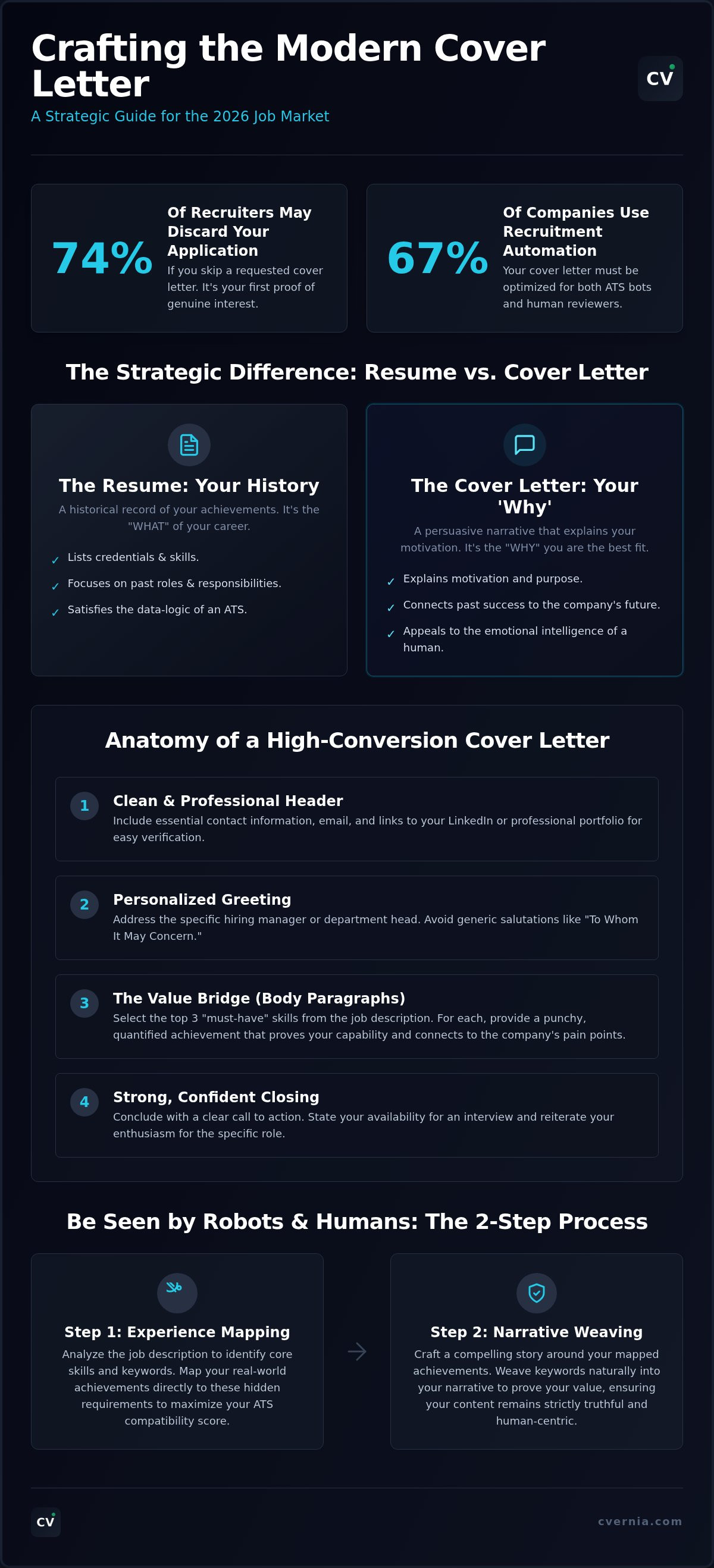
Your resume is a historical record of your achievements. It's the "what" of your career. In contrast, the cover letter is the "why." If you want to understand the foundational purpose of this document, you can look at the general definition of What is a Cover Letter? and how it has evolved from a simple introduction into a persuasive marketing tool. Instead of repeating your bullet points, use this space to explain how your past success predicts your future performance in this specific role. This dual approach satisfies both the cold logic of an ATS and the emotional intelligence of a human reviewer. Don't waste space on facts they already have; use it to provide the context they need to hire you.
The Impact of Personal Branding on Your Application
Your application is the first chapter of your professional story. A consistent voice builds immediate trust with a potential employer. When you create cover letter drafts that align with your CV's tone and the company's mission, you establish a strong personal brand early in the process. CVernia helps you maintain this alignment without the risk of AI-generated "hallucinations" or fake skills. By connecting your career goals to their specific mission, you show that you aren't just looking for any job. You are looking for this job. Establishing this connection through a professional, consistent layout makes your application memorable and authoritative.
The Anatomy of a High-Conversion Cover Letter
A high-conversion cover letter isn't a generic wall of text. It is a modular document designed for quick scanning and high impact. In a competitive market, your structure must guide the recruiter's eye toward your value immediately. Start with a clean header that includes your essential contact information, a professional email, and links to your LinkedIn profile or portfolio. These digital touchpoints provide the verification recruiters crave. When you create cover letter drafts, remember that the goal is to reduce friction for the hiring manager. Every second they spend looking for your phone number is a second they aren't reading about your achievements.
The middle of your letter serves as the bridge between your past and their future. This is where you connect specific achievements to the pain points mentioned in the job description. If you need a foundational look at how these pieces fit together, the University of Wisconsin–Madison Writing Center guide offers excellent structural templates that remain relevant in 2026. Finally, conclude with a call to action. Don't just hope for a call; state your availability for an interview and express your enthusiasm for discussing how you can contribute to their specific goals.
Addressing the Hiring Manager Correctly
Personalization starts with the greeting. Spend five minutes on LinkedIn or the company's "About Us" page to find the name of the department head or recruiter. If the name is truly hidden, use professional alternatives like "Dear [Department] Hiring Manager" or "Dear [Team Name] Lead." Avoid the outdated "To Whom It May Concern," as it suggests a lack of effort. Your tone should mirror the company culture. A tech startup might appreciate a friendly "Hi [Name]," while a traditional law firm requires a formal "Dear Mr./Ms. [Last Name]."
Selecting Your Most Relevant Achievements
Don't try to fit your entire career into three paragraphs. Instead, identify the top three "must-have" skills listed in the job description. Write one punchy sentence for each that quantifies your impact. For example, instead of saying you "managed a team," say you "led a team of 10 to exceed quarterly targets by 15%." If you're pivoting to a new industry, focus on transferable skills like project management or strategic communication. It's about showing, not just telling. You can easily check if your selected achievements align with the job's core competencies using CVernia's ATS analysis tool to ensure you haven't missed any critical keywords.
Manual vs. Automated: Finding the Right Balance
The rise of generative AI has created a new dilemma for job seekers. You might feel tempted to let a chatbot handle the heavy lifting, but generic AI often produces "hallucinations" that can derail your application. These tools sometimes invent qualifications or use over-the-top language that recruiters spot instantly. When you create cover letter drafts, your most valuable asset is the truth. A strategic tool differs from a basic chatbot because it uses your verified history to build alignment with a job description. It doesn't make things up; it simply translates your existing success into the language a hiring manager understands.
Finding the right balance means using technology to handle the technical hurdles while you provide the heart. Modern recruitment relies heavily on Applicant Tracking Systems (ATS), and your letter must be readable by these algorithms. By incorporating ORISE cover letter best practices, you can ensure your document follows a logical structure that appeals to both humans and machines. Digital assistance should act as a mentor that polishes your professional voice rather than a ghostwriter that replaces it.
The Risks of Fabricated Experience
Honesty is the foundation of a sustainable career. CVernia maintains a strict policy against inventing skills or work experience because we know the stakes are high. Background checks and technical interviews are designed to expose discrepancies. If an application claims a level of expertise you don't actually possess, the truth will surface during the hiring process. Dishonest applications don't just lose you a job; they damage your long-term reputation in your industry. Building credibility starts with an accurate self-representation that highlights your genuine growth and potential.
Leveraging Technology for Strategic Advantage
You can use technology to gain a competitive edge without sacrificing integrity. Use ATS analysis to scan your letter for missing keywords that are central to the role. This ensures your application doesn't disappear into a "black hole" before a human ever sees it. When you create cover letter versions for different companies, smart tools help you manage these variations efficiently.
- Identify core competencies that you might have overlooked in your manual draft.
- Speed up the tailoring process for multiple roles while maintaining a high standard of quality.
- Verify that your document's formatting is compatible with major systems like Greenhouse, Workday, and Lever.
This streamlined approach allows you to apply to more roles with higher precision. You ensure every submission is optimized for the specific system the employer uses, leaving you more time to prepare for the actual interview.
Step-by-Step: How to Create a Tailored Cover Letter in Minutes
Efficiency is your greatest advantage in a competitive market. You don't need to spend hours agonizing over every sentence to produce a high-quality result. By following a structured, logical workflow, you can create cover letter drafts that are both professional and persuasive in a fraction of the time. This process moves you from a blank page to a finished document by focusing on strategic alignment rather than just filling space. It is about working smarter, not harder, to ensure every word serves a purpose in your career transition.
- Step 1: Analyze the job description. Look for core competencies and hidden requirements. Companies often bury their most urgent needs in the middle of a bulleted list.
- Step 2: Map your truthful experiences. Identify which of your real-world achievements directly solve the problems mentioned in the job post.
- Step 3: Draft using a benefit-first structure. Lead with the positive outcome you achieved, then briefly explain the technology or method you used to get there.
- **Step 4: **CVernia analyses both your CV and the job description to calculate an ATS Compatibility Score, helping you identify areas that can be improved without exaggerating your experience.
- Step 5: Perform a final review. Check for a consistent professional tone and ensure your formatting is clean and modern.
Ready to build your next application? Use CVernia's tailored cover letter creator to streamline this entire process and ensure your narrative is perfectly aligned with your target role.
With CVernia, you don't need to start from a blank page. After tailoring your CV for a specific job, you can generate a matching cover letter based on your verified experience and the job description. Every cover letter remains truthful, reflects your actual qualifications, and stays aligned with your tailored CV, helping you present a consistent application to employers.
Analyzing Job Descriptions Like a Recruiter
Recruiters scan for specific signals. You must distinguish between "required" qualifications, which are non-negotiable, and "preferred" ones, which are your opportunity to stand out. Look for high-frequency keywords. If a specific software or methodology is mentioned three times, it is a core problem you are being hired to solve. Address these points directly to prove you understand their operational needs. This level of precision shows you aren't just looking for any job; you're looking for their specific role.
Final Polish and Formatting Rules
In 2026, digital readability is paramount. Stick to standard, clean fonts like Arial or Calibri and maintain one-inch margins to keep the layout organized. While the debate between PDF and Docx continues, a PDF is generally better for preserving your layout across different devices. However, ensure the file is text-searchable so ATS filters can read it easily. Adhere to the "One Page" rule without exception. Brevity is the soul of a good application. If a hiring manager cannot see your value in 300 words or less, they likely won't keep reading.
Beyond the Letter: Managing Your Application Journey with CVernia
Your work doesn't end when you hit the save button. Many guides treat the cover letter as a standalone task, but a successful job search requires ongoing management and strategic oversight. CVernia acts as your digital mentor, providing the infrastructure to track every move you make in the hiring landscape. Once you create cover letter versions for multiple companies, you need a way to organize them without losing track of your unique strategy for each role. Our platform centralizes your search, ensuring that your professional narrative remains consistent across every touchpoint.
Managing different versions of your application is essential for high-volume searching in 2026. You don't want to walk into an interview and realize you're referencing the wrong document. Smart version management allows you to see exactly which document was sent to which recruiter. This level of organization builds the self-assurance you need to transition from uncertainty to readiness. Additionally, our smart reapplication detection identifies your history with specific employers. This feature ensures you don't repeat yourself or contradict previous claims when returning to a company you've applied to before. It helps you improve your odds by building on your existing data rather than starting from scratch.
CVernia remembers every application you submit. If you later apply to the same employer or role, it detects your previous application and allows you to build an improved version while keeping your original CV, cover letter, interview notes, attachments, and application history.
Organizing Your Career Dashboard
Maintain total control over your search with a centralized Application Tracking Dashboard. Store interview notes, recruiter feedback, follow-up reminders and supporting documents alongside each application. Track application dates, current status, and set automated follow-up reminders so you never miss an opportunity. You can also store interview notes and attachments in one secure place. Analyzing your success rate across different industries becomes simple when all your data is in one view. Use this birds-eye perspective to pivot your strategy based on real results. When you create cover letter drafts that consistently lead to interviews in a specific sector, the dashboard makes that trend visible immediately.
Continuous Growth with the Career Academy
The hiring landscape moves fast, and staying prepared is a full-time job. Access our Career Academy to find learning resources that help you bridge skill gaps truthfully and effectively. You will get expert guidance on modern recruitment trends and the hidden rules of the 2026 market. Preparedness is the key to confidence in any professional journey. Move forward with a partner that understands the mechanics of personal branding and application optimization. Create a tailored CV and matching cover letter with CVernia, measure ATS compatibility, track every application, prepare for interviews, and manage your complete job search from one platform.
Secure Your Professional Future Today
You now have the blueprint to transform your job search from a game of chance into a strategic success story. A high-conversion letter isn't just about keywords; it's about connecting your verified history to a company's specific vision. When you create cover letter drafts that prioritize human-centric storytelling and data alignment, you stand out in a crowded digital landscape. You've learned how to map your skills truthfully and navigate the technical requirements of modern recruitment systems with ease.
Take the next step toward your new role with a partner that understands the modern hiring landscape. CVernia provides a truthful representation guarantee and built-in ATS-compatibility analysis to ensure your application reaches the right hands. You can manage every version of your search through an integrated application tracking dashboard, giving you the clarity and organization you deserve. Start building your ATS-optimized cover letter on CVernia and move forward with the confidence of a top-tier candidate. Your career transition is a journey, and you're ready to lead the way.
Frequently Asked Questions
Is it okay to use a cover letter generator?
Using a specialized tool is highly effective as long as it maintains your authentic voice and truthfulness. Avoid basic chatbots that often hallucinate skills or use generic, over-the-top language. Instead, choose a platform that uses your real experience to create cover letter drafts aligned with specific job descriptions. This ensures you pass background checks while saving hours on the manual drafting process.
How long should a cover letter be in 2026?
Aim for a length between 250 and 400 words to respect the recruiter's time. Research shows that 49% of hiring managers prefer a half-page document, while only 26% want to see a full page. Keep your paragraphs punchy and focused on high-impact results. Brevity proves you can communicate complex value propositions efficiently, which is a skill valued in any professional environment.
Do I need a different cover letter for every job?
Yes, you must tailor your document for every single application to remain competitive. A tailored letter can increase your interview chances by 40% compared to a generic submission. Since 74% of recruiters reject candidates who skip the letter when it's requested, sending a template is a high-risk strategy. Use version management tools to track which specific narrative you sent to each company.
What should I do if I don't have the hiring manager's name?
Use a professional, department-specific greeting if a name isn't available after a thorough LinkedIn search. "Dear [Department] Hiring Manager" or "Dear [Team Name] Lead" is much better than "To Whom It May Concern." This shows you understand the company's internal structure even without a direct contact. It maintains a professional tone while avoiding the stiff formalities of traditional job hunting.
Can ATS systems read cover letters as well as resumes?
Modern Applicant Tracking Systems scan cover letters for keyword alignment just as they do with resumes. Systems like Greenhouse and Workday are programmed to look for core competencies mentioned in the job description. When you create cover letter content, ensure your formatting is clean and your keywords are placed naturally to maximize your compatibility score before a human ever sees it.
What are the most common mistakes when creating a cover letter?
The most frequent errors include repeating your resume word-for-word and using generic AI-generated fluff that lacks substance. Recruiters look for specific motivation and cultural fit that your CV doesn't provide. Another mistake is failing to quantify your impact. Always use numbers to prove your success, such as "reduced costs by 12%," rather than just saying you "managed the budget."
Should I include my salary expectations in the cover letter?
Only include salary expectations if the job posting explicitly requires them as part of the application. Including a number too early can limit your negotiating power or lead to an immediate rejection if your range doesn't align with their budget. Focus on your value proposition first. Save the financial discussion for the interview stage where you have more leverage to discuss total compensation packages.
How do I mention a referral in my cover letter?
Mention your referral in the very first paragraph to grab the recruiter's attention immediately. State the person's name and their current role or relationship to the company clearly. For example, "I am applying for this role after discussing the team's goals with [Name], who suggested my background would be a strong fit." This provides instant social proof and encourages a closer look at your credentials.


