
Did you know that many employers use Applicant Tracking Systems (ATS) to filter and rank applications before recruiters review them. A well-tailored, ATS-compatible CV can significantly improve your chances of reaching a human recruiter. It's a staggering reality that explains why so many qualified candidates feel ghosted after hours of effort. You've likely felt the weight of application fatigue or the headache of managing dozens of CV versions, which is why a robust job search management system is no longer optional. We understand that the modern hiring process often feels more like a technical hurdle than a genuine career opportunity.
It's time to stop guessing and start strategizing for your next move. You deserve a clear path from "applied" to "hired" without the stress of disorganized spreadsheets or failed ATS scans. This guide will show you how to transform your current workflow into a high-conversion engine that keeps your documents truthful and your progress visible. We'll explore how to build a centralized dashboard, master ATS-aligned documents, and use smart version control to ensure you always put your best foot forward in 2026.
Key Takeaways
- Escape the "Black Hole" of automated recruitment by identifying why manual spreadsheets fail in a high-volume market.
- Implement a centralized job search management system to track applications and manage multiple CV versions with professional precision.
- Navigate 2026 ATS requirements using semantic alignment and clean formatting while maintaining the integrity of your professional story.
- Optimize your interview preparation by integrating notes and attachments directly into your application workflow for seamless follow-ups.
- Leverage continuous learning resources like a Career Academy to bridge skill gaps and stay ahead of evolving industry demands.
Why Your Job Search Feels Like a Full-Time Job (And Why It Shouldn't)
Searching for a new role shouldn't feel like a grueling second shift. Yet, for many professionals in 2026, the process is exactly that. You spend hours tailoring documents and scouring boards, only to receive silence in return. This cycle leads to burnout and a sense of helplessness. It's time to shift your perspective. You aren't just a job seeker; you are a career manager. Adopting a professional job search management system is the first step toward regaining your time and your sanity.
The 'Black Hole' of Modern Recruitment
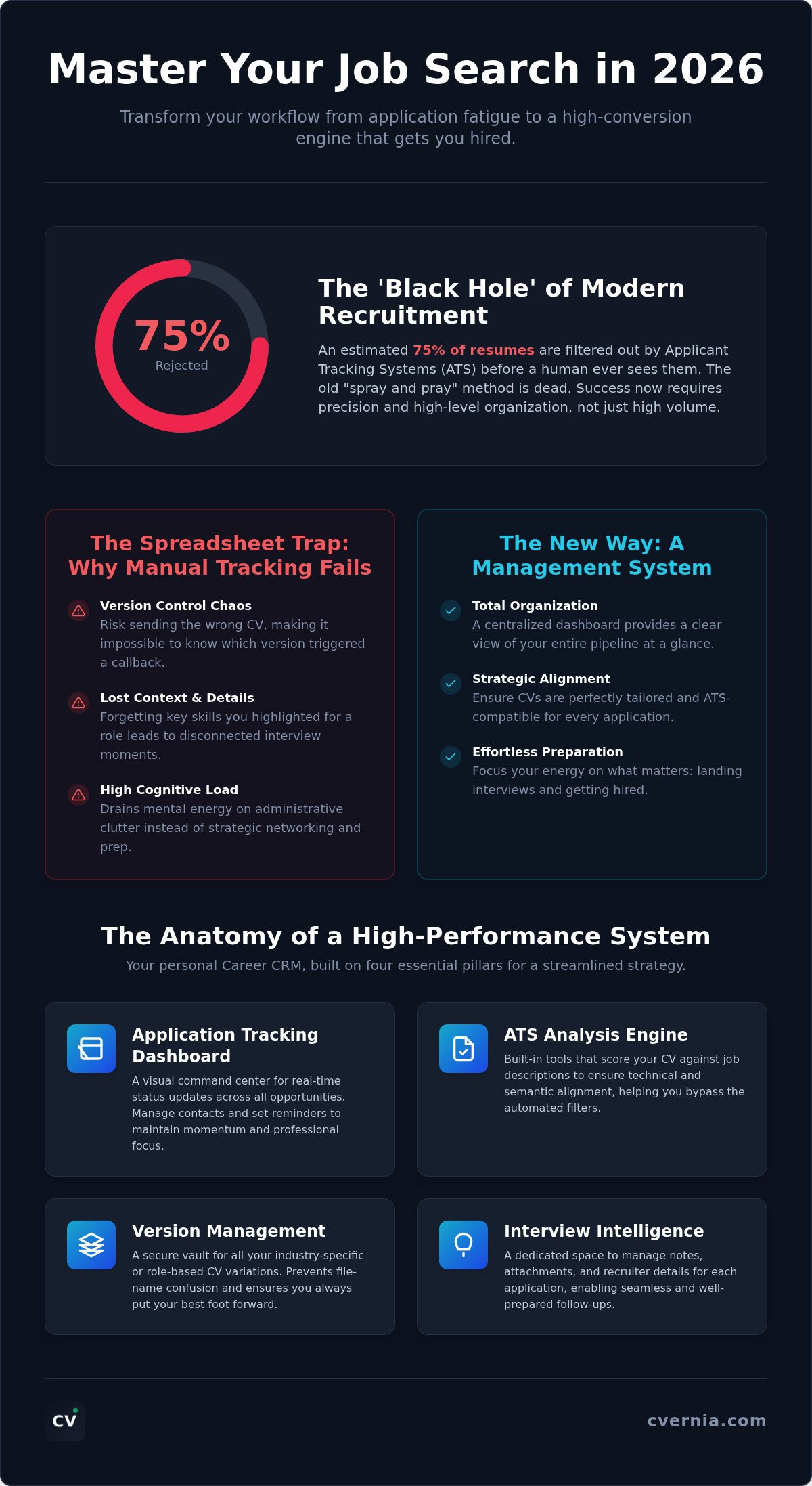
Modern hiring is faster and more automated than ever before. Recruiters often receive hundreds of applications within hours of a posting. To manage this volume, they rely heavily on an Applicant Tracking System (ATS) to filter candidates in seconds. If your application doesn't hit the right semantic notes immediately, it vanishes into the "Black Hole." The old "spray and pray" method is dead. It only leads to exhaustion. Success now requires precision and high-level organization rather than just high volume.
Why Spreadsheets Are No Longer Enough
Many people still rely on basic spreadsheets to track their progress. While better than a blank page, spreadsheets are fundamentally flawed for a modern career transition. They can't effectively store your interview notes, different CV versions, or specific cover letters in a way that's easy to retrieve. When you manage five or more CV versions across twenty applications, the risk of sending the wrong file increases significantly. This disorganization carries a heavy cost.
- Version control chaos: Storing multiple files in different folders makes it nearly impossible to remember which specific CV triggered a call back.
- Lost context: Forgetting which unique skills you highlighted for a particular role can lead to awkward, disconnected interview moments.
- Cognitive load: Tracking follow-up dates and contact names in a flat file drains mental energy you should be using for networking.
A dedicated job search management system solves these problems by centralizing your entire journey. It keeps your documents aligned and your schedule clear. Stop wasting energy on administrative clutter. Instead, use a system that allows you to focus on the strategic moves that actually land interviews. By treating your search like a managed project, you move from a state of uncertainty to a position of total readiness.
The Anatomy of a High-Performance Job Search Management System
A high-performance job search management system is far more than a simple list of links or a digital filing cabinet. It functions as your personal Career Application Management Platform; a centralized platform designed to track, tailor, and optimize every phase of your professional transition. While a spreadsheet merely records the past, a sophisticated management system prepares you for the future. It provides real-time insights into your application health and ensures you never miss a critical follow-up.
To operate at a peak level, your system must integrate four essential pillars. These components work together to turn a chaotic hunt into a streamlined strategy:
- Application Tracking Dashboard: A visual command center for real-time status updates across all active opportunities.
- ATS Analysis Engines: Built-in tools that score your CV against job descriptions to ensure technical alignment.
- Version Management: A secure vault for industry-specific or role-based CV variations that prevents file-name confusion.
- Interview Intelligence: A dedicated space for managing notes, attachments, and recruiter contact details for each specific application.
The Centralized Dashboard: Your Command Center
Visibility is the enemy of anxiety. When you can see your entire pipeline from "Saved" to "Offer" in one glance, you regain control over your schedule. A dashboard allows you to manage recruiter contact information and set automated reminders for follow-ups without digging through your inbox. Experts at Columbia University emphasize that utilizing dedicated job search organization tools is essential for maintaining momentum and professional focus. By integrating your interview notes directly into each job record, you ensure that every conversation is grounded in the specific context of that role.
Version Control: The Secret to Multi-Role Success
Modern career paths are rarely linear. You might be applying for a Project Manager role in one industry and a Operations Lead in another. This requires distinct CV versions that highlight different aspects of your expertise. A robust job search management system tracks which "story" you told to which hiring manager, ensuring your interview answers align perfectly with the documents they're holding. Use smart reapplication detection to identify when a previous application has expired, allowing you to try again with a refreshed, better-aligned version of your profile.
Unlike traditional CV builders, CVernia remembers every application you create. If you later apply for the same employer or role again, CVernia detects your previous application and lets you create an improved version while preserving your original CV, cover letter, interview notes, attachments, and application history. This gives you a complete record of how your application has evolved over time and helps you avoid repeating the same mistakes.
Managing these moving parts manually is a recipe for error. You can easily experience the clarity and confidence of a centralized application tracking dashboard to keep your search moving forward. When your documents, notes, and deadlines live in a single ecosystem, you stop reacting to the market and start managing your career with the authority you deserve.
Solving the ATS Puzzle: Compatibility Without Compromising Integrity
By 2026, the Applicant Tracking System (ATS) has evolved into a sophisticated semantic analyzer. It no longer simply counts keywords; it interprets the context of your achievements and the trajectory of your career. This technological shift means that "tricking" the system with hidden text or keyword stuffing is a relic of the past. To succeed now, you need a job search management system that prioritizes technical alignment while keeping your professional story authentic. You must bridge the gap between machine readability and human persuasion without losing your integrity in the process.
Truthful Tailoring vs. AI Hallucination
The rise of generative AI has created a dangerous trend: "AI Over-Tailoring." Some tools now offer to rewrite your CV in seconds, often inventing skills or embellishing dates to achieve a perfect match. Don't fall into this trap. Recruiters are increasingly using fraud detection software to spot AI-generated content that lacks a human pulse. If you're caught with "hallucinated" skills, you won't just lose the job; you'll likely be blacklisted from the firm's future postings.
Use your management platform to highlight existing experience that matches the job description. If a compatibility score reveals a genuine skill gap, don't ignore it or fake it. Instead, leverage resources like the Career Academy to bridge those gaps with real knowledge. This approach ensures that when you finally sit down for an interview, you can speak to every bullet point on your CV with total confidence and honesty.
Formatting Mistakes That Kill Your ATS Score
Even the most impressive career can be derailed by a poorly formatted document. Many candidates spend hours on graphic-heavy layouts that are visually stunning to humans but appear as total gibberish to a machine. Tables, complex headers, and non-standard fonts often break the parsers used by modern employers. When the data extraction fails, your application is often discarded before a human ever sees your name.
- Avoid Tables and Columns: These often scramble the reading order of your work history.
- Stick to Standard Headers: Use "Work Experience" and "Education" rather than creative alternatives like "My Journey."
- Check your PDF: Ensure your file is "selectable" text rather than a flattened image.
ATS compatibility is the alignment of structured data with employer requirements. By focusing on clean, parsed data, you ensure your information flows correctly into the recruiter’s database. A robust job search management system helps you identify whether a low compatibility score is due to a lack of relevant experience or simply a formatting error. Fix the technical hurdles first so your true qualifications can finally take center stage.
Strategic Workflow: Managing Versions, Reapplications, and Interview Intelligence
Execution is the bridge between having a plan and landing an offer. A high-performance job search management system only delivers results when it's powered by a consistent, data-driven workflow. You must treat your career transition like a professional project, moving methodically through every stage of the funnel. This structured approach reduces the mental burden of "what's next" and allows you to focus on the quality of your interactions rather than the quantity of your clicks.
Follow these five steps to transform your daily routine into a high-conversion engine:
- Step 1: Centralize. Capture every lead, job posting, and recruiter contact in your application tracking dashboard. Don't let a "saved" job on a random board become a missed opportunity.
- Step 2: Tailor with Precision. Use ATS analysis to align your documents with the role while keeping your Master Version safe. This ensures you never overwrite your primary career history.
- Step 3: Document Interactions. Record every email and phone call. Use an integrated interview notes system to keep track of who you spoke with and what they valued most.
- Step 4: Activate Smart Reapplication. Revisit dream companies after their typical "cool-down" periods. A system that alerts you when it's safe to try again is a massive competitive advantage.
- Step 5: Review Performance. Analyze which CV versions yield the highest interview conversion rates. Use this data to refine your messaging for future applications.
Mastering the Reapplication Loop
Rejection is rarely a permanent "no"; it's often just a "not right now." Many top-tier firms have internal policies regarding how soon a candidate can reapply, often ranging from six months to a year. Use your version management history to review exactly what you submitted last time. By analyzing your previous interview notes, you can identify the specific areas where you can improve your next attempt. A dedicated system ensures you don't accidentally send the same failed CV twice, allowing you to present a more evolved, better-aligned version of yourself. You can easily manage these cycles by utilizing smart reapplication detection to keep your dream roles within reach.
Interview Intelligence: Turning Notes into Offers
The interview is where your preparation meets the employer's reality. Track more than just the date and time; record the names of your interviewers, specific questions that challenged you, and your overall "vibe check" of the company culture. This repository of intelligence becomes your most valuable asset for second-round interviews. When you link your Career Academy learnings directly to specific feedback received during a call, you turn every interaction into a learning opportunity. This level of preparedness shows recruiters that you're organized, attentive, and deeply invested in the role.
Elevating Your Career Journey with CVernia’s Unified Platform
Choosing a job search management system is about more than just organizing links. It’s about building a foundation for your entire professional future. CVernia operates as a complete career development ecosystem, designed to support you far beyond the initial application click. While other tools focus solely on volume, we prioritize the quality and integrity of your journey. This shift from reactive searching to proactive management is what separates successful candidates from those lost in the digital shuffle.
The Career Academy serves as a vital pillar of this ecosystem. It provides the learning resources you need to bridge skill gaps identified during your search. Instead of feeling discouraged by a high-level job description, you can use our integrated tools to grow into the role you want. This continuous improvement cycle ensures that your professional value increases every day you spend on the platform. You aren't just waiting for a call; you are actively preparing for the moment it arrives.
The CVernia Advantage: Truth, Tech, and Tracking
Our commitment to truthful representation is your greatest competitive advantage. In a market flooded with AI-embellished profiles, recruiters value candidates who can back up every claim with real-world evidence. Centralizing your attachments, interview notes, and CV versions in one secure system reduces the friction of the hiring process. This structure significantly lowers your "time-to-hire" by ensuring you are always ready for a spontaneous recruiter screen or a final-round interview. You gain the peace of mind that comes from knowing every detail is accounted for and professionally aligned.
Ready to Master Your Search?
Stop fighting with messy spreadsheets that can't hold your notes or track your progress. It's time to graduate to a system that works as hard as you do. When selecting your management platform, look for these essential features to ensure your long-term success:
- Centralized tracking for all job boards and discovery channels.
- Honest ATS analysis that focuses on alignment without AI hallucinations.
- Secure version management to protect your professional story across different roles.
- Integrated interview intelligence for managing notes and recruiter feedback.
- On-demand learning through a dedicated Career Academy.
A job search management system should be your most trusted companion in a volatile market. CVernia provides the structure you need to move from uncertainty to total readiness. By centralizing your notes, versions, and attachments, you eliminate the administrative chaos that often leads to burnout. This platform isn't just a utility; it's a strategic ally invested in your career growth. Step into your next interview with the confidence of a candidate who is fully prepared, truthfully represented, and professionally organized.
Start managing your career with CVernia’s Application Dashboard
Take Charge of Your Professional Future
Success in the 2026 hiring landscape requires a fundamental shift from reactive applying to proactive management. You've learned how a professional job search management system eliminates the "Black Hole" effect by centralizing your efforts and maintaining document integrity. By mastering version control and documenting every interview interaction, you turn a chaotic process into a predictable path toward your next role. You're no longer just a candidate; you're a career manager with a clear strategy.
Don't let another opportunity slip through the cracks due to disorganized spreadsheets or outdated files. Leverage Smart Reapplication Detection to keep dream companies on your radar and use ATS Compatibility Analysis to ensure your true skills are always visible to recruiters. With the Career Academy at your fingertips, you can bridge skill gaps in real time while maintaining a truthful, high-impact professional presence that stands out for all the right reasons.
Take control of your career journey with CVernia's Management Platform. You have the talent and the ambition; now you have the strategy to match. It's time to step forward with total confidence and readiness.
Frequently Asked Questions
What is a job search management system?
A job search management system is a centralized digital platform designed to track, tailor, and optimize every phase of your professional transition. It acts as a Career CRM, moving beyond simple spreadsheets to integrate version control, interview notes, and real-time status updates. This system ensures you remain organized and strategic throughout the entire hiring journey by keeping all your essential data in one secure location.
How do I track my job applications effectively in 2026?
Effective tracking in 2026 requires moving away from manual entry and towards automated dashboards that centralize all your discoveries. Use a dedicated application tracking dashboard to manage recruiter contacts, set follow-up reminders, and store specific document versions. This approach prevents missed deadlines and ensures you never lose the context of a specific application, even when managing dozens of active leads simultaneously.
Can an ATS resume checker really help me get more interviews?
Yes, a professional ATS analysis tool increases your interview chances by identifying formatting errors and semantic gaps that cause automated rejections. These checkers ensure your CV is parsed correctly by modern software, allowing your actual qualifications to reach a human recruiter. By fixing "invisible" errors like complex tables or non-standard headers, you ensure your data remains readable and competitive in a high-volume market.
Is it okay to use AI to write my cover letter and CV?
You should use AI as a supportive tool for tailoring and structure rather than a total replacement for your own voice. Avoid "AI hallucinations" where tools invent skills or experiences that don't exist, as recruiters now use fraud detection software to spot these embellishments. Focus on using technology to highlight your genuine achievements in a way that aligns with the employer's specific requirements while maintaining total honesty.
How many versions of my CV should I actually have?
You should typically maintain one comprehensive "Master Version" and several tailored variations for specific industries or job titles. Most professionals find success with three to five targeted versions that highlight different aspects of their expertise. Managing these through a version control system prevents you from accidentally sending the wrong document to a hiring manager and ensures your "story" remains consistent for each role.
What should I look for in an application tracking dashboard?
Look for a dashboard that offers real-time status updates, integrated note management, and secure attachment storage. A high-performance dashboard should allow you to visualize your entire pipeline from "Saved" to "Offer" while managing recruiter contact details. Ensure it also supports version tracking so you can see exactly which documents were used for every submission without digging through local folders.
How does smart reapplication detection work?
Smart reapplication detection monitors the specific "cool-down" periods often used by major firms, which typically range from six to twelve months. The system alerts you when it's safe to apply again with a refreshed profile, preventing you from being automatically filtered out for applying too soon. This feature allows you to strategically revisit dream companies with improved skills or a better-aligned CV based on previous interview feedback.
Can I manage interview notes within my job search system?
Yes, managing interview notes within your job search management system is a vital part of building "Interview Intelligence." You can record recruiter names, specific questions asked, and your overall impressions of the company culture directly within the job record. This centralized repository ensures you're fully prepared for second rounds and can use previous feedback to bridge skill gaps through resources like a Career Academy.


