

A rejection is a signal, not a verdict. Analyzing my job application performance means tracking how many applications lead to responses, interviews, and offers, then looking for patterns in the roles I pursue and the achievements I highlight. These measures can show where to adjust your approach without treating one outcome as proof of your value.
It’s easy to focus on how many applications you’ve sent, but volume alone doesn’t show what’s working. Record each stage and compare results across similar roles for a clearer picture. This article explains which metrics to track, how to interpret them, and how evidence of your achievements can strengthen your CV and cover letter. Tracked findings can also point to practical changes, helping each new application build on what you’ve learned.
Key Takeaways
- Track applications through responses, interviews, and offers to see where your search gains momentum or stalls.
- Calculate response rates consistently, then compare similar roles and application periods to spot meaningful patterns.
- Tailor your resume and cover letter to each role, using measurable achievements to show the impact of your work.
- Use a centralized tracking and ATS analysis platform to organize applications and identify opportunities to refine your approach.
Typical application and interview conversion rates?
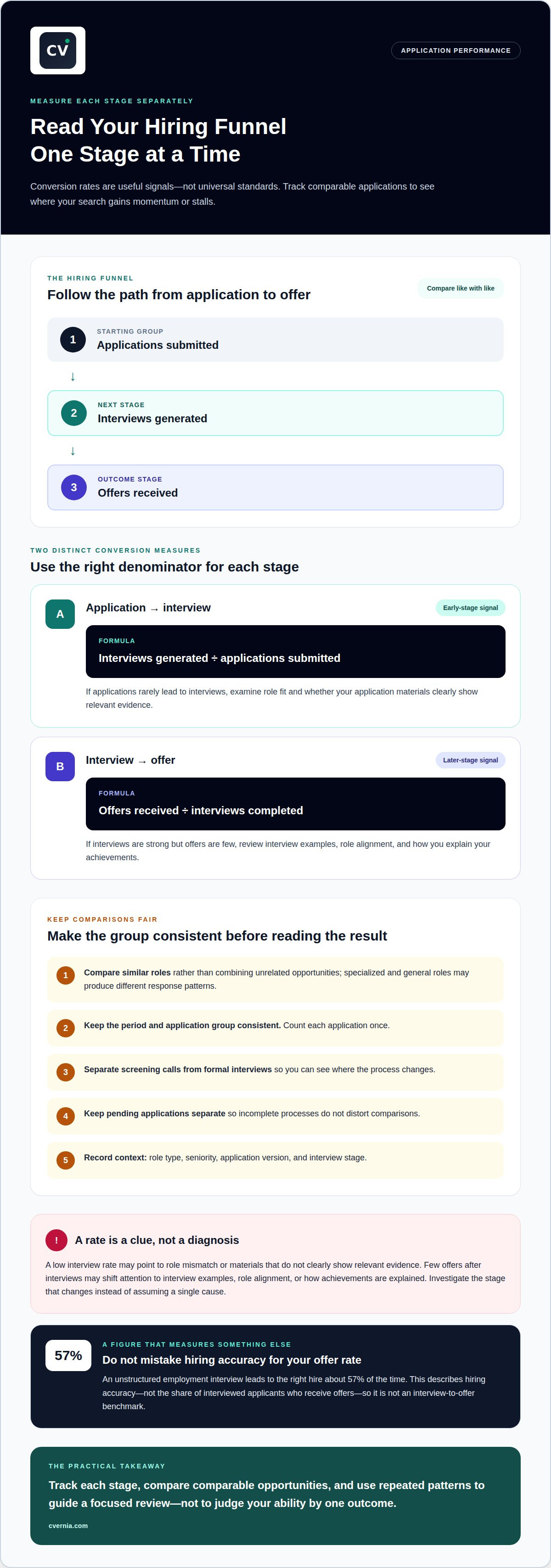
Application-to-interview and interview-to-offer rates measure different stages, so track them separately. A single benchmark can mislead because employers, roles, hiring processes, and candidate pools differ. A specialized position, for example, may produce a different response pattern from a general administrative role. Compare similar applications at the same stage rather than combining unrelated opportunities.
Calculate application-to-interview conversion by dividing the applications that led to interviews by the total number in the group. Calculate interview-to-offer conversion by dividing offers received by completed interviews. Keep the period and application group consistent. For example, compare similar roles submitted during the same search period, counting each application once. Separate screening calls from formal interviews to see where the process changes.
Treat the figures as signals, not universal standards. A low interview rate may point to a mismatch with the roles or application materials that don’t clearly show relevant evidence. A strong interview rate followed by few offers shifts attention to interview examples, role alignment, or how you explain achievements. A practical way to analyze my job application performance is to identify which stage changes, then investigate relevant factors instead of assuming a single cause.
- Application-to-interview: interviews generated ÷ applications submitted.
- Interview-to-offer: offers received ÷ interviews completed.
- Stage comparison: compare similar roles and application periods.
Keep hiring research in context. An unstructured employment interview leads to the right hire about 57% of the time, but that figure isn’t an interview-to-offer conversion rate. It describes hiring accuracy, not the share of interviewed applicants who receive offers. Mixing those measures can make personal results seem comparable when they answer different questions.
Use a simple example, not an industry norm: if applications for a role type lead to interviews but few offers, review what happens after the invitation. If applications rarely lead to interviews, examine role fit and how your experience comes across in your materials. Record each stage, keeping pending applications separate so incomplete processes don’t distort comparisons.
Conversion rates are most useful with context. Note the role type, seniority, application version, and interview stage for each result. When analyzing my job application performance, look for repeated patterns across comparable opportunities. For example, a change after revising a CV section can help you decide whether that revision merits further testing. Use the figures to guide a focused review, not to judge your ability by one outcome.
How can I calculate my job application response rate?
First, define what counts as a response. Include direct communication from an employer or recruiter, such as a rejection, interview invitation, or request for more information. Track automated receipt confirmations separately. They confirm delivery, but don’t show that someone has reviewed your application. Use the same definition throughout your tracking period.
Use this formula: response rate = applications with a qualifying employer response ÷ eligible applications × 100. Count a rejection as a response, even if it doesn’t move you forward. Apply the same rule to every application in the group. Otherwise, inconsistent counting can change the result without any real difference in employer engagement.
Choose a clear group to measure. You might compare applications for similar roles, applications using the same CV version, or submissions from a consistent job-search period. Include applications with a reasonable opportunity to receive a response, and mark pending submissions separately. This prevents unanswered, ongoing applications from being treated as completed outcomes.
Record details that help explain the result:
- Employer, role title, and application source
- Submission date and current status
- Resume and cover letter versions used
- Response type, such as rejection or screening request
- Relevant notes, such as a referral or stated role requirements
For example, compare applications submitted through referrals with those sent through employer portals. A difference may suggest a pattern worth examining, but it doesn’t prove the source caused the outcome. Role fit, experience, timing, and application materials could also differ. Record these details alongside the rate before deciding what to change.
A useful part of analyzing my job application performance is checking whether low response rates cluster around certain roles or document versions. If applications for a particular role type receive little employer communication, revisit how clearly your relevant experience matches the posting. If one version performs differently, inspect its emphasis and evidence before drawing conclusions.
Recalculate using consistent definitions as you add applications. Compare similar groups, and note any changes to your target roles or materials. When analyzing my job application performance, treat the response rate as a starting point for focused review, not a judgment of your qualifications. Each new result can then add context to your decisions.
Keep response-rate tracking focused on employer communication about applications. It answers a different question from workplace time-use research. Time study survey responses can help identify employees’ duties and how they spend their time. That information concerns duties and time allocation, while the rate above concerns qualifying responses to applications. If you review both kinds of information, label them distinctly in your records and don’t combine their counts. This keeps clear what your application response rate represents.
How can I tailor my resume and cover letter to improve results?
Start with the specific role, not a generic list of strengths. Identify the job description’s central responsibilities, required skills, and repeated terms. Then choose the experience that best demonstrates those needs. If a role emphasizes customer retention, prioritize a relevant example over unrelated achievements. Tailoring means changing emphasis and wording to reflect your real experience, not adding qualifications you don’t have.
Make achievements concrete with evidence. Use documented details, such as percentages or timelines, to show the impact of your work. For example, replace “improved reporting” with a truthful description of what changed, how you contributed, and the documented result. If you can’t share a precise figure, accurately describe the scale, frequency, or timeline instead. Never estimate a result just to make a bullet sound stronger.
Use a simple relevance check for each resume bullet:
- Action: What did you personally do?
- Context: Which team, process, customer, or challenge was involved?
- Evidence: What measurable outcome or observable change followed?
- Relevance: How does this example connect to the target role?
For instance, a project coordinator applying for a scheduling role could highlight a documented improvement to project timelines. Applying for a client-facing role, the same coordinator might foreground communication and stakeholder support. Keep the underlying experience accurate, but select examples that make the strongest case for each position.
Give the cover letter a distinct purpose. Use the opening to identify the role and connect your relevant experience to the employer’s stated needs. Develop one or two examples that add context beyond your CV, then explain how those strengths apply to the position. Avoid repeating every CV bullet. A concise, specific connection is more useful than broad claims about being hardworking or passionate.
Before sending, compare the final documents with the job description. Check that essential terms appear naturally where they accurately describe your background. Confirm that dates, job titles, and achievement details match across both documents. Save each version with the role or employer in its filename, then record which version you used. This gives you a clearer basis for assessing later application outcomes.
Refine your CV and cover letter with a role-specific focus, measurable achievements, and consistent details.
Job context: working conditions, risks, reporting relationships, hazards, mental and physical demands. Performance-based interviewers should review employment history covering the past 5 to 10 years; STAR structures answers around the situation, task, action, and result.
CVernia: Career Application Management Platform
CVernia brings application tracking and CV compatibility analysis together in one career management platform. Use the Application Tracking Dashboard to organize roles, application versions, and outcomes, making patterns easier to review. CV Compatibility & ATS Analysis helps you assess how your CV aligns with a job description before applying. For each prepared application, Interview Preparation & Guidance helps you get ready for the next stage.
Turn to CVernia when scattered records make it difficult to compare results or remember which CV you sent. A centralized view connects application details with tracked findings, helping you decide what to refine for future roles. It supports a more structured job search while leaving your experience and decisions in your hands.
Visit cvernia.com to explore how CVernia can support your application tracking and preparation.
Make Your Next Application More Intentional
Let your next application reflect what you’ve learned, not just what you’ve sent before. A useful approach to analyzing my job application performance is to treat each change as a focused test: adjust one part of your strategy, track the version you use, and observe how employers respond. This makes it easier to build on evidence instead of reacting to every outcome as a separate verdict.
When you want help organizing the process, CVernia’s Career Application Management Platform brings application management together with Tailored CV & Cover Letter Creation and CV Compatibility & ATS Analysis. These tools help you prepare targeted materials and review how they align with job descriptions. They support your search while your judgment and experience guide each application.
Contact CVernia for application support and take a clear next step toward a more focused search. Keep learning from each application, and carry that insight into the opportunities ahead.
Frequently Asked Questions
Which job application metrics should I track?
Track more than outcomes: record role fit, application source, document version, follow-up status, and the stage reached. For example, note whether a role matched your core experience and whether you used a tailored CV. These details help explain patterns behind interview invitations or stalled applications. Keep definitions consistent, and separate applications awaiting a decision from completed outcomes so your review compares like with like.
How can I identify why my applications are not getting interviews?
Compare your application materials with the requirements of the roles you targeted. For each posting, note whether your CV clearly demonstrates the required skills, relevant experience, and any stated eligibility criteria. Then inspect a few applications that differ by role type or document version. If a specific requirement is missing or difficult to find, revise how you present relevant evidence before changing unrelated parts of your search.
Which tools or spreadsheets can I use to track job applications?
A spreadsheet works well if you keep it current. Create columns for employer, role, source, submission date, document version, status, follow-up notes, and next action. Use filters to review applications by status or role type. A dedicated application tracker can keep the same records together. Choose a format you’ll reliably update, and use consistent status labels to make later comparisons clear.
What are common job application tracking mistakes and privacy risks?
Common tracking mistakes include mixing automated receipt confirmations with employer responses, treating pending applications as completed outcomes, using inconsistent response definitions, counting applications more than once, and comparing unrelated roles or periods. Keep records centralized and compare similar groups.


