
Employee-referral applications have reported response rates of 30–50%, while the average job application leads to human contact about 2–3% of the time. Networking can improve your chances of getting noticed, but a focused, well-aligned resume still matters. To understand how to improve your job application response rate, look at both how you apply and how clearly your experience fits the role.
It’s frustrating to submit applications and hear nothing back. A low response rate doesn’t automatically mean you lack the right skills; your CV may need to align more closely with each role, or your approach may rely too heavily on applications without building professional connections. This guide to how to improve my job application response rate covers tailoring your CV to relevant accomplishments, deciding whether and when to follow up, and interpreting application-to-interview rates without treating any single figure as a guarantee. Tracking applications can also reveal where to adjust your strategy and focus on roles that match your strengths.
Key Takeaways
- Match your resume to each role by prioritizing relevant skills and showing the results of your work.
- Choose roles that fit your experience, apply early when possible, and follow up thoughtfully.
- Track applications and interview invitations to spot patterns and decide what to adjust in your search.
- Customize each cover letter around the employer’s needs, using specific examples to explain your fit.
1. Resume alignment and measurable accomplishments
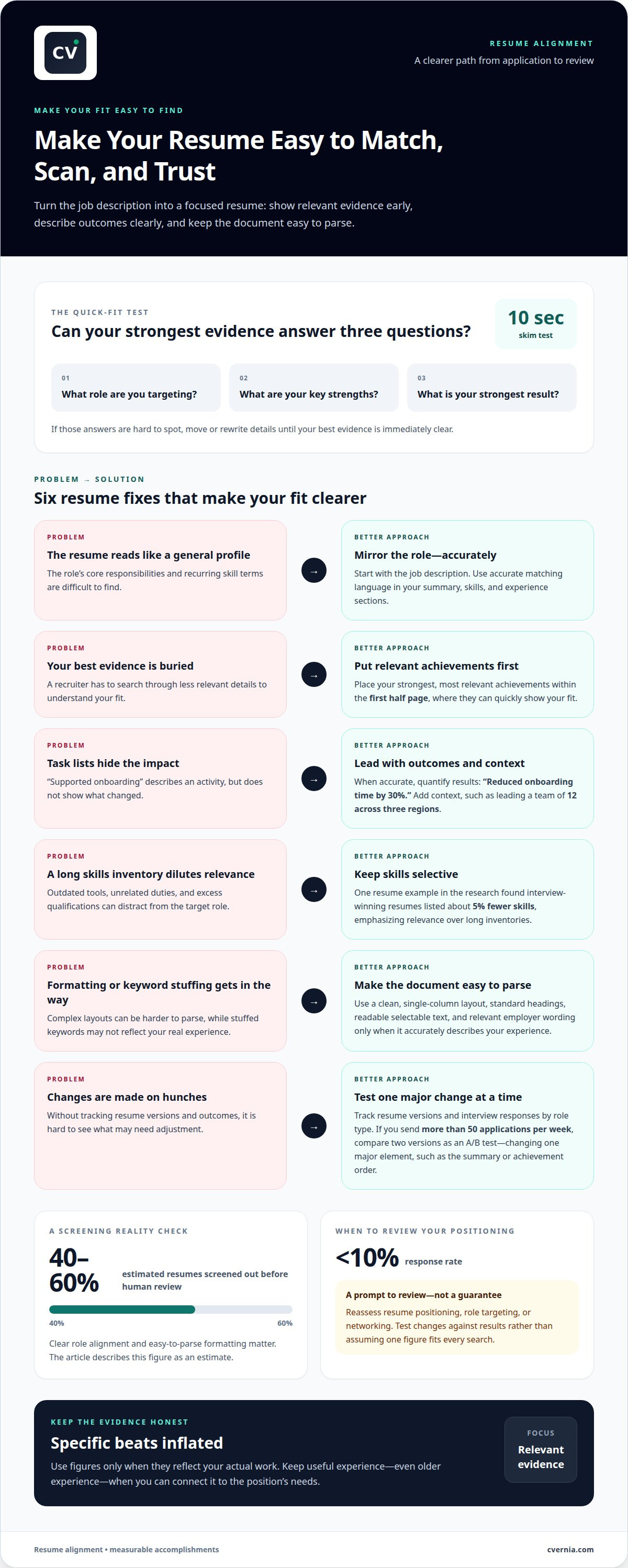
Start with the job description and tailor your CV to the role. Identify the main responsibilities and recurring skill terms, then use accurate matching language in your summary, skills and experience sections. Keep the layout simple, with standard headings and readable, selectable text. Clear formatting makes it easier for screening software and recruiters to scan your qualifications.
Make your strongest evidence easy to find. Put the most relevant achievements within the first half page, where they can quickly show your fit. A useful test is a 10-second skim: can someone identify your target role, key strengths, and strongest result? Move or rewrite details that don't answer those points.
Replace task lists with outcomes, using figures only when they reflect your actual work. For example, “Reduced onboarding time by 30%” communicates a result more clearly than “Supported onboarding.” You might also describe leading a team of 12 across three regions. Add context so employers understand the scale and significance of each achievement.
Keep skills selective. One resume example in the research found interview-winning resumes listed about 5% fewer skills, emphasizing relevance over long inventories. Remove outdated tools, unrelated duties, and qualifications that don't support the target role. Don't delete useful experience simply because it's older; connect it to the position’s needs.
Make the document ATS-friendly without stuffing keywords. Use the employer’s wording when it accurately describes your experience, and include each relevant term naturally. A clean, single-column structure with standard section labels keeps information easy to parse. Estimates suggest ATS filters screen out 40–60% of resumes before human review, so clear alignment matters.
Test changes against results, not hunches. Track resume versions and interview responses by role type. If you send more than 50 applications per week, compare two versions as an A/B test. Change one major element at a time, such as the summary or achievement order. A response rate below 10% can prompt a review of resume positioning, role targeting, or networking.
2. Should I follow up after submitting a job application?
If the posting gives no timeline, a single follow-up can be appropriate. Wait five to seven business days, then send a concise note to the recruiter or hiring contact. Mention the role, when you applied and one relevant qualification. For example: “I applied for the analyst role last week and remain interested. My reporting experience aligns closely with the team’s needs.” Avoid repeated messages or asking for an immediate decision.
Apply early, but keep role fit central. Applications submitted within the first 24 hours after a posting goes live are associated with a response rate 2–4 times higher than applications submitted a week later. Early submission can help your application reach review sooner, before volume grows. Read the requirements first, then tailor your materials before applying.
For direct applications versus job boards, use the company’s career site when it offers the role and lets you submit a complete application. Job boards can help you discover openings, but follow their listing to the employer’s application process when available; direct company-site applications have reported response rates of 3–5%.
How many applications should you submit each week? A practical target is 5–10 quality applications weekly, rather than dozens of generic submissions. Prioritize roles that match your skills, then reserve time for thoughtful tailoring and follow-up. The right pace depends on how much preparation each application needs.
Build a focused target list before applying. Choose companies that fit your strengths and career goals, then compare each posting’s core duties with your experience. If a role has been open for two weeks, the employer may already be reviewing applications. Prioritize newer listings that suit your experience, while still assessing each role carefully.
Track each submission’s date, channel, role, and follow-up status in one place. After five to seven business days, use that record to send one personalized note, unless the employer specifies another timeline. A clear application tracking approach helps you stay organized and follow through consistently.
3. Application-to-interview response rates
Measure outcomes consistently before changing your search strategy. Divide applications that lead to human contact by total applications, then multiply by 100. For example, 20 applications and 3 responses produce a 15% response rate. Track interview invitations separately, since a recruiter message and an interview are different outcomes.
The average application response rate is approximately 2–3%, meaning 2–3 out of every 100 applications lead to human contact. Rates vary by role and channel: reported figures include 0.5–2% in technology and 5–10% for clinical healthcare applications. Compare like with like, rather than judging your results against a different field.
Record each application’s role, industry, submission channel, date, and outcome. Group results by these details after 30–50 applications, a useful range for spotting patterns. For example, if company-site applications receive replies but job-board submissions don’t, review whether the roles or application materials differ before changing your approach.
Troubleshoot the funnel in stages. If relevant applications rarely lead to recruiter screens, reassess role fit, resume alignment, and screening compatibility. If recruiter conversations happen but interviews don’t follow, refine how you explain your experience and interest. Candidates with almost no recruiter screens after 150 relevant applications should review their targeting or resume positioning.
Channel and seniority can shift the comparison. Reported response rates range from 1–2% for entry-level roles to 3–6% for senior or manager roles. Applications through employee referrals have reported rates of 30–50%, while recruiter-submitted applications have reported 10–20%. Treat these as context, not interchangeable benchmarks.
Use your application records to test one change at a time. Compare similar opportunities by role type, CV version or application channel. If a change leads to more interview invitations, keep it and continue tracking; if not, reassess your fit criteria. This helps you improve your application response rate based on patterns in your own search, not guesswork.
4. How should I customize a cover letter for each job application?
Write each cover letter for the specific job rather than reusing a generic version. Identify the employer’s priorities, responsibilities and recurring terms, then choose one or two relevant examples from your experience. For a project coordinator role, emphasize project coordination instead of listing unrelated customer service duties.
Make the opening specific to the role. Name the position and explain how your background fits its central needs. If the posting emphasizes client communication, for example, describe how you handled client updates or resolved a project issue. Avoid broad claims such as “I’m a motivated professional” unless you support them with evidence.
Connect your experience to the employer’s stated requirements. Choose a genuine accomplishment and explain what you did and what came of it. If the role requires cross-team collaboration, describe how you worked with colleagues in another department. Keep the example accurate, relevant and consistent with your CV.
Use the job description’s language naturally. Include a phrase such as “budget tracking” only if it accurately describes work you’ve done. Don’t copy whole sentences or cram in keywords. A clear account of your experience gives hiring teams context that a skills list alone may not provide.
Keep the letter focused on the employer’s needs. Remove paragraphs that repeat your CV without adding insight, and replace generic praise with a specific reason for your interest. Before sending, check the company name, role title, recipient details and attachment. Using the wrong employer name can make a tailored letter look copied.
Save a separate version for each role, labeled with the employer and position. This makes it easier to review the right letter alongside the matching resume. For support creating role-specific application documents, explore tailored CV and cover letter creation and refine each draft to reflect your own experience.
CVernia: Career Application Management Platform
CVernia’s career management platform helps you organize your job search and prepare tailored applications. Use CV compatibility and ATS analysis to see how your CV aligns with a job description, then refine it to highlight relevant requirements and genuine experience.
As you apply, CVernia’s application tracking dashboard keeps submissions and outcomes organized in one place. Review which roles led to responses and spot where your approach may need adjustment. If you receive an interview invitation, the platform’s interview preparation tools help you prepare for that application’s next stage.
Use CVernia when you want a clearer workflow for tailoring applications, tracking progress and preparing for interviews. Explore the platform to manage your job search in one place.
Make your next application a deliberate step
Build a job-search routine that supports both progress and perspective. Hiring decisions involve factors beyond your control, so don’t let a quiet inbox define your value. For your next application, choose one clear priority, such as making your professional focus easier to understand or showing a stronger connection to the role.
A useful approach to how to improve my job application response rate is to treat each application as one step in a wider career plan, not a verdict on your ability. Keep refining your professional story as your goals develop, and use each new opportunity to decide what to emphasize. Your experience has value; present it with intention.
For support with your application journey, contact CVernia for application support. Take the next step with focus, and keep moving toward work that fits your strengths.
Frequently Asked Questions
Does networking really improve interview chances?
A genuine professional connection can help your application reach someone who understands your fit. Contact people familiar with the role or organization, such as former colleagues or alumni. Ask a focused question about the work, then briefly share relevant experience. Build the relationship honestly, and don’t ask anyone to endorse skills or accomplishments they haven’t seen.
How can I improve my ATS score?
Improve compatibility by matching your CV’s wording to the posting when it accurately describes your experience. Use standard headings, selectable text and a straightforward layout rather than graphics or decorative text boxes. Make sure key information appears in the document itself, not only in headers or footers. An ATS score can help identify gaps, but it is not a hiring decision.
Should I follow up after submitting a job application?
Follow the employer’s instructions first. If the posting asks applicants not to follow up, respect that; otherwise, send one brief, courteous message through the recruiter or contact named in the listing. Refer to the position and reiterate your interest in a specific responsibility. Avoid asking whether you’ve been hired or sending repeated messages before the employer’s stated timeline has passed.
What is a good job application-to-interview ratio?
No single response ratio applies equally across roles, industries and application channels. Track applications that lead to interviews, rather than counting general acknowledgments or recruiter messages as interview responses. Compare similar roles and channels over time. A consistent pattern is more useful than judging your search by one week or comparing it with someone in another field.
Why am I applying to many jobs but getting no interviews?
To understand how to improve my job application response rate, first identify where applications may be falling short. Review recent postings and note which essential requirements you meet, then compare them with the qualifications shown near the top of your CV. Check that each application was submitted successfully, too. If the same type of role repeatedly gets no response, adjust your targeting or materials before applying to more.
How can I tailor my resume to improve job application response rates?
One practical step in improving your job application response rate is to create a CV version for each role. Identify the employer’s main need, reflect your relevant strengths in the opening summary and place supporting evidence near the top. For a client-facing position, foreground relationship management or communication examples. Keep dates, titles and qualifications accurate, and label each version clearly with the employer and role.


