

There is no universal benchmark for a good application-to-interview rate. It depends on the role, industry, seniority and how closely your experience matches each vacancy. To understand what a good application-to-interview rate is for you, track how often submitted applications lead to interview invitations and assess the result in context. A low rate is a reason to review your approach, not proof that you lack ability.
It’s easy to focus on how many applications you send, but volume alone doesn’t show whether your materials are resonating with employers. Your rate can help you spot patterns and decide what to adjust.
This article explains how to calculate your application-to-interview rate, what can affect it and how to assess your results fairly. You’ll also learn how to use that assessment to strengthen your CV, tailor future applications and track changes over time, so you can move forward with a clearer plan.
Key Takeaways
- Calculate your rate by comparing interview invitations with the applications you submitted over the same period.
- Interpret the result in context: role fit, seniority, industry, and application quality can all shape your outcomes.
- Look for patterns across applications to identify where your CV or targeting may need adjustment.
- Use application tracking and CV compatibility tools to organize your search and make more informed revisions.
What is a good application to interview rate
A good application-to-interview rate is one that reflects a strong match between your experience and the roles you pursue. No single benchmark applies across every country, industry, employer or career level. A specialist role with narrow requirements may produce a different response pattern from a broad entry-level vacancy. Assess your results against the jobs you target, rather than relying on an unsupported universal percentage.
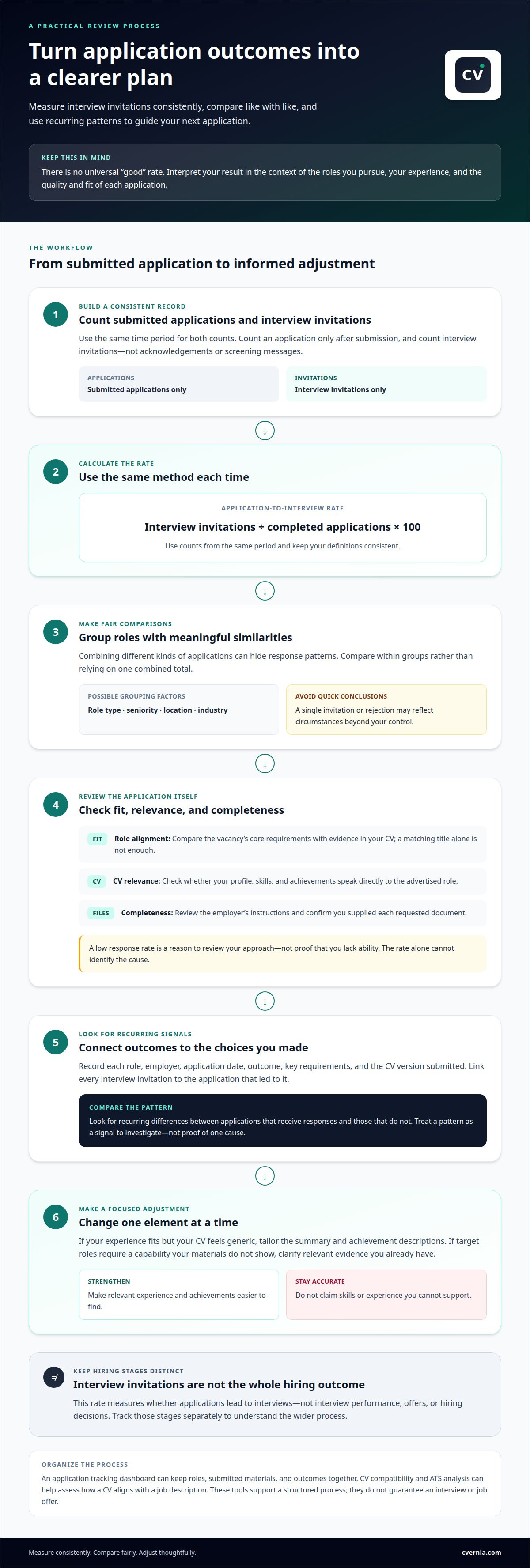
Calculate your rate consistently: divide the number of interview invitations by the number of completed applications in the same period. To express it as a percentage, multiply the result by one hundred, using the same method each time. Count an application only after submission, and distinguish interview invitations from acknowledgements or screening messages. Consistent definitions make comparisons meaningful.
For example, applications across several fields may produce different response patterns. Combining them into one total could hide those differences. Group applications by role type, seniority, location or industry, then compare the invitation rate within each group. This can help you see whether the issue lies in your overall materials or in a particular target.
Interpret your result alongside the quality and fit of your applications. A low response rate may follow from applying to roles that require experience or skills your CV doesn’t demonstrate. It may also reflect a crowded hiring process, unclear application instructions or materials that make relevant achievements difficult to find. The rate alone cannot identify which factor is responsible.
- Role alignment: Compare each vacancy’s core requirements with evidence in your CV. A job title match is not enough if the responsibilities differ.
- CV relevance: Check whether your opening profile, skills, and achievements speak directly to the advertised role.
- Application completeness: Review whether you followed the employer’s instructions and supplied each requested document.
- Comparison group: Separate roles with different seniority, functions, or industries before drawing conclusions.
Use a repeatable review process instead of reacting to each rejection. Record the role, employer, application date and outcome, then note the role’s key requirements and the CV version you submitted. When you receive an interview invitation, connect it to the application that led to it. This gives you a clearer record of your choices and outcomes than memory alone.
Look for patterns once you have enough comparable applications to make a meaningful comparison. A single invitation or rejection may reflect circumstances beyond your control. Check for recurring differences between applications that receive responses and those that don’t. If applications tailored to a particular function lead to more conversations, for example, consider prioritizing that approach. Treat the pattern as a signal to investigate, not proof of a single cause.
Improve one element at a time. If your experience matches the job but your CV feels generic, tailor its summary and achievement descriptions to the vacancy. If your target roles repeatedly require a capability your materials don’t show, clarify relevant evidence you already have. Don’t claim skills or experience you can’t support. A credible, specific application gives hiring teams a clearer basis for assessing your fit.
Finally, distinguish interview invitations from later hiring outcomes. This rate measures whether applications lead to interviews, not interview performance, offers or hiring decisions. Track those stages separately to understand the wider process. A clear assessment combines a consistently calculated rate with role-by-role context, documented application versions and practical adjustments based on recurring patterns.
CVernia: Career Application Management Platform
CVernia’s Career Application Management Platform helps you organize applications and review your job search in one place. Use it to keep a clear record of roles, submitted materials and outcomes. The Application Tracking Dashboard keeps applications organized, while CV Compatibility & ATS Analysis helps you assess how your CV aligns with a job description.
Use those insights to identify where your materials may need closer tailoring, then manage versions as your target roles change. If you receive an invitation, Interview Preparation & Guidance can help you prepare for the next stage. These tools support a more structured process, but don’t guarantee an interview or job offer.
Contact CVernia to explore how the platform can support your application process.
Make your next application more intentional
Use your application-to-interview rate as a prompt for a deliberate next step, not a verdict on your ability. Understanding what a good application-to-interview rate is for your target roles starts with identifying where your experience is most relevant and matching your materials to the requirements employers emphasize. Focus on evidence you can stand behind, and refine your approach as you learn which applications connect. A consistent review routine can turn those observations into clearer decisions about where to focus next.
CVernia supports this process with its Career Application Management Platform, Tailored CV & Cover Letter Creation, and CV Compatibility & ATS Analysis. Use these tools to organize your search and align your application materials with each opportunity. They help structure your process while keeping your choices and experience at the center.
Take the next step at a pace that works for you. Contact CVernia for job search support and explore how its tools can fit into your application routine. Keep building on what you learn with confidence.


