

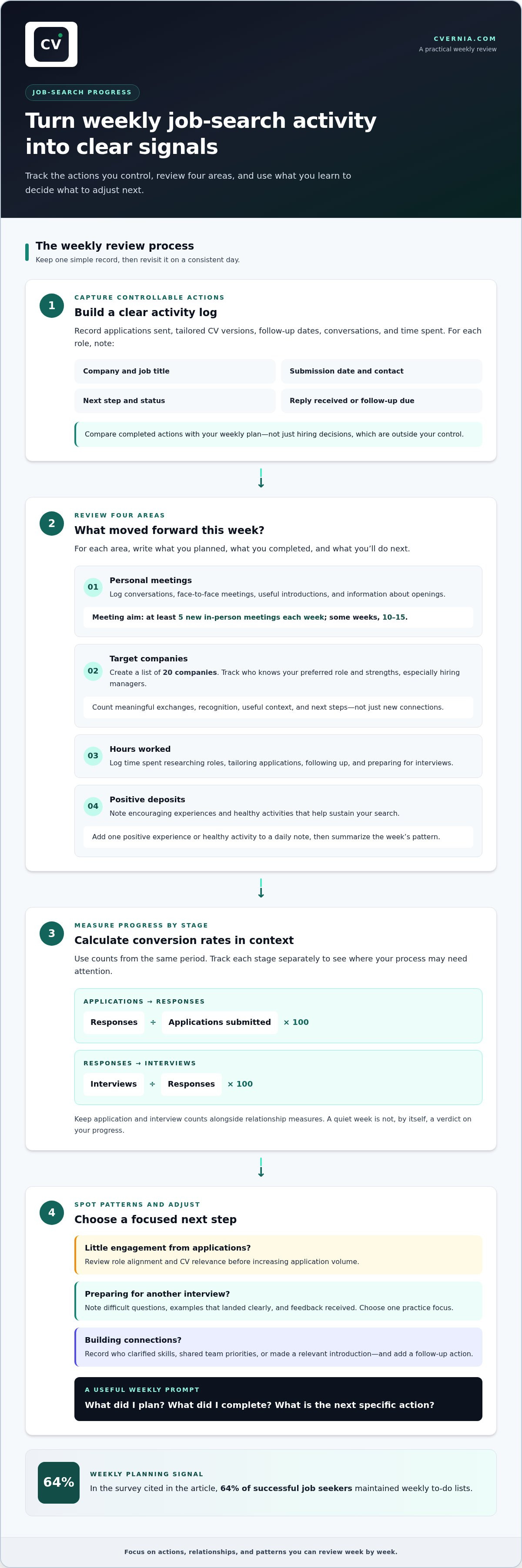
Applications and interviews don’t tell the whole story. To understand how to measure job search success, review your progress each week across four areas: personal meetings, target companies, hours worked, and positive deposits, such as healthy activities or encouraging experiences. These measures help you focus on actions you can control while your search is underway.
It’s easy to feel stuck when responses are slow or outcomes are uncertain. A weekly record gives you a clearer view of the effort and relationships you’re building, without treating every interview as a verdict on your progress.
You’ll learn which activities to track, how to create a simple weekly review, and which signals can help you assess your approach. Use the routine to spot patterns, recognize steady progress, and decide what to adjust next.
Key Takeaways
- Track the job-search actions you control, including conversations, new contacts, and tailored applications.
- Review your progress weekly across personal meetings, target companies, time invested, and positive experiences.
- Use relationship-building and visibility as progress signals, not just interview counts or application totals.
- Interpret response and interview rates in context, then use your records to identify where to refine your approach.
1. Tracking controllable job-search activities
A useful weekly record separates actions within your control from hiring decisions. Track applications sent, tailored CV versions, follow-up dates, conversations, and time spent. For each role, note the company, job title, submission date, contact, next step, and status. This creates a clear timeline instead of relying on memory. A practical way to measure job search success is to compare completed actions with your weekly plan.
Track applications and follow-ups in one simple log. Record each submission, then add a reminder for the next appropriate follow-up and note whether you received a reply. Keep messages brief and specific, such as asking about the hiring timeline for a particular role. Review open follow-ups weekly so promising opportunities don’t disappear from view.
Measure networking through conversations and relationships, not just connection totals. Record new contacts made through one-on-one meetings, people met since your search began, and target-company employees who understand the role you want. Aim to schedule at least five new in-person meetings each week; some weeks, you may schedule 10-15. Note useful introductions or information about openings as outcomes.
To assess your CV, compare its skills and keywords with each job description, then track whether tailored applications lead to responses. If applications receive little engagement, review role alignment and CV relevance before increasing volume. Assess interview skills by noting questions that felt difficult, examples that landed clearly, and feedback received. Use those notes to choose one practice focus before your next interview.
Stay active between opportunities by tracking structured activities alongside applications. Joining a nonprofit board or starting a consulting business can build experience and relationships while keeping your professional routine moving. Record the activity, skills used, and contacts made each week. These details help you identify progress beyond interview invitations and keep your search connected to meaningful work.
2. Recording weekly progress
Use a weekly review to turn scattered activity into a clear record. Track progress in four areas: personal meetings, target companies, hours worked, and positive deposits. Positive deposits include encouraging experiences and healthy activities that help sustain your search. A weekly to-do list can keep those areas visible; 64 percent of successful job seekers in the survey maintained weekly to-do lists.
Choose a consistent day to update your record. For each area, note what you planned, what you completed, and what you’ll do next. For example, record a conversation with a target-company contact under personal meetings, then add a follow-up action. Under hours worked, log time spent researching roles, tailoring applications, and preparing for interviews. This makes your weekly review specific, rather than a vague impression of effort.
To calculate a job-search conversion rate, divide the number of responses or interviews by the applications submitted during the same period, then express the result as a percentage. Track each stage separately, such as applications to responses and responses to interviews, so you can see where your process needs attention.
In the United States, the time it takes to find a job depends on factors such as your field, location, experience, role requirements, and employers’ hiring timelines. Set realistic milestones around actions you control, such as completing targeted applications, following up, and building professional relationships. Review those milestones weekly, then adjust your plan based on what moved forward.
Keep the record brief enough to maintain. Add a daily note about one positive experience or healthy activity, then summarize the week’s pattern during your review. A simple weekly application tracking routine can help you keep those records consistent.
To make your record more relationship-focused, measure conversations and relationships instead of relying only on interview counts or progress through interview rounds. Note how many people at target companies, ideally hiring managers, know what role you want next. You can also count face-to-face meetings scheduled each week and the people you have met since beginning your search.
Many job seekers gauge progress by counting online applications and interviews, or by noting whether they are waiting to hear from a recruiter or hiring manager. Keep these indicators alongside relationship measures so your review reflects both search activity and connections.
3. What metrics should you use to measure job search success?
Choose measures that show whether your search is gaining traction, not only whether an employer has responded. Conversations and relationships reveal access, visibility, and useful information, while interview counts depend on decisions outside your control. A strong measure connects your weekly actions to clearer knowledge of roles, employers, and hiring needs. Review patterns over time rather than treating one quiet week as a verdict.
Start with target-company awareness. Create a list of 20 companies, then record how many people at each know your preferred role and relevant strengths. Give particular attention to hiring managers, who can connect your experience with their team’s needs. The count matters less than whether conversations create recognition, useful context, or a next step.
Track relationship progress by recording meaningful exchanges, not just new contacts. Note who shared information about a team, introduced you to someone relevant, or explained a company’s priorities. Prepare a 30-second elevator pitch about your background and next role, then notice whether listeners understand your focus and can suggest a useful connection.
Measure the quality of your conversations through the information they produce. For example, record whether a contact clarifies required skills, identifies a team’s hiring priorities, or explains how roles are filled. These details can sharpen your search and help tailor your next conversation. Add a follow-up action when an exchange points toward a specific person or opportunity.
Use these indicators together to understand how to measure job search success: company visibility, relevant conversations, introductions, and clearer role alignment. If outreach creates conversations but few useful next steps, refine your pitch or target list. If people understand your goal but cannot connect it to your experience, strengthen the examples you share. Review the evidence regularly, then adjust one part of your approach at a time.
4. What are typical job application response and interview rates?
There isn’t one response rate that fits every job search. Replies depend on role alignment, application quality, employer hiring timelines, and how the application reaches the hiring team. Compare results within your own search instead: separate applications by role type or industry, then review which group receives more replies. Keep the time period consistent so the comparison is useful.
Interview outcomes also vary. In the survey, nearly one-third of active job seekers were interviewed for more than half the positions they applied to. Treat that as a finding from surveyed job seekers, not a universal benchmark or personal target. Your results reflect the roles pursued, your qualifications, and how closely each application speaks to the employer’s needs.
Track each application through the same stages: submitted, response received, screening, interview, and final outcome. Calculate a rate by dividing the number reaching a stage by the number submitted, then multiplying by 100. For example, compare interviews with applications from the same group and period. Keep response rate and interview rate separate, since an employer reply doesn’t always lead to an interview.
Read the pattern before changing your strategy. If applications receive few replies, review whether the roles match your experience and whether each CV reflects the job description. If replies arrive but interviews remain limited, examine the screening stage and how clearly you explain your fit. If interviews progress, note which role types and application approaches are producing those outcomes.
Record pending applications separately from closed outcomes. A recruiter or hiring manager may still be reviewing an application, so don’t count it as a rejection before receiving a decision. Set a follow-up date, then update the status when new information arrives. Use application tracking tools to keep statuses and interview notes organized.
84 percent of surveyed active and passive job seekers updated or created résumés with keywords and skills from the specific job description after securing an interview.
Job seekers can also track progress by counting how many people in their target companies, ideally hiring managers, know what role they want next. After an interview, send a tailored thank-you message to each person you met. If you cannot reach the recruiter by phone, send a brief report.
CVernia: Career Application Management Platform
CVernia’s career management platform helps you organize applications and assess how your materials align with job descriptions. Use CV Compatibility & ATS Analysis to review a CV against a specific role, then refine your application based on the results. The Application Tracking Dashboard brings application statuses into one place, making it easier to review progress and identify follow-ups.
Use Interview Preparation & Guidance when your tracking shows interviews are progressing and you want to prepare deliberately. Together, these tools support a consistent process, from tailoring application materials to preparing for conversations with employers. They help you manage your search; hiring decisions remain with employers.
Visit cvernia.com to explore how CVernia can support your application journey.
Make your next job-search move with clarity
Your next step is to turn what you’ve learned into a focused adjustment. Choose one part of your search to refine, such as the roles you target, how you present your experience, or how you prepare for employer conversations. Then give that change attention in your next review. This keeps your process intentional without making every hiring decision a measure of your worth.
Knowing how to measure job search success means using your progress record to guide practical choices. CVernia’s career management platform supports organized application management, while Tailored CV & Cover Letter Creation and CV Compatibility & ATS Analysis help you prepare materials for specific roles. Use these tools when you want a more structured way to manage applications and improve how your qualifications align with job descriptions.
Contact CVernia for job search support and take your next step with greater focus. Keep learning from each application, and build a search routine that reflects your goals.
Frequently Asked Questions
How do you measure job search success beyond getting an offer?
Measure success by whether your search is helping you make better-informed career decisions. For example, you may clarify which responsibilities energize you, identify a skills gap to address, or recognize that a role doesn’t match your priorities. Record these insights after conversations and interviews. Progress includes stronger role fit and more confident choices, even before an employer makes an offer.


