

What if the same CV could earn two different ATS scores, and neither one could tell you whether you’ll get an interview? That’s the tricky part: a score can highlight how closely your document matches a particular job description, but it isn’t a universal hiring verdict. A low result can feel like a judgment, especially when the checker doesn’t explain what to change.
If you’ve compared resume checkers and come away with conflicting numbers, your confusion is understandable. Tools assess documents in different ways, and a score leaves out important factors such as a recruiter’s judgment and the full context of your experience.
This guide explains what an ATS score measures, why results vary, and how to use the feedback to improve your CV for a specific application without overstating your skills or experience. You’ll learn how parsing, formatting, and keyword alignment can affect a result, then how to prioritize truthful, useful edits. Treat ATS analysis as one input in your application process, not a promise of an interview.
Key Takeaways
- Use an ATS score as a checker’s estimate, not a universal measure of your chances or a hiring decision.
- Check what the tool evaluates and how clearly it explains its feedback before deciding what to revise.
- Tailor your CV to the specific role by highlighting relevant experience you genuinely have.
- Improve clarity with well-organized sections, then review the complete application rather than chasing a target number.
- Use ATS analysis as one practical input alongside your evidence, cover letter, and application preparation.
What an ATS Score Means, and What It Does Not Tell You
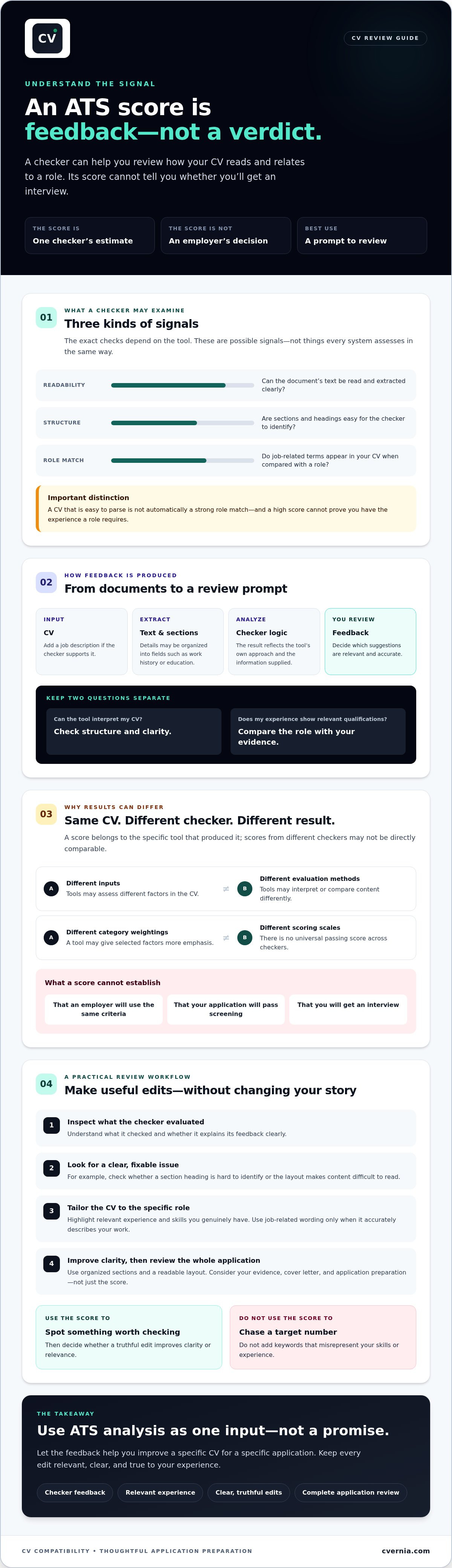
An ATS score is a checker’s estimate of selected factors in your CV, such as how clearly it can read the document or how closely the content appears to match a job description. It isn’t a rating issued by an employer, and it can’t predict how your application will be screened.
Put simply: an ATS score is feedback from a specific checker, not a verdict from a hiring team. Each tool can choose its own inputs, evaluation methods, category weightings, and scoring scale. A number from one checker may not be directly comparable with a number from another. Even when two tools review the same CV, their results can differ because they measure different things.
For context, an Applicant Tracking System (ATS) is software used to support the handling of job applications. A third-party CV checker and an employer’s ATS aren’t necessarily using the same criteria or producing the same kind of assessment.
What an ATS score may measure
Depending on the checker, feedback may cover whether text is readable, whether section headings are recognized, or whether job-related terms appear in your CV. These are possible checker-dependent signals, not features every ATS evaluates in the same way. A document that’s easy to parse isn’t automatically a strong match, and a high score can’t establish that you have the experience a role requires.
Keep two questions separate: Can the tool interpret my CV? and Does my experience show relevant qualifications? Use the first to spot clarity or structure problems. Answer the second by comparing the role’s requirements with evidence you can accurately support.
Why there is no universal passing score
A checker’s score scale belongs to that tool. Employers may use different systems, settings, and review processes, so a result from an external checker isn’t a shared employer threshold. No single number can establish that your application will pass screening or be considered suitable.
Instead, use the result as a prompt to inspect the feedback. Look for a clear, fixable issue, such as a section the tool couldn’t identify, then decide whether a truthful revision would help a recruiter understand your fit. For a broader explanation of how applicant tracking systems handle applications, see our separate guide to how ATSs work.
How ATS Score Checkers Turn Your CV and Job Description into Feedback
Most checkers follow a straightforward workflow: provide your CV, add a job description if the tool supports it, then review the analysis. The result reflects the information you supplied and the checker’s own approach. It can help you spot issues to investigate, but it doesn’t prove an employer’s system uses the same logic.
CV and job description → Text extraction → Checker analysis → Feedback for you to review
That final review is essential. A checker may flag a missing term or an unclear heading, but you decide whether its suggestion fits your actual experience and the role.
Parsing, sections, and document structure
Parsing means extracting text from a document and organizing details into fields or sections, such as contact information, work history, education, and skills. A checker may report that some content is hard to identify if the layout or headings interfere with extraction. Standard section names and a readable layout can make the document easier to interpret, although systems don’t all parse documents identically.
Keep structure separate from substance. Clear formatting can help present your background, but it can’t make your experience more relevant or substitute for evidence of a qualification.
Keywords, skills, and job-description matching
If you include a job description, a checker may compare its terms with the language in your CV. For example, it could notice that a listed skill or responsibility isn’t clearly reflected in your document. Treat that as a prompt to check whether you have relevant experience worth describing, not as an instruction to add a keyword that doesn’t accurately represent you.
Matching language is useful only when it describes your real skills and work. Review each suggested change for accuracy, then make the wording clearer where appropriate. To compare tools by their features and selection criteria, consult a separate ATS resume checker guide rather than relying on a headline result alone.
Use the ATS score as a starting point for a careful review: check what the tool extracted, inspect its feedback, and decide which edits are both relevant and truthful. CVernia offers CV compatibility and ATS analysis to help you review a CV against a job description as part of your application preparation.
Why ATS Scores Differ, and How to Judge the Feedback
Two checkers can assess the same CV and return different results without either number being a definitive judgment. One may focus more on document readability, while another may compare your content with a job description or weigh particular categories differently. The score depends on the tool, its inputs, and your document version, so compare the explanations rather than treating the numbers as directly interchangeable.
Why the same CV can receive different scores
Start with the inputs. A profile-only scan reviews your CV without a target role, while a job-specific scan compares your document with a supplied description. Even with matching inputs, checkers may extract text differently, use different matching rules, or assign different weight to the factors they assess.
Small changes matter, too. A revised CV may use clearer headings or describe relevant experience more specifically. A different job description may prioritize different skills and responsibilities. Before comparing results, confirm that you used the same CV file and job posting. Otherwise, the difference may reflect changed inputs as much as changed analysis.
| Checker input | Feedback type | Interpretation caveat |
|---|---|---|
| CV without a job description | May flag document readability or section structure | Doesn’t show how closely your experience aligns with a particular role |
| CV plus a job description | May highlight terms or qualifications that appear to match, or seem absent | Reflects that checker’s comparison, not necessarily an employer’s screening logic |
| A different CV version or job description | May produce changed findings and a different score | Results aren’t a like-for-like comparison unless the inputs match |
What a high or low score can, and cannot, signal
ATS checker scores are tool-specific estimates, not employer-issued ratings or hiring decisions. A high result may indicate that the checker found clear structure or relevant matches in the materials you provided. It doesn’t confirm compatibility with an employer’s system or guarantee that your application will advance.
A low result isn’t a verdict on your ability, either. Read the specific feedback and look for a fix you can support truthfully. If the tool says a relevant responsibility is missing, check whether your real experience includes evidence you haven’t made clear. If it doesn’t, don’t add the responsibility just to raise the number.
To judge a checker’s usefulness, ask four questions: What information did I provide? What does the tool say it assessed? Does it explain its findings? Can I act on the feedback without misrepresenting my background? A clear, relevant suggestion is more useful than a higher ATS score with no meaningful explanation.
How to Improve Your ATS Score Without Misrepresenting Your Experience
Improve your CV by acting on specific, useful feedback, not by chasing a headline number. A thoughtful revision makes relevant experience easier to find and understand while keeping every claim accurate.
A practical review sequence for your CV
Work through these steps for the job you’re applying to:
- Read the checker’s explanation. Identify the specific issue it flags, such as an unclear section or a relevant requirement that isn’t easy to find. Don’t revise just because the score seems low.
- Compare the job requirements with your evidence. For each relevant requirement, ask whether your work history, education, or skills demonstrate it. Include only details you can substantiate.
- Check your section labels and structure. Make contact details, work history, education, and skills easy to locate. If the checker reports an extraction or readability concern, review the layout and headings.
- Make focused edits, then reread the full CV. Confirm each change is accurate, relevant, and clear in context. Remove wording that feels repetitive or makes a claim stronger than your experience supports.
When formatting or keyword feedback deserves attention
Take a formatting suggestion seriously when the checker explains that it struggled to identify or read part of your CV. Use clear headings and an orderly layout, but don’t assume every tool or employer interprets documents identically. For a separate step-by-step workflow, see our guide on scanning a resume for ATS compatibility.
Keyword feedback can also help you notice relevant experience that your CV describes in different language. If a posting asks for “project management,” for instance, and you have managed projects, consider whether your existing bullet could state that responsibility more clearly. Don’t add the phrase if it implies experience you don’t have.
Rule to remember: Include a job-posting term only when it truthfully describes relevant experience. Repeating keywords without context can make your CV harder to read and may create claims you can’t support. Clear, accurate evidence matters more than matching every phrase.
Use CVernia’s CV compatibility and ATS analysis to review how your CV aligns with a specific application, then decide which suggested changes genuinely reflect your background.
Use ATS Score Feedback as One Step in a Stronger Application
An ATS score is most useful when it helps you make a considered revision, not when it becomes the goal of your application. Use the feedback to identify what might need clarification, check that each change reflects your real background, then review the full application before sending it. A tailored CV is one part of that application. Relevant evidence and clear communication matter, too.
Turn feedback into a job-specific application review
Keep each CV version connected to the role it was prepared for. Use clear file names, such as a role title and date, and compare the document with the correct job description. This makes it easier to review suggestions in context and avoid sending the wrong version.
Before finalizing, check that every change is accurate and supported by your responsibilities, skills, or qualifications. Then read the whole CV as a person would. Does the wording make sense? Are your strongest relevant examples easy to find? A final human review can catch errors, awkward phrasing, or missing context that a score may not address.
- Confirm the CV version matches the job description.
- Verify each tailored detail against your actual experience.
- Review the complete application for accuracy, clarity, and consistency.
Keep your application process organized
Track which CV you used for each role and note any follow-up or interview details in one organized process. These records can help you prepare consistently and remember which version you submitted, especially when applying to roles with different requirements.
CVernia brings together CV compatibility and ATS analysis, tailored CV and cover-letter creation, and application tracking. Its interview notes and attachment management can also help you keep related information organized. These tools support your preparation, while the decisions about what to change and what to submit remain yours.
Use checker feedback as a review prompt, make truthful edits, and assess the application as a whole. If a structured workflow would help you manage tailored documents and application details, explore CVernia’s career application tools.
Make Your Next Application Clearer and More Relevant
An ATS score is feedback from a checker, not a hiring verdict. Its value lies in the reasons behind the number: use those details to spot clarity issues, then tailor your CV to the role with evidence you can honestly support. A score can guide your review, but it can’t replace your judgment or show the full strength of your application.
Keep the whole application in view. Check that your CV and cover letter communicate relevant experience clearly, and review every tailored change for accuracy. The goal isn’t to match every keyword or chase a particular score. It’s to present your real qualifications in a way that’s easy to understand.
CVernia offers CV compatibility and ATS analysis, along with tools for tailoring CVs and cover letters without fabricating skills or experience. Explore CVernia’s tools for tailoring and managing your applications as you organize your next application. Take the feedback that helps, make truthful improvements, and move forward with confidence.
Frequently Asked Questions
What is a good ATS score for a resume?
There’s no universal good ATS score because checkers use different methods, inputs, and scales. A result is useful only in the context of what that specific tool assessed. Review its explanation for practical issues, such as unclear sections or relevant experience that’s hard to find. Don’t treat a particular number as an employer’s passing threshold or proof that your CV is ready for every application.
Can an ATS score guarantee that my resume will pass screening?
No. A third-party checker’s score can’t guarantee that an employer’s system will interpret your CV the same way or that your application will advance. Employers may use different systems and screening processes, and hiring decisions can involve factors a checker doesn’t assess. Use the feedback to identify possible improvements, then review your document for accuracy and relevance to the specific role.
Why do different ATS checkers give my resume different scores?
Different checkers can use different inputs, parsing methods, evaluation factors, and weightings. A scan without a job description may focus on document structure, while a job-specific scan may also compare your CV with the role’s requirements. Results can change if you upload a different document version or job description. For a fair comparison, use the same CV and posting, then assess the feedback, not just the numbers.
How accurate are ATS score checkers?
They can offer useful feedback about the factors they assess, but their results aren’t a complete or definitive measure of your application. A checker might flag text it can’t interpret or terms that appear relevant to a job description. It can’t reliably predict every employer’s screening process, verify the full context of your experience, or judge your overall suitability. Treat its suggestions as prompts to review, not instructions to follow blindly.
Does a high ATS score mean my resume will get an interview?
No. A high result means the checker found a favorable match according to its own approach, not that an employer will invite you to interview. Your application may be reviewed using different criteria, and the checker can’t account for every aspect of a hiring decision. Make sure your CV presents relevant, supportable evidence clearly, then consider the score one part of your application review rather than a prediction.
How can I improve my ATS score without adding skills I do not have?
Start by reading the checker’s specific feedback and comparing the job requirements with experience you can substantiate. Make relevant responsibilities easier to find, use clear section headings, and describe your skills in accurate, natural language. Don’t copy keywords that imply abilities or qualifications you lack. An ATS score can help you spot a possible clarity gap, but truthful evidence should guide every revision.
Should I tailor my resume for every job description?
Tailor your CV for roles that genuinely match your background, focusing on the requirements most relevant to your experience. You don’t need to rewrite every section for each application. Adjust emphasis and wording where it helps explain your fit, and keep every claim accurate. Before submitting, check that the tailored version matches the role and that its content remains clear and consistent with your actual work history.


