

A strong career plan starts with resources that help you explore options, build skills, and take practical next steps. Career development resources for young professionals include career information from the U.S. Department of Labor’s Employment and Training Administration and the Bureau of Labor Statistics, along with apprenticeships that combine paid work experience, mentorship, and classroom instruction. Together, these tools can help you connect your interests with real occupations and learning opportunities.
It’s normal to feel unsure about which direction to take, especially when you’re balancing skill-building with gaining experience. You don’t need to commit to a path before understanding your options. Start by exploring occupations, then review their education or training requirements and consider ways to learn through hands-on work.
This guide explains where to find career resources, how to compare your options, and what to consider when choosing a learning or work-based pathway. You’ll also learn how to turn your research into a clear next step, whether that means developing a skill, pursuing an apprenticeship, or preparing a job application.
Key Takeaways
- Use career information tools to compare occupations, training requirements, and job outlook before choosing a direction.
- Look for apprenticeships that combine paid experience, classroom learning, and mentorship. In the United States, some hazardous apprenticeship jobs are limited to individuals over 18 years old, according to the U.S. Department of Labor.
- Turn career exploration into a practical plan by identifying a skill to build and a learning or work-based opportunity to pursue.
- Prepare application materials that align with the roles you’re targeting, and keep track of your applications and interview preparation.
- Choose resources that fit your circumstances, including the way you learn and the type of support you need to take your next step.
Career development resources for young professionals
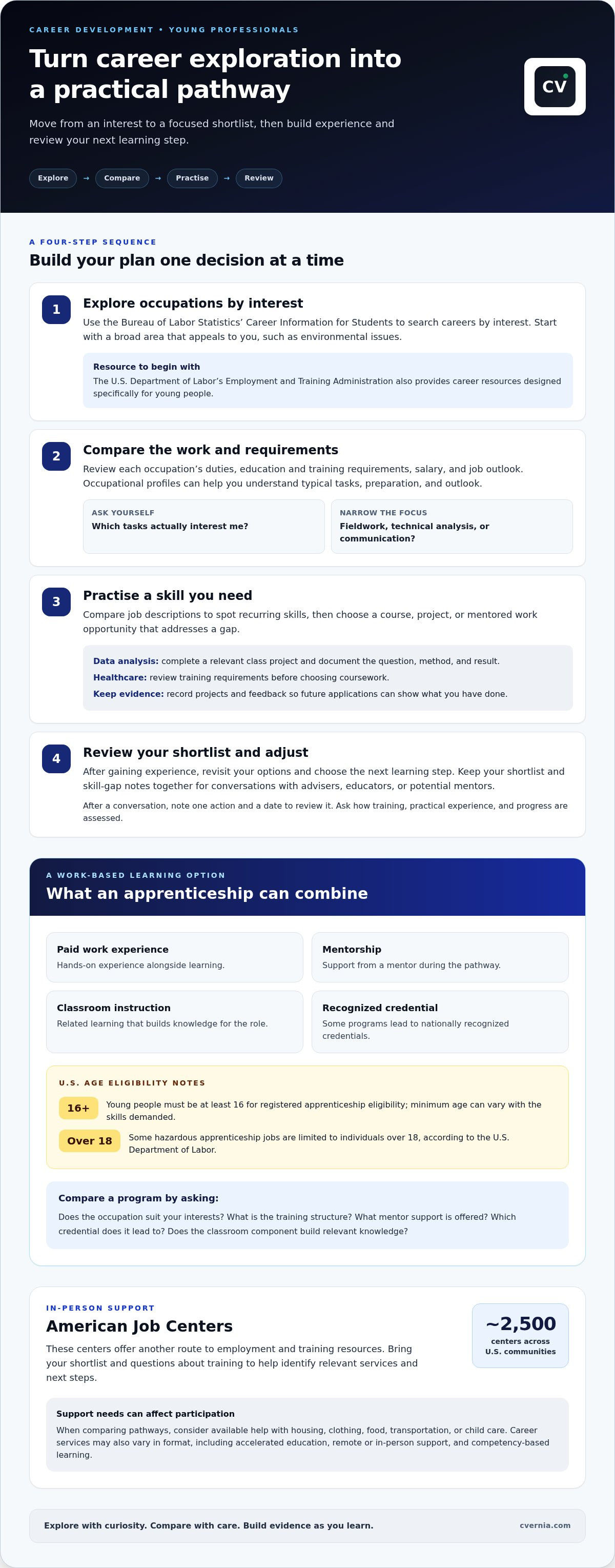
Career development resources for young professionals work best when they connect exploration, learning, and action. In the United States, the Employment and Training Administration provides career resources designed specifically for young people. The Bureau of Labor Statistics’ Career Information for Students helps users search careers by interest and compare occupations, education and training requirements, salary, and job outlook. Use these tools to build an initial shortlist, then investigate what each role requires.
Start with your interests, then test them against the work itself. If environmental issues appeal to you, compare occupations related to conservation, engineering, or policy. The Bureau of Labor Statistics’ occupational profiles can help you review typical duties, preparation, and outlook. Note which tasks interest you and which requirements call for more learning. This turns a broad interest into a focused question: do you prefer fieldwork, technical analysis, or communication?
Next, identify the gap between your current experience and the skills required for roles on your shortlist. Compare job descriptions to find recurring requirements, then choose a specific way to practise one skill. A beginner interested in data analysis might complete a relevant class project and document the question, method, and result. Someone considering healthcare work might review training requirements before choosing coursework. Keep a record of projects and feedback so future applications can show evidence, not just broad claims.
Apprenticeships can connect instruction with paid, hands-on work. Programs offer paid experience, mentorship, classroom instruction, and nationally recognized credentials. Youth apprenticeship programs pair classroom learning with structured on-the-job training and a mentor. In the United States, young people must be at least 16 years old for registered apprenticeship eligibility, although minimum age can vary with the skills demanded. Some hazardous apprenticeship jobs are limited to individuals over 18 years old, according to the U.S. Department of Labor.
Before choosing an apprenticeship, compare the occupation, training structure, mentor support, and credential it leads to. Consider whether the daily work suits your interests and whether the classroom component builds relevant knowledge. For example, someone exploring a skilled technical role could look for a program that combines supervised practice with related instruction. A useful pathway makes progress visible through completed tasks, feedback, and work toward a recognized credential.
Career pathways can connect education, training, and employment services across organizations. That coordination matters when practical needs affect your ability to participate. Support with housing, clothing, food, transportation, or child care can help young people stay engaged in training and work. Career services may offer flexible formats, such as accelerated education, remote or in-person support, and competency-based learning. Compare options with your schedule, learning preferences, and responsibilities before committing.
Use this simple sequence to turn exploration into a plan:
- Explore: Search occupations by interest through the Bureau of Labor Statistics’ Career Information for Students.
- Compare: Record each role’s duties, training needs, and outlook.
- Practise: Choose a course, project, or mentored work opportunity that addresses a skill gap.
- Review: Revisit your shortlist after gaining experience, and adjust your next learning step.
For local, in-person career support, American Job Centers provide another route to employment and training resources. Approximately 2,500 centers are located in communities across the United States. Bring your shortlist and questions about training, then use the conversation to identify relevant services and next steps. Organizations such as the Annie E. Casey Foundation have also invested in employment social enterprises, including REDF and Juma Ventures, where young people can develop skills through paid work.
Assess a pathway by asking what work it lets you try, what preparation you still need, and what evidence you can build next. Keep your shortlist and skill-gap notes together to guide conversations with advisers, educators, or potential mentors. Ask specific questions about training, practical experience, and how progress is assessed. After each conversation, record one action and a date to review it. This helps turn exploration into a manageable next step rather than an open-ended search.
American Job Centers are career centers funded under the Workforce Investment Act’s Employment and Training Administration. They can be one place to discuss career planning and available support. Explain which occupations you’re considering, the skills you hope to develop, and any constraints affecting your choices. Ask what resources could help you compare pathways or plan your next move, then assess each option against the work and learning you actually want.
CVernia: Career Application Management Platform
CVernia helps you move from career exploration to job applications with its Career Application Management Platform. Turn your target roles into tailored application materials, then use CV Compatibility & ATS Analysis to assess how your CV aligns with a job description. The analysis can help you identify areas to refine before applying.
Keep your search organized with the Application Tracking Dashboard, which lets you manage applications in one place. As interviews approach, use Interview Preparation & Guidance to prepare responses and present your experience clearly. These tools are most useful once you’ve chosen roles to pursue and want a consistent way to prepare, track, and review each application.
Explore the platform at cvernia.com.
Turn Your Next Step Into a Clear Plan
Career development resources for young professionals are most valuable when you turn what you learn into a focused move. Choose a role that interests you, identify the skills or experience it requires, and decide what to do next. A clear application plan connects that direction to how you present your experience.
CVernia supports this process with a Career Application Management Platform, Tailored CV & Cover Letter Creation, and CV Compatibility & ATS Analysis. Use these tools to shape application materials for the roles you’re pursuing and assess how your CV aligns with a job description. The result is a more intentional application process grounded in your actual skills and experience.
Ready to put your next career move into action? Contact CVernia for career support and take the next step with greater clarity and confidence.


