

A long job search is easier to sustain when you stop treating it as a full-time task you have to manage alone. To learn how to stay motivated during a long job search, pace your applications, make time for interests outside work, ask trusted people for support, and use practical coping strategies. Steady progress comes from a sustainable routine, not spending every waking hour searching.
Rejection, silence, and uncertainty can make it hard to keep going. If you’re wondering how to stay motivated during a long job search, focus on what you can control and build a manageable plan. A thoughtful routine can help you keep moving while you wait for responses.
This article covers four ways to maintain momentum: set a sustainable application rhythm, make room for volunteering or hobbies, reach out to former colleagues, professors, or career centers, and build habits that support your wellbeing. Use these practical steps to suit your schedule and energy. Learning how to stay motivated during a long job search can help you move forward without letting the process take over your life.
Key Takeaways
- Set a focused job-search routine that leaves room for work, hobbies, volunteering, and rest.
- Prioritize roles that fit your skills and interests, then tailor each application with care.
- Ask former colleagues, professors, or career centers for advice, introductions, and encouragement.
- Use simple coping habits, such as journaling, movement, and small rewards, to manage difficult days.
- Break larger goals into manageable tasks and track progress so you can adjust your approach.
1. Balancing job searching with volunteering, hobbies, or other work
Keep the search inside a routine instead of letting it fill every day. A job search isn't a 24/7 task, and you don't need to spend eight hours staring at a screen. Set a focused block, such as four hours daily, then step away when it ends. A clear stopping point protects time for paid work, volunteering, and interests that keep your week varied.
If you’re employed, fit applications around your existing schedule. You might spend an hour applying before work, then leave the rest of the day for your job and personal commitments. Choose a repeatable time that suits your energy, and set aside separate blocks for reviewing roles, tailoring documents, and following up. This gives job searching a place in your calendar without taking over every available hour.
Volunteering can add structure and connection, especially when you choose opportunities strategically. Look for tasks that build relevant skills or connect you with people in a field you’re exploring. If money is a concern, weigh the time commitment and prioritize activities that fit your budget and schedule. A focused contribution can build experience without becoming another full-time obligation.
Make time for personal projects and hobbies, too. Cooking, gardening, music, or a creative project can shift your attention and help you recharge. For example, set aside an evening for photography instead of checking job listings between activities. Keep the hobby enjoyable, not another performance target, and choose something that genuinely interests you.
Build movement and breaks into your week. One writer describes walking her dog for two miles each day, showing how exercise can fit into an existing routine. You could take a walk after an application block or stretch between tasks. Schedule demanding work for the hours when you feel most alert, and put breaks on your calendar instead of waiting until you’re drained.
When should you revise your resume, cover letter, or job-search strategy? Review them when your target roles change or you notice a recurring mismatch between your experience and the roles you’re pursuing. For example, if you’re applying for project coordinator positions instead of design roles, adjust your documents to highlight relevant coordination work and skills.
A job search may take months or longer, so plan for a sustainable pace rather than a sprint. At the end of each week, check whether your routine leaves room for work, volunteering, rest, and hobbies. If applications are crowding out everything else, shorten or restructure your search blocks. If your schedule feels manageable, keep the rhythm going.
2. Pacing applications and focusing on intentional applications
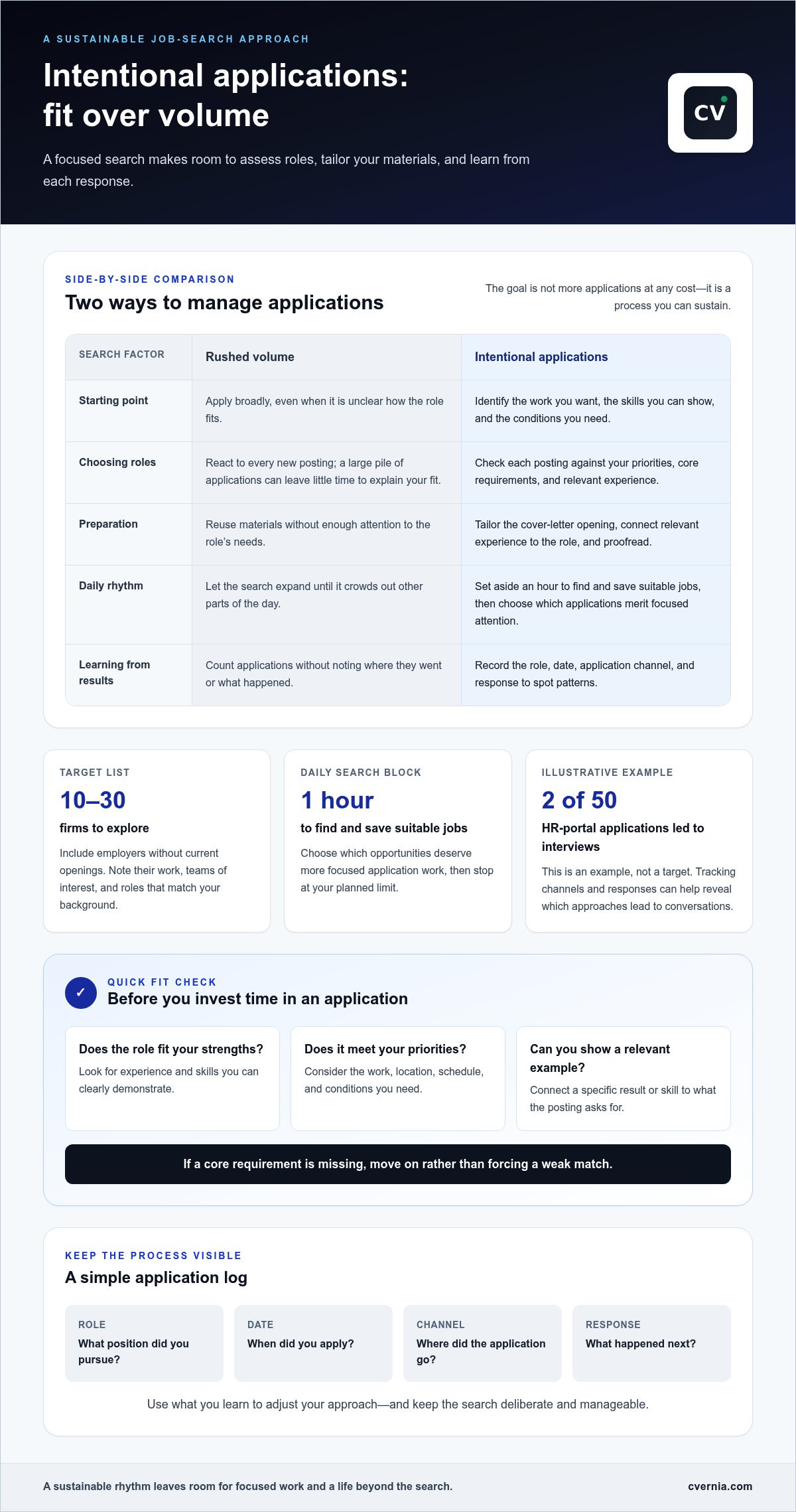
Prioritize fit over volume. Sending out 500 resumes may feel productive, but rushed applications can leave little time to show why your experience matches each role. Start by identifying the work you want, the skills you can demonstrate, and the conditions you need, such as location or schedule. Then compare each posting against those priorities before deciding whether to apply. A role that aligns with your strengths gives you clearer details to emphasize in your application.
Build a target list of 10-30 firms, including employers without current openings. For each firm, note its work, the teams that interest you, and any roles that match your background. This turns a broad search into a manageable set of prospects. When an opening appears, you can assess it against your list instead of reacting to every new posting. Keep the list flexible as your interests or priorities shift.
How do you create a sustainable daily job-search routine? Set aside an hour to find and save suitable jobs, then choose which applications deserve focused attention. Set a clear stopping point and vary the tasks, such as reviewing postings, tailoring a resume, or preparing a follow-up. For anyone wondering how to stay motivated during a long job search, defined limits can make it easier to return tomorrow.
Use a simple fit check before applying. Ask whether the role uses skills you want to develop, whether your experience meets its core requirements, and whether the work fits your priorities. For example, if a posting emphasizes client communication and you’ve handled customer projects, identify a specific result that demonstrates your experience. If you lack a core skill the role requires, move on rather than forcing a weak match.
Track outcomes by application method, not just by total applications. In one example, two of 50 applications submitted through HR portals led to interviews. That figure is an illustration, not a target for every search, but it shows why recording the route and result can reveal patterns. Note the role, date, channel, and any response. If one approach produces stronger conversations, consider investing more effort there.
Keep each application deliberate. Tailor the opening of your cover letter to the role, connect relevant experience to its needs, and proofread before submitting. A focused application log can help you remember which resume version you used and when to follow up. This kind of practical structure can support how to stay motivated during a long job search by making progress easier to see. If organizing applications is taking time away from tailoring them, an application tracking dashboard can keep the process easier to manage.
3. Asking former colleagues, professors, and career centers for help
You don’t have to search alone. Former managers, professors, and career center staff can offer advice, help clarify your direction, or share useful connections. Start with someone who knows your work or studies. For example, contact a former manager who can speak to your strengths, or a professor familiar with projects related to your target roles. A specific request makes it easier to respond.
Keep your message personal and brief. Remind the person where you worked or studied together, explain the kind of role you’re pursuing, and ask for one practical form of help. You might request feedback on how you describe a skill, ask about changes in your field, or see if they’re open to a conversation. Avoid asking someone to find you a job. A focused request respects their time and gives the exchange a clear purpose.
For example, an author asked a former internship supervisor to share her résumé with his network, and three people offered to talk with her. This shows how a direct request can lead to conversations, not that every outreach will get the same response. Make your message easy to pass along by describing your target role and relevant experience. If the supervisor knows someone who could help, they can decide whether an introduction makes sense.
Professors can be valuable contacts, especially when your search relates to coursework, research, or a past project. Mention the specific class or assignment you shared, then explain the kind of work you’re exploring. Ask which skills employers may value or how to present academic work on a résumé. A professor might also help you find career resources connected to your school or field.
Career centers can help students and alumni approach applications with more structure. Ask about résumé feedback, interview preparation, or finding roles related to your studies. Before reaching out, prepare a brief summary of your target positions and questions. For instance, bring a job description and ask which experience deserves more emphasis. This gives the conversation a practical focus.
Keep a simple record of whom you contacted, what you asked, and any next steps. If someone offers an introduction, send a short thank-you and explain your interests clearly. If they can’t help, you can still ask whether they recommend another useful contact. Treat each conversation as one part of your search, and use what you learn to shape your next outreach.
4. Coping strategies, mindfulness, and journaling
Give difficult emotions a place to go instead of carrying them through every application. Journaling can help you process job-search thoughts and feelings. Write what happened, how it affected you, and one action you can take next. For example, after a rejection, note what you learned and choose whether to follow up or move on.
Try a short mindfulness reset before opening your inbox. Sit comfortably, notice your breathing, and bring your attention back whenever thoughts drift toward unanswered applications. On a pleasant day, step outside for sunshine or stand up to stretch during your workday. A 10-minute walk outdoors can also create a clear pause between searching and the rest of your day.
Have a simple plan for disappointing news. One suggested approach is to counter each rejection or other bad news with three positive actions. These might include contacting someone supportive, completing a small household task, and returning to a hobby. They won’t erase disappointment, but they can give the day more than one defining moment.
Watch for changes in how you feel over time. The New York Times has noted that depression can set in after around 10-12 weeks of a job search. That makes regular check-ins useful: notice whether sleep, concentration, or everyday responsibilities have become harder to manage. Treat those changes as reasons to seek support, not as personal failures.
When should you seek mental health support during a long job search? Reach out to a mental health professional if distress persists or starts interfering with daily life, relationships, or your ability to function. A 50-minute therapy session can provide uninterrupted time to discuss what you’re experiencing and consider coping strategies with a professional.
Choose coping tools before a difficult day arrives. Write a short list of people you can contact, activities that help you reset, and small tasks that feel manageable. After an interview or rejection, for instance, take a walk, message someone you trust, or spend time on a personal project. Choose what helps you regain focus without expecting yourself to feel positive immediately.
Journaling can also reveal which parts of the search are causing the most strain. At the end of each 20-30-minute session, review what you wrote and identify one adjustment, such as taking a screen break after an interview or asking someone to listen. If low mood or anxiety continues, bring those observations to a qualified professional for support.
5. How can you set realistic weekly job-search goals and track progress?
Set goals around actions you control, not outcomes employers decide. For example, choose a number of suitable applications, networking messages, or follow-ups for the week. Sending 15 emails or applications per day is one example of a short-term goal, not a required pace. Adjust the target to your available time and the effort each application needs. A realistic goal should challenge you without forcing rushed submissions.
Break large tasks into smaller steps with clear endpoints. If updating your LinkedIn profile feels daunting, revise one section at a time. Clarify your headline first, then update a work-history entry in another scheduled block. Add each step to your weekly plan so you can see progress before the whole profile is finished. This approach also works for researching employers or preparing application materials.
Use a simple funnel to connect activity with outcomes. One example estimates that 50 applications and 20 LinkedIn messages generate 10 responses. In that same example, four interviews lead to second interviews with two companies. Treat these figures as a planning illustration, not a promise or universal benchmark. The useful lesson is to track each stage, from outreach to responses and interviews, then notice where your own search slows.
Set a mix of goals that reflects your search. For example, set targets for suitable applications alongside time for networking and preparation. Attending two networking events per week is another short-term goal. If an event leads to a useful conversation, record the person’s name and any agreed follow-up. This makes networking progress visible, even before it leads to an interview.
Review your progress at the end of each week. Record applications sent, replies received, interviews scheduled, and follow-ups completed. Compare the results with your plan, then decide what to adjust. If you’re completing applications but not hearing back, consider whether your target roles fit your experience and whether your materials clearly show relevant strengths. If you’re getting interviews, schedule preparation time for the next stage.
Keep the tracking method easy to maintain. A spreadsheet can record the role, employer, application date, next action, and outcome in one place. Use short notes, such as “follow up after interview” or “revise project example,” to make the next step clear. If your CV needs to align more closely with the roles you’re targeting, review your CV and cover letter options as part of your plan.
CVernia: Career Application Management Platform
CVernia’s Career Application Management Platform helps you organize applications and keep each step visible. Use it when scattered documents or unclear follow-ups make your routine harder to maintain. CV Compatibility & ATS Analysis helps you assess how your CV matches a job description, while the Application Tracking Dashboard keeps application details together. Interview Preparation & Guidance can support you as an application moves toward an interview.
Use these tools to structure your search, not to replace your own decisions or personal support. You remain in control of which roles to pursue and how to pace your efforts. To manage your applications in one place, explore CVernia’s career management platform.
Choose a next step you can sustain
A long search can make every unanswered application feel like a verdict. It isn’t. Treat the next step as a small experiment: choose one action you can complete, notice what you learn, and use it to guide your next decision. Your direction can evolve as you discover which roles suit your strengths and what kind of work feels worthwhile.
Motivation doesn’t need to arrive before you act. Build it through steady, manageable progress, and let support make the process feel less solitary. If organizing your search or strengthening your application materials would help you move forward, contact CVernia for job search support.
You don’t have to solve the whole job search today. Take the next useful step, then give yourself credit for taking it.
Frequently Asked Questions
What are practical ways to stay motivated during a long job search?
Make progress visible with a short record of skills you’ve practiced, useful conversations, and application milestones. When motivation dips, choose one manageable action from that record, such as preparing an example for a likely interview question. You can also connect each task to a personal reason for seeking work, such as learning a skill or finding a role with more meaningful responsibilities.
How can you handle rejection and avoid job-search burnout?
Give yourself time to feel disappointed, then separate what you know from what you’re assuming. A rejection doesn’t reveal every reason behind an employer’s decision. If you receive specific feedback, identify one change to make. If you don’t, avoid endless guessing. Reduce pressure by setting a stopping point for job-search activity and choosing something enjoyable afterward, such as cooking a favorite meal.
What are effective ways to maintain confidence while unemployed?
Connect your professional identity to evidence, not just your current employment status. Write down examples of problems you’ve solved, skills you’ve used, and contributions you’ve made in previous roles or projects. Before an interview, choose a relevant example and practice explaining your actions and results clearly. This gives you concrete material to draw on and helps you describe your experience accurately, without overstating it.
How can networking help during a prolonged job search?
Networking can help you understand how people in your field describe their work and the challenges their teams face. Use conversations to learn about a role’s day-to-day responsibilities, then reflect that language accurately in your applications. Keep the exchange mutual: share a relevant resource or insight when you can, and send a brief thank-you afterward. Treat each conversation as a chance to learn, not a request for a job.
How can you balance a job search with part-time work or caregiving?
Plan around fixed responsibilities first, such as a part-time shift, school pickup, or caregiving appointment. Keep a list of tasks you can do in flexible moments, like saving a posting or drafting interview questions. For interviews, offer specific availability windows that fit your existing schedule. This helps you manage commitments while keeping track of the next action for each application.


