

More applications aren’t always the fastest way forward. Dealing with job search burnout starts with setting a clear limit: one workable model is to cap job-search tasks at two hours per day, split between morning and afternoon, and take a day off when exhaustion starts to build. Protecting time to rest can help you return with more focus.
If your job search feels like a second full-time job, you’re not alone. Balancing applications with everyday commitments can be draining, but you don’t need to fill every available hour to make progress. A steady, sustainable routine can keep your search moving without letting it take over your life.
This guide explains how to pace job-search hours, make room for rest and personal responsibilities, and recognize progress while results take time. You’ll also find practical ways to connect with peers and use mindfulness or journaling during stressful moments. Start with a routine that fits your life, then adjust it as your energy and priorities change.
Key Takeaways
- Set boundaries around search tasks so applications, research, and follow-ups don’t crowd out the rest of your day.
- Build a routine that fits your existing commitments, with protected time for activities that restore your energy.
- Recognize small signs of progress, such as refining an application or preparing for an interview, to keep your search moving.
- Use conversations with peers, mentors, and trusted people to gain perspective and feel less isolated.
- Try mindfulness or journaling to notice stress patterns and respond to self-critical thoughts with more balance.
1. Avoiding diminishing returns from excessive job-search hours
More search hours can feel productive, but fatigue can make it harder to complete each application thoughtfully. When dealing with job search burnout, set a daily limit and protect time away from job boards, email, and application tasks.
Common signs of burnout include exhaustion, disillusionment, and disengagement from the search. A prolonged search, repeated rejection, uncertainty, and financial difficulties can contribute to fatigue and make it harder to concentrate or stay motivated.
Count the full workload, not only time spent submitting applications. Research, networking, interviews, and follow-up can expand a search to 40 or 50 hours a week. That can resemble a full-time schedule, especially when job-search tasks stretch across the entire day. A calendar boundary helps separate useful effort from hours that drain energy without improving focus.
- Set a daily cap. One job seeker capped applications at two hours per day, split between morning and afternoon. Treat this as a practical starting point, then adjust it to your responsibilities and energy.
- Block focused sessions. Schedule job-search calendar blocks of two to three hours when feasible. Keep each block focused on a task, such as researching roles or preparing applications, rather than switching between tabs all day.
- Take a day off. When burnout starts creeping in, pause the search for a day. Use that break for genuine rest, rather than repeatedly checking messages or mentally replaying application outcomes.
Decide on a specific task before each session. For example, use one block to identify suitable roles and another to tailor materials for a strong match. A clear task gives the session a finish line. If your concentration drops, don’t add applications just to hit an arbitrary count. Review whether the roles fit your skills and priorities instead.
At the end of the day, note what you completed, what needs follow-up, and when you’ll return to it. Then close your job-search tabs and step away. A genuine break means turning your attention to something outside the search, not refreshing your inbox at lunch or replaying an interview while trying to rest.
Seek professional mental health support if exhaustion or distress persists, intensifies, or interferes with sleep, relationships, or daily responsibilities. If you feel at risk of harming yourself, seek urgent help immediately. You deserve support beyond a job-search plan.
A break is more restorative when you give your mind permission to leave the search alone. If application thoughts keep returning, notice them without turning them into another planning session, then redirect your attention to the activity you chose. You don’t need to resolve every uncertainty during a pause. Returning later with a defined task can help separate rest from job-search work and reduce the urge to stay mentally on call.
2. Balancing search activities with rest and personal commitments
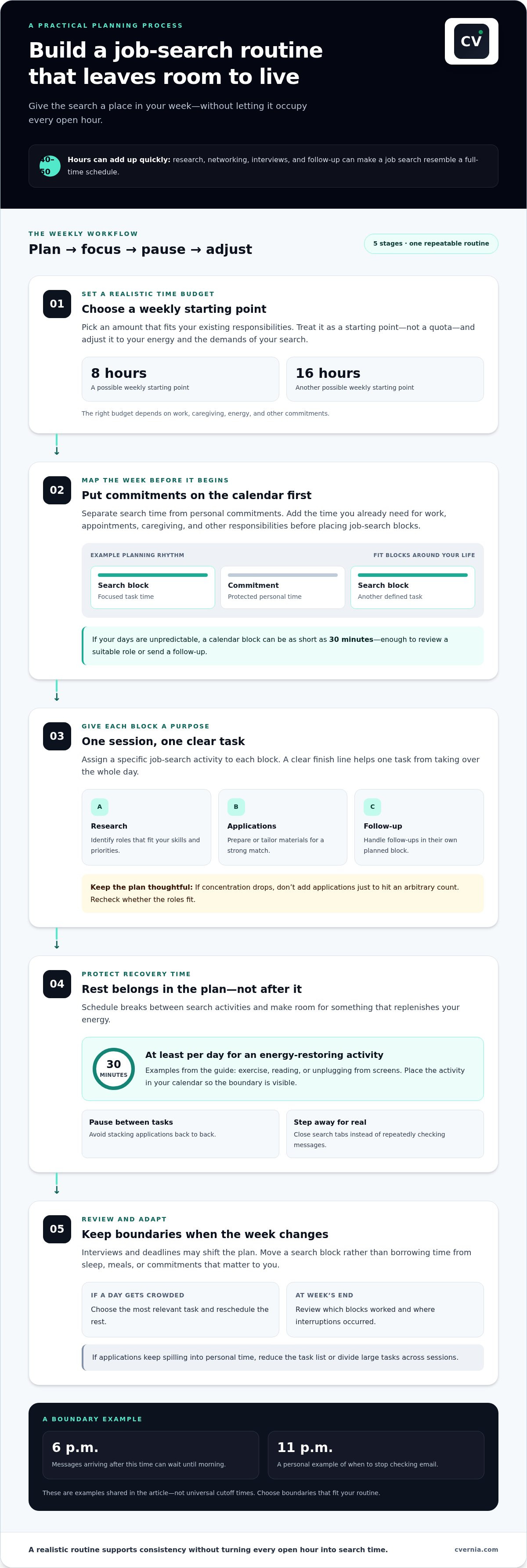
A sustainable search plan gives job hunting a place in your calendar without letting it occupy every open hour. Start by choosing a weekly time budget that fits your current responsibilities. Some job seekers can begin with 8 hours a week; others may have room for 16 hours. Treat either as a starting point, then adjust based on energy, caregiving, work, and the demands of your search.
Separate job-search time from personal commitments before the week begins. Add blocks for research, applications, and follow-up, then schedule breaks and non-work activities around them. If your days are unpredictable, calendar blocks can be as short as 30 minutes. A focused half-hour might be enough to review a suitable role or send a follow-up without pushing aside an appointment or family commitment.
- Choose a task for each block. Use one session to research roles, another to prepare applications, and a separate block for follow-ups. A clear purpose helps prevent one task from taking over the whole day.
- Build in breaks. Add a pause between search activities instead of scheduling applications back to back. Breaks give you a natural point to reassess your energy and shift attention to another responsibility.
- Set an email boundary. One job seeker advised herself to stop checking email at 11 p.m. She also decided that messages arriving after 6 p.m. could wait until morning.
Make rest part of the plan, not a reward you earn after completing every possible task. Set aside at least 30 minutes per day for something that replenishes your energy, such as exercise, reading, or unplugging from screens. For example, put a walk after an application session or reserve reading time for the evening. A planned activity makes the boundary visible in your calendar.
Keep your schedule flexible when interviews or application deadlines change your week. Move a job-search block rather than borrowing time from sleep, meals, or commitments that matter to you. If a day becomes crowded, choose the most relevant task and reschedule the rest. A realistic plan supports consistency without treating every open hour as search time.
At the end of each week, review which blocks worked and where interruptions occurred. If applications repeatedly spill into personal time, reduce the task list or divide large tasks across sessions. If organizing applications is making your planned blocks harder to protect, consider a more structured application workflow as part of your routine.
3. Building momentum
Build momentum through actions you can complete, not outcomes you can’t control. Choose one positive step each day, such as tailoring an application, reviewing a role, or practicing an interview answer. A manageable action keeps your search active without making your day depend on hearing from an employer.
How can you set realistic job search goals and track progress? Choose goals based on actions within your control, then record each completed step. Track applications submitted, interview requests received, and resume revisions, while separating employer decisions from your measure of progress.
Make each goal specific enough to guide your next session. Instead of “make progress,” write “revise the opening summary for a target role” or “prepare examples for a likely interview question.” If a task feels too large, break it down. Updating one resume section can be a concrete start; then check whether the revised content reflects the role’s requirements.
- Record completed actions. Keep a simple log of applications, follow-ups, interview preparation, and resume updates. A record makes effort visible when responses are delayed.
- Acknowledge useful progress. Mark an application submitted, an interview request received, or a resume revision completed. These are meaningful steps, even before an offer arrives.
- Choose one learning action. Read a book by or about a successful businessperson, or build a skill relevant to your target roles.
Use your progress log to spot where momentum is slowing. If you repeatedly save roles but don’t apply, identify the obstacle. You might need clearer criteria for suitable positions, more time to tailor materials, or a smaller next step. Turn the obstacle into an action you can complete instead of treating it as proof that you aren’t making progress.
Learning can also give your search direction between applications. Choose a subject connected to the roles you want, then apply the learning in a practical way. If you’re strengthening presentation skills, practice explaining a project clearly. If you’re developing a technical skill, document what you’ve learned and consider how it supports your experience.
Review your log when motivation dips. Look for completed actions and patterns, such as which resume version you revised or which interview answers you practiced. Then choose the next useful step, not the longest task on your list. Visible, consistent actions help you keep moving while grounding your goals in what you can influence.
4. Joining job-seeker communities
Job searching can feel isolating when applications and employer responses happen privately. Talking with peers, mentors, and trusted people gives you space to compare experiences, exchange practical feedback, and feel less alone. Longitudinal studies found that social support eases unemployment’s adverse mental health effects. People without jobs who had strong support networks reported better mental health than employed people with weak support networks.
What job search strategies are most effective besides submitting online applications? Contact people in your network, speak with mentors, request feedback, and join job-seeker communities. These conversations can help sharpen your materials, explore opportunities, and maintain connections beyond application portals.
Start with a specific, manageable request. One designer asked other designers for twenty minutes of career and portfolio feedback. You could ask a former colleague to review a project description or invite a mentor to discuss how your experience fits a target role. A clear request makes it easier for someone to help and gives the conversation a useful focus.
- Reconnect with your network. Send a brief message to someone you trust, share the kind of role you’re pursuing, and ask for a focused conversation.
- Join a peer community. Look for online groups organized around your industry, profession, or job-search stage. Contribute questions and useful observations, not only requests for referrals.
- Ask for targeted feedback. Share a portfolio section, resume summary, or interview response and explain what kind of input would help.
- Make room for honest conversation. Talk openly with close friends about how the search is affecting you, rather than sharing only application updates.
What free U.S. resources can help with job searching and career support? American Job Centers and state workforce agencies provide job-search assistance, while public libraries and community organizations may offer career workshops or access to local resources. Availability varies by location, so search by your city or state and look for services that match your needs.
Peer support can help you recognize strengths that are easy to overlook during a difficult search. Support from peers and loved ones helped job-seeking students recognize and use their strengths more effectively, improving overall wellbeing. For example, a former teammate may remind you how you handled a challenging project, giving you a stronger example for an interview.
Keep community contact purposeful and balanced. Choose one person or group to connect with, decide what you want to discuss, and leave time afterward to reflect. If a conversation leaves you more discouraged, turn to a trusted friend, mentor, or group that offers constructive, respectful support.
5. Mindfulness and journaling
Rejection can trigger anxiety, especially when an employer’s decision feels like a judgment of your ability. Pause before reacting, name the feeling, and write down what happened separately from what you fear it means. Then choose one useful next step, such as taking a break or reviewing your interview notes.
Mindfulness can bring your attention back to the present instead of looping over unanswered questions. After reading a rejection, try a brief grounding exercise: notice your feet on the floor, relax your shoulders, and take several slow breaths. The aim isn’t to force optimism, but to create enough space to respond thoughtfully.
Journaling can turn a loop of worry into clear, manageable observations. After an application or interview, record what you learned, what went well, and what you want to change next time. You might note that a project story felt strong, while one answer needs a clearer result. That gives your next preparation session a practical focus.
- Separate facts from assumptions. Write the employer’s actual message, then identify the conclusion you’re drawing from it.
- Capture a useful takeaway. Record one lesson from an interview or application, rather than judging your entire career from one outcome.
- Choose a next action. Decide whether to rest, follow up, revise an answer, or move to another suitable role.
Be cautious with self-critical thoughts that arrive at 2 a.m. A late-night worry can sound convincing while leaving out context, such as your preparation, experience, or the fact that hiring decisions involve factors you can’t see. Write the thought down, label it as a worry, and revisit it during your next planned reflection instead of treating it as a final verdict.
A phone-free walk can also create room to think. One respondent recommends walking alone without a mobile phone to reflect on difficult situations. Try leaving your phone behind on a familiar route, or put it away for the walk. Notice your thoughts without immediately searching for another role or checking for employer updates.
Keep the practice simple enough to repeat. Use a notebook or private digital document to write a few lines after a stressful moment. If writing feels difficult, try prompts: “What happened?”, “What am I telling myself?”, and “What would I say to a friend?” You can also write before bed, then close the notebook and leave job-search decisions for the next day.
Mindfulness and journaling don’t erase rejection or uncertainty. They can help you notice stress, question harsh conclusions, and choose your next action more clearly. When an unanswered application starts dominating your thoughts, record the concern, take a grounding pause, and return to the next step you can control.
CVernia: Career Application Management Platform
CVernia’s Career Application Management Platform helps you organize applications and prepare for each step of your search. Use it when scattered documents or unclear next actions make your routine harder to manage. CV Compatibility & ATS Analysis helps assess how your CV aligns with a job description, while the Application Tracking Dashboard keeps application details organized. Interview Preparation & Guidance helps you prepare more deliberately for upcoming conversations.
These tools support your process; they don’t replace rest, personal support, or decisions about what pace works for you. Use them to bring structure to application tasks and keep your search visible without relying on memory alone. If a more organized workflow would help, visit CVernia to explore the platform.
Make your next step more manageable
Progress doesn’t mean solving your entire career in one sitting. Choose a next step that supports both your search and your wellbeing, then give yourself permission to stop when it’s done. A more sustainable routine can start with one focused action and a clear boundary around your time.
If dealing with job search burnout is making applications harder to organize, use tools that bring structure to the process. CVernia offers a Career Application Management Platform, Tailored CV & Cover Letter Creation, and CV Compatibility & ATS Analysis to help you prepare and manage application materials. These tools support your search; you set the pace and priorities.
Take the next step that feels useful today. Contact CVernia for career support and explore ways to bring more clarity to your application process. Keep moving at a pace you can sustain, and make room for the rest that helps you return with renewed focus.
Frequently Asked Questions
How can you create a sustainable weekly job search schedule?
Build your schedule around your energy, responsibilities, and the stages of your search. Set separate days or calendar blocks for researching roles, preparing applications, networking, and interview practice. Leave room for unexpected interviews or personal commitments instead of filling every available slot. At the end of the week, review what felt manageable and adjust the next schedule. A sustainable approach to dealing with job search burnout makes space for recovery as well as career tasks.
How many jobs should you apply to each week to avoid burnout?
Choose a weekly application goal based on how many suitable roles you find and how much tailoring each application requires. A fixed quota can lead to rushed applications for poor-fit positions. If a role needs substantial customization, prioritize that application over sending several generic ones. Track completed applications alongside role fit and preparation quality. If the workload regularly spills into personal time, reduce the target or narrow your search criteria.
When should you take a break from job searching, and for how long?
Take a break when fatigue makes it difficult to focus, complete tasks, or mentally step away. A day off can give you space to reset when burnout is creeping in. Decide in advance when you’ll resume, and use the pause for something unrelated to applications, such as a walk or time with a friend. If distress continues or worsens, consider seeking professional mental health support.
What daily habits can support mental health during unemployment or a job search?
Build a simple daily routine that includes movement, a restorative activity, and time away from job-search screens. Exercise, reading, and unplugging can help replenish energy; mindfulness or journaling can help you notice stress and reflect on difficult moments. For example, write down one concern and one next step, then close your notebook. Regular contact with someone you trust can also make difficult days feel less isolating.


