

A job rejection can hurt, but it doesn’t have to define what happens next. To learn how to handle job rejection gracefully, let yourself feel disappointed, take ten minutes to breathe and gather your thoughts, then look for useful lessons without blaming yourself. Respond with thanks, ask for feedback if appropriate, and keep applying to roles that fit your strengths.
It’s understandable to replay the interview or wonder what you could have done differently. But hiring decisions depend on employers’ needs and choices, many of which are beyond your control. Don’t treat one rejection as a verdict on your potential.
This guide shares five practical ways to process disappointment, reflect on interviews, protect your optimism, build resilience, and continue your search with purpose. Use the steps that help you regain perspective and turn your next application into a more focused one.
Key Takeaways
- Separate the hiring decision from your self-worth, and give yourself room to process the disappointment.
- Request feedback graciously, then identify one practical lesson to carry into your next interview.
- Challenge assumptions about why you were rejected instead of letting speculation undermine your confidence.
- Protect your energy with breaks, supportive routines, and activities that matter beyond work.
- Keep your search organized by tailoring each application and tracking the roles you pursue.
1. Acknowledging disappointment after rejection
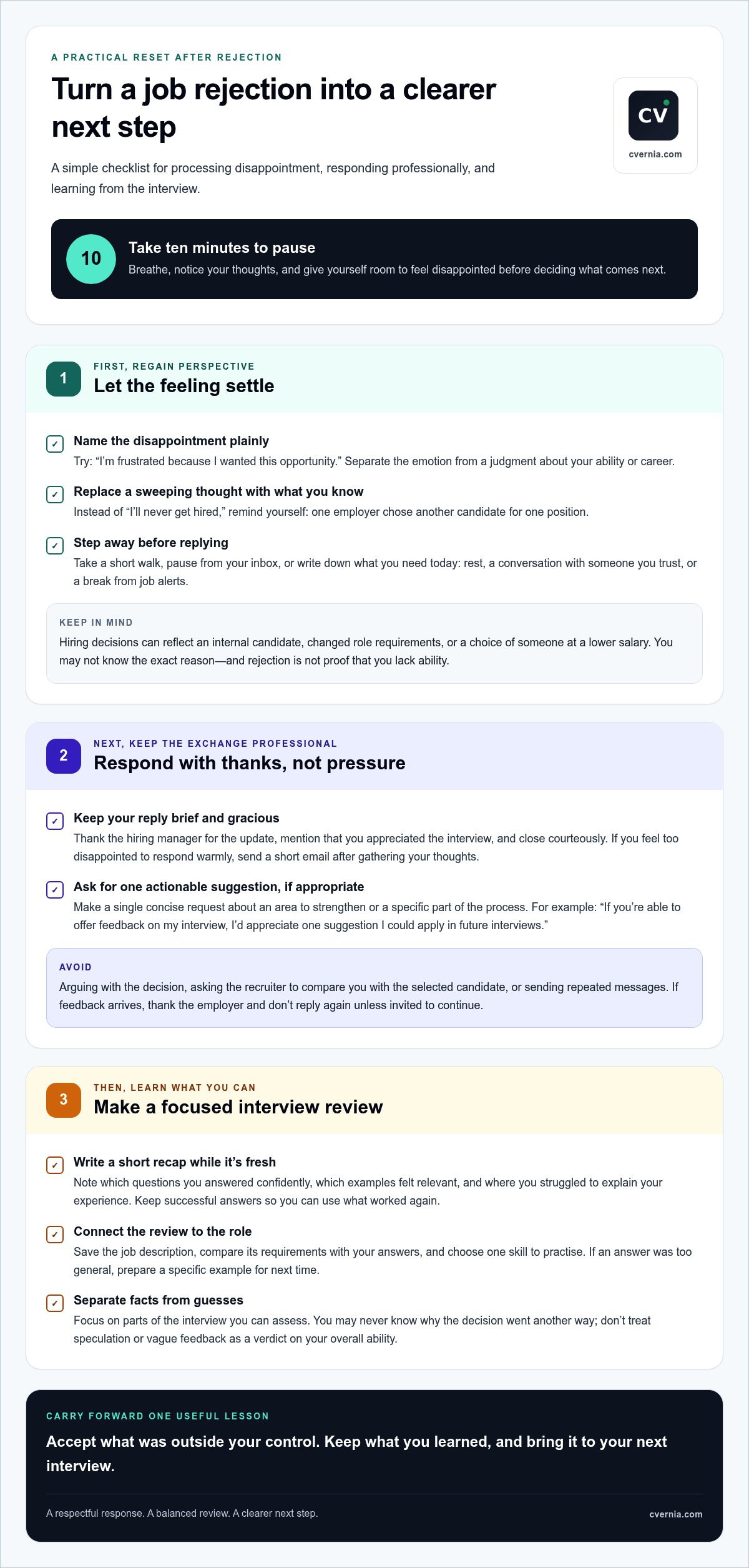
A job rejection can sting, especially after you’ve invested time in an interview, prepared examples, and pictured yourself in the role. Let yourself feel disappointed instead of forcing an immediate positive spin. Name the feeling plainly: “I’m frustrated because I wanted this opportunity.” This helps separate the emotion from a broader judgment about your ability or career.
Take ten minutes to breathe and notice your thoughts without treating each one as fact. After a rejection, you might think, “I’ll never get hired.” Reframe it accurately: one employer chose another candidate for one position. Then step away from your inbox or take a short walk before deciding what to do next.
If a recruiter rejects you by phone, keep your response gracious and brief: “Thank you for letting me know. I appreciated the chance to interview and learn more about the role.” If you’re too disappointed to respond warmly, thank the recruiter for calling and send a short email once you’ve gathered your thoughts.
Reply to a job rejection when you can do so calmly and professionally. There’s no need to send an emotional message immediately. If you didn’t thank the interviewer during the call, a brief follow-up email lets you express appreciation and close the conversation respectfully.
To thank an employer and leave the door open, mention one specific part of the process you valued, then say you’d welcome consideration for suitable future opportunities. For example: “Thank you for the thoughtful interview process. I’d be glad to be considered for another role that matches my experience.”
Keep in mind that a qualified candidate may miss out because an employer has an internal candidate, changes the role’s requirements, or chooses someone at a lower salary. An interview invitation still means the employer considered you a potential hire. Neither fact erases the disappointment, but both can help you avoid seeing rejection as proof that you lack ability.
After a job rejection, don’t blame or accuse the interviewer without knowing the facts, argue with the decision, or send repeated messages seeking a different answer. If the employer gives feedback, respond graciously and don’t reply again unless they invite you to continue the conversation.
When the first wave of disappointment passes, write down one thing you need today: rest, a conversation with someone you trust, or a pause from job alerts. A specific act of care can help you move from reacting to the rejection toward choosing your next step.
2. Reflecting on interviews and seeking feedback
Before interpreting a rejection, separate what you know from what you’re guessing. The employer may have chosen a more qualified candidate, or the decision may reflect an internal budgetary or political consideration. You might never learn the exact reason. Rather than repeatedly analyzing what you can’t know, focus on the parts of the interview you can assess.
Write a short interview recap while the conversation is still fresh. Note the questions you answered confidently, the examples that felt relevant, and any moment when you struggled to explain your experience. For example, if your answer about managing deadlines was general, prepare a specific project example for next time. Keep successful answers, too, so you can repeat what worked.
To respond to a job rejection email, keep your reply brief and professional: thank the hiring manager for the update, mention your appreciation for the interview, and close courteously. If you want feedback, make one concise request instead of challenging the decision or sending several follow-ups.
You can politely ask for feedback after a job rejection. Ask whether the interviewer can share one area to strengthen for similar roles. For example: “If you’re able to offer feedback on my interview, I’d appreciate one suggestion I could apply in future interviews.”
Make your request easy to answer by asking about a specific part of the process, such as whether your examples demonstrated the skills the role required. Don’t ask the recruiter to justify the decision or compare you with the selected candidate. A focused question invites practical guidance without turning the exchange into an argument.
If feedback arrives, thank the employer and consider how it relates to your interview notes. A comment about unclear examples could prompt you to prepare more relevant details. A vague response may offer little to act on, so don’t turn it into a verdict about your overall ability. Don’t reply again unless the employer asks you to.
Use a simple review routine for your next interview: save the job description, compare its requirements with your answers, then choose one skill to practise. This keeps reflection tied to the role instead of spiraling into guesses about what the interviewer thought. For structured practice, prepare for your next interview with focused questions and notes.
Keep your review balanced: note the questions you handled well and continue using the approaches that worked. Replaying every answer may leave you unsure whether you could have improved a response or the employer simply preferred another approach. Don’t treat speculation as a reliable explanation. You may never know why the decision went another way; it could have involved a more qualified candidate or an internal budgetary or political decision.
After a reasonable review, accept that the hiring decision was outside your control and move on. Carry a useful lesson into your next interview rather than trying to reopen the decision. If the employer shares feedback, respond graciously, even if it’s brief or difficult to hear. Don’t argue about the rejection or feedback. Use what’s actionable to improve your next conversation.
3. Adopting an optimistic outlook after rejection
After a rejection, replace “I failed” with “I wasn’t selected for this role.” That describes one hiring outcome, not your whole career. For example, a product designer passed over by one company may still suit another team’s priorities. Write the factual version in a note before reviewing the next vacancy. This separates what happened from what you fear it means. Learning how to handle job rejection gracefully starts with keeping one decision in perspective.
Resist guessing why the employer chose someone else. You might wonder whether your answer about project deadlines sounded weak, but the employer could have prioritized a different skill or experience. Speculation can turn missing information into self-criticism. Instead, divide your notes into two columns: “What I know” and “What I’m assuming.” Put the rejection email in the first column and unsupported explanations in the second.
Keep the role itself in perspective, too. It’s easy to romanticize a position after investing time in an application, especially if you pictured the title or team as a perfect fit. Revisit the job description and consider the actual culture, commute, work demands, and office politics. If the commute would have been difficult or the workload conflicted with your priorities, losing the role may leave room for a better-aligned opportunity.
A hiring decision often reflects a specific need, not a judgment of your personal worth. An employer might choose someone whose background closely matches an immediate project, while your strengths suit a different role. Treat the decision as information about this opening, not a rating of your potential. Then identify which requirements you genuinely meet and where another position could make better use of your experience.
Before your next interview, remember that an offer is possible, but it isn’t the only acceptable outcome. The employer may prefer another candidate or change what the team needs. Prepare thoroughly, then judge your performance by what you controlled, such as explaining a relevant result clearly or asking a thoughtful question. Knowing how to handle job rejection gracefully also means measuring progress by preparation, not just the final decision.
Use a short reset after each outcome. Record one thing that still interests you about the field, one skill you want to develop, and one role to explore next. For example, if a marketing interview highlighted a gap in analytics experience, shortlist roles where your campaign skills remain central while you build that capability. Optimism doesn’t require pretending rejection feels good. It means keeping the next step visible without inventing a story about why you weren’t chosen.
4. Building resilience and staying motivated
Build resilience by keeping your identity broader than your job title. After a rejection, write down three sources of self-worth unrelated to work, such as being a dependable friend, learning guitar, or helping coach a youth team. These reminders put your career search in perspective. A hiring decision concerns one role; your interests, relationships, and abilities extend beyond that application.
Plan an enjoyable activity after a difficult interview or rejection. Cook with a friend, take a walk in a familiar park, or return to a book you set aside during interview preparation. Treat the activity as part of your recovery, not as a reward you must earn through applications. Planning a pause also gives your attention somewhere useful to go besides replaying each answer.
Set a boundary around reviewing the interview. For example, spend a short session noting what you learned, then close your notes and move to another task. Repeatedly questioning whether one phrase sounded wrong rarely reveals what the interviewer thought. If the same concern returns, write it down once and choose a practice step, such as rehearsing a clearer example aloud.
Reconnect your search with the work that genuinely interests you. List the tasks that energize you, then name one skill you want to develop. A project coordinator might enjoy untangling schedules and want to strengthen stakeholder communication. Together, those details can guide which roles to pursue and what learning activity to prioritize, rather than applying out of discouragement alone.
Protect your basic routines while applications compete for your attention. Keep a steady sleep schedule, include movement such as a walk or workout, and take a short break when your concentration stalls. If you’ve spent the afternoon refreshing email, step away and return to one manageable task, such as preparing an answer to a common interview question. Small routines make the search easier to sustain.
Turn to your network for encouragement and perspective. Message a former colleague, mentor, or friend with a specific request: “Could we talk through how I’m approaching project manager interviews?” A focused conversation can help you feel supported and identify a next step. You don’t need to share every detail; choose someone who can listen without turning one rejection into a judgment of your abilities.
Jia Jiang offers a striking example of practising resilience: after an investor rejected his request for company financing, he practised seeking rejection for 100 days. You don’t need to copy his challenge. Instead, try a small, relevant experiment, such as asking a professional contact for advice or applying for a role that stretches your experience. Treat each action as practice in continuing, not a test of your worth.
5. Continuing to apply for opportunities
Keep your search moving by applying to several suitable roles while giving each application careful attention. A rejection from one employer doesn’t require you to pause every other application. Choose positions that match your experience and interests, then adapt your materials to each job description. A steady, organized process helps you keep options open without sending the same generic application everywhere.
Prepare a strong starting CV and cover letter, then tailor them to each vacancy. For a project coordinator role, highlight scheduling and stakeholder communication; for an operations role, emphasize process improvements. Match your examples to the employer’s stated requirements and keep your experience accurate. A reusable foundation saves effort, while thoughtful edits show how your background relates to the specific position.
You can ask an employer to consider you for another position after a rejection. Thank them, express interest in suitable future openings, and briefly identify the kind of role that fits your experience. For example: “I appreciated meeting the team and would welcome consideration for future project coordination roles.”
Make every application easy to track. Record the application date, job title, company, site where you applied, and hiring professional’s details when available. Save each job advert or description with your notes. If you’re invited to interview later, you can review the original requirements and prepare examples that address them directly.
Set a practical rhythm for your search: review new postings, choose relevant opportunities, tailor an application, and update your tracking record. Focus on fit and quality, not simply the number of applications. If a role requires experience you don’t have, spend your time on an opening that better matches your skills or on developing a relevant capability.
Review your materials before sending each application. Check that the employer and job title are correct, your examples support the role’s requirements, and your contact details are current. A tailored CV and cover letter can help make your qualifications clearer for each opportunity. Tailor your CV and cover letter to the roles you’re pursuing.
Expect the search to take persistence. Zainab spent months applying and interviewing before finding her current job. Her experience is a reminder that the route to a suitable role can involve several applications and conversations. Keep applying, learn from each process, and maintain a record that helps you return to promising opportunities prepared.
You can pursue multiple opportunities while giving each application your best effort. Treat each one as its own process: read the advert carefully, consider how your experience fits, and give the application the attention it needs. Continuing with other applications doesn’t mean rushing or lowering your standards. Focus on roles you genuinely want to pursue, and make time to present your experience clearly in each application.
Use a completed application form, CV, and cover letter as a starting point, then adapt them to each job advert. Check that each version responds to the specific role: review the requirements, choose relevant examples from your experience, and make sure the details are accurate. This approach helps you maintain momentum while giving each opportunity an individual, considered response.
CVernia: Career Application Management Platform
CVernia helps you manage the next steps of your job search in one place. After a rejection, use its Application Tracking Dashboard to organize active applications and keep each opportunity visible. CV Compatibility & ATS Analysis helps you assess how your CV aligns with a job description, while Interview Preparation & Guidance supports preparation for upcoming conversations.
Use the platform when applications, interview details, and follow-ups become difficult to manage together. Its centralized tools help you carry useful lessons from one application into the next while keeping your search organized and focused.
Visit cvernia.com to explore how CVernia can support your application journey.
Make your next application a fresh start
Learning how to handle job rejection gracefully means letting a difficult outcome inform your next move without allowing it to define your potential. Choose one action to restore momentum: explore a role aligned with your strengths, refine how you present relevant experience, or organize your applications more clearly. Progress can begin with a focused adjustment, not a complete career overhaul.
CVernia supports that next step through its Career Application Management Platform. Use Tailored CV & Cover Letter Creation to shape your application materials, and CV Compatibility & ATS Analysis to assess how your CV aligns with a job description. These tools help you approach each opportunity with greater clarity while keeping ownership of your search.
Contact CVernia for career support and choose a practical next step for your job search. One rejection is one outcome, not the limit of what you can achieve. Keep moving forward with purpose.
Frequently Asked Questions
How can you manage disappointment and stay motivated after rejection?
Give disappointment a clear boundary, then choose a small action that supports your wellbeing or search. For example, mute job alerts during dinner and plan to review one suitable vacancy the next morning. Track a process goal, such as completing a thoughtful application, rather than judging progress only by offers. This keeps your effort visible while leaving room for interests and relationships outside work.
How can you learn from a rejection and improve future job applications and interviews?
Look for patterns across several applications rather than drawing conclusions from one employer’s decision. Keep a private decision log with the role’s key requirements, the evidence you presented, and questions you still have about the position. After a few interviews, compare your notes: perhaps you consistently explain technical work clearly but need stronger collaboration examples. Use that pattern to adjust one detail in an application or practice answer.


