

A rejection can be useful feedback, not a verdict on your worth. Building confidence after job rejection starts with separating the hiring decision from your professional value, reflecting on what you can learn, and choosing one manageable next step. You don’t have to feel completely confident before moving forward.
It’s understandable to replay an interview or question your abilities after a rejection. This guide will help you challenge those doubts, review what went well and what you’d change, and keep your job search moving at a manageable pace. Small actions, such as updating an application or tracking your progress, can help rebuild confidence by giving you evidence of your own effort.
Key Takeaways
- Separate a hiring decision from your worth by considering how timing, role requirements, and business needs may shape the outcome.
- Review what went well in an interview and identify one area to strengthen; use any employer feedback as practical input for your next application.
- Give yourself room to process disappointment, then choose a manageable job-search step to regain momentum.
- Track applications, interviews, and professional connections to recognize progress you can build on, even before an offer arrives.
1. Separating hiring outcomes from self-worth
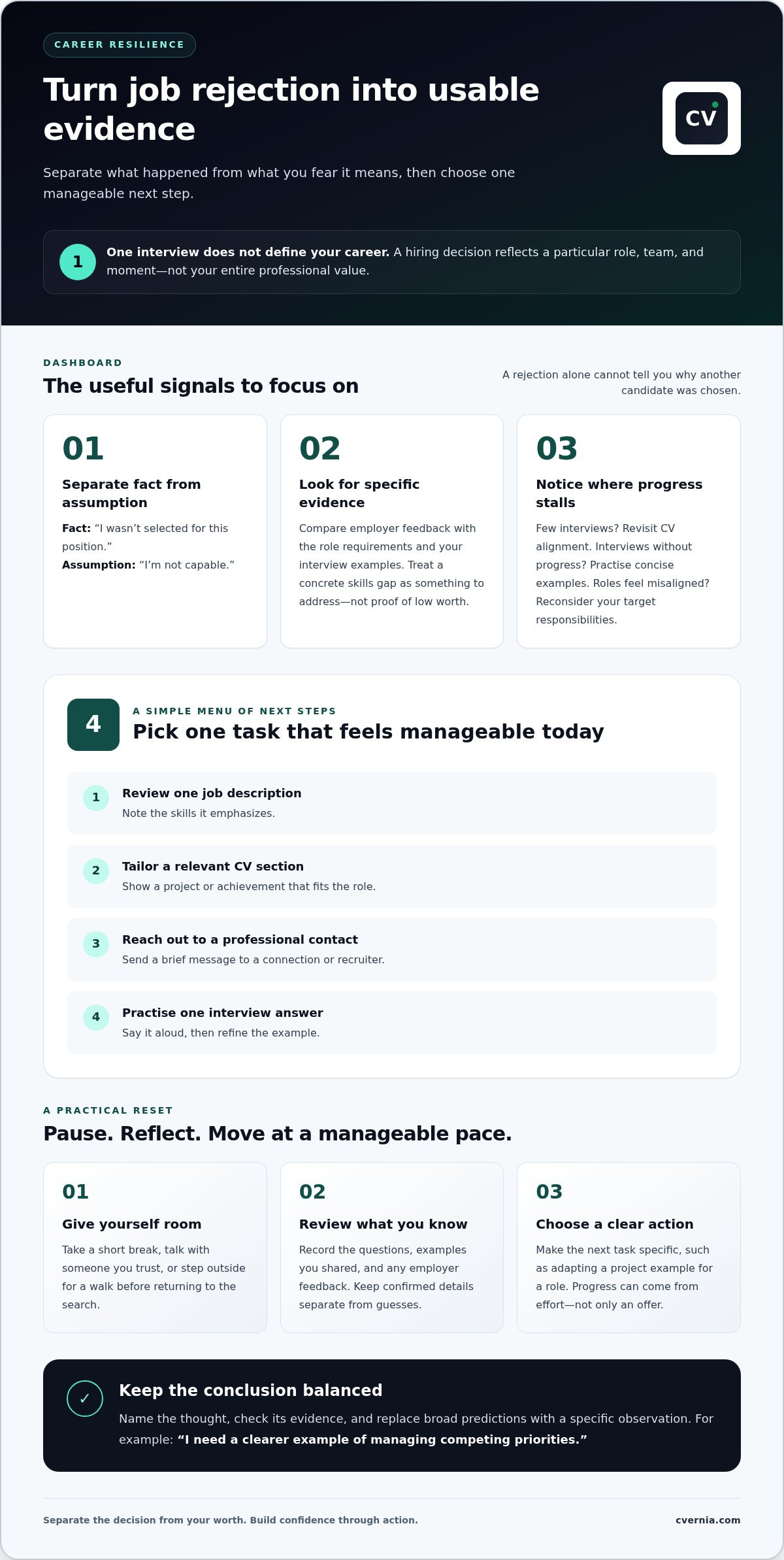
A rejection can feel personal because interviews ask you to present your skills, experience, and ambitions. But one hiring decision reflects a particular role, team, and moment, not your entire professional value. Hiring priorities may include specialised experience, budget, timing, or internal needs. These factors can shape the outcome even when you meet the role’s requirements. Separate the event from the conclusion: “I wasn’t selected for this position” is a fact; “I’m not capable” is an interpretation.
To assess whether a rejection reflects your skills or a competitive process, look for specific employer feedback about a requirement you didn’t meet. Compare that feedback with the job description and your interview examples. If the employer gave no details, the decision alone can’t tell you why another candidate was chosen. Treat a concrete skills gap as something to address, not as proof of low worth.
Practise self-compassion with a practical reset. Write down what you’d say to a friend in the same situation, then offer yourself that response. For example: “This is disappointing, and one interview doesn’t define my career.” Add evidence to challenge self-doubt, such as positive feedback, a completed project, or a challenge you handled. This puts your feelings in context instead of letting them define your abilities.
Self-care can help you process disappointment before your next application. Take a walk, stretch, or choose another form of physical activity that fits your day. Then talk with a trusted friend or family member who can listen without turning the rejection into a judgment. CVernia’s Career Academy & Learning Resources can support skill development when reflection points to an area you want to strengthen. Building confidence after job rejection takes practice: separate facts from assumptions, acknowledge what you’ve achieved, and choose one supportive action.
2. Reflecting on interviews and seeking feedback
After a rejection, write down what you know before interpreting the outcome. Record the interview questions, examples you shared, and any feedback the employer gave. Separate confirmed details from guesses: “They chose another candidate” is known; “I sounded unqualified” may be an assumption. This distinction limits speculation and gives your reflection a useful starting point.
If you want more detail, send the recruiter a brief, polite follow-up. Thank them for the opportunity, then ask whether they can share one area to strengthen for similar roles. Keep your request specific and gracious. For example: “Was there a skill or interview response I could develop for future opportunities?” Employers may not provide feedback, but a clear question makes it easier for them to offer something actionable.
What should you do after a job rejection to learn from the experience? Review the role requirements alongside your interview notes, then identify what went well and what you’d prepare differently. If feedback mentions a skills gap, choose a learning step; if it points to unclear examples, practise a more focused response.
Challenge negative thoughts by naming the thought, checking its evidence, and writing a balanced alternative. “I’ll never get hired” predicts every future outcome from one decision. Replace it with a specific observation, such as, “I need a clearer example of managing competing priorities.” That shift supports resilience while turning reflection into a practical adjustment.
Repeated rejections can point to different issues, depending on where applications stall. If your applications rarely lead to interviews, revisit how your CV and experience align with role requirements. If interviews end without progress, practise concise examples and prepare for common questions. If the roles consistently feel misaligned, reconsider your target responsibilities or career direction.
Use interview preparation and guidance to organise practice around the questions and examples you want to improve. Pair interview notes with one specific next step, then apply that learning to your next conversation. Reflection builds confidence when it produces a change you can actually practise.
3. Taking manageable steps to continue the job search
A rejection can disrupt your routine, so give yourself room to recover before starting another application. Take a short break to process the disappointment, talk with someone you trust, or step outside for a walk. Returning with a small, clear task can feel easier than expecting yourself to submit several applications immediately. A pause can help you reset, while an extended break may make it harder to regain momentum.
Choose actions you can complete without knowing how every employer will respond. For example, save one suitable vacancy, update a relevant CV section, or prepare an answer to a question that challenged you. These steps keep the process moving without making confidence depend on an offer. Graduates may apply to dozens of positions before securing work, so a single rejection doesn’t define the wider search.
Use a simple menu of next steps when you’re unsure where to begin:
- Review one job description and note the skills it emphasizes.
- Tailor your CV to show a relevant project or achievement.
- Send a brief message to a professional connection or recruiter.
- Practise one interview answer aloud, then refine the example.
Pick the task that feels most manageable today. If an application feels overwhelming, break it into smaller actions, such as identifying relevant experience before drafting a cover letter. If you’re waiting to hear back, use that time to prepare for another suitable role rather than repeatedly checking for updates. A completed action gives you evidence of progress, even when an employer’s decision remains outside your control.
Keep the next step realistic and specific. “Work on my job search” is difficult to act on; “adapt my project example for this role” gives you a clear starting point. After completing it, decide whether to pause or continue with another task. This steady rhythm can rebuild confidence through effort, rather than through trying to predict the outcome of every application.
4. Building confidence through action
Confidence grows when you collect evidence of what you can do, rather than waiting for approval. After a rejection, choose a task you control and complete it. You might revise an interview example, submit an application suited to your experience, or contact a professional connection. Each action gives you a concrete record of effort, helping counter the feeling that one employer’s decision defines your prospects.
To rebuild confidence after rejection, set a small goal tied to your next opportunity. For example, prepare a concise story about solving a workplace problem, then practise saying it aloud. Notice what feels clear and where you lose detail. Adjust the example and practise again. This turns preparation into a repeatable skill, not a test of your worth.
Before your next interview, make preparation specific. Review the role description, select relevant achievements, and draft questions about the team’s priorities. Practise answers aloud, then note the examples you want to use. A tailored preparation routine can help you focus on what you bring instead of trying to predict every possible question.
- Track applications and interviews to see progress beyond offers.
- Record new professional contacts and follow up with a thoughtful message.
- After each interview, note one effective answer and one area to practise.
- Choose the next action based on your notes, such as refining an example or researching a role.
Keep your record factual. “I explained the project clearly” is useful evidence; “I must have failed” is a guess. Reviewing completed tasks and interview notes lets you see your skills in action. If a specific interview challenge keeps recurring, practise that skill before the next conversation. If you communicated your experience well, carry that example forward.
For focused practice, use Interview Preparation & Guidance to work on your examples and interview readiness. Pair preparation with a small action after each rejection, such as updating one answer or applying for a well-matched role. Confidence becomes more dependable when it’s built through steps you can repeat.
CVernia: Career Application Management Platform
CVernia brings job-search tasks together in its Career Application Management Platform. After reflecting on a rejection, use CV Compatibility & ATS Analysis to review how your CV aligns with a role description. Track applications in the Application Tracking Dashboard to see progress and keep opportunities organised. For upcoming interviews, Interview Preparation & Guidance can help you prepare examples and questions with greater focus.
Turn to these tools when you’re ready to translate reflection into a clearer, more structured search. They support your preparation and application management, while hiring decisions remain with employers. Visit CVernia to explore how the platform can support your next steps.
Make your next step intentional
Let your next application reflect what you’ve learned, not what one rejection made you fear. Choose a role that fits your priorities, then prepare a clear account of the strengths and experience you bring. Building confidence after job rejection is an ongoing practice: each thoughtful decision helps you approach the search with greater clarity and purpose.
When you want a more organised way to prepare, CVernia’s Career Application Management Platform brings application support into one place. Its Tailored CV & Cover Letter Creation helps you adapt your materials to a role, while CV Compatibility & ATS Analysis lets you review how your CV aligns with a job description. Use these tools to make your next application more deliberate and focus on the work you can control.
Contact CVernia for job search support and take your next step with a clearer plan. A rejection can close one opportunity, but it doesn’t decide what you’re capable of pursuing next.
Frequently Asked Questions
How to cope emotionally with job rejection and avoid taking it personally?
Give the disappointment a boundary: write down what happened, then set a time to return to another part of your day. For example, note that the employer selected someone else without turning that outcome into a judgment about your character. If the rejection keeps dominating your thoughts, share your concern with someone you trust. Building confidence after job rejection can also mean protecting time for relationships and interests beyond work.
How can I ask an employer for feedback after a job rejection?
Send a brief note to the recruiter or hiring contact, thank them for the interview, and ask one focused question about your candidacy. For example, ask which experience or qualification would have made your application more relevant. Keep the tone professional and avoid challenging the decision. If you don’t receive a reply, treat that as the end of the request and use the information you already have.
How long does it typically take to recover emotionally from job rejection?
There’s no single recovery timeline. It can depend on how much you wanted the role, current pressures, and the support around you. Notice whether the disappointment is easing enough for you to manage everyday responsibilities and consider another opportunity. If distress stays intense or begins affecting sleep, relationships, or daily life, talk with a qualified mental health professional for support tailored to your situation.


