

The feeling of sending a resume into a black hole can be intense, but your application may pass through several steps before an employer responds. Applicant tracking systems organize applications, and some employers use AI-assisted tools to help screen them. A quiet inbox doesn’t automatically mean your resume disappeared or that you weren’t qualified.
It’s understandable to expect an acknowledgment after investing time in an application. When none arrives, it can be hard to tell whether the reason was timing, how your experience matched the role, or the employer’s hiring process.
Learn how applicant tracking systems handle resumes, where AI may fit into screening, and why applications sometimes receive no response. This guide also explains how to make your qualifications easier to recognize and keep your job search organized, so you can move forward with greater clarity and confidence.
Key Takeaways
- AI can assist with drafting, but tailor the resume to the role and keep your experience accurate and recognizably your own.
- Applicant tracking systems help employers organize applications; clear formatting and relevant details make your qualifications easier to identify.
- A quiet inbox doesn’t explain why an application stalled. Learn what response-rate data can and can’t tell you about an individual outcome.
- Follow up thoughtfully by considering the employer’s instructions and hiring timeline, and keep track of each application so you can plan your next step.
AI-assisted resumes and AI screening
Nearly 70% of organizations use artificial intelligence somewhere in hiring. Software may sort applications, identify terms, or flag details for recruiter review. That doesn’t mean every resume receives an automated yes-or-no decision. An AI-assisted draft can improve clarity, but generic wording may obscure what you actually accomplished.
Experiments show how wording can affect automated comparisons. In a controlled experiment, AI models preferred resumes they had generated over equally good human-written resumes 67% to 82% of the time. In simulated hiring across 24 occupations, candidates using the same AI model as the screener were 23% to 60% more likely to be shortlisted. These findings don’t predict an individual hiring outcome. They do underline the importance of clear, role-relevant language.
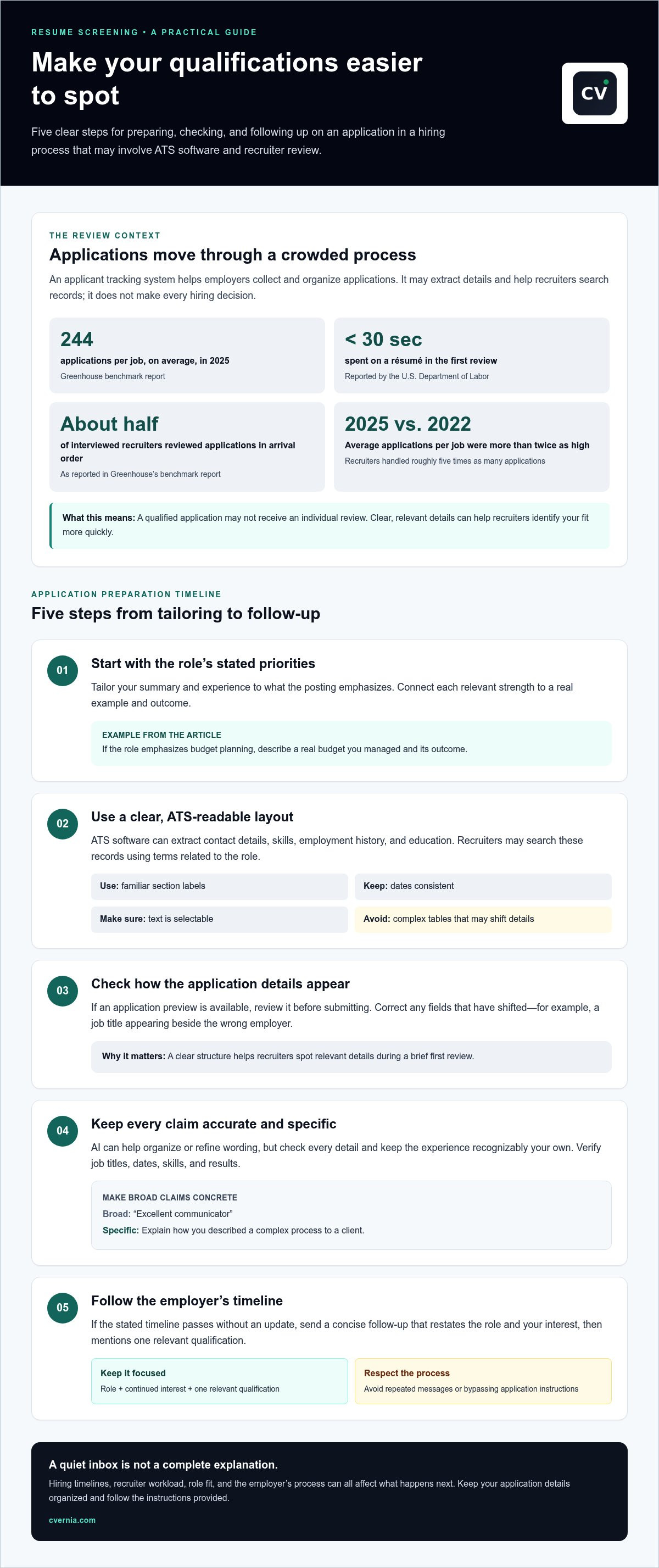
How can you tailor a résumé to improve your chances of getting noticed? Match your summary and experience to the role’s stated priorities. For example, if a posting emphasizes budget planning, describe a real budget you managed and its outcome. Use AI to organize or refine your wording, then check every detail and restore your natural voice.
How can you find out whether a job posting is still active or legitimate? Check the employer’s careers page for the same role and compare its title, location, and requirements. Look for a consistent company identity and application process. Treat requests for payment or sensitive information early in hiring as warning signs.
How can job seekers cope with stress and discouragement during a job search? Set a manageable routine, such as choosing a role to target, tailoring an application, and then taking a planned break. Track the steps you complete, not only the replies you receive, and talk through setbacks with someone you trust.
Some employers may use AI tools to detect AI-generated resumes. Review every suggested sentence for accuracy, especially job titles, dates, skills, and results. Replace broad claims like “excellent communicator” with a specific example, such as explaining a complex process to a client. A polished application should make your real experience easier to recognize, not make it sound invented.
How applicant tracking systems handle resumes
An applicant tracking system, or ATS, helps employers collect and organize applications. It can extract contact details, skills, employment history, and education. Recruiters may search these records using role-related terms. For example, a hiring team looking for spreadsheet experience can search for relevant skills. The software supports the review process, but it doesn’t make every hiring decision.
Resume layout can affect how clearly information is extracted. Use familiar section labels, consistent dates, and selectable text. A complex table may place a job title beside the wrong employer when parsed. Check the application preview, if available, and correct any fields that shifted. The U.S. Department of Labor reports that employers spend fewer than 30 seconds looking at a résumé on the first review. Clear structure helps recruiters spot relevant details quickly.
Recruiter workload also shapes what gets reviewed. Greenhouse’s benchmark report says the average job received 244 applications in 2025. About half of interviewed recruiters said they reviewed applications in arrival order. The average job drew more than twice as many applications in 2025 as in 2022. Recruiters handled roughly five times as many applications in 2025 as in 2022. Under that volume, a qualified person may not receive an individual review. A role may close, priorities may shift, or an application may not surface in a recruiter’s search.
How can you follow up on a job application professionally? Follow the employer’s stated timeline. If it passes without an update, send a concise message that restates the role and your interest, and mentions one relevant qualification.
What alternatives to online applications help job seekers reach hiring managers? Build connections through professional groups, events, and direct conversations with people in your field. A thoughtful introduction can complement an online application and help you learn about a role’s needs.
For example, a data analyst could pair an application with a brief note to a relevant contact. Be specific: mention the role, connect one skill to its requirements, and ask a focused question. Avoid repeated messages or bypassing the employer’s application instructions. Professional outreach can clarify how your experience fits.
Keep each submission and follow-up organized, so you can act on the employer’s timeline. An application tracking dashboard can help you record role details and application status in one place.
What is the average job application response rate in the United States?
There isn’t one universal response rate that describes every U.S. job application. The available benchmark measures a different outcome: job applicants had roughly a 0.4% chance of landing the job they applied for, as reported in November 2025. That figure describes job outcomes, not how often employers reply. A rejection, interview invitation, and silence are distinct outcomes, so don’t treat them as interchangeable.
Define what you’re measuring before interpreting a percentage. A response rate could count any employer reply, while an interview rate counts invitations. An offer rate measures a later stage, and a hiring rate tracks who ultimately gets the job. For example, a recruiter’s rejection email counts as a response, but not an interview or offer. These distinctions matter when comparing your results with broad job-search figures.
The 0.4% benchmark also can’t predict what will happen with one application. Outcomes depend on the role, employer requirements, applicant fit, and competition. A specialized position with narrow qualifications differs from an entry-level opening attracting a wider range of candidates. A strong match may still face timing or hiring-priority changes. Read the figure as broad context, not a verdict on your ability.
Track your search using clear categories. Record the application date, role, employer, and current status. Separate employer acknowledgments from interview invitations, rejections, and unanswered applications. After applying to several roles, look for patterns: Are relevant positions leading to conversations? Are applications stalling before interviews? This helps you identify where to refine your approach without assuming every quiet inbox means the same thing.
Use response patterns to guide practical changes. If applications rarely lead to interviews, compare your resume with the role’s core requirements and make relevant experience easy to find. If you get interviews but no offers, prepare examples that show your impact and explain your decisions. Keep applying to well-matched openings while following each employer’s process. Broad benchmarks offer context, but reviewing each stage of your own search can reveal more useful next steps.
How long should you wait before following up on a job application?
Start with the employer’s stated timeline. If the posting or confirmation email names a review date, wait until it passes before following up. For example, if the message says interviews begin after applications close, contact the employer after that point. This respects the hiring process and gives the team time to review submissions.
If there’s no timeline, allow time for an initial review before sending a brief inquiry. The right moment depends on the closing date, the employer’s process, and any updates you receive. A role that remains open may still be accepting applications. Check the company careers page for changes before writing, then refer to the exact job title.
Keep your message focused. Include your name, the position, and the date you applied. Reaffirm your interest, add one relevant qualification, and ask whether the team can share an update. For example: “I’m following up on my application for the operations analyst role. My reporting experience aligns closely with the position. I’d appreciate any update you’re able to share.”
Use the channel named in the application instructions. If the employer directs questions to a recruiting email, use that address rather than contacting several employees. If a recruiter has already contacted you, reply in the existing thread. Avoid repeated messages, requests for an immediate decision, or extra documents the employer didn’t request.
After following up, return to your search instead of waiting on one inbox. Record the application, follow-up date, and any reply in a tracker. This helps distinguish a pending application from a closed role and prevents duplicate messages. If the employer provides a new timeline, use it to plan your next check-in.
Bring consistency to your follow-up routine by organizing your application updates alongside each role’s details and status.
CVernia: Career Application Management Platform
CVernia brings key parts of your job search together in one Career Application Management Platform. If you’re tailoring applications and losing track of follow-ups, its CV Compatibility & ATS Analysis helps you assess how your CV aligns with a job description. The Application Tracking Dashboard helps organize role details and progress, while Interview Preparation & Guidance supports your preparation when an employer responds.
Connect each application with its next step. For example, review your CV’s fit before applying, record the submission, then keep interview preparation linked to your search workflow. CVernia helps make the process clearer and more organized, but it doesn’t promise interviews or job offers.
Explore CVernia or contact the team to learn more.
Make your next application more intentional
The feeling of sending a resume into a black hole can ease when you have a clear next step. Present your experience accurately and make each application reflect the role you want. A thoughtful process gives you more control over how you prepare, submit, and manage your search.
CVernia’s Career Application Management Platform brings application preparation into one workflow. Tailored CV & Cover Letter Creation helps you shape materials for specific opportunities, while CV Compatibility & ATS Analysis helps you assess alignment with a job description. Use these tools to make your experience clearer and your application process more deliberate.
Take the next step at your pace. Explore CVernia’s resume tools and choose the support that fits your job search. Each focused application is a chance to communicate your value with greater clarity. Keep moving forward with confidence.
Frequently Asked Questions
Why does applying for jobs feel like sending a résumé into a black hole?
The feeling of sending a resume into a black hole often comes from not knowing what happens after submission. An application may be stored, filtered, or waiting for review, while the employer communicates only with selected candidates. A confirmation email, for example, can show that your application arrived, but not reveal its review status. Keep a record of submissions and focus on the next suitable opportunity.
How common is it for employers not to respond to job applications?
Applicants may hear nothing because employers don’t always send individual updates at every hiring stage. A role may attract a large pool, remain open while priorities change, or close after another candidate advances. Silence alone doesn’t tell you whether your qualifications matched. Check the employer’s stated process, send one concise follow-up when appropriate, and continue pursuing roles that fit your experience.
How do applicant tracking systems screen résumés?
Applicant tracking systems store application details and help recruiters organize or search candidate records. For instance, a recruiter might search for a certification or software skill listed in a posting. Identify relevant qualifications in plain language on your resume rather than relying on graphics or unexplained abbreviations. Review the application fields after uploading your resume, since the system may separate information into sections for recruiters to scan.


