

A stronger reapplication shows clear progress, not just a fresh submission. Improving your application before reapplying starts with identifying what held the earlier version back, then making targeted changes. For a job application, use the time before reapplying to strengthen your profile and tailor your materials to the role.
It’s natural to wonder whether trying again can improve your chances. The key is to show a closer match for the role through relevant skills, experience, and examples that address its requirements. Resending the same materials without reviewing them may leave the original gaps untouched.
This guide will help you reassess your target list, identify weaknesses in your previous application, and update your personal statement or other written materials with purpose. You’ll also learn how to describe your growth in a reapplicant interview: what changed, what you learned, and how your recent experience prepares you for the opportunity now. Use the review to build a focused application that reflects your progress and makes your fit clear.
Key Takeaways
- Rebuild your school list around program requirements and fit, rather than relying on the same choices from your previous cycle.
- Update your personal statement to reflect meaningful growth, and choose recommenders who can speak to your recent work and strengths.
- Review your application for gaps in academic preparation, experience, clarity, and alignment before deciding what to improve.
- Prepare to explain what changed since your last application and how those changes have strengthened your candidacy.
- Track each revision and application so your next submission is organized, tailored, and ready for interview preparation.
1. Reassessing school lists and program requirements
Start by comparing your previous school list with your current academic profile, experience, and goals. For each school, record the program’s prerequisites, testing expectations, application components, and stated priorities. Then note where your qualifications align and where gaps remain. A list based on last cycle’s choices may miss programs that better match your updated experience.
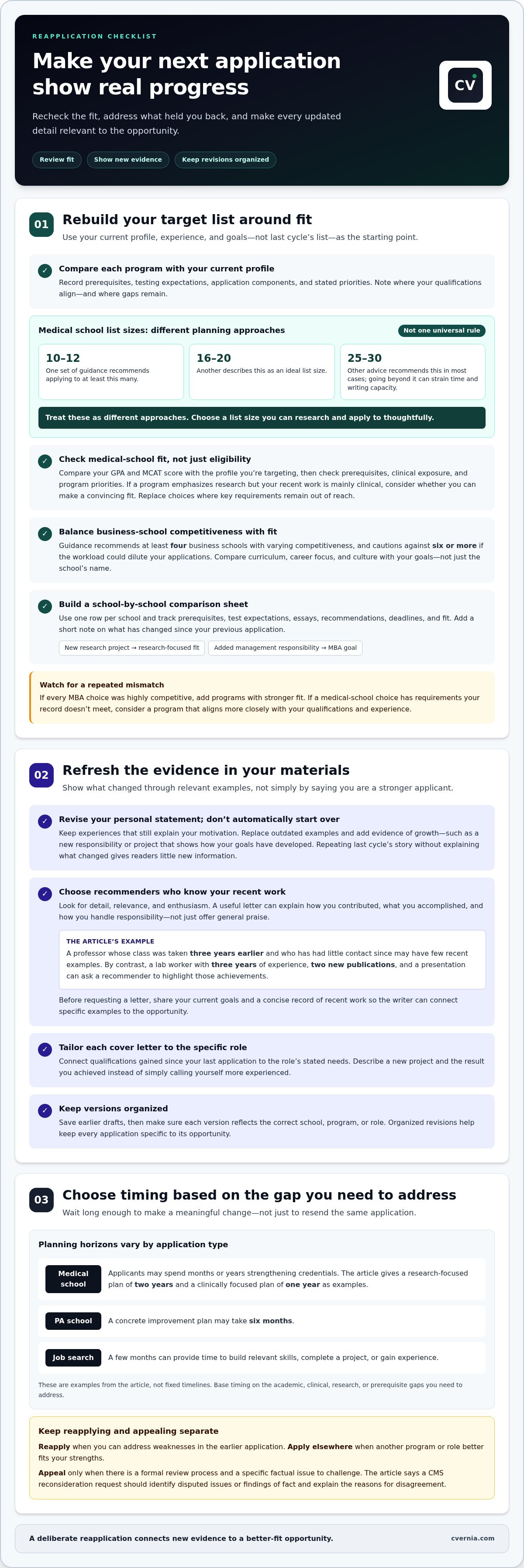
Medical school list recommendations vary. Some guidance recommends applying to at least 10-12 medical schools, while another describes 16-20 as an ideal list size. Other advice recommends 25-30 medical schools in most cases, but applying to more than 25-30 can strain your time and writing capacity. Treat these figures as different planning approaches, not a universal rule. Choose a number you can research and apply to thoughtfully.
Recheck each medical school’s requirements before applying again. Compare your GPA and MCAT score with the profile you’re targeting, then review prerequisites, clinical exposure, and program priorities. For example, if a school emphasizes research and your recent work is mainly clinical, consider whether your experience supports a convincing fit. Remove choices where key requirements remain out of reach and consider programs that better match your strengthened record.
For business school, balance competitiveness with fit. Guidance recommends applying to at least four business schools with varying competitiveness, while cautioning against six or more if the workload could dilute your applications. Compare each program’s curriculum, career focus, and culture with your goals. A well-matched school may make more sense than a famous name that has little connection to your intended direction. Note why each program belongs on your list.
Build a practical comparison sheet before finalizing your choices. Use one row per school and columns for prerequisites, test expectations, essays, recommendations, deadlines, and fit. Add a short note about what has changed since your previous application. For example, a new research project could strengthen your case for a research-focused medical program, while added management responsibility could support a particular MBA goal.
Finally, check whether your previous list was balanced or repeated the same mismatch. If every MBA choice was highly competitive, add programs with stronger fit rather than choosing by brand alone. If your medical list included programs with requirements your record didn’t meet, replace those choices with schools where your experience and qualifications align more closely. This review gives your next cycle a deliberate focus.
2. Should I rewrite my personal statement when reapplying?
Usually, revise your statement rather than starting from a blank page. Keep experiences that still explain your motivation, but replace outdated examples and add evidence of growth since your previous application. For example, a new responsibility or project can show how your goals have developed. A statement that repeats last cycle’s story without explaining what changed gives readers little new reason to consider you.
Reapply when you can address weaknesses in your earlier application; apply elsewhere when another program or role better fits your strengths. Appeal only when there is a formal review process and a specific factual issue to challenge. According to the Centers for Medicare & Medicaid Services (CMS), a reconsideration request should identify disputed issues or findings of fact and explain the reasons for disagreement.
Rules and timing vary by application type. Medical school applicants may spend months or years strengthening their credentials; a research-focused plan may mean applying in two years, while a clinically focused plan may mean applying in one year. PA school applicants can build a concrete improvement plan for six months, while job seekers can use a few months to upgrade their profile.
After a rejection, wait long enough to make a meaningful change, rather than simply resending the same materials. For a job application, a few months can give you time to build relevant skills, complete a project, or gain experience. For school applications, base your timing on the academic, clinical, research, or prerequisite gaps you need to address.
Strengthen recommendation letters by choosing people who know your recent work and can discuss specific accomplishments. A professor whose letter relies on a class taken three years earlier, with little contact since, may have few recent examples to share. A lab worker with three years of experience, two new publications, and a presentation could ask a recommender to highlight those achievements.
Evaluate each letter for detail, relevance, and enthusiasm. A strong recommender can explain how you contributed, what you accomplished, and how you handle responsibility. Before requesting a letter, share your current goals and a concise record of recent work. That context helps the writer connect specific examples to the program or role, rather than relying on general praise.
Tailor each cover letter to the specific opportunity. Identify qualifications gained since your last application, then connect them to the role’s stated needs. For example, describe a new project and the result you achieved, rather than simply calling yourself more experienced. Keep earlier drafts organized so each version reflects the right application; application version management can help you track those revisions.
3. Updating the personal statement
Revise your statement around evidence of change, not a claim that you’ve become a stronger applicant. First, identify the central question your earlier writing answered, such as why you want a medical career or an MBA. Keep your motivation if it remains true, then add a recent experience that shows how your understanding has developed. A student with new clinical responsibilities, for example, can explain what those encounters taught them about patient care.
For an MBA application, use an additional essay to explain what has changed and why you’re now a stronger candidate. Connect each new experience to a skill, goal, or perspective relevant to the program. If you took on a team leadership role, describe the challenge, your decision, and the result. Aim for clear, compelling writing rather than perfection; make your development easy to follow.
Make each school’s writing specific to that program. Don’t reuse an old essay unchanged or submit the same essay to multiple schools. Instead, connect your interests to the school’s culture and goals, using a concrete detail to explain the fit. For instance, if a program emphasizes collaborative projects, describe how a recent team experience prepared you to contribute. Recheck every prompt to ensure your response answers the question asked.
Refresh your resume or profile with relevant achievements gained since your previous application. For job applications, compare your resume with the job description and include accurate keywords that reflect your experience. If the role calls for data analysis and you completed a project using that skill, describe the project and its outcome. Avoid adding keywords unsupported by your work; clear evidence makes the match credible.
Update work and activities descriptions even when you’re keeping the same experience. Medical school activity descriptions are 1,325 characters long, so use the space to clarify your role, contribution, and learning. A volunteer entry might change from listing regular duties to showing how you coordinated a new community event. Keep the details factual, and distinguish continuing responsibilities from new achievements.
Before submitting, compare the new draft with your previous version. Highlight every sentence that reflects a new insight, achievement, or clearer connection to your goals. If a paragraph still describes the same experience in the same way, revise it with a more precise example or remove it. This final pass helps your writing show genuine progress while keeping the experiences that still define your direction.
4. Assessing weaknesses in a previous application
Begin with a side-by-side review of your previous application and the requirements for your target role or program. Check clarity, focus on achievements, and alignment with stated qualifications. Mark each requirement as supported by evidence, partly addressed, or missing. For a job, replace generic claims such as “strong communicator” with a specific example of how you used that skill.
Address gaps directly with accurate updates, not explanations that distract from your qualifications. Add relevant coursework, experience, or achievements gained since applying, and correct missing or unclear details. For medical school, compare your GPA with the median at your target schools; a lower GPA may call for delaying reapplication for a year or more while strengthening your academic record. PA applicants are advised to retake prerequisite courses with grades below B.
Use each application result to identify the next step. An applicant with a 504 MCAT score targeting schools with a median of 512 could aim to raise the score by eight points or more. By contrast, a 510 MCAT score may be improvable without being the main weakness. For business school, a GMAT score substantially below target-school averages calls for significant score gains or other exceptionally strong qualifications.
If you’re unsure why a medical school application fell short, ask admissions representatives at the schools you applied to for feedback on its weak points. Before contacting a decision-maker about a job, review the posting and your previous materials. If an appropriate contact is available, send a concise, specific request for feedback. Avoid asking for reconsideration without identifying a concrete issue.
Reapply when you can show meaningful changes that address the original gaps; appeal when a formal process lets you challenge a specific factual finding. According to the Centers for Medicare & Medicaid Services (CMS), a reconsideration request should identify disputed issues or findings of fact and explain the reasons for disagreement. That approach differs from submitting a stronger new application.
To write a stronger application after rejection, connect each qualification to a stated requirement and support it with a clear example. The U.S. Census Bureau advises that an application should show how skills and experience meet the job’s qualifications and requirements. For instance, describe a project, your contribution, and its result instead of listing responsibilities alone.
Interview outcomes can also point to a weakness. Receiving three or more medical school interviews without an acceptance is a strong sign to work on interview skills. Review the questions that challenged you, identify where your answers lacked detail, and practice explaining your decisions with specific examples. Turn the previous cycle into a focused improvement plan.
5. Discussing growth in a reapplicant interview
A reapplicant interview tests more than your commitment. Admissions teams want a clear account of what changed after you were rejected and why that growth matters now. Prepare a focused answer that names the earlier gap, describes the action you took, and explains what you learned. For example, if your previous interview answers lacked detail, show how you now connect decisions to specific experiences.
Keep your explanation accountable and forward-looking. Avoid blaming admissions, disputing a decision without evidence, or repeating your personal statement word for word. Instead, explain what you understand differently and support it with a real example. If you received feedback about limited clinical exposure, describe the steps you took to gain relevant experience and how those encounters clarified your goals.
Use concrete details to make progress easy to assess. One applicant reported 25 hours of shadowing with two surgeons, 125 hours of clinical volunteering, and 1,500 hours of cybersecurity research over three years. They also reported two first-author publications and one first-author poster. Those experiences can support a focused story about clinical insight, research discipline, and how the applicant’s interests connect.
Choose examples that answer the question being asked. For “What has changed since your last application?” describe an experience and its impact, not just a list of new activities. For “Why should we reconsider you?” connect your development to the program’s priorities. A research-focused applicant might explain how a publication sharpened a research question, while clinical volunteering deepened their understanding of patient care.
Practice aloud, then review whether each answer has a clear beginning, evidence, and takeaway. Ask a trusted listener to flag answers that sound generic, defensive, or disconnected from your application. Keep your dates, hours, responsibilities, and achievements consistent across your interview and submitted materials. A clear timeline helps you discuss growth without confusion.
Prepare for direct questions about rejection, too. A concise answer can acknowledge disappointment, identify what you learned, and describe a specific change. Don’t claim that one new activity guarantees success; explain how it addresses a meaningful gap. If you had three or more medical school interviews without an acceptance, give interview practice particular attention alongside your other application changes.
Organize practice questions and feedback so you can refine answers between sessions. Use interview preparation and guidance to structure your practice, capture useful notes, and present your growth with clarity and confidence.
CVernia: Career Application Management Platform
CVernia helps you organize the next application cycle in one Career Application Management Platform. Use the Application Tracking Dashboard to record application status, deadlines, and follow-ups, then compare versions as you tailor materials for different opportunities. CV Compatibility & ATS Analysis can help you review how your CV aligns with a job description. For reapplicant interviews, Interview Preparation & Guidance gives you a place to refine how you explain your progress and experience.
Turn to CVernia when you’re ready to move from reviewing past applications to managing a more focused next round. Keep your documents and application steps organized as you put your revisions into practice. Visit CVernia to explore the platform.
Make Your Next Application a Deliberate Step Forward
Your next application can show more than renewed interest. Let it reflect the decisions you’ve made since your last attempt: what you learned, what you strengthened, and how your current goals fit the opportunity. Improving your application before reapplying means turning that progress into clear, relevant evidence.
Before you submit, read your materials from the decision-maker’s perspective. Can they see the connection between your experience and the role or program? Does each example support the story you want to tell? A focused final review can help you catch gaps and make your progress easier to understand.
When you’re ready to put your revisions into practice, CVernia’s Career Application Management Platform can support your application workflow. Tailored CV and cover letter creation and CV Compatibility & ATS Analysis can help you prepare materials aligned with your target opportunity. Contact CVernia for application support and take your next step with greater clarity and confidence.
Frequently Asked Questions
Ever wondered if reapplying for a job can actually increase your chances of getting hired?
Yes, a reapplication can strengthen your candidacy when it gives the hiring team clearer evidence of fit. For example, if a role asks for client communication and your new experience includes presenting project updates, show that directly in your resume. The benefit comes from addressing the employer’s needs with relevant proof, not from submitting another application alone. Keep your explanation focused on what you can contribute now.
Is Being a Reapplicant Bad?
No, being a reapplicant isn’t inherently a disadvantage. Employers may see a thoughtful return as continued interest, especially if your qualifications or understanding of the role have developed. For instance, a candidate who previously lacked a required software skill can now point to a completed project using that tool. Don’t frame your return as a request for another chance; present it as a fresh, evidence-based match.
Should I rewrite my personal statement when reapplying?
Usually, revise the statement to reflect what has changed rather than replacing every paragraph. Keep details that still explain your motivation, but add a new example that demonstrates a clearer perspective or stronger preparation. For instance, explain how a recent responsibility changed your understanding of the field. Before submitting, check that the opening answers the prompt and each example supports the same central message.
How can you find out why your application was denied?
Start with the rejection message, interview notes, and any feedback the organization provided. Separate confirmed reasons from your assumptions; a short response may reflect timing or role fit rather than one specific weakness. If an appropriate contact is available, send a brief, courteous request asking which qualifications you could strengthen. Record the response in your application notes so it informs your next decision.
What steps should you take to strengthen your application before reapplying?
A practical approach to improving your application before reapplying starts with choosing one gap to address first. Compare the posting with your evidence, then decide whether you need a new example, clearer wording, or additional preparation. For example, if the role requires presenting findings, prepare a concise account of a project where you explained results. Review the revised materials for consistency before sending them.
Does reapplying affect your chances or create any risks?
Reapplying can work against you if you submit unchanged materials, overlook eligibility instructions, or apply before you can show relevant progress. Read the organization’s reapplication guidance and note any restrictions or requested updates. Then make sure your new application reflects the correct role, current details, and a genuine reason for returning. A careful review helps prevent avoidable errors from distracting from your qualifications.
What documents or evidence should you update before reapplying?
Refresh the documents that reflect your current qualifications: resume, cover letter, portfolio, references, and any requested records. Replace outdated contact details, add relevant completed work, and confirm that dates and titles match across documents. For a design role, include a recent project with a short explanation of your contribution. Keep a clean master version, then tailor copies to each opportunity so details don’t carry over incorrectly.


