

A rejection isn’t always a closed door, but sending the same application again rarely gives an employer a reason to reconsider. If you’re wondering how to reapply for a job you were rejected for, focus on what’s changed since your last application and how that change matches the role.
It’s understandable to worry that applying again could seem unprofessional, especially when the employer offered little or no feedback. But a previous rejection doesn’t automatically rule you out. The key is to make your next application a stronger, more relevant case, not simply a repeat.
This guide will help you decide whether reapplying makes sense, when to try again, and what to update in your CV, cover letter, and approach. You’ll learn how to identify new skills or experience that address the role’s requirements, use what you learned about the company, and keep your application truthful and focused. You’ll also see how organizing previous documents and notes can help you compare versions and make a deliberate improvement. Reapply with a clear reason, evidence of growth, and a plan for what to do differently.
How to reapply for a job you were rejected for
Start by comparing the current opening with your previous application. Reapply when you can follow the employer’s instructions and show a relevant change, such as clearer evidence of a required skill, new experience, or a meaningfully different role. If nothing has changed, consider targeting another opportunity instead.
Key Takeaways
- Decide whether to try again by weighing your fit for the role against what’s changed since your last application.
- For how to reapply for a job you were rejected for, separate confirmed feedback from gaps you’ve spotted and assumptions you can’t verify.
- Compare reapplying with pursuing another role or focusing on different employers before committing to your next step.
- Strengthen your application with role-specific examples that show your genuine skills and experience.
- Keep past versions, notes, attachments, and follow-up activity organized to make your next application more intentional.
Can you reapply for a job after rejection? Start with the reason
Being rejected can sting, especially when you invested time in the application or reached an interview and received little explanation. But the decision alone doesn’t tell you whether applying again would be appropriate. The answer depends on the employer’s instructions, the specific role, how far you progressed, and what has changed in your experience or application since then.
Reapplying should mean submitting a fresh, relevant case for a particular opening, not resending the same CV and cover letter without considering what the employer communicated. Hiring can involve several stages of application review and candidate assessment, as outlined in the Job Interview Process. A rejection at one stage is an outcome, not a complete explanation of your ability or future prospects.
What a rejection does and does not tell you
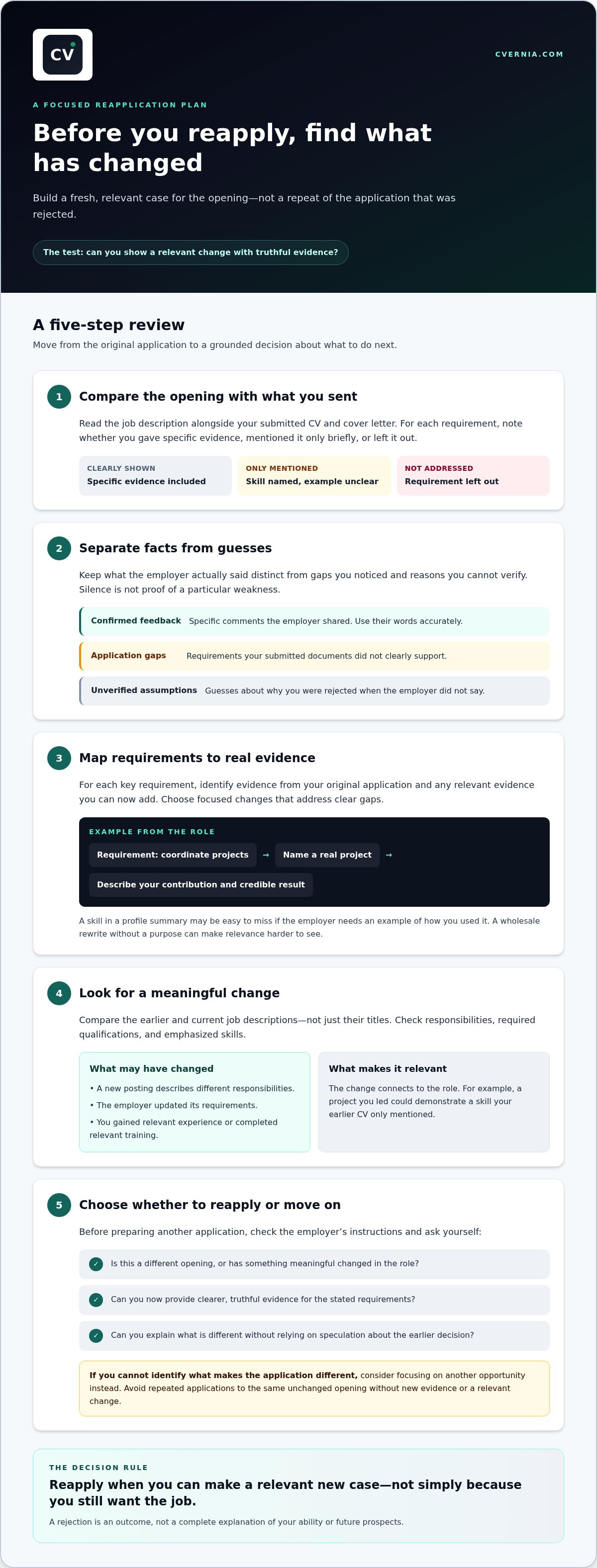
Separate facts from guesses. You know the employer chose not to move forward with your application for that opening. Unless they shared a reason, you don’t know whether the decision came down to experience, a particular skill, timing, a change in hiring needs, or another factor. Don’t turn an unknown into a verdict about your potential.
If you received feedback, treat it as useful evidence, not a full diagnosis. A note that your examples lacked detail can point to a clear revision; a brief form rejection may offer no insight into the decision. Record what you were told separately from what you noticed in your own materials and what you’re only assuming. That distinction keeps your next steps grounded.
When another application may be worth considering
Look for a real reason to revisit the opportunity. A new posting may describe different responsibilities, the employer may have updated its requirements, or you may have gained relevant experience since you applied. Perhaps you led a project that demonstrates a skill the previous CV only mentioned, or completed training that directly supports a stated requirement. The change should connect to the role, not just make your application look newer.
Before applying, ask yourself:
- Is this a different opening, or has something meaningful changed in the role?
- Can I now provide clearer, truthful evidence for its stated requirements?
- Did the employer give instructions about repeat applications or timing?
- Can I explain what’s different without relying on speculation about the earlier decision?
Follow any instructions the employer provided, and avoid submitting repeated applications to the same unchanged opening without new evidence or a relevant change. If you can’t identify what makes this application different, it may be better to focus on another role for now.
Reapply when you can make a relevant new case, not simply because you still want the job. That principle won’t predict an employer’s decision, but it gives you a practical test for deciding whether your next application is thoughtful, focused, and worth preparing.
Work out what changed before you apply to the same employer again
Before starting a new application, compare the role you applied for with the materials you submitted. Read the job description alongside your CV and cover letter. For each requirement, ask: did I provide specific evidence, mention it only briefly, or leave it out? A skill listed in a profile summary may be easy to miss if the employer needs an example of how you used it.
Keep your review grounded by sorting what you find into three groups:
- Confirmed feedback: Specific comments the employer actually shared.
- Application gaps: Requirements that your submitted documents didn’t clearly support.
- Unverified assumptions: Guesses about why you were rejected, such as assuming your experience level was the issue when the employer didn’t say so.
This separation matters. Silence isn’t proof of a particular weakness, and feedback may address one part of your application without explaining the whole decision. For a practical approach to how to reapply for a job you were rejected for, use what you know to guide a focused review, not to invent a reason for the outcome.
Turn rejection feedback into a focused review
Use the employer’s words accurately. If they said your examples needed more detail, look for places where your documents describe a responsibility but don’t show what you did. If they didn’t provide feedback, don’t translate a general rejection message into a specific criticism.
Next, map the posting’s key requirements to evidence in your original application and any relevant evidence you can now add. For example, if the role asks for experience coordinating projects, identify a real project, your contribution, and the result you can credibly describe. Select a few changes that address clear gaps. A wholesale rewrite without a purpose can make it harder to see whether the new version is actually more relevant.
Check whether the new opening is truly a match
Compare the earlier and current job descriptions, not just their titles. Look for changes in day-to-day responsibilities, required qualifications, and the skills emphasized. A new title can describe nearly the same work, while a familiar title may come with substantially different expectations.
Then test your fit against the current posting. For each essential requirement, identify a truthful example from your work, education, or relevant projects. Mark requirements you can’t yet support, and consider whether the role remains a realistic match. Also note changes in your circumstances, such as a newly completed project or added responsibility, only when they strengthen your case for the stated work.
A meaningful application change adds relevant evidence, not just cosmetic edits. Keep your original documents and notes alongside the revised version so you can see exactly what changed and why. CVernia’s application and version management tools can help organize those materials as you prepare a thoughtful reapplication.
Reapply or move on? Compare the opportunity with your readiness
Reapplying after rejection isn’t automatically unprofessional. What matters is whether you’re responding to a suitable opening and following the employer’s instructions. Repeatedly sending unchanged applications, however, may not give the employer a meaningful new reason to consider your fit.
Use this comparison to choose a practical next step. Judge the specific role and the evidence you can present, not just how much you want to work for the company.
| Option | Role fit | Evidence and changes | Employer instructions |
|---|---|---|---|
| Apply again | The opening suits your skills, or its responsibilities differ in a relevant way. | You can show specific, truthful evidence that strengthens your case since the previous application. | You can follow the stated process and any guidance about repeat applications. |
| Pursue another role | A different position at the same employer is a closer match. | Your current experience supports that role more clearly than the one you applied for before. | You meet the instructions for the new opening. |
| Focus on other employers | The role remains a poor match, or the employer has closed the door on another application. | You don’t yet have relevant evidence to address the role’s needs. | The employer says not to reapply or gives instructions that rule out another submission. |
Signs that a new application has a stronger case
Consider applying again when the opening has changed in ways that matter to your experience, or when you can now demonstrate a relevant skill through a real project, responsibility, or qualification. For instance, if a current role emphasizes client reporting and you’ve since taken on that work, describe your contribution accurately and connect it to the listed responsibility.
A stronger case also depends on process. Read the employer’s instructions and follow them, including any guidance on whether or when to submit another application. There’s no universal waiting period that fits every employer and role. A fixed wait by itself doesn’t make an application stronger; a materially different opening or relevant new evidence may make an earlier application reasonable. Treat the circumstances of the role and the employer’s instructions as your guide.
When to redirect effort to another opportunity
Move on for now if the role still calls for experience you can’t demonstrate and nothing relevant has changed. Do the same if the employer explicitly asks you not to reapply. Respecting that direction is more professional than trying to work around it.
Redirecting effort doesn’t mean abandoning your career goal. A better-fitting position at the same organization, a role at another employer, or a focused skill-development step may give you a clearer path forward. For deciding how to reapply for a job you were rejected for, choose the option where your current qualifications, evidence, and the employer’s instructions line up. No option guarantees a hiring result, but a deliberate choice helps you invest your effort where you can make the most relevant case.
How to reapply after rejection: prepare a stronger, relevant application
Build your next submission around the current opening, not just the fact that you’ve applied before. This workflow helps you turn your review into an application that clearly connects your genuine experience to the employer’s stated needs.
- Confirm the instructions. Check the current posting and any message from the employer for reapplication guidance, required documents, and submission steps. Follow the stated process rather than sending extra materials through another channel.
- Reassess your fit. Identify the role’s essential requirements and the strongest truthful examples from your work, education, or projects that support them. If you can’t show evidence for a key requirement, don’t imply that you have it.
- Update your evidence. Add relevant experience or responsibilities gained since your previous application. Make your contribution clear. For example, describe the reporting task you handled and the audience it served, rather than simply adding “reporting” to a skills list.
- Tailor your documents. Prioritize the examples that match this role. Adjust wording for relevance, but keep every claim accurate and consistent across your CV and cover letter.
- Track the application. Save the final versions, record the date and role, and note any feedback or follow-up activity. This creates a clear reference if you consider another opening later.
Update your CV and cover letter with relevant evidence
For each important requirement, ask whether your CV shows a specific example or only names a skill. If the role calls for coordinating work across teams, describe a real situation, your responsibility, and the outcome you can substantiate. Keep the details concise and relevant; don’t add achievements simply to make the document look more impressive.
Use your cover letter to explain why your background fits this particular opening. Keep the focus on the employer’s needs and what you can contribute. You don’t need to dwell on the previous rejection or suggest that the employer owes you another opportunity. For help shaping a focused message, use this tailored cover letter guide.
Keep the new application organized and reviewable
Save the revised CV and letter as a distinct version, then add a short note explaining what changed and why. Record the role, current application stage, feedback you received, and any follow-up you make. Comparing versions helps you check that edits improved relevance instead of introducing inconsistencies.
An ATS compatibility review can help you spot formatting or content issues and assess how clearly your documents reflect the role’s language. It can’t ensure selection or reveal every employer’s screening rules. Use it as one review tool, alongside careful proofreading and a direct comparison with the posting. This ATS resume checker guide explains what to consider.
If the employer’s process permits a follow-up, keep your message brief, courteous, and relevant. Thank them, refer to the application, and share a concise update if you have genuinely new information. Otherwise, respect the stated process. Organize your application versions and follow-up notes with CVernia as you prepare your next submission.
Use CVernia to manage a thoughtful reapplication from one place
Once you’ve decided that a new application makes sense, keep the decision, documents, and next steps connected. CVernia is a career management platform that helps you organize applications, tailor materials, and manage reapplications. Instead of relying on scattered files and notes, you can keep a clear record of what you submitted and how your approach changed.
This is especially useful when you apply to more than one role at the same employer. A record of the opening, your application stage, and the version you sent can help you distinguish a genuine new opportunity from a repeat submission. It also gives you a place to capture feedback and follow-up activity, so the context doesn’t get lost between applications.
Keep previous and updated application materials together
Compare your earlier application with the revised, role-specific version. CVernia’s reapplication support and version management help you organize previous application versions and make improvements with a clear purpose. Keep the relevant job details, notes, and attachments with the application record, so you can refer back to the requirements and the evidence you chose to highlight.
Use each revision to make your fit easier to understand. For example, you might move a relevant project higher in your CV or clarify your contribution to a task that matches the posting. Keep every detail accurate. Tailored CV and cover-letter content should reflect your actual experience, qualifications, and skills, not what you think an employer wants to see.
Track the next step without losing context
Update the application as it moves through its stages, including marking an outcome as rejected when applicable. CVernia’s application tracker includes a Rejected stage and tracks follow-up activity separately. That makes it easier to review the history of an application without confusing a follow-up message with a new submission.
Before following up, check the employer’s instructions and decide whether a message is appropriate. If it is, note when you contacted them and keep the wording professional and concise. Your notes can also preserve useful context, such as a response you received or a date you may need to refer to later. The tracker supports organization; it can’t determine an employer’s decision or guarantee a hiring outcome.
If you’re weighing how to reapply for a job you were rejected for, use your application history to check what’s genuinely different and keep your next materials aligned with the role. CVernia’s CV compatibility and ATS analysis can help you review relevance and compatibility, but it can’t reveal every employer’s screening criteria or ensure selection.
Organize your next application with CVernia and keep your documents, notes, and application progress together as you prepare your next step.
Make your next application a deliberate step forward
A previous rejection can be part of your career story without defining what comes next. Give yourself permission to choose the opportunity that fits your current experience, whether that means applying again, targeting a different role, or building evidence for a future opening.
If you’re still deciding how to reapply for a job you were rejected for, set one clear intention before you begin: make the next application reflect what you can genuinely offer now. A thoughtful process won’t control an employer’s decision, but it can help you move forward with greater clarity and confidence.
Keep your plan and application materials organized as you take that next step. Organize your next application with CVernia and make room to focus on the opportunity ahead. Your next move can start with a practical choice, and you’re ready to make it.
Frequently Asked Questions
Is there a standard amount of time to wait before reapplying?
No, there isn’t one waiting period that suits every employer or role. Start by checking the employer’s instructions and whether the opening is new, still active, or materially different from the one you applied for. Then consider what has changed in your qualifications or evidence. If the role and your application are essentially unchanged, waiting a certain number of days by itself may not give the employer a stronger reason to reconsider.
Can I apply for a different job at the same company after being rejected?
Yes, you can apply for another role if it genuinely fits your background and you meet its stated requirements. Treat it as a separate application: for example, a previous application for a customer support position doesn’t automatically disqualify you from a suitable operations role. Adapt your CV and cover letter to the new responsibilities, and use the application process provided for that opening rather than resubmitting old materials unchanged.
Should I mention my previous rejection in a new application?
Usually, no. Keep the focus on why you’re suited to the current opening, not on persuading the employer to revisit an earlier decision. If the application asks whether you’ve applied before, answer honestly and briefly. If a hiring team member brings up your previous application in conversation, acknowledge it professionally and explain any relevant change, such as new responsibilities or a completed project, without criticizing the earlier decision.
Can I reapply if I never received feedback on my rejection?
Yes. No feedback doesn’t, by itself, mean you’re barred from applying again. As you consider how to reapply for a job you were rejected for, avoid treating silence as proof that a specific part of your application was weak. Instead, check whether your documents clearly address the role’s requirements. For instance, if a posting asks for scheduling experience, make sure your relevant duties are easy to identify if you’ve performed them.
Should I use the same CV when reapplying?
Use your existing CV as a starting point, not as an automatic repeat. Compare it with the current posting and update relevant details, such as a newly completed project or a clearer description of a responsibility. Keep a copy of the version you sent before so you can review your edits. Check dates, job titles, and claims for consistency, and never add a skill or qualification you don’t have.
Does a previous rejection mean an applicant tracking system will reject me automatically?
Not necessarily. A prior rejection doesn’t reveal how a particular employer’s system handles later applications; screening settings and hiring processes vary. A compatibility score can help you review how clearly your CV reflects the job description, but it can’t show every internal rule or predict the employer’s decision. Submit through the current posting’s instructions, use accurate information, and save a copy of the materials you send for your records.


