

What if a low ATS score is an editing signal, not a verdict on your chances? It’s understandable to worry that a weak result means your CV will be rejected. But CV Compatibility & ATS Analysis compares your CV with a specific job description. It can help you spot areas to review, not predict whether you’ll get an interview.
Use the feedback to focus your application. You’ll learn how to interpret compatibility results, decide which job-description terms accurately reflect your experience, and turn useful feedback into clear, truthful edits. A closer match can make your relevant skills and achievements easier to see, without adding claims that don’t belong.
We’ll also explain what a score can’t promise and how to compare your CV with a role before applying. CVernia’s job-specific analysis and CV tailoring tools help you make thoughtful improvements and manage each application with greater clarity.
Key Takeaways
- Compare your CV with a specific job description to identify where your experience aligns and where it may need clearer evidence.
- CV Compatibility & ATS Analysis can highlight useful areas to review, but its score isn’t a universal hiring standard or an interview prediction.
- Prioritize relevant requirements, find truthful examples from your background, and refine your wording to make the connection clearer.
- Consider document readability and the relevance of your experience as separate parts of preparing your application.
- Use job-specific feedback to tailor your CV thoughtfully, while keeping every skill and achievement accurate.
What CV Compatibility & ATS Analysis Checks in Your Application
A CV can be clear and professional yet still make it hard to see why you fit a particular vacancy. CV Compatibility & ATS Analysis compares your CV with the requirements and language of a specific role. It can help you see whether relevant experience is easy to find and understand.
CV compatibility feedback is guidance on how your CV aligns with a particular job description, not a hiring decision or prediction of your chances. A result can point to material worth reviewing, but it can’t determine how an employer will assess your application.
How CV compatibility differs from a general CV review
A general CV review looks at broad qualities such as organization, clarity, and presentation. A compatibility check asks a narrower question: does this document make the evidence relevant to this role clear? These checks are related, but not interchangeable. A readable CV may still give little space to the experience a vacancy emphasizes. A strong match in experience may also be buried in a confusing layout.
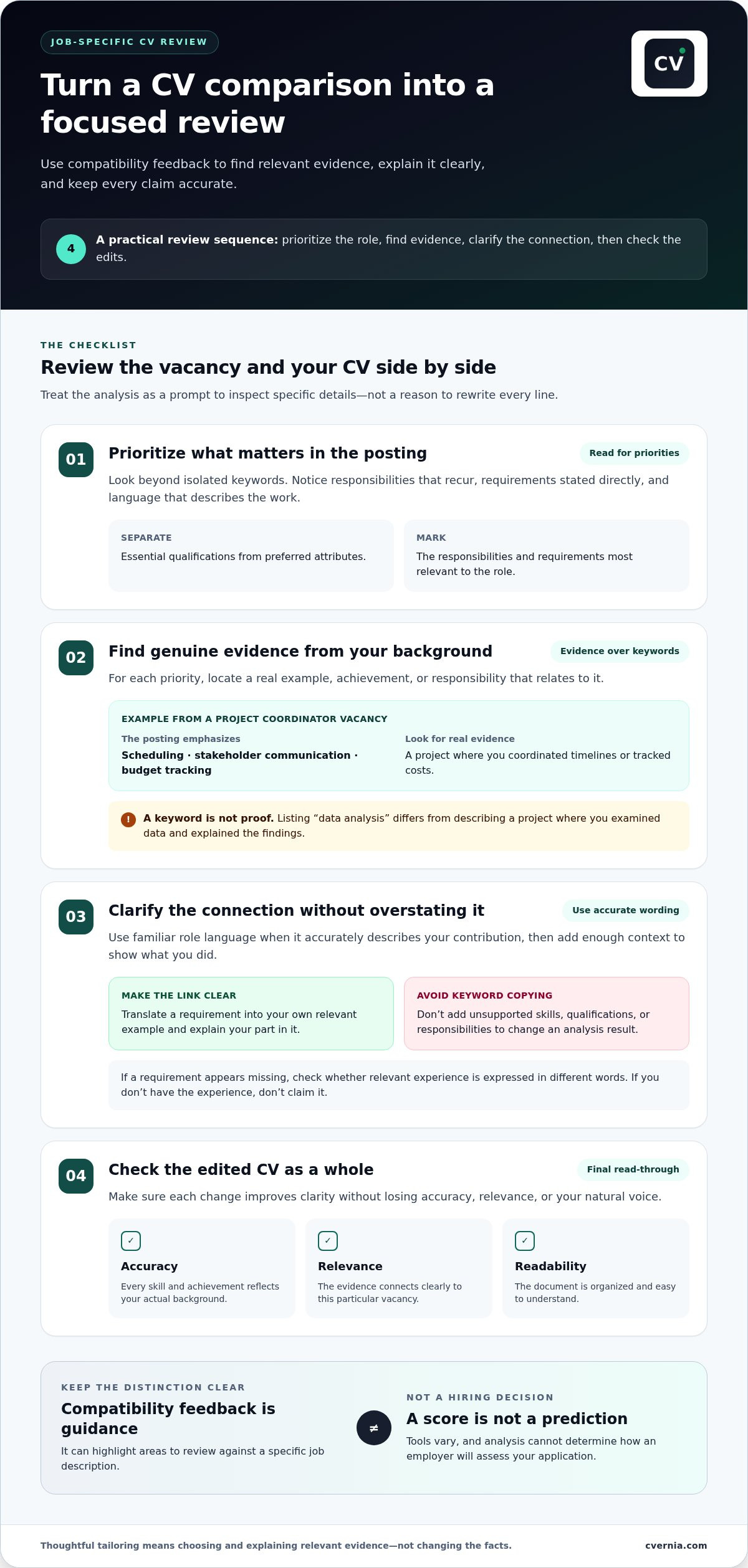
For example, a project coordinator vacancy may emphasize scheduling, stakeholder communication, and budget tracking. A general review might recommend clearer headings, while a job-specific comparison may prompt you to bring forward a real project where you coordinated timelines or tracked costs. It shouldn’t encourage you to claim a skill you don’t have.
Each vacancy has its own priorities. One CV version might foreground client communication, while another highlights reporting or team coordination, provided each accurately represents your background. Tailoring means choosing and explaining relevant evidence, not changing the facts.
Where ATS analysis fits in the application process
Use analysis during preparation, while you still have time to clarify your experience and adjust your CV for the role. An Applicant Tracking System (ATS) is software employers may use to manage applications. Its role and features can differ between organizations. Analysis tools offer another way to compare your document with a vacancy before submission, but they don’t know every employer’s process or replace a hiring team’s judgment.
A compatibility result should guide your next review, not decide whether you apply. If a requirement appears missing, check whether you have relevant evidence expressed in different words. If you don’t, don’t add it as a claim. If the experience is present but hard to spot, make its context and your contribution clearer.
For a broader explanation of the technology and its place in recruitment, see the guide How Applicant Tracking Systems Work: A 2026 Guide to CV Compatibility. Analysis can help you prepare a more relevant application, while employers and hiring teams make their own selection decisions.
How CV ATS Analysis Compares Your CV With a Job Description
A job-specific comparison looks for connections between what a vacancy asks for and what your CV shows. Depending on the analysis tool, this may include relevant skills, terminology used for the role, and evidence of experience. Criteria and scoring vary by tool, so treat feedback as a prompt to review your application, not as a universal checklist. CVernia measures CV compatibility against job descriptions, helping you examine how your CV relates to a particular opportunity.
A keyword shows that a term appears in your CV; evidence shows how you’ve used the related capability. For instance, listing “data analysis” is different from describing a project where you examined data and explained the findings. Context gives a reader a clearer picture of your experience.
Which details in a job description deserve attention?
Read the posting for more than isolated keywords. Look for responsibilities that recur, requirements stated directly, and terminology that describes the work itself. If the employer separates essential qualifications from preferred attributes, keep that distinction in view. A desirable extra shouldn’t outweigh a core requirement you can demonstrate.
For each priority, ask what genuine evidence you have. A posting that asks for “cross-functional collaboration” may connect to a project where you coordinated with colleagues in different departments. Use the employer’s wording when it accurately describes your contribution, then add enough context to show what you did.
Why matching language isn’t the same as copying keywords
It’s useful to use familiar role language when it fits, but copying whole phrases can make a CV awkward or misleading. Translate each requirement into your own evidence. If a role asks for “customer relationship management,” for example, you might describe how you maintained client records and followed up on requests, if that reflects your actual work.
Don’t insert a skill, qualification, or responsibility you can’t support just to change an analysis result. If a term seems relevant but unfamiliar, consider its meaning in the job description. A clear, truthful description of adjacent experience is stronger than claiming a capability you haven’t developed.
Turn the comparison into a focused review
Use feedback to decide what to inspect, not to rewrite every line. Review the vacancy and your CV side by side:
- Prioritize: Mark the responsibilities and essential requirements that matter most.
- Find evidence: Locate a real example, achievement, or responsibility that relates to each one.
- Clarify: Refine the wording so the connection is easy to understand without overstating your role.
- Check: Read the edited CV for accuracy, relevance, and a natural voice.
This approach keeps the analysis grounded in your experience. For another perspective on evaluating these tools, the ATS Resume Checker Guide 2026: Choosing the Right Tool to Beat the Bot explores what to consider. To compare your CV with a specific vacancy, use CVernia’s CV compatibility analysis as one step in preparing your application.
What an ATS Compatibility Score Can, and Cannot, Tell You
A score can make a comparison feel simple: one number, one verdict. But an ATS compatibility score is an indicator produced by a particular tool, not a universal hiring standard. It may summarize signals the tool evaluates, such as how closely your CV relates to a vacancy or how clearly its content is presented. It can’t show exactly how an employer’s system will process your application or how a hiring team will judge it.
Think of the result as a review prompt. CV Compatibility & ATS Analysis can help you decide what to inspect, but the number alone can’t establish whether you meet an employer’s needs. Different tools may assess or weigh information differently, so don’t treat a score from one checker as directly comparable with a score from another.
Why a high score cannot guarantee an interview
A strong result doesn’t account for every factor in a hiring decision. Employers set their own criteria, and the applicant pool, the needs of the team, and a recruiter’s assessment can all affect who advances. A compatibility tool can’t confirm whether your experience is the right fit in practice or predict how an employer will interpret it.
No score threshold should be treated as a universal pass mark. A high number isn’t a promise of selection, and a lower one doesn’t by itself prove an employer will reject your application. The hiring team makes that decision.
How to use a low or changing result constructively
Look past the number and review the feedback behind it. If a revision changes the result, check what changed and whether the edit made your experience more relevant, accurate, or readable. A higher score isn’t useful if it came from adding unsupported claims or awkwardly repeating terms.
Use this quick review before deciding what to keep:
- Check the suggestion: Does it point to a real gap, unclear wording, or a presentation issue?
- Verify your evidence: Can you support the skill or requirement with your actual experience?
- Review the edit: Does the revised wording make your contribution clearer to a person?
- Recheck the vacancy: Does the CV still address the role’s requirements without exaggerating your fit?
If feedback recommends adding a term, include it only when it accurately describes your background. A lower result can still be useful if it reveals an area to clarify; a higher result deserves the same careful review.
For a closer explanation of interpreting results, consult Understanding Your ATS Score: What the Numbers Mean. Keep the number in perspective: use it to guide a thoughtful review, then base your application decisions on the role and the experience you can genuinely demonstrate.
How to Improve CV Compatibility Without Misrepresenting Your Experience
Use analysis feedback to make relevant experience easier to recognize, not to reshape your background into someone else’s. Start with the vacancy, connect its requirements to evidence you can support, then check that every change remains accurate and readable. CV Compatibility & ATS Analysis can highlight what to review, but you decide which edits truthfully represent your work.
Every claim on your CV should be supported by real experience you can explain. Keep that rule in view as you tailor each application.
Follow this sequence:
- Identify priorities: Note the vacancy’s central responsibilities and essential requirements.
- Locate evidence: Find a real task, project, or achievement that demonstrates a relevant skill.
- Revise the wording: Use concise, familiar terms where they accurately describe your experience.
- Review for accuracy: Confirm that the final CV is clear, consistent, and fully truthful.
Turn relevant experience into clearer evidence
Choose examples that show how you used a skill, rather than listing qualities without context. If a role asks for organization and you have experience coordinating schedules, describe the responsibility and its purpose. If you supported a team but didn’t manage it, say “supported” rather than implying you led it. Transferable experience is valuable when you explain the connection clearly and don’t overstate its scope.
Where possible, describe an outcome you can substantiate, such as completing a project by an agreed deadline or resolving a customer issue. Use numbers only when you know they’re accurate and can explain their basis. Don’t invent metrics, software tools, responsibilities, or achievements to make a bullet sound stronger. Simple wording is often more credible and easier to verify.
Review the tailored CV before submitting
Read the updated document as both a recruiter and the person who will be asked about it. Check dates, job titles, qualifications, and skill levels against your records. Then look for unclear phrasing, inconsistent formatting, or repeated terms that make the CV sound forced. Each bullet should communicate a real contribution in language that feels natural to you.
For a broader step-by-step approach to creating a CV, the guide How to Build an ATS-Friendly Resume from Scratch covers document preparation. Before submitting, compare your tailored version with the vacancy once more. Does it foreground relevant evidence without changing the facts? Keep a separate version for each role where useful, and make sure each remains an accurate record of your experience.
Put these principles into practice by comparing your CV with a specific job description using CVernia’s CV compatibility and ATS analysis, then review the feedback before making edits.
Use CVernia ATS Analysis to Prepare a More Relevant Application
Turn job-specific feedback into a focused final review. CVernia’s CV compatibility and ATS analysis compares your CV with a job description, helping you assess how clearly your experience relates to that opportunity. Use the results to decide what deserves attention, then make only changes that improve relevance and accuracy.
Analysis works best alongside thoughtful tailoring. If a posting highlights reporting, for example, bring forward a genuine reporting task or achievement when you have one. Don’t add a tool, qualification, or level of expertise you can’t support. The goal is to present your real background clearly, not to reshape it to fit a score or imply that a result guarantees an interview.
Make role-specific feedback part of an organized job search
Keep track of which CV version relates to each opportunity. This makes it easier to review the right material when you revisit a vacancy and reduces the risk of sending a version tailored for a different role. A brief record of the opportunity and your application status can also help you stay oriented as you apply to multiple positions.
CVernia brings analysis into a broader application workflow, with an application tracking dashboard and CV version management to support organization across opportunities. These tools help keep application activity and role-specific materials in view, while you remain responsible for checking that each CV accurately reflects your experience. For more ideas on keeping applications organized, the job search management system guide offers a wider view of job search management.
Take the next step with a truthful, tailored CV
Start with one target job description and your current CV. Compare the requirements with your evidence, review the analysis feedback, and choose edits that make relevant experience easier to understand. Before submitting, check that your wording, dates, titles, qualifications, and skills remain accurate. A clear, role-focused application presents your fit more credibly than keyword additions that don’t reflect your background.
CV Compatibility & ATS Analysis supports preparation; it can’t promise that an employer will select you or invite you to interview. Hiring decisions depend on the employer and its assessment of applicants. Treat the analysis as one practical input, alongside your own judgment about whether the role suits your experience and goals.
Ready to compare your CV with a specific vacancy? Explore CVernia’s CV compatibility and ATS analysis and use the feedback to prepare a relevant, truthful application.
Make Your Next Application More Intentional
Choose one vacancy that genuinely interests you and use it as an opportunity to make your experience easier to understand. Compare your CV with the role using CV Compatibility & ATS Analysis, then decide which feedback deserves action. Keep edits that improve clarity and relevance; leave out anything that would overstate your skills or experience.
That focused review can become part of a steadier application routine. CVernia brings job-description comparison together with tools for tailoring CVs and tracking applications, helping you keep role-specific preparation organized. The analysis is a planning aid, not a promise of selection or an interview. Your judgment and an accurate account of your background remain essential.
Take the next step with the role in mind: Explore CVernia’s CV compatibility and ATS analysis and prepare an application that reflects your experience with confidence. You can move forward thoughtfully, one well-matched application at a time.
Frequently Asked Questions
Can I use ATS analysis before applying to every job?
You can, but role-specific analysis is most useful when you have the job description, since requirements differ between vacancies. Prioritize roles where you can point to relevant experience, then tailor your CV honestly. Using CV Compatibility & ATS Analysis can help you organize preparation and keep each application focused. Treat the feedback as a review aid, though; it can’t predict an employer’s decision or guarantee an interview.
Is CV compatibility analysis useful when I am changing careers?
Yes, it can help you spot transferable experience and language that relates to a new field. For example, coordinating volunteers may demonstrate scheduling or communication skills relevant to an operations role, if those reflect what you actually did. Explain the connection using genuine responsibilities and achievements rather than claiming direct industry experience you don’t have. A compatibility result can’t replace a clear explanation of your career change or establish whether an employer will consider you.
What should I do if an ATS analysis flags a skill I do not have?
Don’t add the skill unless you genuinely possess it. First, consider whether you have related experience that’s relevant and can be described accurately. For instance, using one project-planning tool may demonstrate transferable organization skills, but it doesn’t mean you’re proficient in a different tool. Treat a flagged skill as information about the vacancy’s requirements, not an instruction to claim a qualification or ability you lack.
Can a CV compatibility checker work without a job description?
A general CV review may examine document qualities, but job-specific compatibility needs a role or its requirements as a point of comparison. Tools differ, so don’t assume every checker offers the same kind of assessment. CVernia measures compatibility between CVs and job descriptions. If you’re still exploring roles, use general feedback to review your document, then compare it with a specific posting once you have one.
How should I compare two CV versions for the same role?
Compare both versions against the same job description, then check which one makes your relevant evidence clearer. Look beyond tool feedback: confirm that each version is readable and consistent, and that dates, titles, and claims are accurate. Don’t choose based on a score alone. Keep role-specific documents distinct with version management, and retain only wording you can support with your actual experience.
Should I include every keyword from a job description in my CV?
No. Use job-description terms when they accurately describe your skills or experience, and place them in natural context. Prioritize requirements you can substantiate rather than mechanically adding every phrase. For example, mention a specific software tool only if you’ve used it and can explain how. Unsupported keywords may misrepresent your background and weaken credibility with a human reviewer; a matching term alone doesn’t prove qualification.


