

Financial skills belong on more resumes than you might think. Budgeting, forecasting, and cost analysis can strengthen your case for leadership and non-finance roles, too. When adding financial skills section to resume, it’s natural to wonder which terms recruiters and applicant tracking systems (ATS) will recognize, and how to show your impact without overstating your experience.
The key is to connect relevant skills to real examples. A list of software and finance terms alone won’t show how you used them. Clear, verifiable achievements make your expertise easier for hiring teams to assess. An ATS-friendly resume should use language that matches the role while accurately reflecting your background.
This 2026 guide explains where to place financial skills so they’re easy to find, which keywords to consider for different roles, and how to describe results with credible numbers. You’ll also learn how to balance technical strengths with communication and problem-solving, then tailor your resume to each job description. The goal is a polished, truthful skills section that supports your application, whether you’re pursuing a finance position or a role with budget responsibilities.
Key Takeaways
- Identify the financial skills that match your target role, from budgeting and forecasting to relevant software and reporting tools.
- Separate technical abilities from strengths such as analytical thinking and communication, then connect both to the job description.
- When adding financial skills section to resume, use relevant keywords naturally and support them with truthful evidence of your experience.
- Choose whether to feature financial competencies in your summary, skills section, or work history based on their relevance to the role.
- Use ATS analysis and resume version management to align each application with a specific job description while keeping your skills accurate.
Why Adding a Financial Skills Section to Your Resume is Critical in 2026
A financial skills section gives employers a clear place to see how you handle resources, costs, budgets, and business data. It isn’t reserved for accountants. Project managers, department heads, operations professionals, and other candidates can use it to show how they account for the financial impact of their decisions. The goal of adding financial skills section to resume is to connect your abilities to the role, not to imply finance experience you don’t have.
Organizations use data to guide priorities, measure results, and allocate resources, making financial awareness useful beyond the finance department. A project manager who tracks spending against a budget can identify a cost overrun early. A department head who understands cost per project can explain trade-offs and recommend how to allocate resources. These examples show budget accountability in practice.
Financial literacy also helps professionals communicate across teams. The Financial Literacy concept covers the knowledge and skills people use to understand financial information and make informed decisions. At work, this understanding can help you explain how a process change affects costs, revenue, or resource use. It gives teams a shared language for discussing business decisions.
The Rise of Financial Literacy in Modern Management
Project managers and department heads don’t need to claim responsibility for a company’s full profit and loss statement (P&L) to demonstrate financial judgment. They can show familiarity with the measures tied to their work, such as project budgets, forecasts, spending variance, or return on investment. Cost efficiency matters because it helps organizations pursue results while using time, people, and funds responsibly.
This perspective shows that you consider not only what a task requires, but also what it costs and what value it delivers. On your resume, describe the decision or responsibility you handled, then connect it to an outcome you can verify.
Meeting 2026 Hiring Expectations
Hiring teams want to understand how your day-to-day work contributes to business outcomes. “Budgeting” alone doesn’t show the scope of your experience. Clarify whether you prepared estimates, monitored expenses, reconciled invoices, forecast resource needs, or reported variances. Use only terms that accurately reflect your work.
Connect technical execution to financial responsibility with a concise example. Rather than writing “managed project budget,” explain that you monitored project spending, identified a variance, and adjusted resource allocation to keep delivery on track. Include figures only when you can substantiate them. This detail helps hiring managers assess your contribution and understand how you make decisions.
Categorizing Your Expertise: Hard vs. Soft Financial Skills
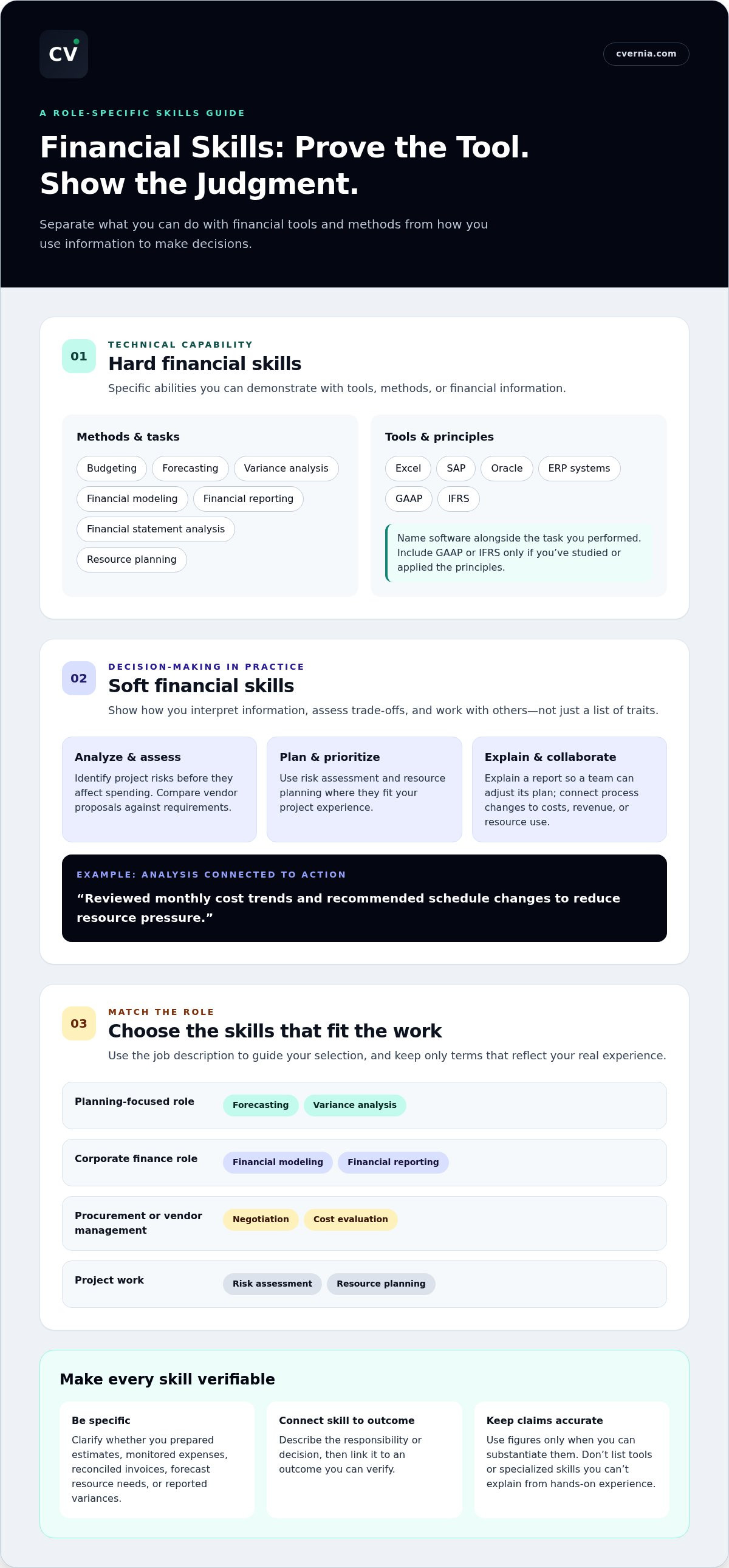
A strong financial skills section separates what you can do with tools and methods from how you use financial information to make decisions. This distinction helps hiring managers see both your technical capability and your judgment, even if finance isn’t your job title. As you consider adding financial skills section to resume, keep every claim grounded in work you’ve actually performed. A keyword should describe a real strength, not an aspiration.
Hard Financial Skills: Tools and Technical Proficiency
Hard skills are specific abilities you can demonstrate, such as building forecasts, analyzing statements, or working in an ERP system. Name the tools you’ve used and the tasks you performed with them. Listing SAP, Oracle, or Excel is more useful when your experience shows how you applied the software. Include GAAP or IFRS only if you’ve studied or applied the relevant accounting principles.
Choose technical terms that fit the vacancy rather than adding every finance-related phrase you know. A role focused on planning may emphasize forecasting and variance analysis; a corporate finance position may prioritize financial modeling or reporting. Don’t list specialized fintech platforms, tax regulations, or auditing as skills unless you can explain your hands-on experience in an interview.
Soft Financial Skills: Strategic and Analytical Thinking
Soft financial skills describe how you interpret information, assess trade-offs, and work with others. Avoid presenting them as vague personality traits. Show them through decisions: identifying a project risk before it affects spending, comparing vendor proposals against requirements, or explaining a report so a team can adjust its plan. For example, “Reviewed monthly cost trends and recommended schedule changes to reduce resource pressure” connects analysis to action without implying responsibility you didn’t hold.
For procurement or vendor management roles, highlight negotiation and cost evaluation when they’re part of your background. For project work, risk assessment and resource planning may be more relevant. Support each skill with a short example in your experience section whenever possible.
Build a Role-Specific Financial Skills Checklist
Use this checklist as a starting point, then compare it with the job description. Keep only the terms that reflect your experience and match the role’s priorities.
- Analysis: financial analysis, financial statement analysis, variance analysis
- Planning: budgeting, forecasting, financial modeling, resource planning
- Tools: advanced Excel, Power BI, Tableau, SAP, Oracle, NetSuite
- Standards: GAAP, IFRS, financial reporting
- Judgment: risk assessment, cost control, data interpretation, vendor negotiation
Read the posting closely. If it asks for cost forecasting, use that phrase only if it accurately describes your work. A broad substitute like “financial skills” may not make the connection clear. Match the employer’s language where it fits, then explain how you used the skill in your accomplishments. This helps ATS analysis identify relevant terms and gives hiring managers evidence behind them. CVernia’s compatibility analysis can help you review keyword alignment while keeping your resume truthful.
Optimizing Financial Skills for Applicant Tracking Systems (ATS)
An ATS helps employers organize and review applications. Depending on the system and employer settings, it may parse resume text and compare skills, job titles, and experience with the role’s requirements. Financial language needs to be clear enough for software to identify and for a recruiter to understand. If you're adding financial skills section to resume, focus on accurate terms that reflect the job description and your experience, not a long string of keywords.
Keyword Matching Without the Fluff
Start with the finance requirements in the job posting. Look for repeated skills, named tools, and specific responsibilities, then identify which ones you can honestly support with your background. For example, a posting that asks for financial planning and analysis may also use the abbreviation FP&A. If both terms accurately describe your experience, include the full phrase and abbreviation together once, such as “Financial Planning & Analysis (FP&A).”
Use job-specific wording where it fits, then give it context in your work history. “Forecasting” is a useful skill term; “Prepared monthly forecasts using sales and expense data” shows how you applied it. Avoid repeating the same phrase in every section or listing software you’ve never used. Keyword stuffing makes a resume harder to read and can weaken trust with a hiring manager. This ATS-compliant resume guide offers practical checks for resume structure before you submit.
CVernia’s ATS compatibility analysis can help you compare a resume with a specific job description, review keyword alignment and skill gaps, and tailor your wording truthfully.
Avoiding Formatting Pitfalls with Financial Data
Clear formatting makes financial data easier for both software and people to interpret. Use a straightforward, single-column layout for key skills, with standard headings such as “Skills” or “Financial Competencies.” Tables, sidebars, text boxes, and charts can place content in an order that some systems may parse poorly, so keep essential information in the main text.
Present numbers consistently, and make the meaning of each figure clear. For international applications, identify the currency where relevant and use a consistent style throughout the resume. Don’t leave readers guessing whether a figure is in dollars, euros, or another currency. Avoid relying on color, icons, or graphics to communicate a financial result.
Systems such as Greenhouse and Workday are used by employers to manage applications, but settings and parsing can vary by organization. No single format guarantees identical results everywhere. Use standard headings, selectable text, and a clean document structure, then review the finished file to make sure its content remains readable. A tailored version for each role lets you prioritize relevant financial terms without sacrificing clarity or accuracy.
Strategic Placement: Where to Add Financial Skills on Your Resume
Put financial expertise where it will be noticed and supported. A summary can spotlight a key strength, a dedicated skills section makes competencies easy to scan, and experience bullets prove how you’ve applied them. You don’t need to repeat every skill in all three places. Choose the placement that best connects your experience to the target role, then support important claims with specific evidence.
For an early-career applicant, a focused skills section near the top can surface relevant coursework, tools, or practical experience. Mid-career candidates can pair a concise list with achievement-led work history. For senior roles, emphasize financial scope and decision-making in the summary and recent experience, such as oversight of forecasts, budgets, or resource allocation. Keep the most relevant information high on the page, where a quick scan can catch it.
Build a Dedicated Financial Skills Section
Create a clean, bulleted list of five to seven core competencies that match the vacancy. Group related skills by theme so readers can find details quickly. Use a standard heading such as “Financial Competencies” or “Skills,” and keep essential content in the main text rather than relying on a decorative sidebar that may disrupt document parsing.
- Analysis: Variance analysis, financial reporting
- Planning: Budgeting, forecasting, resource planning
- Software: Advanced Excel, Power BI, SAP
- Compliance: GAAP, IFRS, when relevant to your experience
A skill label can include brief context if it remains concise. For example, “Budget management: monitored departmental spending against an approved plan” gives more meaning than “Budgeting” alone. The figure-based template “Budgeting: managed $2M annual spend” is appropriate only if that amount accurately reflects your own documented responsibility. Never use sample numbers as though they were your results.
Quantify Impact in the Experience Section
Use this formula to turn a financial competency into evidence: Action verb + financial skill + result. Choose a result you can verify, and explain your contribution clearly. For example, “Analyzed supplier costs and renegotiated service terms, reducing operating expenses by 15%” works only if you can substantiate both the action and the outcome. If you can’t confirm a percentage, describe the measurable scope or decision without inventing one.
Financial achievements can come from operations, project delivery, procurement, or administration, not only formal finance roles. Show the connection between your work and its financial effect, while distinguishing your individual contribution from a team result. Career changers can connect relevant budget, reporting, or resource-planning experience to new goals in a career change resume, focusing on transferable skills they’ve actually used.
Tailor the emphasis for each application rather than sending the same arrangement everywhere. Use CVernia to create and track role-specific CV versions, then review how your competencies align with each job description. Tailor your CV to the role while keeping every skill and achievement accurate.
How CVernia Helps You Tailor Financial Skills Truthfully
Financial skills should be tailored to each role, but your experience must stay consistent. CVernia helps you compare a CV with a specific job description, review ATS compatibility and keyword alignment, and manage tailored CV versions. This makes it easier to emphasize relevant experience without adding skills or achievements you can’t support.
Start with a personal “skills bank”: a working list of financial tasks, tools, and outcomes you’ve genuinely handled. Note the context, your level of responsibility, and any results you can verify. When adding financial skills section to resume, use this source list to select relevant details for each application rather than rewriting your background from memory.
Truthful Tailoring with ATS Analysis
Compare your CV with the specific job description using CVernia’s ATS analysis. Review keyword alignment and skill gaps, then decide whether each requested term accurately describes your experience. If the employer asks for “financial forecasting” and you’ve prepared forecasts, use that wording where it fits. If your experience is related but not equivalent, describe what you actually did instead of adopting a stronger label.
ATS analysis can help you notice differences in terminology, but it shouldn’t dictate your claims. An employer may use a particular phrase while your CV describes the same relevant work in different words. Align the language where accurate, then include enough context for a hiring manager to understand your contribution. Be precise about financial responsibilities: don’t imply that you owned a budget, approved spending, or delivered a savings result if your role was limited to supporting the process.
Managing Multiple Resume Versions
A financial-focused version and a leadership-focused version can highlight different parts of the same verified background. For a finance-oriented role, bring forward relevant reporting, forecasting, or analysis experience. For a management role, give more space to resource planning, budget oversight, or communicating financial considerations to a team. Keep the facts consistent; adjust emphasis, not your history.
Use CVernia’s version management and application tracking to keep each tailored CV connected to the relevant application. Smart reapplication detection can help flag when you encounter a role or employer you’ve applied to before, so you can review the earlier version and update it thoughtfully. Compare the new job requirements with your skills bank, check that the financial language fits, and save the revised version with a clear label. This creates an organized record of what you submitted without assuming that a particular version caused an application outcome.
Keep your applications organized and your financial expertise accurate as you tailor each CV. Explore CVernia’s CV tailoring tools.
Make Your Next Application More Intentional
Your financial skills can support a career move when they’re presented in a way that fits the role and reflects what you’ve truly done. Treat each application as a chance to make that connection clearer. Before you submit, check that your examples are accurate, your strongest evidence is easy to find, and the language aligns with the position you want.
CVernia helps you review ATS compatibility against a job description, tailor your CV truthfully, and keep different versions organized. Smart reapplication tracking can also help you revisit earlier applications and refine your approach when a similar opportunity comes along. Use these tools to stay consistent while giving each role the most relevant view of your experience.
Take the next step in adding financial skills section to resume by checking how your current CV aligns with your target role. Tailor your financial skills with CVernia and create a version that presents your expertise clearly and honestly.
Frequently Asked Questions
Should I include a financial skills section if I am not applying for a finance role?
Yes, if financial skills are relevant to the responsibilities in the job posting. Roles in operations, project management, and administration may involve tracking expenses, reviewing invoices, or allocating resources. Use the section to show capabilities that support the work, not to suggest you’re a finance specialist. For example, a coordinator could mention expense tracking if it was part of their actual duties. Prioritize relevance over adding financial terms just to fill space.
What are the most in-demand financial skills for 2026?
Commonly sought skills include financial analysis, financial modeling, forecasting, financial statement analysis, and knowledge of accounting principles such as GAAP or IFRS. Employers may also value data skills, including advanced Excel, Power BI, and Tableau, as well as familiarity with ERP platforms such as SAP, Oracle, or NetSuite. The right terms depend on the role. Check the job description and list only skills you can support with experience, training, or relevant projects.
How do I list financial software skills if I am self-taught?
You can include self-taught software skills if you can use them confidently for tasks relevant to the job. Describe your ability accurately, such as “Excel, PivotTables and XLOOKUP” or “Power BI, basic dashboard creation.” If you’ve applied the tool in a personal project, coursework, or volunteer role, briefly explain that context in your experience or projects section. Avoid labels like “expert” unless your practical ability matches that level.
Can I use abbreviations like P&L or ROI on my resume?
Yes, but write the full term alongside the abbreviation at its first mention so both readers and software can interpret it. For example, use “profit and loss (P&L) reporting” or “return on investment (ROI) analysis.” After that, the abbreviation alone is usually clear. Make sure the term fits your actual responsibilities. If you discussed ROI but didn’t calculate or evaluate it, describe your contribution more precisely.
How many financial skills should I list in a dedicated section?
Choose enough skills to show a clear fit without turning the section into a catalogue. A focused group of five to seven relevant competencies is a practical starting point, but the job description and your experience should guide the final selection. If you’re applying for an operations role, expense tracking may matter more than financial modeling. Remove any item you can’t explain with a concrete example or relevant learning.
What happens if an ATS doesn’t recognize my financial certifications?
Make the credential easier to identify by spelling out its official name, including the issuing organization, and placing it under a clear “Certifications” heading. Use the acronym in parentheses after the full name if it’s commonly used. Keep the information as selectable text rather than placing it in an image or graphic. If the certification is relevant, describe related knowledge or application elsewhere in your CV without implying the credential itself proves experience.
How do I quantify financial skills if I didn’t have direct budget access?
You can show financial awareness without claiming budget ownership. Describe your contribution to work that affected costs or resources, such as checking invoice accuracy, comparing supplier quotes, tracking purchase requests, or identifying a discrepancy for a manager to review. Use figures only if you have a reliable record and permission to share them. If you can’t verify a monetary result, explain the action and its effect without inventing a number.
Is it better to list skills in a sidebar or the main body of the resume?
The main body is generally the safer choice for important skills because a simple, linear layout is easier to read and parse across different systems. A sidebar can look organized, but some resume parsers may handle columns or text boxes unpredictably. If you use one, don’t put essential skills or contact details there alone. Keep a plain-text copy of your CV to check whether key information remains in a sensible order.


