

What if the reason you left your last job could help explain why you’re ready for your next one? Good reasons for leaving a job include seeking career growth, needing a healthier work-life balance, or finding a role that better fits your goals. The key is to explain your decision honestly without turning the conversation into a list of complaints.
It’s natural to worry that a genuine reason might sound negative, or to wonder how much detail belongs in an application versus an interview. You don’t need to share every personal or workplace detail. A clear, concise explanation can acknowledge what prompted your decision and shift the focus to what you’re looking for now.
This guide will help you identify a reason that reflects your experience, frame it constructively, and connect it to your next career step. You’ll find examples for common situations, along with practical ways to keep your account consistent across applications and interviews. With a little preparation, you can speak about the past with confidence and keep the conversation focused on the future.
Key Takeaways
- Employers value a genuine, clear explanation more than a single “perfect” reason for leaving.
- Explore good reasons for leaving a job by considering organizational changes, role fit, career direction, and personal circumstances.
- Use a quick self-assessment to distinguish a temporary frustration from a persistent mismatch with your needs or goals.
- Shape your explanation around your reason, brief context, what you learned, and what you’re seeking next.
- Keep your core account truthful and consistent, while tailoring your CV and cover letter to each role.
Why employers ask about your reasons for leaving a job
There’s no single perfect reason to give, and good reasons for leaving a job don’t have to sound like a promotion or a carefully polished success story. A strong explanation is genuine, professionally appropriate, and relevant to the work you want to do next. You don’t need to make a difficult departure sound ideal or share every detail. Clear, truthful context helps an employer understand your decision.
Interviewers may ask this question to understand what motivates you, how you make career decisions, and what conditions help you do your best work. If your responsibilities shifted away from the role you accepted, for example, they may want to know what kind of work you’re seeking now. If your position ended after a restructure, they may simply need context for the change. Your answer helps them understand your expectations and whether they align with the role.
Good reasons for leaving a job reflect a wide range of workplace experiences. The Great Resignation drew attention to factors such as limited advancement, wage concerns, and difficult work environments. That context can help explain why people make career changes, but your answer should center on your own circumstances rather than broad claims about employers or work.
What employers are listening for in your answer
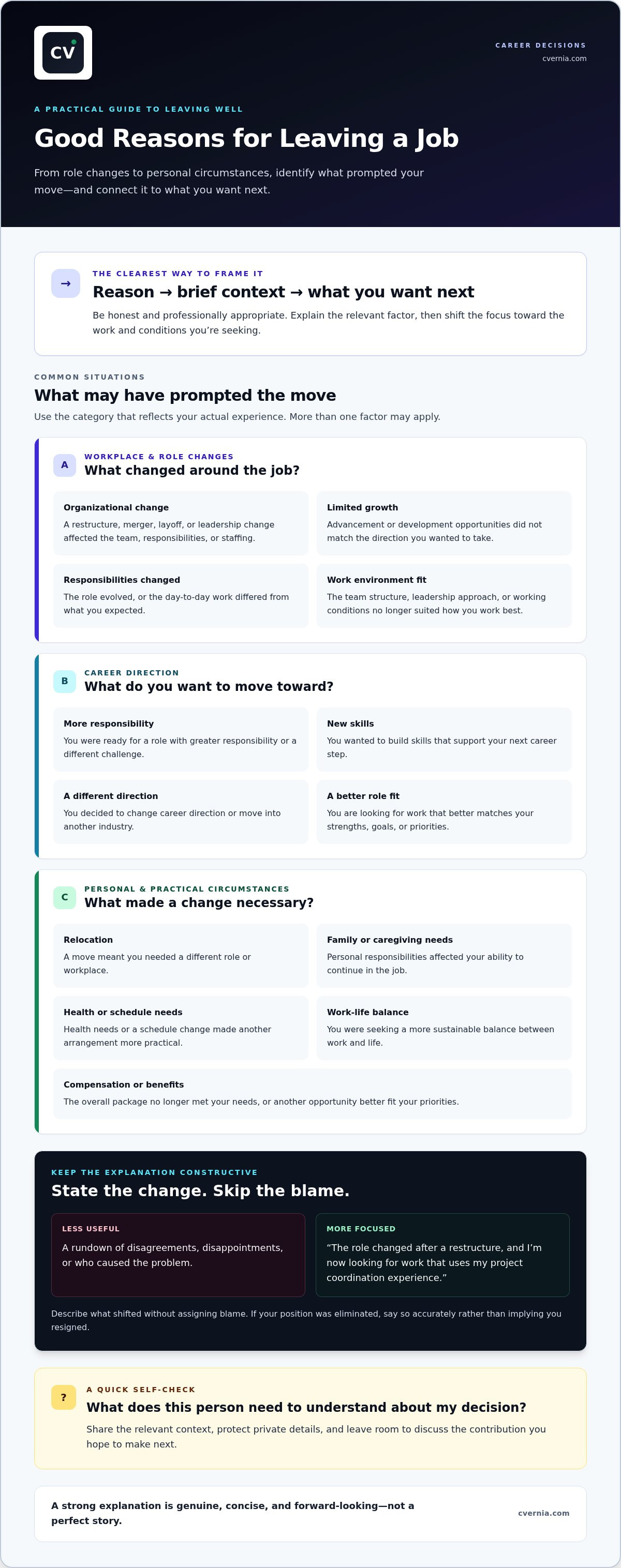
Employers may be listening for your priorities and judgment, not just the headline reason. They need enough context to understand whether you made a considered decision and what you expect from your next role. Explain the relevant factor without recounting every disagreement, disappointment, or workplace issue.
A strong explanation is honest, concise, and forward-looking: it gives useful context, then connects your decision to what you’re seeking next.
Keep the distinction clear: a reason describes what led you to leave, while a complaint centers on blame. “The role changed after a restructure, and I’m now looking for work that uses my project coordination experience” gives context and direction. A rundown of who caused the problem may distract from your qualifications and leave the interviewer unsure what you want.
A good reason is not the same as a perfect story
Some departures aren’t neat career milestones. A position may be eliminated, a contract may end, or personal circumstances such as caregiving or health needs may make continuing impractical. These are valid reasons to leave. You don’t have to describe them as exciting opportunities or suggest they were entirely within your control.
Choose truthful wording that gives the interviewer the context they need, while protecting details that are private or unrelated to the role. For instance, you can say family responsibilities led you to step away without explaining sensitive circumstances. If you were laid off, state that plainly rather than implying you resigned. Accuracy builds a dependable account, and unnecessary detail can make a simple explanation harder to follow.
Before answering, ask yourself: “What does this person need to understand about my decision?” Share that information, avoid exaggeration, and leave room to discuss the contribution you hope to make in your next position.
Good reasons for leaving a job, grouped by situation
Your reason may fit more than one category. Start with what actually prompted the decision, then separate that fact from how you’ll explain it. The examples below are prompts for reflection, not lines to borrow: a polished answer won’t help if it doesn’t match your experience. A voluntary move and an involuntary departure can both be explained clearly; neither automatically defines your candidacy.
Workplace and role changes that can prompt a move
Organizational changes can alter a job or bring it to an end. A restructure, merger, layoff, or leadership change may affect a team’s direction, responsibilities, or staffing. If your position was eliminated, say so accurately. If your role changed substantially, describe what shifted without assigning blame.
Other reasons come from the day-to-day fit between the work and your strengths or needs. Consider whether any of these reflects your situation:
- Limited growth: Advancement or development opportunities didn’t align with the direction you wanted to take.
- Mismatched responsibilities: The role evolved, or the work differed from what you expected to do.
- Work environment: The team’s structure, leadership approach, or working conditions no longer suited the way you work best.
These reasons don’t require a verdict on a former employer. Rather than labeling a workplace “bad,” for example, you might explain that changing team priorities moved the role away from the work you want to focus on. The Harvard Business Review: Why Employees Quit discusses the mix of factors that can push someone away from a job and pull them toward another. Considering both can help you identify what truly drove your choice.
Career goals and personal circumstances
Some departures reflect a deliberate change in direction. You may have been ready for more responsibility, wanted to build new skills, sought a different challenge, or decided to move into another industry. A change can also be practical rather than ambitious: relocation, family needs, a schedule change, or a more sustainable work-life balance may make a different role necessary.
Compensation and benefits can matter, too. You might leave because the overall package no longer meets your needs, or because another opportunity better fits your priorities. You don’t have to present pay as the only factor if growth, responsibilities, or flexibility also influenced your decision. Focus on what’s true and relevant to the role you’re pursuing.
A reason is strongest when it accurately reflects the decision. Use that as your filter: don’t recast a layoff as a resignation or claim a career-growth motive if personal circumstances were the real reason. When preparing applications, organize your application materials around the genuine facts and the experience relevant to each target role.
How to decide whether your reason points to a job change
Not every frustrating day means you need a new role. Before treating dissatisfaction as a reason to leave, look for a pattern. Does the concern keep returning, limit the work you can do, or reflect a lasting change in your responsibilities or needs? This reflection can help you decide whether to explore other opportunities, seek a change in your current role, or give a temporary issue time to resolve.
Separate the trigger from the underlying reason
Start by naming the event that prompted you to reconsider your situation. Then ask what it revealed. A missed promotion might point to a lack of growth, or it might be one disappointment in an otherwise rewarding position. A schedule change might be manageable for a short period, or it might conflict with an ongoing family responsibility.
Use these questions to look beyond the immediate trigger:
- What happened, and how did it affect my work or personal needs?
- Has the concern happened repeatedly, or is it tied to one event?
- Is the issue specific to my role, or does it reflect a wider organizational change?
- Could a realistic adjustment to my responsibilities, schedule, or development path address it?
These questions help distinguish a temporary frustration from a persistent mismatch. If a practical change could resolve the problem, consider whether it’s reasonable to explore that possibility. If the issue is outside your control, such as a position ending or a major shift in team priorities, focus instead on what you want your next step to offer. The goal isn’t to decide in haste or to resign; it’s to make an informed job-search choice.
Turn your priorities into criteria for the next role
Once you understand the underlying reason, translate it into clear criteria. List what you want more of, less of, or handled differently, then rank the priorities that matter most. Good reasons for leaving a job become more useful when they help you identify the responsibilities and working conditions you want, rather than simply describing what you want to escape.
- Responsibilities: Which tasks or areas of ownership do you want to take on?
- Development: What skills, learning opportunities, or advancement options are important?
- Working conditions: How do flexibility, schedule, location, and team structure affect your decision?
- Compensation: What pay and benefits priorities should factor into your search?
Compare your criteria with the actual duties and expectations of target roles. Read beyond the job title and look for evidence that the work aligns with your priorities. If repetitive tasks prompted your search, for instance, check whether the new position includes the project work you hope to do. A different title alone won’t guarantee a better fit.
A clear reason for leaving points to a concrete priority you can look for in your next role. Use that connection to guide your search and assess opportunities thoughtfully, without feeling pressured to make an immediate move.
How to explain your reason for leaving in an application or interview
You don’t need a rehearsed speech. Prepare a truthful explanation that gives enough context to make your decision understandable, then connects it to what you’re looking for now. A useful structure has four parts: your genuine reason, brief context, what you learned or clarified, and the priority you’re seeking in your next role.
Build a concise, honest answer
State the reason plainly. Add only the context needed to explain it, then connect your experience to a relevant priority for the role ahead. Professional framing should clarify the truth, never disguise it. Don’t blame former colleagues, share confidential information, or claim a motivation that wasn’t yours.
Adapt the structure to your real circumstances. These examples are starting points, not scripts to use if they aren’t accurate:
- Growth: “I was ready to take on broader responsibilities. I’m now looking for a role where I can build on my experience coordinating projects.”
- Restructuring: “My position was affected by an organizational restructure. I’m focusing on roles where I can apply my experience in customer operations.”
- Relocation: “I left because I relocated. I’m now looking for a position that fits my location and makes use of my background in administration.”
- Career direction: “I decided to move toward data analysis after gaining experience with reporting in my previous role. I’m seeking a position where I can develop that focus.”
Keep an application field shorter than an interview response. A form may need only a direct phrase or sentence, such as “Position eliminated during restructuring.” In an interview, add a little context and explain what you’re seeking next. Answer the question asked rather than turning a brief prompt into a full account of your work history.
Adjust the answer to the situation
Choose the level of detail that fits the reason. For an involuntary departure, state the organizational change clearly and avoid suggesting that it was your personal fault if it wasn’t. For a difficult workplace experience, explain the conditions or role needs that matter to your next step without making accusations. Keep the focus on what you’re looking for, not a verdict on former colleagues.
Personal circumstances can be described with discretion. You might say, “I stepped away to manage a family responsibility, and I’m now ready to return to work,” without sharing private details. If the interviewer asks a follow-up, respond honestly and briefly, then bring the conversation back to your relevant experience and future priorities.
Before using your explanation, check that it matches the facts and stays consistent across forms and conversations. Organize your interview notes and application materials so you can prepare a clear account for each opportunity without changing the underlying reason.
Prepare your next application with a clear, consistent career story
A clear career story connects your departure, experience, and next-step priorities without changing the facts. Prepare a concise explanation to use as your foundation across application forms and interviews. Adjust its length and emphasis for each situation, but keep the underlying reason consistent. This makes it easier to answer follow-up questions calmly and accurately.
Keep application materials aligned with your real experience
Tailor your CV and cover letter to show how your genuine skills and achievements relate to each role. Highlight the most relevant experience first, but don’t add qualifications, responsibilities, or motivations you can’t substantiate. A role-specific version should sharpen your story, not rewrite your history.
- Identify the role’s main responsibilities and select relevant examples from your actual work.
- Use the cover letter to explain why your experience and next-step priorities fit this opportunity.
- Keep dates, job titles, achievements, and your reason for leaving consistent across documents.
If you’re changing industries or career direction, explain the connection between your existing experience and the work you want to do next. A career change resume guide can help you consider how to present transferable experience while keeping every claim accurate.
Track applications and prepare for follow-up questions
Small details are easy to mix up when you’re applying to several roles. Keep a record for each opportunity, including the position, submission date, CV and cover letter versions, interview dates, and useful conversation notes. Before an interview, review the relevant record so your examples and explanation match the materials the employer has seen.
After each conversation, note the questions you were asked, the topics you discussed, and any details you may want to revisit. These notes can help you prepare for later conversations without relying on memory alone. A job interview tracker guide offers ideas for keeping interview information organized.
CVernia brings application records, tailored CV and cover letter versions, and interview notes together in one place. Its tools help you keep materials aligned with each target role and prepare a consistent, truthful account of your experience. Use them to manage the process, not to embellish your qualifications or predict an employer’s decision.
Keep a clear record of what you’ve submitted and what you want to discuss. Organize your next application with CVernia and keep your preparation focused from document tailoring through interview notes.
Take your next career step with confidence
Your explanation doesn’t have to make every part of your work history sound perfect. It needs to be accurate and help you move forward with intention. Use what you’ve learned about good reasons for leaving a job to decide what you want your next role to offer, then let that priority guide the opportunities you pursue.
Before applying, make sure your career story reflects your real experience and remains consistent from one conversation to the next. CVernia helps you keep role-specific application materials and interview preparation organized, so you can focus on presenting your qualifications clearly and truthfully.
Organize your next application with CVernia and take a practical step toward your next opportunity. Your past decision is one part of your story, not the limit of what you can do next.
Frequently Asked Questions
Is getting laid off a good reason for leaving a job?
Yes. A layoff or restructuring is a legitimate, employer-driven reason for leaving a job. You can state it plainly, such as, “My position was eliminated during a restructuring, and I’m now pursuing roles in operations.” You don’t need to apologize or guess at confidential business decisions. If asked whether the change reflected your performance, distinguish the two only if you know that’s accurate. Then turn to the kind of role you’re seeking next.
Can I say I left a job because of a difficult manager?
Yes, but describe the work situation rather than making a personal accusation. For example, you might explain that communication expectations or the management approach made it difficult to do your best work. Share only relevant details, and avoid claims you can’t support. Then identify what helps you contribute effectively, such as clear priorities, regular feedback, or collaborative decision-making, and relate that preference to the position you’re discussing.
How do I explain leaving a job after a short time?
Give a brief, truthful explanation instead of hoping the short tenure goes unnoticed. If accurate, you could say the day-to-day responsibilities differed substantially from what you understood, or that a change in personal needs required you to leave. Avoid criticizing individuals or suggesting the job was a long-term fit if it wasn’t. Close by naming what you’ve learned to look for, such as specific responsibilities or clearer expectations.
Should I tell an interviewer I was fired?
Answer direct questions truthfully, and don’t use wording that could mislead the interviewer. You don’t need to offer a lengthy account before it’s relevant, but prepare a concise explanation of what happened, what you learned, and what has changed since. Stick to facts you can support, avoid shifting blame, and make sure your interview answer matches the information in your application. If asked for more context, respond to that specific question.
Do I need to give a detailed reason for leaving a job?
No. The right amount of detail depends on the setting and the question. A short application field may only need a factual phrase, while an interviewer may ask for a little context. You can protect private information and confidential workplace details without being misleading. Prepare a core explanation that stays consistent, then add detail only if it helps answer a follow-up or clarify your decision.
Is wanting better work-life balance a good reason to leave a job?
Yes, if it reflects a genuine priority or an ongoing mismatch with your needs. Focus on the working arrangement that helps you perform well, such as predictable scheduling or flexibility, rather than criticizing your former employer. Before describing a new position as a strong fit, compare its stated schedule and expectations with what you need. That check helps you avoid pursuing a role that may recreate the same conflict.
Can I say I left a job for better pay?
Yes. Compensation can be one honest reason, but don’t present it as your only motivation unless that’s true. You could say you’re looking for compensation that better reflects the responsibilities you’re ready to take on, then explain what else attracts you to the role. Keep the answer grounded in your real priorities. Don’t invent a competing offer, quote unverified salary details, or claim expectations you don’t hold.


