

What if the clearest interview answer isn’t the most polished one, but the one backed by a real example? Interview Preparation & Guidance can feel daunting when you’re unsure what you’ll be asked, which experience to highlight, or how to stay composed if a question catches you off guard. You don’t need to memorize a script. You need a focused plan and evidence you can explain honestly.
This practical guide will help you prepare with the time you have, shape truthful answers around relevant examples, and approach the conversation with greater confidence. You’ll learn how to research the role, choose examples that show your contribution, practice without sounding rehearsed, and respond when you lack direct experience. You’ll also get tips for interview-day nerves, thoughtful questions to ask, and a simple follow-up process. Keep your notes and application details organized so each preparation step stays connected to the role.
Key Takeaways
- Set a focused preparation goal and adapt your plan to the role and time you have.
- Use the job description and employer research to identify the capabilities interviewers may prioritize.
- Choose truthful examples that show relevant skills and impact, using STAR as a flexible structure when helpful.
- Practice aloud with adaptable talking points, then refine answers that lose focus instead of memorizing a script.
- Connect organized interview notes, role details, and follow-up actions to each application.
Interview preparation starts with a clear goal and a focused plan
Feeling nervous before an interview is normal, especially when you’re unsure what the employer will ask or how much preparation is enough. Start with one goal: understand what the role needs and be ready to explain how your genuine experience relates to it. Your plan should fit both the position and the time you have.
Effective preparation connects role requirements to truthful examples, then gives you time to practice explaining them clearly and plan useful questions. It isn’t about predicting every question or memorizing perfect answers. For context on common interview formats and question types, explore Understanding the Job Interview Process. Use what you learn to guide your preparation, not to build a script.
What interview preparation should help you accomplish
Good preparation helps you identify what the employer needs and which parts of your background offer relevant evidence. It also gives you flexible talking points you can adapt to different questions. Aim to communicate your experience clearly, not to anticipate every possible scenario. You’re ready to practice when you can explain, in your own words, why an example matters to this role.
Use this checklist in order. Treat the first three steps as essential; add the final steps when your schedule allows:
- Essential: Review the role description and note its main responsibilities and requirements.
- Essential: Learn the basics about the employer and identify a few relevant examples from your experience.
- Essential: Prepare brief talking points that connect those examples to the role.
- Optional polish: Practice aloud, check interview logistics, and prepare questions for the interviewer.
How to prioritize preparation when time is limited
Short on time? Start with the role description, a quick review of the employer’s public information, and a few examples that best match the position. With more time, practice your talking points aloud, confirm practical details such as the interview format and location, and prepare questions that help you understand the role. Keep your notes with the application so the details stay connected.
Leave a final review period before the interview rather than cramming in new material at the last minute. Scan your key points, check logistics, and give yourself a moment to pause. Interview Preparation & Guidance works best as a focused routine, not an attempt to eliminate every uncertainty. Clear priorities help you arrive ready to have a conversation, even if the questions take an unexpected turn.
Research the role and employer to make your preparation specific
Research is most useful when it changes what you prepare to say or ask. Start with the job description, then review the employer’s own information and check broader claims against reliable public sources. Separate confirmed facts from interpretation. A listed responsibility is a fact; guessing how the team handles it is an assumption. Keep assumptions as questions, not claims about the employer.
Turn the job description into interview priorities
Read the posting once for the overall purpose of the role, then review it again for repeated responsibilities, stated qualifications, and expected outcomes. Repetition can signal emphasis, but treat it as a clue rather than proof of what the interviewer will ask. Match each priority with one truthful example, achievement, or relevant learning experience. If a requirement is broad or unclear, note a concise question to clarify its scope.
Research the employer without relying on guesswork
Use the employer’s website to understand its stated mission, products or services, and the customers or communities it serves. Review recent public announcements for developments that may help you ask informed questions. Prefer direct company information and reliable reporting over unverified posts. Prepare one or two specific observations, distinguish what the source says from what you infer, and avoid presenting speculation as fact.
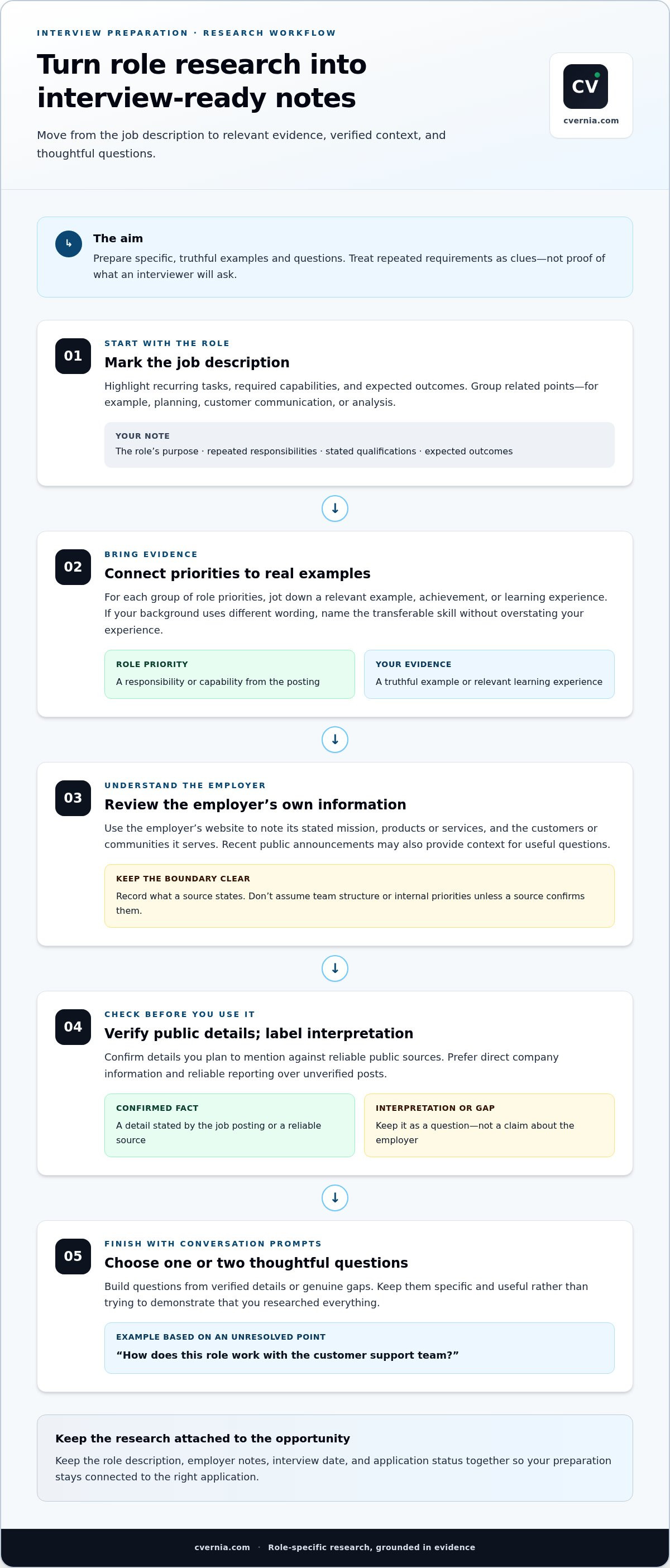
Use this workflow to turn research into useful interview notes:
- Step 1: Mark the job description. Highlight recurring tasks, required capabilities, and outcomes. Group related points, such as planning, customer communication, or analysis.
- Step 2: Connect priorities to evidence. For each group, jot down a relevant example or learning experience. If your background doesn’t match the wording exactly, identify the transferable skill without overstating your experience.
- Step 3: Review the employer’s website. Note its stated work, services, and context for the role. Look for details that help you understand how the position may contribute, but don’t assume team structure or internal priorities unless a source states them.
- Step 4: Check public information. Confirm details you plan to mention against reliable sources. Label interpretations clearly and turn unresolved points into questions, such as, “How does this role work with the customer support team?”
- Step 5: Choose questions. Build one or two thoughtful questions from verified details or genuine gaps, rather than trying to demonstrate that you’ve researched everything.
Keep the role description, employer notes, interview date, and application status together so your research stays tied to the right opportunity. CVernia’s application tracking and interview notes help organize those details alongside each application, making it easier to return to role-specific information as you prepare. Organize interview details and notes alongside each application.
Build interview answers from real examples, not memorized scripts
A clear answer doesn’t need to sound polished down to the last word. It needs to show, truthfully, how your experience connects to what the role requires. Choose examples that demonstrate the priorities identified in your research. If you haven’t handled the exact responsibility before, consider transferable evidence from coursework, volunteering, personal projects, or another role. Show what you did and learned without implying experience you don’t have.
Interview Preparation & Guidance is most useful when you organize real evidence into answers you can adapt. Before practicing, jot down the challenge, your contribution, the steps you took, and what happened next. A result doesn’t have to be a dramatic metric. It could be a completed project, a resolved issue, or feedback you can accurately describe.
Use the STAR method without making answers sound mechanical
STAR is one optional outline: Situation, the brief context; Task, your responsibility; Action, the steps you personally took; and Result, the outcome. Keep context short and spend most of your answer on your actions. Share a measurable result only if you can support it accurately. Treat STAR as a flexible guide, then adjust the detail to the interviewer’s follow-up questions.
Replace broad claims with evidence the interviewer can understand. For example:
| Vague claim | Evidence-based element |
|---|---|
| “I’m a strong problem-solver.” | Name a real problem, explain the steps you took, and describe the outcome you observed. |
| “I work well with others.” | Explain your role in a specific collaboration and how you helped move the work forward. |
| “I’m experienced with the process.” | State what you’ve done, the context, and what you’re still learning. |
Answer questions about gaps, change, or limited experience
Answer the question directly, then offer relevant evidence without apologizing at length. If you’re new to a field, a course project may show how you approached a task; volunteering may demonstrate communication or coordination. Be precise about the setting and your contribution. Don’t present practice as paid work, claim a qualification you don’t hold, or inflate an outcome to make the example sound stronger.
For a career change, connect the experience you do have to the role’s needs, then name any capability you’re actively building. For a gap, give a concise, honest explanation and return to your readiness for the opportunity. You don’t need to disclose details unrelated to the role or defend your whole history. Save your examples and notes with the relevant application so you can revisit them accurately. CVernia’s Interview Preparation & Guidance tools help you keep interview preparation organized and grounded in your real experience.
Practice interview delivery and reduce avoidable uncertainty
Practice helps you notice where an answer gets tangled before you’re in the interview. It doesn’t mean rehearsing until every sentence sounds polished. Useful rehearsal builds familiarity with your key points; memorizing answers word for word can make it harder to respond naturally. Keep a few flexible prompts nearby, such as the example you want to use, your specific contribution, and the outcome you can accurately describe.
Try this repeatable routine with likely questions drawn from the role’s priorities:
- Speak your answer aloud. Answer without reading a script, using your notes only as a prompt.
- Check the connection. Ask whether you addressed the question directly and included a concrete example.
- Review the parts that wander. Notice where you lose focus, add unnecessary background, or leave your contribution unclear.
- Make one targeted adjustment. Tighten that section, then practice again. Don’t rewrite an answer that already sounds clear.
A trusted practice partner can ask follow-up questions and point out what came across clearly. Prefer to review on your own? Record an answer and listen for clarity, pace, and whether the main point is easy to follow. Focus on one or two improvements at a time. The aim is a conversation, not a performance you’ve memorized.
Practice aloud while keeping your answers natural
Choose a small set of likely questions and rehearse concise responses aloud. After each one, check that you answered what was asked and gave enough detail to make your point credible. Use a practice partner or recording to spot specific areas to refine, such as a long opening or an unclear explanation of your role. Keep talking points, not a word-for-word script.
Prepare for video, phone, and in-person interviews
Each format calls for different practical checks, but none is automatically harder. Prepare your setup so avoidable distractions don’t pull your attention away from the conversation. Follow any instructions the interviewer provides, and keep your role notes accessible without letting them replace active listening.
- Video: Test the meeting link, camera, and microphone beforehand. Check lighting, choose a quiet setting, and position your screen so you can focus on the conversation.
- Phone: Check reception, reduce interruptions, and keep the role description and a few brief prompts within reach. Find a place where you can hear clearly.
- In person: Confirm the location and route, plan your arrival, and review any instructions you’ve been given. Allow room for ordinary travel delays without assuming the interview will follow a particular format.
Use CVernia’s interview notes to keep practice points connected to the relevant application, then make your final review a scan of key points and logistics. Organize your interview preparation and notes so you can focus on the conversation.
Manage interview notes and follow-up with a consistent system
A consistent record keeps each interview connected to the right role and makes the next step easier to manage. Set up a note for every opportunity before the conversation, then update it soon after while details are fresh. This helps prevent employer research, interview dates, and follow-up commitments from blending together when you’re managing several applications.
Keep preparation notes connected to the right application
Create one record per role. Before the interview, capture the job title, employer, date and time, format, interviewer names, and any instructions you’ve received. Attach or save the job description and other relevant application materials with that record. During the conversation, keep notes brief so you can stay engaged instead of trying to transcribe everything.
CVernia’s application dashboard brings application tracking together with interview notes and attachment management. Keep role-specific information accessible in one place, then update the record as the hiring process progresses. A dedicated job interview tracker can also help you manage interview dates and application progress, especially when opportunities move forward on different timelines.
After the interview, add a concise record of what happened:
- Questions and topics: Note the main areas discussed, including anything you want to reflect on later.
- People and context: Record who you spoke with and relevant details about the role or team they shared.
- Next steps: Write down stated timelines, requested materials, and actions you agreed to take.
- Status: Update the application’s progress and note when a follow-up may be appropriate, based on what the employer told you.
Follow up thoughtfully and learn from each conversation
If a thank-you message is appropriate, keep it concise and refer accurately to a relevant point from your discussion. Avoid generic praise or claims about what the interviewer thought. A brief, specific reference shows you were attentive; a clear note about any promised next step helps you follow through reliably.
Use your post-interview record as a learning tool, not a verdict on your performance. Note which topics felt clear, what you’d like to explain more effectively next time, and any questions you still have. Keep observations factual and constructive. For example, record “prepare a clearer example of coordinating a project” rather than “I’m bad at interviews.”
Application tracking can keep interview dates, role details, and follow-up actions organized across your search. CVernia’s Career Academy provides resources for continued career development between conversations. Together, these tools make Interview Preparation & Guidance part of an organized process, from the first scheduled interview through your next learning step. Organize interview notes and application follow-ups in one place.
Carry your preparation forward
Interview Preparation & Guidance isn’t about controlling every moment of a hiring conversation. It’s about building a steady process you can return to, learn from, and adapt as your career develops. After each interview, choose one useful takeaway and one next action. That small habit can help you approach future opportunities with more clarity, whatever the outcome of this one.
Give that process a reliable home. CVernia brings application tracking together with interview notes and attachments, helping you keep each opportunity’s progress and related materials organized. Career Academy resources can support your continued learning as you decide what skills or knowledge to develop next. These tools help you manage your job search and career development without making promises about hiring decisions.
Take the next step with a system that supports your preparation from application to follow-up. Organize your applications and interview preparation with CVernia, and move into your next conversation with a clearer plan. Keep going, one purposeful step at a time.
Frequently Asked Questions
How do I prepare for an interview step by step?
Start by confirming the interview time, format, and any instructions, then review the role and employer. Choose relevant evidence from your experience and prepare a few questions to ask. Practice explaining your examples aloud, but keep notes brief enough to scan rather than read. This Interview Preparation & Guidance sequence helps you focus on what you can control and leaves room to respond naturally.
What should I bring to a job interview?
Bring only what’s relevant and follow the employer’s instructions. For an in-person meeting, consider a copy of your CV, a notebook and pen, and any work samples the employer requested. Keep the interviewer’s contact details and location accessible in case plans change. For a virtual meeting, have your notes and relevant files ready on your device. Don’t bring confidential materials from a current or former employer.
How can I calm my nerves before an interview?
Reduce last-minute decisions by preparing your route or setup, outfit, and materials ahead of time. Before joining or entering, take a few slow breaths and focus on one practical intention, such as listening fully to each question. If you feel nervous during the conversation, pause briefly and gather your thoughts before answering. You don’t need to hide every sign of nerves; aim to stay present and communicate one point at a time.
How long should I spend preparing for an interview?
There’s no fixed preparation time that suits every role. Match the effort to the interview’s scope and the time available: prioritize understanding the position and selecting relevant examples first, then use any remaining time for practice and logistics. If the interview is soon, focus on the essentials rather than trying to research everything. Leave a short buffer before it starts so you’re not reviewing notes right up to the first question.
What is the STAR method for interview answers?
STAR stands for Situation, Task, Action, and Result. It gives you a simple way to explain an example: set the scene, clarify your responsibility, describe what you did, and share the outcome. Distinguish your own actions from the team’s work. Use the structure when it helps organize your response, but don’t force every answer into STAR if a direct explanation fits the question better.
What should I do if I do not know how to answer an interview question?
Take a brief pause and, if needed, ask the interviewer to clarify what they mean. If you haven’t faced that exact situation, be honest, then explain how you’d approach it using relevant knowledge or a related experience. For a technical question, describe your reasoning rather than guessing or claiming expertise you don’t have. It’s also reasonable to say what you’d need to learn before giving a definitive answer.
Should I send a thank-you email after an interview?
A concise thank-you email can be a thoughtful follow-up when appropriate, especially if it reflects the tone and instructions of the interview process. Address the interviewer by name, thank them for their time, and mention a specific discussion point accurately. If you agreed to send information, include it or clearly state when you’ll follow up. Keep a record of the message and any next steps with the relevant application.


