
What if your resume already contains evidence for your next role, but hides it beneath a list of duties? Tailoring resume for career advancement isn’t about borrowing impressive phrases from a job description or making your experience sound bigger than it was. It’s about showing how your contributions, skills, and responsibilities have grown.
If your resume doesn’t make that progression clear, it can be hard to know which achievements to feature or how to connect them to a more senior position. You don’t need to stretch the truth to make a stronger case. Choose relevant evidence and explain it clearly.
This guide shows you how to identify achievements that demonstrate readiness, link your real experience to a target role, and create a focused, readable resume for each opportunity. You’ll learn how to use job descriptions to guide your choices without stuffing in keywords, and how to keep every claim accurate. The goal is to make your growing impact easy to see for both recruiters and screening systems.
Key Takeaways
- Show readiness for a more senior role through relevant results, broader scope, and evidence of growing responsibility, not a new title alone.
- Use a repeatable process for tailoring resume for career advancement: define your target, identify its requirements, then select documented achievements that match.
- Adapt your wording to the role’s language when it accurately describes your experience. Avoid keyword repetition that makes your resume harder to read.
- Review your resume for relevance, clear evidence, readability, accuracy, and consistency before sending it.
- Keep role-specific versions organized so each application aligns with the opportunity while remaining grounded in your actual experience.
Why a Career-Advancement Resume Needs More Than a New Job Title
A more impressive title won’t explain why you’re ready for greater responsibility. An advancement-focused resume is a targeted account of relevant results, growing scope, and evidence that connects your experience to the role you want. In short, a career-advancement resume makes increasing responsibility visible through credible, role-relevant evidence.
A resume summarizes experience and qualifications for an employment opportunity, as outlined in this overview of the Resume. For career progression, the key is choosing the parts of that experience that best support your next move. A list of duties may leave your growth hidden. “Managed project updates” describes a task; explaining how you coordinated teams, resolved delays, or improved delivery gives a clearer picture of your contribution, as long as those details are accurate.
What hiring teams need to see in a candidate moving up
Hiring teams need evidence that reflects the demands of the target role, not an unsupported statement that you’re “ready to lead.” Show ownership through decisions or workstreams you handled, judgment through a challenge you addressed, collaboration through relevant partnerships, and outcomes through the results of your work. Increasing project complexity, broader stakeholder involvement, or responsibility for planning and follow-through can all signal progression. Focus on what you’ve demonstrated rather than presenting future performance as fact.
Promotion, lateral move, or career pivot: tailor to the destination
For a promotion in the same field, highlight deeper expertise, broader accountability, and outcomes that match the next level. For a move into a new function or industry, prioritize transferable evidence. A project involving analysis may support a move into operations, while cross-team coordination could be relevant to a role that relies on collaboration. Preserve useful experience, but give the most space to what the target position requires.
That distinction matters when tailoring resume for career advancement. Your goal is credible alignment, not making it appear that you already hold the role. Choose examples that show relevant capability, describe your contribution accurately, and make the connection easy to follow. If your next step is a significant career pivot, the existing career-change resume guide can help you focus on transferable skills and frame the transition.
How to Match Your Resume Evidence to a More Senior Role
Start with evidence, not edits. Before changing your resume, compare the target job description with achievements you can document. This keeps your application grounded in what you’ve actually done and helps you identify examples that show broader ownership, relevant outcomes, or cross-functional work.
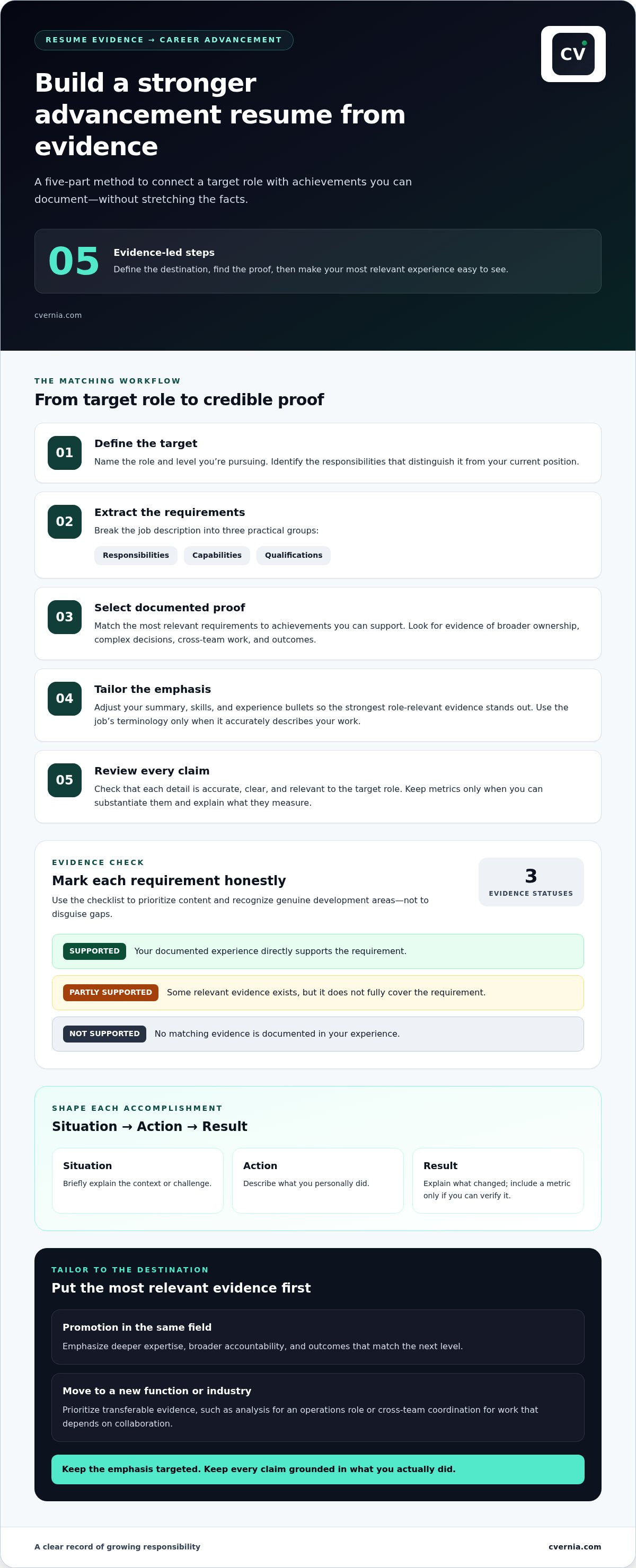
The strongest resume match connects a role requirement to specific, truthful evidence of your ability to meet it. Use this sequence to build that connection:
- Define the target: Identify the role and level you’re pursuing, including the responsibilities that distinguish it from your current position.
- Extract requirements: Group the job description into responsibilities, capabilities, and qualifications.
- Select proof: Find documented achievements that support the most relevant requirements.
- Tailor sections: Adjust your summary, skills, and experience bullets to give your strongest relevant evidence appropriate emphasis.
- Review: Check that every claim is accurate, clear, and relevant to the target.
Turn a target job description into a short evidence checklist
Don’t copy every phrase from the posting. Translate its priorities into a practical checklist, then mark each item as supported, partly supported, or not supported by your experience. For example, a requirement to coordinate cross-functional projects may be supported by a project where you worked with product and finance teams, even if your title didn’t include “project lead.” Use the checklist to prioritize resume content and identify genuine development areas rather than disguising gaps. Berkeley Career Engagement’s Creating an Effective Resume guidance also emphasizes tailoring content and highlighting relevant skills.
Choose accomplishments that demonstrate greater scope
Look for examples where you took on more ownership, made complex decisions, collaborated across teams, or delivered outcomes over time. Shape each example around situation, action, and result: briefly explain the context, what you personally did, and what changed. A metric can strengthen the result, but include it only if you can substantiate it and explain what it measures. If you can’t verify a number, describe the outcome accurately without one.
Keep each accomplishment specific to the requirement it supports. Use the role’s terminology when it accurately describes your work, then read the bullet aloud to check that it sounds natural. For related guidance on document formatting and compatibility, see the ATS resume checker guide.
To keep role-specific versions organized, use CVernia’s resume tailoring tools to align application documents with job descriptions and manage versions as you refine them.
Does Tailoring Your Resume Mean Exaggerating or Stuffing Keywords?
No. Tailoring changes the emphasis and wording of your resume, not the facts of your experience. You can bring relevant achievements forward, describe them in language the target role uses, and clarify your contribution. Don’t invent a metric, credential, responsibility, or claim of sole ownership to appear more qualified.
Effective tailoring clarifies evidence; it doesn’t manufacture qualifications. For example, if a job posting asks for “cross-functional collaboration,” use that phrase when it accurately describes work you did with teams in different functions. Repeating it in every bullet, skills list, and summary won’t add meaning. It can make the document harder to read and your genuine strengths less clear.
How to describe leadership without a formal management title
You don’t need a manager title to show leadership. Use specific examples of mentoring colleagues, coordinating a project, taking ownership of a workstream, or influencing a decision. Choose verbs that reflect your actual role: “coordinated,” “mentored,” or “recommended” may be more accurate than “managed” or “directed.” Make your individual contribution clear and distinguish it from the team’s shared work or overall result.
For instance, if you organized input from several teams but didn’t supervise their members, describe the coordination rather than implying direct authority. If your recommendation shaped a decision, explain what you proposed and what happened next. Don’t suggest you made the final call unless you did.
Use ATS terminology without making the resume sound robotic
Include relevant terms from the job description where they fit naturally, such as in your summary, skills section, or an accomplishment bullet. Use standard section headings and straightforward formatting so readers and screening systems can interpret your information. Then read the resume as a person would: does each phrase make sense, and does each bullet explain your work?
For example, instead of listing “strategic planning” several times, show how you used it: “Developed a quarterly planning process with sales and operations to align team priorities.” Keep the wording only if it reflects what you actually did. A clear resume balances relevant terminology with specific, human-readable evidence.
This is the credibility test for tailoring resume for career advancement: could you explain every claim with a real example if asked? Remove any statement that depends on an inflated title, unverified number, or overstated responsibility. For more context on how applicant tracking systems interpret resumes, consult the guide on how applicant tracking systems work.
A Practical Review Checklist for Your Advancement Resume
Before submitting, review your resume against the role, not just for typos. A focused check can reveal whether your strongest relevant achievements are easy to find, your claims are supported, and the document is clear to both a recruiter and a screening system. Use this checklist as the final step in tailoring resume for career advancement.
Check the resume for clarity, credibility, and ATS readability
Keep the structure consistent, with familiar section headings, readable formatting, and a logical work history. Then compare the final version with the job description. An ATS compatibility result can help you spot differences in terminology or document readability, but it isn’t a prediction of whether you’ll be hired.
- Relevance: Do your most relevant achievements appear near the top of the resume or experience section?
- Evidence: Does each key claim explain your contribution and its outcome clearly?
- Accuracy: Have you checked dates, job titles, qualifications, and metrics against your own records?
- Readability: Have you removed unexplained jargon, distracting details, and repeated phrases?
- Consistency: Does your summary, skills section, and experience support the same target role?
Review the document in its intended format, then check a plain-text version by copying its contents into a basic text editor. Look for missing words, scrambled sections, or details that appear out of order. Fix layout or parsing problems, and make sure formatting choices haven’t obscured important information.
Keep each tailored version organized
Give each file a descriptive name that identifies the role or organization, and save the exact version you submit. Record the opportunity, submission date, and follow-up notes in one consistent system. This makes it easier to track what you sent and avoid attaching an older draft to a later application. A dedicated guide to managing resume versions across multiple applications can help you refine this routine.
A final review should leave you confident that your resume is targeted and truthful. For a more organized workflow, use CVernia’s resume version management tools to keep role-specific documents and application details together.
Build a Repeatable Career-Advancement Resume Workflow with CVernia
Once you’ve identified the evidence to highlight and reviewed your resume for accuracy, make the process easier to repeat. A consistent workflow helps you tailor each application to its role while keeping documents, versions, and follow-up details organized. CVernia brings these application tasks together in a digital platform.
Use a simple sequence:
- Record the target role: Add the opportunity to your application tracking system so you can connect the job description with the right documents.
- Prepare a truthful tailored resume: Bring relevant accomplishments forward and adjust wording only where it accurately reflects your experience.
- Review compatibility: Compare your resume with the job description to spot relevant terms or possible gaps that deserve your review.
- Track the application: Keep the submitted version and application details organized for later reference.
This turns tailoring resume for career advancement into a practical, repeatable routine, without treating every application as a blank page.
Use job-description analysis to refine, not replace, your judgment
A compatibility analysis can surface language and requirements to review against your experience. If a role emphasizes stakeholder communication, for example, check whether your resume clearly describes work involving relevant stakeholders. A comparison can also draw attention to requirements your current document doesn’t address. Decide whether you have genuine evidence to add. Don’t insert qualifications, skills, or experience you can’t support. Compatibility analysis is a review aid, not a promise of screening success or an interview.
Maintain a clear record of every advancement application
Keep the job description, tailored resume version, application record, and any interview notes together. That record can help you recall what you submitted and reflect on which examples or wording may need refinement for a later, relevant opportunity. CVernia supports document version management and application tracking in one platform, with interview notes and attachments available alongside application information.
For added learning support, explore CVernia’s Career Academy resources as you strengthen your application skills. Ready to put your process into practice? Organize and tailor your next application with CVernia.
Make Your Next Career Step Clear on the Page
A compelling advancement resume doesn’t rely on a bigger title or inflated claims. It connects the role you want with evidence of how your responsibility, judgment, and results have grown. That’s the heart of tailoring resume for career advancement: make your strongest relevant proof easy to recognize, keep every detail accurate, and review the document for clarity before you submit it.
Give each opportunity a resume version that reflects its requirements, then keep track of what you sent. A repeatable process helps you stay focused and consistent as you pursue your next move.
CVernia brings role-specific resume and cover letter tools, job-description compatibility analysis, application tracking, and document version management together in one platform. Use these tools to organize your applications and refine your documents while keeping your experience truthful.
Organize and tailor your next application with CVernia. Present your experience with clarity and take your next step with confidence.
Frequently Asked Questions
How do I tailor my resume for a promotion?
Start by reviewing the promotion’s responsibilities and requirements, then select real accomplishments that show relevant ownership, judgment, collaboration, and results. Move your strongest evidence where it’s easy to find, and adjust your summary and skills section using accurate language. For example, highlight a project you led if you genuinely owned it. Don’t imply you already have authority or responsibilities that belong to the target role.
What should I include on a resume for career advancement?
Include experience and accomplishments that show readiness for the target role, especially evidence of increased responsibility, complex work, or relevant outcomes. Explain your contribution clearly and keep dates, qualifications, and metrics accurate. A concise summary can clarify your direction, but it shouldn’t replace specific proof in your experience section. Prioritize evidence that connects directly to the role’s needs rather than giving every past duty equal space.
Can I tailor my resume if I have never managed a team?
Yes. Formal management is only one way to demonstrate leadership. You can describe accurate examples of coordinating work, mentoring colleagues, owning a project, influencing a decision, or collaborating across teams. Make your contribution distinct from the group’s overall result. For example, say you coordinated input from several departments if that reflects your role. Don’t use a manager title or imply authority you didn’t have.
Should I use keywords from a job description on my resume?
Use relevant job-description terms when they accurately describe your experience, skills, or qualifications. Place them naturally in your summary, skills section, or accomplishment bullets, and support important claims with examples. Avoid repeating phrases just to influence an automated system. Clear headings and readable formatting also help people and software interpret your experience. If a term doesn’t fit your real background, leave it out rather than forcing it in.
How often should I tailor my resume for career advancement?
Tailor your resume for each distinct target role, especially when responsibilities or required capabilities differ. You don’t need to rewrite every section each time. Keep a reliable master record of your experience, then create focused versions using relevant, accurate evidence. Label each version clearly and record which one you submitted for each opportunity. This approach makes tailoring resume for career advancement more manageable while helping prevent outdated or mismatched documents.
How can I show career progression on a resume without changing job titles?
Keep your official job titles accurate and show progression through the work you did. Highlight growing project scope, ownership, complexity, collaboration, or outcomes where you have evidence. Use dates and concise accomplishment statements to make that development easy to follow. For example, describe how your responsibilities expanded from supporting a project to coordinating its delivery. Don’t replace an official title with a more senior one that misrepresents your position.
Does an ATS score determine whether my advancement resume will get an interview?
No. An ATS compatibility score is a diagnostic signal, not a hiring decision or a guarantee of an interview. Use it to identify possible gaps in relevant language or document structure, then review those suggestions against the job description and your experience. A strong resume still needs truthful evidence, clear writing, and alignment with the role’s requirements. Treat the score as one input in your review, not a prediction of the outcome.


