
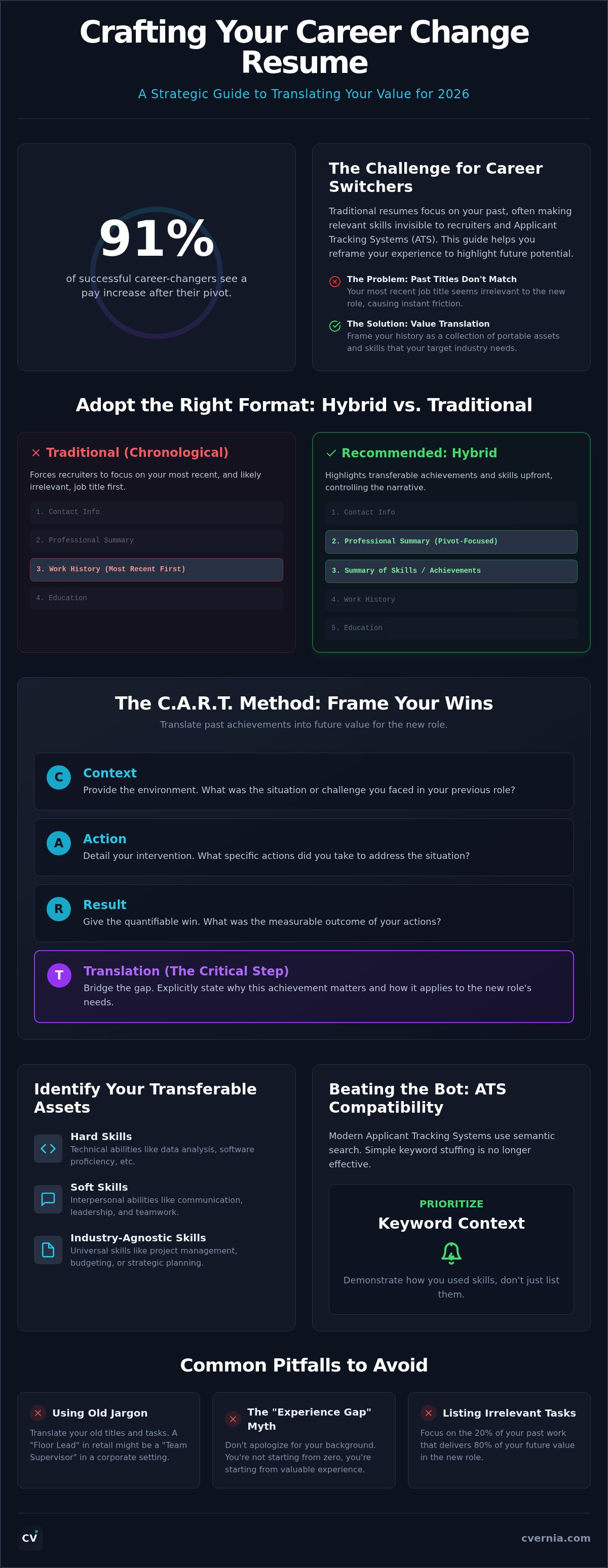
Did you know that nearly 91% of people who successfully pivot into a new field eventually see a pay increase? Despite this high success rate, the initial hurdle of crafting a career change resume often feels like trying to speak a foreign language without a dictionary. You've spent years building authority in your current domain. It's demoralizing to feel like that experience is being reset to zero by an automated tracking system simply because you lack specific industry keywords.
We understand the frustration of seeing your hard earned expertise ignored. This guide changes that narrative. Translate your existing wins into a dialect that new hiring managers crave. You will learn how to build an ATS-optimized document that bypasses filters and highlights your future potential over your past job titles. Gain the confidence to apply for roles where you know you can excel.
Prepare for a successful transition as we explore the hybrid resume format and identify the transferable skills that matter most in 2026. We will also ensure your document aligns with the latest AI screening regulations and California's updated pay scale transparency laws to keep your strategy competitive.
Key Takeaways
- Learn to frame your professional history as a value translation document that speaks the language of your target industry.
- Master the CART method to build a career change resume that identifies bridge skills and demonstrates your immediate utility.
- Adopt the hybrid resume format to highlight your transferable achievements while maintaining the structural integrity recruiters expect in 2026.
- Navigate modern semantic search algorithms by prioritizing keyword context over simple keyword stuffing to bypass automated rejection filters.
- Implement a multi-pronged application strategy by managing tailored versions of your CV for different industry pivots.
What is a Career Change Resume? Redefining Your Narrative for 2026
A career change resume is far more than a simple list of previous employers. It's a strategic value translation document. Think of it as a map that guides a hiring manager through your professional evolution. Standard resumes focus heavily on where you've been, but a pivot focused document prioritizes where you're going. Understanding what is a career change resume requires you to stop viewing your history as a rigid timeline and start seeing it as a collection of portable assets.
Most candidates default to a reverse chronological format because it's familiar. While this works for linear growth, it's often a career killer for switchers. This traditional structure forces recruiters to look at your most recent, and likely irrelevant, job title first. This creates immediate cognitive friction. You don't want a recruiter to wonder why a teacher is applying for a project management role. You want them to see a leader who has mastered stakeholder communication and complex scheduling.
Your professional summary acts as the vital bridge in this transition. It's your elevator pitch. It sets the stage by framing your background through the lens of your new industry. Don't just list years of experience. State exactly how your core competencies align with the new role's requirements. This allows you to control the narrative before the reader even reaches your work history.
The 2026 Shift: Why Adaptability is the New Industry Experience
Hiring trends in 2026 show a massive move toward skills based models. Companies now prioritize cross functional utility over narrow industry silos. They care less about the specific sector where you worked and more about the "how" behind your results. If you managed a million dollar budget in hospitality, those financial skills are just as valid in the tech sector. This requires a psychological shift. You must speak the language of your target industry from the very first line. A career change resume serves as a vital bridge between your past achievements and your future potential.
Common Pitfalls of Traditional CVs in a Career Pivot
Many switchers fail because they use industry specific jargon that alienates recruiters. If a hiring manager doesn't understand your impact, they'll move to the next candidate. Avoid these common mistakes to keep your application in the "yes" pile:
- Translating Titles: A "Floor Lead" in retail might be a "Team Supervisor" in a corporate setting. Use terms that resonate with your new field.
- The Experience Gap Myth: Don't apologize for your background. You aren't starting from zero; you're starting from experience. Proactively address this by highlighting successes that prove your ability to learn and deliver.
- Over-emphasizing Irrelevant Tasks: Strip away duties that don't matter to the new role. Focus on the 20% of your past work that accounts for 80% of your future value.
The Skill Translation Framework: Mapping Your Value to a New Field
Success in a professional pivot depends on your ability to de-contextualize your past. You aren't just leaving one industry; you're harvesting the utility you built there. To do this effectively, we use the CART method: Context, Action, Result, and Translation. While traditional resumes stop at the result, a career change resume requires that final step to explain why a specific achievement matters to a new hiring manager. Context provides the environment, Action details your intervention, Result gives the quantifiable win, and Translation bridges the gap to the new role's needs.
Truthful tailoring is the cornerstone of this process. You don't need to invent experience. You simply need to present your existing wins through a different lens. This ensures your profile remains authentic while meeting the specific demands of a new domain. If you feel overwhelmed by the complexity of this shift, using a career application management platform can help you organize these thoughts into a cohesive, strategic document.
Identifying Your Transferable Assets
Start by dissecting job descriptions in your target field. Look for "utility" keywords that appear across multiple listings. These are your bridge skills. Categorize your history into three buckets: hard skills, soft skills, and industry-agnostic skills. Hard skills are technical abilities like data analysis. Industry-agnostic skills include project coordination or stakeholder management. To ensure your mapping is accurate, use an ats compliant resume approach to verify that your chosen keywords align with what 2026 algorithms expect.
Writing "Translated" Bullet Points
Your bullet points must prove performance regardless of the setting. Replace industry-specific tools with category-level equivalents. For instance, instead of mentioning a "proprietary POS system," refer to it as a "centralized data management system." This makes your technical proficiency universally understandable. Consider the proper resume formatting for a career pivot to ensure these translated points are the focal point of your document.
Review these specific translation examples to guide your writing:
- Original: Managed a retail team of 15 during peak holiday seasons.
- Translated: Led cross-functional operations and personnel management for a high-volume business unit.
- Original: Resolved customer complaints regarding shipping delays.
- Translated: Optimized conflict resolution protocols to maintain 98% client retention rates during supply chain disruptions.
Focus on quantifiable metrics. Numbers are the universal language of business. If you improved efficiency by 20% in a hospital, a tech CEO knows that same logic can improve their software deployment cycle. Use these metrics to ground your potential in proven reality.
Choosing the Best Career Change Resume Format
The layout of your career change resume acts as the structural foundation for your entire pivot strategy. In 2026, the hybrid resume has emerged as the gold standard for professionals switching fields. This format combines the best elements of functional and chronological styles; it allows you to lead with your most relevant skills while providing the credible timeline that recruiters demand. While some older advice suggests functional resumes, these often raise red flags for modern hiring managers. A functional layout that strips away dates can look like you're hiding employment gaps or lack of depth. Stick to the hybrid model to ensure you appear transparent and highly capable.
A hybrid structure works because it prioritizes your "utility" immediately. You don't make the recruiter hunt for your value. Instead, you present a skills matrix at the top of the page that mirrors the job description. This satisfies both the automated filters and the human reader within the first six seconds of their review. By the time they reach your professional history, you've already convinced them that you possess the necessary tools to succeed in the new role.
The Hybrid (Combination) Structure Breakdown
Start with a modernized header. Include your LinkedIn profile and links to any digital portfolios or personal websites that showcase your new skills. Following this, your professional summary acts as your "Elevator Pitch." Use this space to define your transition clearly. State who you are, the value you bring from your previous field, and how that translates to the target role. Finally, build a skills matrix. Group your competencies into three or four categories that align directly with the job's core requirements. This section should be dense with the "bridge skills" we identified earlier.
When to Use a "Projects" or "Education" Section
If you've recently completed a bootcamp, certification, or significant side project, don't hide it at the bottom of the page. Move your education or projects section above your work history if these credentials are more relevant to the new industry than your past jobs. This is especially effective for technical pivots or creative roles where proof of work is more important than a specific job title. Treat volunteer work or pro-bono consulting as legitimate work experience. If you performed the tasks, you earned the right to list them as professional wins.
Remember that your resume can't tell the whole story alone. Use a tailored cover letter generator to provide the narrative context your resume format might lack. This allows you to explain the "why" behind your pivot while your resume focuses on the "how." Combining a strategic hybrid format with a strong narrative ensures you're seen as a prepared professional rather than a risky bet.
Beating the Bot: ATS Compatibility for Career Switchers
Most job seekers view the Applicant Tracking System (ATS) as a simple barrier to entry. In 2026, the reality is more complex. Modern systems, particularly those integrated with Greenhouse and Workday, now utilize semantic search to understand the "meaning" of your professional history. They don't just count keywords. They look for the context surrounding your skills to determine if your experience actually translates to the role. This is why a career change resume requires more than just a few updated terms; it needs a structural alignment with how machines now read data.
Avoid the trap of "keyword stuffing." Older advice suggested repeating the job title fifty times in white text or footer sections. These tactics fail in modern recruitment because AI-driven parsers recognize the attempt to game the system. Instead, focus on "keyword context." If you list "Project Management," the ATS looks for related concepts like "Stakeholder Communication," "Budgeting," or "Agile Methodology" in the surrounding sentences to verify your proficiency.
Semantic Keyword Optimization
Move beyond exact match keywords and embrace industry-related concepts. If you're moving from education to corporate training, the system should see "curriculum development" alongside "instructional design." This ensures your translated skills are recognized as relevant by the algorithm. Modern ATS checkers evaluate the relationship between your specific skills and the job requirement to determine your overall candidacy score. This evaluation happens before a human ever sees your name. To stay ahead, use CVernia’s ATS Analysis to identify genuine gaps in your skill presentation without resorting to fabrication.
Formatting for Machine Readability
Machines are literal. Creative layouts that use tables, columns, or intricate graphics often break the parsing process, leading to a garbled mess on the recruiter's end. This frequently results in automatic rejection because the system can't find your contact info or work history. Stick to a clean, single-column layout with standard section headings like Experience, Education, and Skills. This ensures the parser can map your data correctly into the employer's database.
Managing multiple versions of your CV is essential during a pivot. Use a job interview tracker to monitor which career change resume versions get the most "hits" from your target industries. This data-driven approach allows you to refine your keywords based on actual results rather than guesswork. Once you've identified your strongest version, ensure it's fully optimized for the bot and the human reader alike.
Don't let an outdated format stop your progress. Analyze your resume for ATS compatibility now to ensure your pivot is seen by the right people.
Executing Your Pivot: Career Advancement Strategies & Management
Success in a career change requires more than a single polished document. It demands a multi-pronged application strategy. You might find that your portable skills qualify you for several different roles within your target industry. Sending the same career change resume to every opening is a tactical error. Each role has subtle nuances that require specific keyword alignment and narrative focus. You must treat your job search as a targeted marketing campaign rather than a mass broadcast.
Managing these variations can quickly lead to "pivot fatigue." Organizing dozens of files, tracking which version went to which company, and remembering specific interview notes is a logistical nightmare. Utilizing a centralized job search management system allows you to scale your efforts without losing track of your progress. This high-level organization ensures that you remain efficient and responsive throughout the transition. It turns a chaotic process into a streamlined workflow that builds momentum with every application.
Version Management for Multiple Pivot Targets
Create a "master" resume for each industry pivot you're considering. If you're moving from education into either corporate training or project management, you need two distinct documents. One should emphasize instructional design and adult learning principles. The other should focus on timeline management, resource allocation, and stakeholder coordination. CVernia’s smart reapplication detection helps you avoid sending a previously rejected version to the same company. This allows you to refine your approach and present a fresh perspective if you apply for a different role within the same organization later.
The Final Checklist Before You Submit
Before you hit submit, perform a rigorous final review. A single "old industry" term can break the immersion of your new narrative. Ensure you've removed all jargon that doesn't belong in your target field. Check the functionality of every digital link, including your LinkedIn profile and portfolio. Broken links suggest a lack of attention to detail that can be fatal in a competitive pivot.
Finally, apply the "Human Test." Read your career change resume from the perspective of a hiring manager who knows nothing about your past. Does it tell a compelling story of growth and immediate utility? If the document clearly explains how your past wins solve their future problems, you're ready to launch. Confidence in your strategy is the final ingredient for a successful professional transition.
Master Your Next Professional Chapter
Transitioning into a new industry isn't about starting over; it's about translating the authority you've already built. By adopting the hybrid format and the CART method for skill translation, you ensure your career change resume resonates with 2026 hiring managers. You now possess the strategy to bypass semantic search filters and manage the logistical complexity of multiple industry targets. This level of preparation turns a daunting pivot into a manageable, step-by-step evolution of your personal brand.
Don't let pivot fatigue derail your progress. Start your career pivot with CVernia’s Career Application Management Platform to take control of your transition. Benefit from a centralized dashboard for tracking every pivot application, truthful ATS analysis to verify your skill translation, and smart version management to keep your various targets organized and effective. It's the digital mentor you need to navigate the hidden rules of modern hiring.
Your expertise is a portable asset. With the right tools and a strategic narrative, your next professional breakthrough is closer than you think. You have the skills; now you have the strategy to prove it.
Frequently Asked Questions
Is a career change resume different from a regular resume?
A career change resume differs from a standard CV because it functions as a value translation tool rather than a simple timeline. Instead of leading with your most recent job title, you lead with your most relevant competencies. This strategy shifts the recruiter's focus from your past industry to your future potential. It ensures that your years of experience are seen as a strategic advantage rather than a mismatch for the new role.
How do I list skills on a resume if I haven’t used them in a professional job yet?
List these under a dedicated "Projects" or "Technical Skills" section to demonstrate proficiency. Include details from bootcamps, certifications, or pro bono consulting work where you applied these abilities. Quantify the results of these projects just as you would a paid position. This approach provides concrete proof of your skills to hiring managers, even if you haven't held a formal job title in that specific domain yet.
Should I include an objective statement on a career change resume?
Replace the outdated objective statement with a punchy "Professional Summary." Objectives focus on what you want from the company, but summaries focus on the value you provide to them. Use this space to frame your pivot clearly. State how your background in one field gives you a unique, competitive edge in the new industry. This sets a positive tone for the rest of the document.
Can I use a functional resume to hide my lack of industry experience?
Avoid functional resumes because they often signal to recruiters that you are hiding employment gaps or lack depth. Modern Applicant Tracking Systems also struggle to parse them correctly. Instead, choose a hybrid format. This allows you to showcase your transferable skills at the top while maintaining a chronological work history that provides the professional context and credibility that 2026 hiring teams expect.
How do I handle a significant pay cut when changing careers?
Research the "pay scale" definitions in your target region to understand the good faith estimates for the role. In California, for example, 2026 regulations require employers to provide reasonable salary ranges. Focus your negotiation on your high level transferable wins. If you can prove that your previous experience reduces your learning curve, you may be able to secure a higher starting point within the new industry's pay bracket.
How far back should my work history go on a career pivot resume?
Limit your detailed work history to the last 10 to 15 years. For a career pivot, prioritize the roles that contain the most "bridge skills" relevant to your new target. You don't need to list every responsibility from a decade ago. Focus on the 20% of your past work that accounts for 80% of your future value. This keeps your document concise and highly relevant to the new industry.
What is the best way to explain a career change in a cover letter?
Use your cover letter to bridge the gap between your resume and the job description. Explain the motivation for your pivot and highlight one or two specific achievements that prove you can do the work. A tailored cover letter creation tool can help you maintain a professional narrative. Focus on how your "outsider" perspective brings a fresh solution to the company's existing challenges.
How do I know if my resume is ATS-friendly for a new industry?
Utilize a professional ATS compatibility checker to verify your document's machine readability. These tools analyze whether your formatting is standard and if your keywords align semantically with the job requirements. It's the most reliable way to ensure you aren't being automatically rejected for "wrong" industry terms. Regular analysis allows you to refine your career change resume until it consistently passes through automated filters and reaches human recruiters.


