
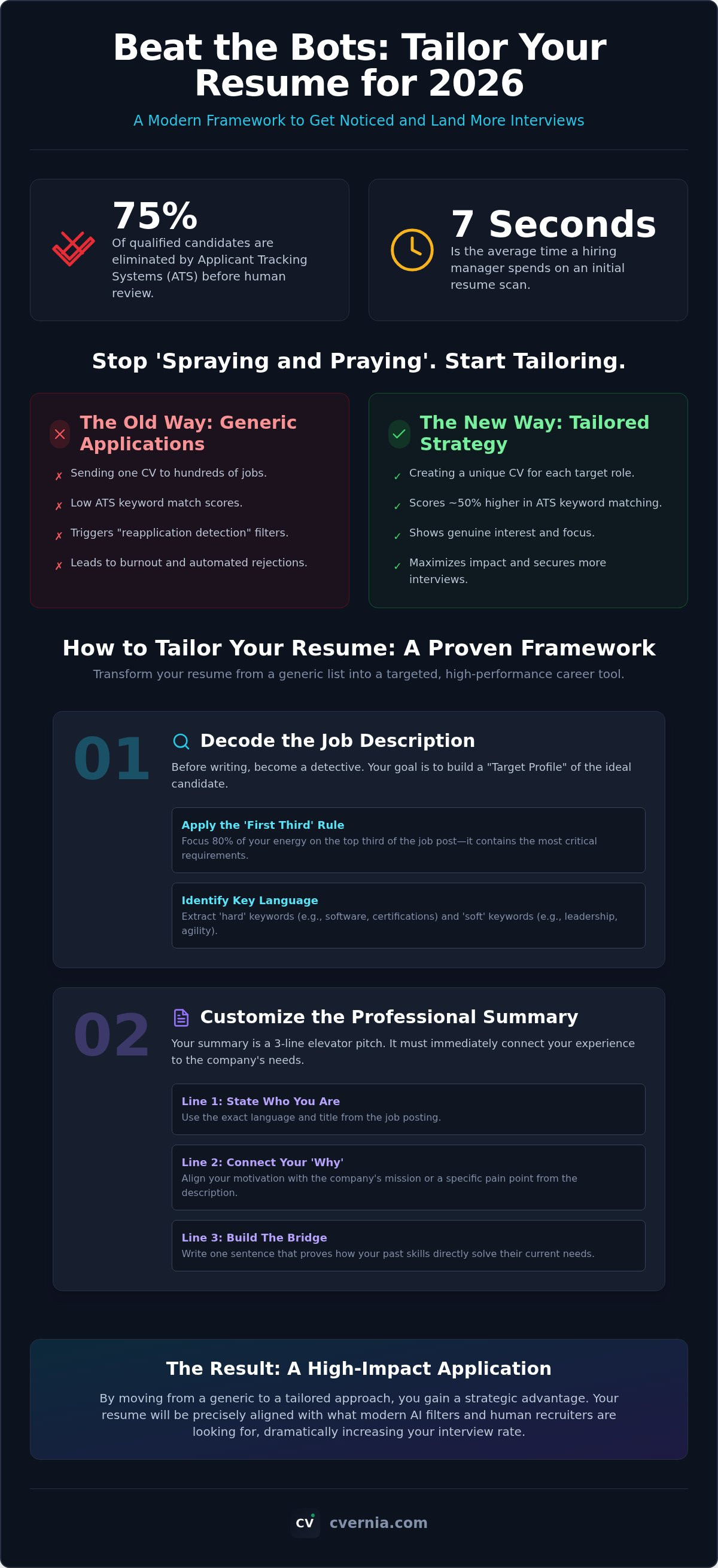
Over 75% of qualified candidates are eliminated by an Applicant Tracking System before a human ever reviews their application. It's a staggering statistic from Jobscan that highlights why the old method of sending one generic CV no longer works in 2026. You've likely felt the sting of sending a carefully crafted document into a digital void, only to receive an automated rejection or total silence. It is exhausting to lose track of which version you sent where, especially when manual formatting eats up hours of your time. Learning how to tailor your resume for each job is the only way to break through these AI filters and get noticed by hiring managers who now spend just seven seconds on an initial scan.
You need a strategic advantage that turns this manual chore into a streamlined, high-performance process. This guide provides the exact framework for customizing your resume to any job description while maintaining perfect version control and high ATS compatibility. We will walk through a repeatable system that secures higher interview rates and keeps your multiple CV versions organized in one central location. You'll gain the clarity and confidence to apply for roles knowing your documents are precisely aligned with what modern recruiters are searching for today.
Key Takeaways
- Understand why 2026 AI filters prioritize contextual relevance, requiring you to align your experience with specific job language.
- Implement a proven five-step framework for how to tailor your resume for each job to mirror employer vocabulary effectively.
- Move away from messy local folders by adopting a centralized version management system to track every unique application you send.
- Secure higher interview rates by standardizing your CV headers for bots while focusing on authentic, transferable skills.
- Use automated analysis tools to get real-time feedback on your tailoring success and ensure your CV is ready for any ATS.
Why Resume Tailoring is the High-Impact Strategy for 2026
Tailoring is the deliberate process of aligning your professional background with the specific requirements and terminology of a job description. It moves beyond simply listing the essential components of a resume and transforms your document into a targeted proposal. By 2026, the hiring landscape has fundamentally changed. A 2025 SHRM survey found that 42% of hiring teams now use AI to pre-screen candidates, a massive jump from previous years. These systems don't just look for words; they look for meaning. Research from Jobscan shows that resumes tailored to a specific role score approximately 50% higher in ATS keyword matching than generic ones. This strategic alignment ensures you aren't part of the 75% of qualified candidates rejected before a human ever sees their name.
The Shift from Keyword Stuffing to Contextual Alignment
Old-school tactics like "keyword stuffing" or hiding white text in margins are completely obsolete. Modern ATS platforms use natural language processing to understand the context of your achievements and how they relate to the role's responsibilities. Recruiters now rely on complex Boolean search strings to find candidates with specific versioned skill sets. If you're wondering **how to tailor your resume for each job ** effectively, you must focus on semantic relevance. When your summary reflects the exact pain points mentioned in the job post, it creates an immediate psychological connection with the human recruiter. During their brief seven-second scan, they need to see a candidate who solves their specific problems, not just a list of past duties. Tailoring shifts the focus from what you've done to what you can do for this specific employer.
The Cost of the 'Spray and Pray' Method
Sending out 100 generic applications is a recipe for burnout and consistent rejection. It's far more effective to send 10 highly tailored versions that speak directly to the hiring manager's needs. High-volume, low-quality applications often trigger "reapplication detection" in modern enterprise systems. If a company sees you've applied for multiple roles with the exact same document, it signals a lack of focus and genuine interest. Transitioning to a job search management system helps you break this cycle of frustration. You'll stop guessing how to tailor your resume for each job and start using a repeatable framework that saves time while maximizing impact. Quality always wins in a market where AI-enhanced parsing penalizes inconsistencies and rewards precise alignment.
How to Tailor Your Resume for Each Job: A 5-Step Framework
Generic applications are the fastest way to get lost in a digital pile. To stand out, you need a systematic approach that aligns your unique history with the specific needs of a hiring manager. This five-step framework transforms your document from a basic list into a high-performance career tool. It's about more than just swapping a few keywords; it's about proving you're the exact solution to a company's current challenges. By following this method, you'll master **how to tailor your resume for each job ** with precision and speed.
Step 1: Decoding the Job Description
Start with the 'First Third' rule. This strategy recognizes that hiring managers place the most critical requirements at the very top of the job description, meaning you should focus 80% of your energy there. Scan this section for 'hard' keywords like specific software or certifications, alongside 'soft' keywords like leadership or agility. Before you type a single word, create a 'Target Profile' that summarizes the ideal candidate the employer is searching for. This mental blueprint ensures every edit you make serves a specific purpose.
Step 2: Customizing the Professional Summary
Your summary is your elevator pitch. Use a three-line formula to hook the reader immediately. The first line should state who you are using the target role's language. The second line connects your 'Why' to the company's specific mission statement. Finally, write a single sentence that bridges your past title to the target role's requirements. This bridge proves you aren't just looking for any job; you're looking for this job. If you find yourself struggling to organize these different versions, using a career application management platform can help you keep every tailored summary perfectly organized.
Step 3: Reprioritizing Work Experience Bullet Points
Implement the 'Delete and Deploy' method. Remove tasks that don't serve the new role to make room for relevant wins. Use the STAR method (Situation, Task, Action, Result) to echo the job duties mentioned in the ad. If the role requires seniority, adjust the scope of your verbs. Instead of saying you "helped with projects," say you "spearheaded cross-functional initiatives." This subtle shift in vocabulary signals that you're ready for the level of responsibility they're hiring for.
Quantify every achievement to provide concrete proof of your value. If the job ad mentions a need for efficiency, highlight how you reduced costs by 15% or saved ten hours of manual work per week. Numbers catch the eye during a seven-second scan and provide the evidence AI filters crave. Before you finish, verify your document's ats compliant resume status. Running a final check ensures your formatting hasn't broken during the tailoring process, giving you the confidence to hit send.
Mastering Version Management: Organizing Your Tailored Applications
Once you understand how to tailor your resume for each job, you face a new logistical challenge: managing the volume of documents you produce. Version Management is the professional practice of tracking every unique resume iteration sent to different employers. It is no longer enough to have one "master" file. In 2026, successful candidates treat their application history as a database of strategic interactions. Without a clear system, you risk 'Resume Chaos,' a state where you lose track of which specific skills or keywords you emphasized for a particular role. This confusion doesn't just waste time; it actively undermines your credibility during the hiring process.
The Problem with 'Final_v2_Copy' File Naming
Relying on local folder structures and vague filenames like "Resume_Marketing_Final_v2" is a recipe for disaster. This disorganized approach takes a heavy psychological toll, increasing the stress of an already demanding job search. You should never send a resume without knowing exactly which bullet points and metrics are included in that specific version. If a recruiter calls you for a screening, you must be able to reference the exact document they are holding. A centralized platform manages this process automatically, ensuring that every tailored draft is linked to its corresponding job description. This level of organization transforms your workflow from a frantic search for files into a streamlined, professional operation.
Linking Versions to Interview Preparation
Your tailored CV acts as the 'script' for your interview answers. If you highlighted your project management skills for Company A but focused on technical coding for Company B, your interview stories must match those specific emphases. Consistency is key to building trust with a hiring manager. Integrating job interview note management into your routine ensures you stay aligned with the version the recruiter is reviewing. Review the specific iteration you sent right before the call to refresh your memory on the exact "wins" you promised to deliver. This preparation prevents the awkwardness of being asked about a metric you forgot you included in that particular version.
Smart handling of reapplications is another critical component of modern version control. Enterprise ATS platforms like Workday or Greenhouse often flag when a candidate submits a new CV to a company that already has an older version on file. Instead of worrying about these systems, use them to your advantage. A well-managed version history allows you to show growth and specific interest. When you know how to tailor your resume for each job while tracking your history, you can reference your previous application as a baseline for your current, more advanced qualifications. This demonstrates persistence and a clear upward trajectory in your career.
- Move away from local desktop folders to a centralized dashboard.
- Use naming conventions that include the company name and date.
- Always keep the specific job description attached to the resume version you sent.
- Review your tailored bullet points 15 minutes before every interview call.
Tailoring for ATS Compatibility Without Sacrificing Truth
Optimizing your application for technology shouldn't mean losing your integrity. While you are learning how to tailor your resume for each job ****, it is tempting to mirror every single keyword to achieve a perfect match. However, 2026 recruitment AI is sophisticated enough to detect "keyword stuffing" and penalize documents that feel robotic or manufactured. A 100% compatibility score is often a myth; aiming for an 85% to 90% match is usually more effective and looks more authentic to human recruiters. Your goal is to pass the digital gatekeeper while remaining entirely truthful about your qualifications.
Formatting is the most common reason for silent rejections. By 2026, there is a dominant return to single-column layouts because they are the most reliable for parsing across all major ATS platforms. Avoid using tables, text boxes, or images, as these elements often scramble the text during the upload process. You must also standardize your headers. While "My Professional Journey" sounds creative, a bot specifically looks for "Experience" or "Work History." Using non-standard headings can cause the system to skip over your entire career section, regardless of how well you've tailored the content within it.
The Ethics of Truthful Tailoring
Integrity is the foundation of a successful career. CVernia maintains a strict stance against inventing skills or falsifying data because a single lie can permanently damage your professional reputation. Instead of fabrication, use "Skill Mapping" to translate your value. If you are pivoting from hospitality to project management, focus on how your experience managing high-volume shifts applies to resource allocation and deadline management. Strategic tailoring allows you to highlight these transferable wins without ever compromising the truth. It turns your history into a relevant narrative that proves your readiness for a new challenge.
Scanning for Success
Before you submit, perform a 60-second manual check. Copy your resume text and paste it into a plain text editor. If the words are out of order or symbols appear as gibberish, your formatting will fail the ATS. To reinforce your resume's message, use a tailored cover letter generator to ensure your entire application package speaks with a unified voice. This consistency proves you've done your homework and are genuinely interested in the role.
Check your final document for ATS-safe fonts like Calibri, Arial, or Georgia. These are designed for digital readability and ensure your text remains clear after parsing. Once you've verified your layout and content, you are ready to apply with confidence. If you want to take the guesswork out of this process and ensure every application is perfectly optimized, explore our CV compatibility and ATS analysis tools today.
Scaling Your Job Search with CVernia’s Tailoring Tools
Mastery of the strategic framework is only half the battle. To truly succeed in the 2026 hiring market, you need a system that scales your efforts without sacrificing quality. Once you understand how to tailor your resume for each job, the next logical step is efficiency. CVernia provides the infrastructure that transforms a manual, time-consuming chore into a streamlined professional workflow. We centralize your entire journey, from the moment you create your first tailored draft to the day you sign your final offer letter. This organization eliminates the mental fatigue of tracking multiple versions and allows you to focus on what matters most: your performance.
Take advantage of automated ATS analysis to receive real-time feedback on your tailoring efforts. Our platform doesn't just check for keywords; it analyzes the contextual alignment of your experience against the job description. This ensures your CV is ready for the sophisticated AI filters used by modern enterprise recruiters. Additionally, our smart reapplication detection knows exactly when you should update your version for a repeat employer. If a company already has an older document on file, the system prompts you to highlight your recent growth, turning a potential hurdle into a strategic advantage.
Beyond the CV Builder: A Complete Management Platform
Tracking your progress is just as important as the tailoring itself for long-term career growth. An integrated dashboard allows you to manage interview notes, attachments, and specific CV versions in one secure place. This centralized approach ensures you never walk into an interview unprepared or inconsistent. You can also access our Career Academy for advanced application strategies that go beyond the document. We help you maintain consistency across LinkedIn and other sites, ensuring your professional brand is unified across every digital touchpoint. We provide the tools that make learning how to tailor your resume for each job a repeatable, high-yield habit rather than a daily struggle.
Start Your Tailored Journey Today
Preparation is the key to confidence. Before you hit send on your next application, use this CVernia "Ready-to-Apply" checklist to ensure total alignment:
- Verify that your professional summary bridges your past experience to the new role requirements.
- Confirm that your bullet points lead with quantified achievements that solve the employer's specific pain points.
- Run a final ATS compatibility check to ensure your formatting is bot-safe.
- Save the version to your dashboard with a clear, company-specific name for future interview prep.
Setting up your first version-controlled application takes only minutes but saves hours of future stress. You deserve a job search that feels organized, empowered, and efficient. Stop fighting the technology and start using it to your advantage.
Optimize your application journey with CVernia's tailoring tools.
Take Control of Your Career Path Today
Mastering the modern job market requires more than just a list of past duties. It demands a strategic, organized approach to how you present your professional value. You now have the framework for how to tailor your resume for each job with precision; ensuring every application you send is a targeted proposal. By moving away from disorganized file names and embracing a centralized version management system, you eliminate the stress of "Resume Chaos" and step into every interview with total consistency. Authenticity remains your greatest asset. We help you highlight your transferable wins through a 100% truthful representation of your career history.
Your journey from uncertainty to readiness starts with the right tools. Our platform provides an integrated ATS compatibility checker and smart reapplication detection to keep your strategy sharp and your documents optimized. Don't let your hard-earned experience get lost in a digital void. Start tailoring your resume for success with CVernia's management platform. You have the skills and the strategy; now it's time to secure the role you deserve.
Frequently Asked Questions
How much should I change my resume for each job application?
You don't need a total rewrite for every submission. Focus your energy on the "First Third" of the document, specifically the professional summary and your most recent work experience bullet points. Aim for approximately 80% alignment with the core competencies listed in the job post. This targeted approach ensures immediate relevance for the recruiter without requiring hours of manual editing for every single role.
Is it okay to have multiple versions of my resume for different industries?
It's a strategic necessity to maintain different versions if you're targeting multiple career paths. If you apply for both Project Management and Operations roles, your achievements must be framed through different lenses to highlight specific industry wins. Keeping these distinct versions organized allows you to pivot your strategy quickly while ensuring your core professional history remains consistent and accurate across all applications.
Can I use AI to tailor my resume without getting flagged by recruiters?
Use AI as a digital mentor for analysis rather than a replacement for your own voice. Recruiters often flag content that feels robotic or lacks specific professional nuance. When learning how to tailor your resume for each job, use tools like CVernia to identify keyword gaps and contextual relevance. This data-driven approach helps you pass ATS filters while keeping your unique personality and integrity intact.
How do I manage different resume versions without getting confused?
Stop relying on local desktop folders and vague filenames like "Final_v2." Use an application tracking dashboard to link every unique resume version directly to its corresponding job description. This centralized system ensures you always know exactly which document a recruiter is holding when they call. It eliminates the stress of searching through files and allows you to prepare for interviews with total confidence.
Do I need to tailor my resume if I'm applying for a similar role as my current one?
Yes, because every company uses a unique internal vocabulary to describe their challenges. One hiring team might prioritize "cross-functional collaboration" while another focuses on "stakeholder management." Even for identical roles, tailoring ensures you speak the specific language of the target company. This alignment proves you've done your research and are ready to integrate into their specific corporate culture immediately.
What is the fastest way to tailor a resume for an ATS?
Identify the top three requirements in the job description and mirror that exact terminology in your professional summary. Use standard section headers like "Experience" and a clean, single-column layout to ensure the bot parses your data correctly. Utilizing automated CV compatibility and ATS analysis tools is the most efficient way to verify your tailoring efforts in seconds, preventing common formatting rejections.
Should I tailor my resume even if I'm applying through a referral?
You should always tailor your document, even with an internal recommendation. While a referral gets you through the door, your resume must still justify the hire to the rest of the interviewing team. A precisely tailored CV makes your referrer look good by proving you are a perfect match for the role's requirements. It demonstrates professional respect for the company's hiring process and standards.
How do I know if my tailored resume is actually working?
Monitor your application-to-interview ratio over a period of several weeks. If you see a consistent increase in recruiter callbacks after implementing a system for how to tailor your resume for each job, your strategy is successful. Use a version management dashboard to track which specific iterations generate the most interest. This data allows you to refine your approach and focus on the "wins" that resonate most with employers.


