
Imagine sitting in your final interview for a dream role when the hiring manager asks how you'd solve the specific departmental bottleneck mentioned three weeks ago. You search your memory, but that crucial detail is lost in a sea of disorganized digital stickies and outdated spreadsheets. It's a common hurdle that stalls even the most qualified professionals. You're balancing different company cultures and complex interview rounds, and without a dedicated system for job interview note management, your best insights often vanish when you need them most.
We believe that your preparation should be as sophisticated as your experience. You deserve a centralized hub that turns every conversation into a strategic advantage. This 2026 checklist shows you how to master your interview insights so you can walk into every meeting with total confidence. We'll explore how to link notes to specific CV versions, prepare for deep-dive second rounds, and gather the exact data points required to win at the salary negotiation table. It's time to stop reacting to questions and start leading the conversation.
Key Takeaways
- Implement a systematic approach to job interview note management to combat the forgetting curve and maintain clarity across multiple hiring rounds.
- Identify the specific cultural cues and technical challenges you must record to build a strategic advantage for your follow-up conversations.
- Avoid the spreadsheet trap by moving your data to a centralized platform that prioritizes security and prevents information fragmentation.
- Master the "Golden 15" rule and the STAR method to capture high-value insights immediately after your interview ends.
- Secure a competitive edge by linking your session notes directly to the specific CV and cover letter versions used for each application.
The Strategic Role of Job Interview Note Management in 2026
Hiring cycles in 2026 are increasingly complex. You aren't just attending a meeting; you're participating in a multi-stage job interview process that can last several weeks. Effective job interview note management transforms these interactions from fleeting conversations into a permanent data asset. It's the systematic capture and retrieval of every insight, challenge, and cultural nuance shared during your candidacy. By treating your notes as a structured database, you ensure that every detail remains accessible when the stakes are highest.
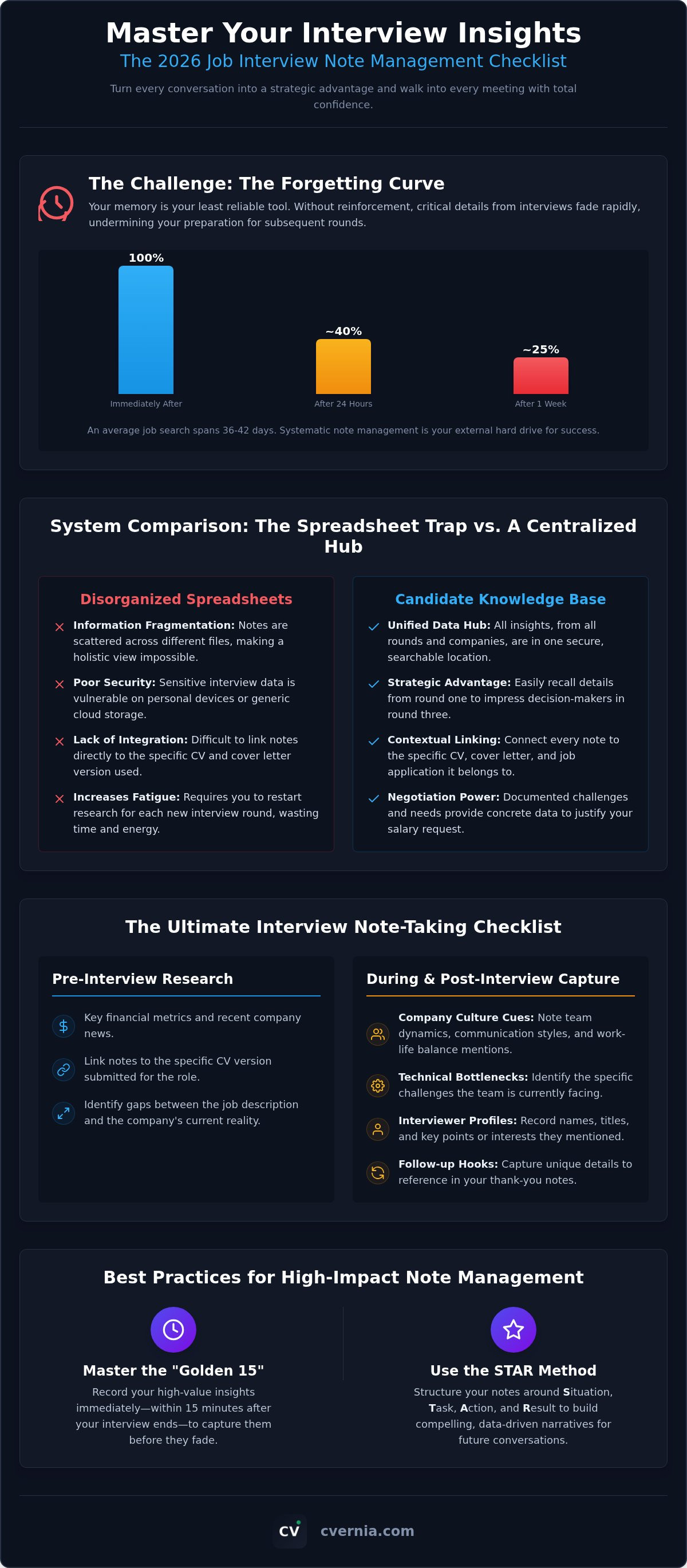
Memory is your least reliable tool during a high-stakes job search. Science highlights the "Forgetting Curve," where we lose nearly 70% of new information within 24 hours if it isn't reinforced. When the average time-to-fill for a role spans 36 to 42 days, relying on your brain alone is a recipe for contradictions. Organized notes act as your external hard drive. They ensure you don't mix up the specific pain points of one company with the culture of another. This clarity reduces interview fatigue because you won't have to restart your research every time you reach a new round.
Your notes are also your best leverage for salary negotiations. By documenting specific technical challenges the team faces, you can quantify the value you bring. You're no longer just asking for a number; you're proposing a solution based on their own stated needs. High-quality data allows you to align your compensation request with the scale of the problems you're being hired to solve.
Moving Beyond the Scribbled Notepad
Stop treating your notes like a diary and start treating them like a Candidate Knowledge Base. Modern hiring managers expect data-driven responses that align with their current roadmap. Passive listening isn't enough anymore. You must actively collect data points on team structure, budget ownership, and upcoming product launches. This transition from passive recording to active data management ensures your answers remain consistent across every department interaction. It turns you from a candidate into a consultant who understands the business landscape.
The Impact on Your Professional Brand
Your preparation is a direct reflection of your future performance. When you reference a specific comment made by a peer in round one while speaking to a Director in round three, you build immediate rapport. It signals that you're attentive, organized, and deeply invested in the role. You'll demonstrate high-level organizational skills by asking follow-up questions that connect the dots between different stakeholder perspectives. Strategic Note Management is the bridge between application and offer; it turns raw information into the persuasive narrative that gets you hired.
The Ultimate Interview Note-Taking Checklist: What to Record
Capturing data is about more than just remembering names. It's about building a strategic dossier that gives you an edge over other candidates. Effective job interview note management requires a structured approach to identifying what actually matters. You aren't just looking for facts; you're looking for the gaps between what a company says and what it actually does. Start by documenting Company Culture Cues. Pay attention to how the interviewer describes the team versus how they actually interact with colleagues during the session. If they mention a "fast-paced environment," record whether that sounds like healthy growth or chronic understaffing.
Next, pinpoint the Technical Requirements and current bottlenecks. Ask what the team is struggling with right now. These specific challenges are the keys to your second-round strategy. Alongside this, build Interviewer Profiles. Record names, titles, and key professional interests. Did they mention a specific industry trend? Use that. Don't forget the "Vibe Check." Your gut reaction to the team dynamic and workspace is a valid data point that belongs in your records. Finally, identify Follow-up Hooks. These are specific, niche points mentioned that you can reference in your thank-you emails to prove you were truly listening. Success in 2026 depends on your ability to connect your pre-interview research with your live performance. This level of job interview note management ensures that no detail is left to chance.
The Pre-Interview Research Checklist
Before the call begins, your research needs a dedicated home. Record key financial metrics or recent news that might impact the department. This is the time to identify "Job Description vs. Reality" gaps. Many roles change between the time the ad is posted and the first interview. Ensure you've linked your ats compliant resume to specific talking points. Most candidates fail to track which version of their CV they used for a specific role. By linking your notes to the exact document the recruiter is holding, you prevent embarrassing contradictions in later rounds. It shows you're organized and prepared for the modern hiring landscape.
Post-Interview Reflection Points
The moments after the screen goes dark are your most valuable. Reflect on which of your answers resonated most with the panel. If a specific story about project management landed well, mark it for future rounds. Conversely, note the questions that caught you off guard. This raw data is perfect for later review. Document the next steps and promised timelines mentioned by the recruiter so you can follow up with precision. Using an integrated interview tracker helps you manage these details without the stress of manual spreadsheets. You'll move from one round to the next with total clarity and a clear path to the offer.
Comparing Management Systems: Spreadsheets vs. Centralized Platforms
You've likely started your job search with a basic spreadsheet. It feels organized at first. However, as your applications grow, the "Spreadsheet Trap" begins to snap shut. Manual entry leads to data fragmentation. You end up with notes in one place, CVs in another, and follow-up dates on a separate calendar. This disconnect is the enemy of effective job interview note management. You need a system where every piece of data talks to the others. A fragmented approach doesn't just waste time; it creates mental clutter that can sabotage your performance.
Security is another critical factor in 2026. When you record sensitive company information or internal challenges mentioned during a call, you can't leave that data in an unencrypted file. Centralized platforms provide the professional-grade security required to protect your intellectual property and your candidate reputation. Beyond safety, searchability is key. You should be able to find a specific mention of a software version or team structure from three months ago in seconds. A search bar is far more efficient than scrolling through endless rows of a spreadsheet.
Version control is perhaps the most vital feature missing from traditional tools. Most candidates lose track of which specific CV version they sent to which recruiter. If you don't link your notes to the exact document the interviewer is looking at, you risk appearing inconsistent. A centralized platform ensures your insights are always tied to the right application version. This alignment builds the confidence you need to handle complex, multi-stage hiring cycles without missing a beat.
Why Spreadsheets Fail at Scale
Spreadsheets are essentially flat files. They struggle when you try to attach documents, screenshots of job ads, or recruiter emails to a single cell. You'll also miss out on automated reminders for follow-ups. This is why specialized job search management systems are rapidly replacing the old Excel tracker. They offer a multidimensional view of your career progress that a grid simply can't match. You deserve a tool that grows with your ambitions, not one that holds you back with manual upkeep.
The Digital Advantage of Centralized Platforms
Modern platforms give you real-time access across all devices. If you're taking a mobile interview while traveling, your full history is at your fingertips. These systems also facilitate automated linking between the job description and your session notes. This data doesn't just help you today. It powers "Smart Reapplication Detection" for the future. If you apply to the same company a year from now, you'll immediately see exactly what was discussed in your previous rounds. This long-term data strategy turns job interview note management into a permanent career asset.
Best Practices for Interview Prep and Post-Session Analysis
Most candidates treat note-taking as a task that ends the moment they hang up the call. In reality, your most valuable work begins during the "Golden 15." These are the 15 minutes immediately following your session where sensory details and subtle cues are still vivid. Use this window to perform a brain dump of everything that didn't make it onto your page during the live conversation. Effective job interview note management relies on this immediate reflection to capture the nuances of the team dynamic that your brain will naturally filter out by the next morning.
Apply the STAR method (Situation, Task, Action, Result) to your own performance notes. Instead of just recording what the interviewer said, document how you delivered your key stories. Did you miss a crucial metric in your "Result" section? Mark it down. This self-audit ensures that your second-round performance is more polished than the first. You'll also want to look for recurring themes in the questions asked. If three different people ask about your experience with conflict resolution, it's a clear signal that the team might be navigating internal friction. Documenting these patterns helps you prepare a strategic narrative for the final hiring manager.
Handling "off-the-record" information requires a professional touch. If an interviewer shares sensitive details about a departmental struggle or a predecessor's departure, record it for your own decision-making but keep it out of your formal follow-up emails. Analyzing these moments allows you to spot interviewer bias or systemic issues early. You're not just being interviewed; you're gathering intelligence to decide if this environment aligns with your career goals. To streamline this process, you can organize your interview insights with CVernia to ensure your analysis is always linked to the right application.
During the Interview: Note-Taking Without Distraction
Maintain your professional presence by using the "Keyword Method." Instead of transcribing full sentences, jot down single words that trigger larger ideas. This keeps your eyes on the interviewer and prevents the conversation from feeling like an interrogation. Always ask for permission by saying, "Do you mind if I take a few notes as we talk?" It shows respect for their time and signals that you value the information they're providing. Choose your medium based on the company culture. A tech startup might prefer a digital tablet, while a traditional law firm might respond better to a classic leather-bound notebook.
The Audit: Reviewing Your Notes for Red Flags
Once you've completed multiple rounds, perform a total audit of your records. Look for inconsistencies in what different team members told you about the role's daily responsibilities. If the recruiter promises remote flexibility but the department head emphasizes "face time," you've spotted a major red flag. This analysis helps you identify "cultural debt" or high turnover warnings before you sign an offer. Ultimately, your job interview note management system should give you the data required to walk away from a bad fit just as easily as you'd accept a great one.
Optimizing Your Journey with CVernia’s Integrated Note Management
Managing a modern career requires more than just a good memory. It demands a centralized hub where your preparation and performance data live in perfect alignment. The job interview tracker provided by CVernia does exactly this. It eliminates the friction of jumping between different apps and physical notebooks. By housing your data in one secure location, you turn the chaotic job search process into a streamlined workflow. You'll move from one application to the next with the confidence that your best insights are always within reach.
A major advantage of this system is the ability to manage attachments alongside your reflections. Whether it's a technical task assignment, a presentation deck, or a specific portfolio version, CVernia keeps everything in one place. This integration is vital for job interview note management because it provides the full context of your candidacy. You won't just remember what you said; you'll see the exact materials you used to support your claims. This level of organization ensures that your professional brand remains consistent and high-impact throughout the entire hiring cycle.
Beyond the immediate interview, our platform supports your long-term growth through the Career Academy. This resource library helps you turn interview feedback and post-session analysis into actionable skills. If your notes reveal a recurring challenge with specific technical questions, the Academy provides the learning resources to bridge that gap. You aren't just tracking jobs; you're actively building a more competitive professional profile for the future.
Smart Tracking for the Modern Job Seeker
Eliminate the "where did I save that?" panic that often strikes right before a final round. CVernia’s unified dashboard ensures that your pre-interview research and live session notes are always visible. Version management is a core feature here. It ensures you never contradict your previous interview answers because you can see exactly which CV version the recruiter is referencing. Having this data on one unified dashboard allows you to focus on the conversation rather than worrying about your records. It's a professional-grade solution for a high-stakes transition.
Your Strategic Ally in Career Advancement
CVernia acts as your strategic ally by supporting truthful and accurate representation through organized record-keeping. A searchable interview history is a goldmine for your future self. It allows you to track your progress over months or even years, identifying which strategies lead to the best offers. This long-term data strategy transforms your job search from a series of random events into a deliberate career path. It's time to take control of your data and your future. Start managing your interview journey with CVernia today to experience the power of integrated career management.
Take Command of Your Career Data
Transforming your interview experience starts with a shift in mindset. You've learned that capturing cultural cues and technical bottlenecks is essential for winning second rounds and negotiating higher salaries. By moving away from fragmented spreadsheets and embracing a centralized system, you ensure that every insight is linked to the correct CV version. Mastering job interview note management is the final step in moving from a reactive applicant to a proactive professional who leads the conversation with data and confidence.
You don't have to navigate the complexities of 2026 hiring alone. CVernia provides the tools you need to stay organized, including Smart Reapplication Detection and Centralized Interview Notes & Attachment Management. Trusted by professionals for modern career management, we help you turn every interaction into a strategic asset. Master your interview data with CVernia and secure the role you deserve. Your dream career is within reach, and your organized history is the key to unlocking it. Walk into your next round with total clarity.
Frequently Asked Questions
Is it professional to take notes during a job interview?
It's highly professional to take notes as it demonstrates active listening and a serious interest in the role. Most hiring managers view note-taking as a sign of organizational strength and attention to detail. Just ensure you ask for permission first to maintain a respectful rapport. This small gesture establishes you as a candidate who values the interviewer's time and insights.
How much detail should I include in my interview notes?
Focus on capturing high-value data points rather than transcribing the entire conversation. Record specific team challenges, cultural nuances, and the names of stakeholders mentioned. You should also jot down any technical bottlenecks the department is currently facing. These details are the foundation of effective job interview note management, allowing you to tailor your responses in later rounds with precision.
Can I use a laptop for note-taking in a face-to-face interview?
Use a notebook or a tablet with a stylus for face-to-face interviews to maintain better eye contact. A laptop screen can create a physical barrier that disrupts the personal connection between you and the interviewer. If you're interviewing for a highly technical role, a laptop might be acceptable, but it's always safer to ask about the company's preference before the session begins.
What is the best way to organize notes for multiple job applications?
Use a centralized career management platform to keep your data organized across multiple applications. Spreadsheets often fail as your search scales because they can't easily link notes to specific CV versions. A dedicated dashboard allows you to track every interaction, attachment, and follow-up date in one secure location. This approach ensures you never mix up company-specific details during a high-volume search.
How do I use my interview notes to write a thank-you email?
Identify specific hooks from your notes that reference unique points discussed during the call. Mentioning a specific challenge the interviewer shared or a project they're excited about proves you were truly engaged. This level of personalization sets your thank-you email apart from generic templates. It reinforces your professional brand by showing you've already started thinking about how to solve their problems.
Should I share my interview notes with anyone else?
Keep your interview notes private to protect your strategic advantage and the company's sensitive information. These records are your personal intelligence for decision-making and negotiation. Sharing them could lead to a breach of confidentiality if an interviewer shared off-the-record details. Treat your notes as a secure asset that belongs solely within your personal job interview note management system.
How long should I keep my interview notes after the process ends?
Retain your notes for at least one to two years, even if you don't get the job. This history is invaluable if you apply to the same company in the future or a similar role elsewhere. Your records help you track your professional growth and identify recurring patterns in your interview performance. Having a searchable history turns every past interview into a learning opportunity for your next career move.
What happens if I forget to take notes during the interview?
Perform a comprehensive brain dump immediately after the interview while the details are still fresh. Spend 15 minutes recording everything you remember about the questions asked, the team's energy, and any promised next steps. While taking notes during the session is ideal, this post-interview reflection still provides the data you need for follow-ups. Just make it a priority to capture these thoughts before the forgetting curve sets in.


