
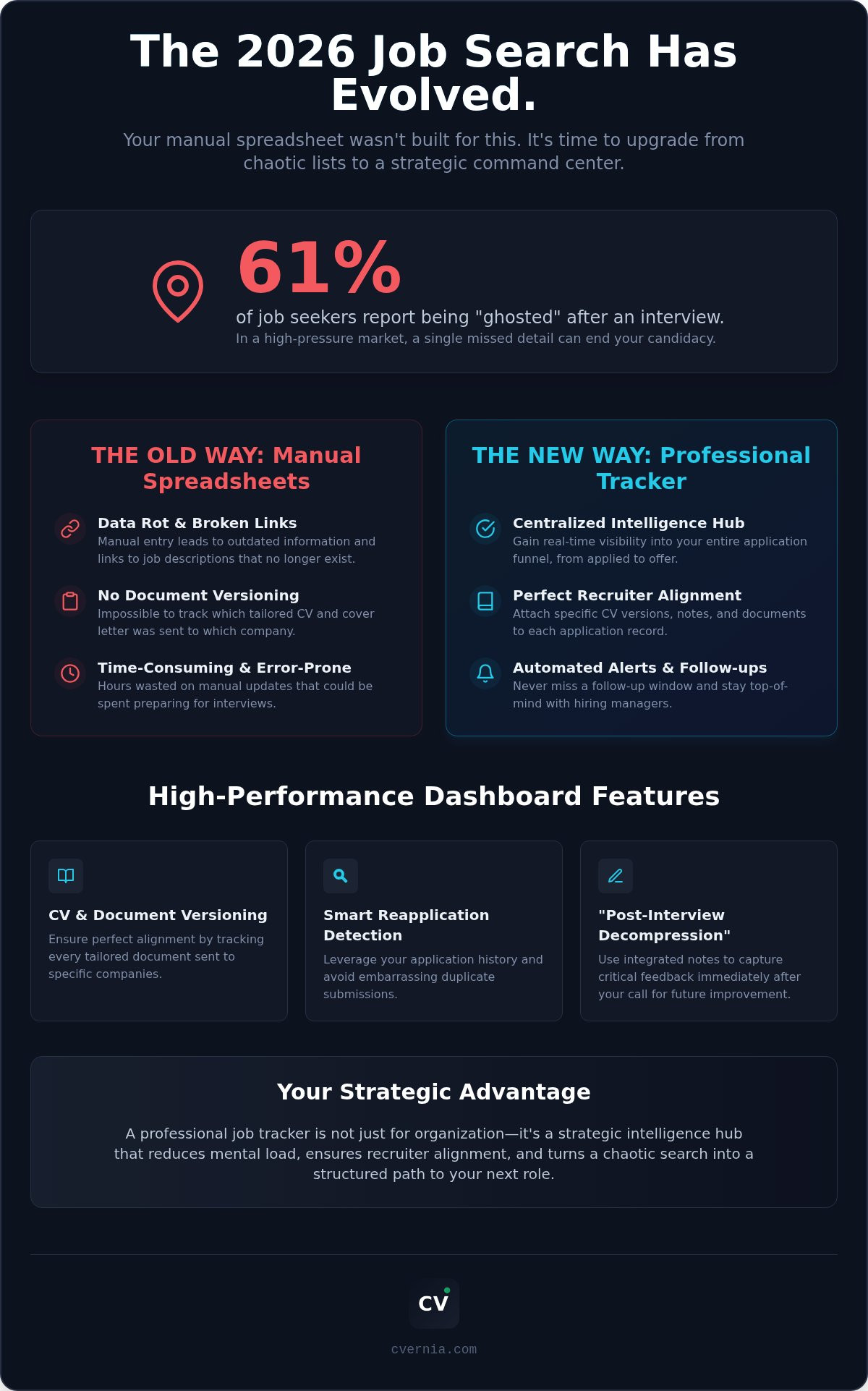
61% of job seekers report being ghosted after an interview in 2026. This statistic reflects a high-pressure market where losing track of a single detail can end your candidacy before it truly begins. You likely feel the frustration of digging through endless emails just to find the right **job interview tracker ** data or the specific CV version you sent to a recruiter. Manual spreadsheets are no longer enough to keep up with the speed of modern hiring. They consume hours of your valuable time and often lead to missed connections when you are already feeling overwhelmed by the search.
Discover how a professional tracking dashboard transforms your interview success rate and restores your confidence. We will show you how to centralize every application status so you know exactly where you stand at a glance. You will learn to manage tailored documents and interview notes with precision, ensuring you are always prepared for the next round. This guide also covers how automated alerts for follow-ups can keep you top-of-mind for hiring managers. Move beyond simple lists and start using a strategic system that works as hard as you do.
Key Takeaways
- Transition from basic lists to a strategic intelligence hub that reduces the mental load of your 2026 career search.
- Ensure perfect recruiter alignment by tracking every tailored CV version and document sent to specific companies.
- Discover the ROI of a professional job interview tracker compared to time-consuming manual spreadsheets and basic templates.
- Use the "Post-Interview Decompression" method to capture critical feedback immediately after your call for better future performance.
- Optimize your strategy with smart reapplication detection to leverage your application history and avoid embarrassing duplicate submissions.
Why Your 2026 Job Search Needs a Professional Job Interview Tracker
The job market in 2026 is faster and more competitive than ever. With applications per opening having doubled since 2022, your success depends on how you manage information. A professional job interview tracker is no longer just a list of companies. It's a strategic dashboard that functions as your personal command center. When you juggle multiple interview stages, the mental load becomes a heavy burden. Forgetting a recruiter's name or missing a follow-up window isn't just a small mistake; it's a lost opportunity. Reduce your anxiety by centralizing your data to create a clear roadmap of your progress.
Think of your search as a high-stakes project. Just as recruiters use an Applicant Tracking System (ATS) to filter and manage candidates, you need a mirror system to manage them. Relying on memory or messy browser tabs leads to a passive approach. You must transition to active application management where you control the narrative of your career journey. This shift allows you to stay organized, efficient, and highly dependable throughout the entire process.
The Death of the Job Search Spreadsheet
Excel and Google Sheets were never designed for the complexity of a modern career transition. Manual entry often leads to data rot, where dates are wrong and links to job descriptions break. You can't easily attach a specific CV version to a row in a spreadsheet. This makes it nearly impossible to remember exactly what you promised a recruiter during that first screening call. Static spreadsheets fail because they cannot adapt to the dynamic, multi-stage nature of 2026 hiring cycles.
Benefits of a Centralized Career Application Management Platform
Gain real-time visibility into your entire application funnel by using a dedicated management platform. You can see exactly how many roles are in the Applied stage versus how many have moved to Interview or Offer. This bird's-eye view helps you maintain a consistent professional brand. When you track dozens of applications, you need to ensure your tone and documents remain aligned with each unique role. Identify patterns in your success by reviewing centralized data within your job interview tracker. If you notice you're getting interviews but no offers, you can adjust your strategy based on the specific feedback stored in your dashboard. This level of insight turns a chaotic search into a structured path toward your next role.
Essential Features of a High-Performance Tracking Dashboard
A high-performance job interview tracker does more than just log dates; it maintains the integrity of your professional story across every interaction. Precision is everything in 2026. When you manage dozens of applications, the risk of sending the wrong document version or forgetting a specific keyword increases. Your dashboard should offer robust version management so you know exactly which CV was sent to which recruiter. It's vital to have integrated interview notes that provide a dedicated space for pre-interview research and post-interview reflections. This ensures you never walk into a meeting feeling unprepared or forget the feedback you received during a screening call.
Organization requires keeping every piece of the puzzle in one place. Attachment management allows you to link job descriptions and offer letters directly to the specific application entry. This prevents the panic of a deleted job posting just before your interview. Even large-scale government platforms emphasize that you should track the status of your application to remain proactive. Additionally, smart reapplication detection identifies when you've engaged with a brand previously. This prevents the embarrassment of duplicate applications and allows you to leverage your existing history with a company to stand out.
Document Tailoring and ATS Integration
Your tracker must bridge the gap between organization and optimization. Every application should store your ATS compliant resume score to help you understand why certain roles are moving forward. By saving the specific keywords used for every unique role, you can speak confidently about your skills during the interview. Linking your tailored cover letter generator outputs directly to the record ensures your messaging remains consistent. Start organizing your search today with our Application Tracking Dashboard .
Automation and Smart Notifications
The average job search now takes nearly five months, making follow-up reminders essential to stay top-of-mind. Automation removes the "drag and drop" fatigue that often leads to abandoned tracking. Professional platforms offer automated status updates and superior data security compared to public templates. Choosing a job interview tracker that prioritizes privacy ensures your sensitive career data remains protected while you focus on landing your next role. Reliable alerts ensure you never miss a follow-up window, keeping your momentum high throughout the 108-day median search period common in 2026.
Comparison: Manual Spreadsheets vs. Notion vs. Professional Platforms
Choosing your primary tool is the first strategic decision you make in a job search. While a manual spreadsheet seems cost-effective, it often becomes a burden as your application volume grows. A high-quality job interview tracker should simplify your life, not add more administrative tasks to your plate. Consider how much time you spend copy-pasting data versus actually preparing for your next big role. Professional platforms offer a return on investment that basic templates simply can't match, especially when you need to Stay organized throughout your job search to remain competitive.
Scalability is where the divide between tools becomes most apparent. A simple list might handle five applications, but what happens when you reach fifty or five hundred? Manual systems break down under pressure, leading to missed follow-ups and lost documents. Professional dashboards are built for high-speed hiring markets, ensuring that mobile accessibility and ease of use remain consistent whether you're at your desk or on the go. Integration depth is another critical factor. Your tracking tool shouldn't remain isolated; it should talk directly to your CV builder and document storage to create a seamless workflow.
The 'Free' Tool Trap
Free tools often hide their true costs in the form of lost time and missed opportunities. Manual tracking requires constant attention to detail, which increases the risk of version confusion. If you're managing separate spreadsheets and file folders, it's easy to lose track of which CV was sent to which recruiter. Automated systems reduce the "Time to Update" from minutes to seconds. This efficiency allows you to focus on high-value activities, like networking and interview prep, rather than data entry. Don't let a "free" tool become the bottleneck that stops you from landing your dream job.
Why Professional Platforms Win for Career Advancement
Professional platforms provide a foundation for long-term career success. They offer long-term data retention through features like Smart Reapplication, allowing you to leverage your history in future searches. By using a comprehensive job search management system , you gain a significant psychological edge. You feel more in control and less overwhelmed by the process. You also gain access to integrated resources like a Career Academy, which helps you sharpen your skills while you track your progress. This holistic approach ensures you aren't just looking for a job, but actively building a career.
How to Use Your Tracker to Win the Interview Stage
Your job interview tracker should function as a living playbook rather than a static archive. Success in the final stages requires more than just showing up; it demands organized intelligence. Use your dashboard to store pre-interview research, including specific "Questions to Ask" and deep-dives into company initiatives. Having this data at your fingertips prevents the common "brain fog" that occurs under pressure. It ensures you walk into every meeting with the authority of a candidate who has done their homework.
Execute a "Post-Interview Decompression" within 30 minutes of every call. Memory fades quickly, and critical details about cultural fit or technical concerns can be lost by the next morning. Record your immediate reflections while the conversation is still fresh. This practice is essential because the median time to an offer has reached 108 days in 2026. If a recruiter calls you back three weeks later for a follow-up, your notes will be the only thing standing between you and a generic, forgettable conversation.
Organization extends to your digital assets as well. Link your portfolio links, presentation decks, and specific case studies directly to the application entry. This prevents the panic of searching through folders while a hiring manager waits on the line. Finally, use your tracker to time your follow-up strategy with precision. Send your "Thank You" notes within 24 hours and schedule follow-up pings based on the timeline the recruiter provided. This structured approach keeps you top-of-mind without appearing desperate.
Interview Notes: Your Secret Weapon
Track specific data points that spreadsheets often ignore. Document the names of every interviewer, the specific concerns they raised, and any cues about the company culture. Over time, these entries become a repository of your best answers. If you identify a recurring technical gap in your interviews, link your performance notes to Career Academy learning resources to sharpen your skills before the next round. Refine your approach by analyzing why certain stories resonated more than others. Start mastering your interview performance with our tracking tools.
Managing Multiple Offer Stages
Handling three or four active interview loops requires military-grade organization. Use your dashboard to compare salary ranges, benefits packages, and company culture side-by-side. This bird's-eye view helps you avoid interview overlaps and the travel fatigue that can derail your performance. When you reach the negotiation stage, your historical data becomes your strongest leverage. You can confidently discuss your value by referencing previous offer details and the specific feedback stored in your job interview tracker. This level of preparedness turns a stressful decision into a calculated career move.
The CVernia Advantage: Smart Tracking for Modern Professionals
CVernia isn't just another digital tool; it's your strategic partner in a competitive hiring environment. Our Application Tracking Dashboard integrates every phase of your search into a single, intuitive interface. You don't have to jump between messy browser tabs or search for the right file seconds before an interview begins. By centralizing your CV tailoring, cover letters, and interview notes under one secure login, you create a seamless workflow that protects your time. This level of organization allows you to focus on presenting your best self rather than managing administrative chaos.
Smart Reapplication Detection is a critical feature that sets our platform apart from generic project management tools. It prevents the embarrassment of double-applying to the same company across different job boards, which can make you appear disorganized to recruiters. Instead, it lets you leverage your previous history with a brand to build a more persuasive case for your candidacy. Truthful representation is also at the core of our platform. We help you track and showcase your genuine skills with precision, ensuring your professional brand remains authentic and reliable without ever needing to invent experience.
Smart Reapplication and Version Management
Precision in your documentation is the foundation of a successful search. CVernia provides a detailed look at how you've engaged with companies in the past, detecting previous applications automatically. This insight is vital for refining your "winning" CV formula. By analyzing which versions of your documents secured the most interviews, you can double down on what works. Our system tracks every iteration of your documents with surgical accuracy. CVernia ensures you never send the wrong document version to a recruiter ever again.
Start Your Organized Job Search Today
Transitioning from a cluttered spreadsheet to the CVernia platform is a straightforward process that yields immediate results. You can migrate your existing data and start seeing the benefits of a professional job interview tracker within minutes. Organization creates confidence. When you know exactly where every application stands, you walk into every interaction with a sense of control and authority. Stop letting opportunities slip through the cracks of a manual system. Optimize your job search with CVernia's tracking dashboard and experience the difference that professional application management makes for your career success.
Master Your Career Journey with Strategic Tracking
Your career transition deserves a system that matches your ambition. Moving beyond static spreadsheets allows you to reclaim your time and focus on high-impact preparation. By using a professional job interview tracker, you transform a chaotic search into a structured path toward your next role. You now understand how centralized management reduces the mental load and how capturing post-interview reflections creates a library of winning answers for future rounds.
CVernia provides the advanced tools you need to stand out in the 2026 hiring landscape. Leverage Smart Reapplication Detection to avoid duplicate efforts and use Integrated ATS Analysis to ensure your documents always hit the mark. Our Secure Interview Note Management keeps your research and reflections organized for every stage of the process. Don't let another opportunity fade into a mess of browser tabs and forgotten emails.
Take control of your job search with the CVernia Tracking Dashboard . You're ready to move from uncertainty to total readiness. Your next professional chapter is waiting, and you finally have the tools to claim it with confidence.
Frequently Asked Questions
Is a dedicated job interview tracker better than an Excel spreadsheet?
Yes, a dedicated tracker is superior because it centralizes your documents and automates status updates. Spreadsheets lack the career-specific logic needed to manage multi-stage interview loops effectively. You'll save hours of manual data entry while ensuring that every CV version is perfectly linked to the correct employer. This efficiency allows you to focus on high-value networking instead of administrative upkeep.
How do I track multiple versions of my resume for different interviews?
Use a system that offers integrated CV versioning to store specific documents alongside each application entry. This practice prevents the confusion of searching through folders for the final version you sent last week. You'll walk into every meeting with the exact keywords and narratives the recruiter has on their screen. It's the most reliable way to maintain accuracy across dozens of tailored applications.
What are the most important things to record in my interview notes?
Prioritize interviewer names, specific technical questions, and any concerns the hiring team mentioned. Capturing these details within thirty minutes of your call ensures you don't lose the emotional data that spreadsheets often miss. You can use these notes to tailor your follow-up messages and address gaps in the next round. This level of preparedness demonstrates a high degree of professional interest and reliability.
Can an application tracker help me with ATS compatibility?
Professional platforms often integrate ATS analysis directly into your job interview tracker workflow. This allows you to check for keyword alignment and formatting issues before you submit your application. You'll gain a strategic advantage by knowing exactly how well your CV matches the recruiter's requirements. This optimization increases your chances of passing automated screenings and securing that first screening call.
How many job applications should I be tracking at once?
Track every application you submit to maintain a complete record of your career journey. Whether you're managing a targeted search of ten roles or a broader campaign of fifty, a centralized system handles the load. A professional dashboard ensures that high volumes don't lead to missed follow-ups or disorganized notes. Consistency is key to staying top-of-mind in a competitive hiring market where timing is everything.
Does CVernia's tracker help with follow-up emails?
Yes, the dashboard includes automated follow-up reminders to help you stay proactive with hiring managers. These alerts ensure you send your Thank You notes within the critical twenty-four-hour window. You'll also receive notifications when it's time to check in after an interview has gone quiet. This automation removes the stress of manual scheduling and keeps your momentum high throughout the entire process.
Is my job search data secure in an online tracking dashboard?
Professional dashboards offer encrypted storage and strict privacy controls that beat public templates every time. Your CVs, offer letters, and interview notes are sensitive documents that require a secure environment. Using a dedicated platform ensures that your job search remains confidential and your data is protected from unauthorized access. It's a much safer alternative to storing your career history in unencrypted spreadsheets or shared drives.
What is smart reapplication detection and why do I need it?
Smart reapplication detection is a technology that identifies your previous interactions with a specific brand or parent company. You need it to prevent the embarrassment of sending duplicate applications for the same role across different boards. It also allows you to leverage your past history to stand out as a returning, high-interest candidate. This technology ensures your strategy is always informed by your full application history.


