
What if your messy post-interview scribbles were actually the secret weapon to securing your next senior role? Most candidates treat their notes as temporary reminders, but in a market where 93% of recruiters plan to increase AI use by 2026, your personal data strategy must be sharper than ever. Masterful interview notes management isn't just about remembering a hiring manager's name; it's about building a strategic knowledge base that turns every conversation into a competitive advantage. You've likely felt the sting of forgetting a crucial detail during a second round or struggling to track feedback across multiple companies. It's exhausting to rely on memory when your career is on the line.
We know that the jump from application to offer is often paved with information overload. This guide will show you how to transform fragmented thoughts into a centralized system for all your interview data. You'll learn to prepare for follow-up rounds with precision and significantly increase your conversion rate from interview to offer. We're moving beyond simple jotting to a structured approach that ensures you're always the most prepared person in the room. Let's explore how to organize your insights and leverage them for long-term career growth.
Key Takeaways
- Replace "vibes-based" interviewing with a systematic data strategy to maintain a professional edge across every round of the hiring process.
- Create a dedicated "Research Layer" before the call starts to ensure your notes align perfectly with the job description and your tailored CV.
- Adopt an "Engagement-First" framework for video interviews to capture critical feedback while maintaining a strong, human connection with your interviewer.
- Apply the "Golden Hour" rule to your interview notes management, converting raw insights into actionable intelligence for smarter follow-ups and negotiations.
- Use a centralized dashboard to organize all interview data and attachments, transforming fragmented information into a strategic asset that wins job offers.
The Evolution of Interview Notes Management in 2026
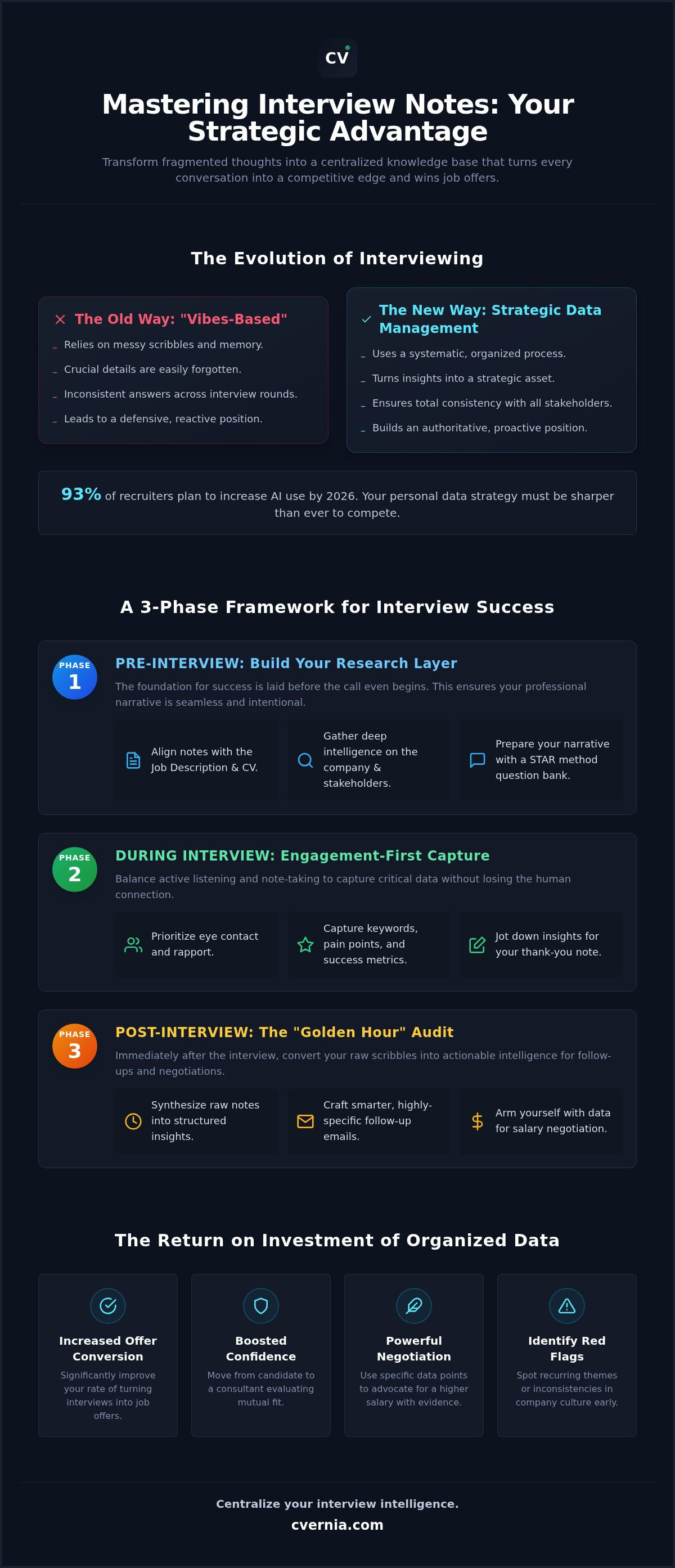
Modern hiring has moved far beyond simple conversations. Today, interview notes management is defined as the systematic process of capturing, organizing, and utilizing every data point from your recruitment journey. Relying on "memory and vibes" is a dangerous strategy in 2026. While an interviewer might seem friendly, your success depends on your ability to recall specific technical requirements and cultural nuances discussed in previous stages. You need a system that works as hard as you do.
The landscape has shifted from passive recording to active interview intelligence. Instead of just writing down what happened, you're now analyzing why it matters for your future role. By utilizing professional note-taking systems, you create a strategic advantage that most candidates ignore. This organized approach builds your confidence. It moves you from a defensive position of "hoping they like me" to an authoritative position of "evaluating if this is the right fit for my career growth."
Why Candidates Need a Note Strategy
Interviews are high-stakes environments that trigger a significant cognitive load. When your brain is busy processing complex questions, it's nearly impossible to commit every detail to long-term memory. A structured strategy allows you to offload this mental weight. It ensures total consistency across multiple rounds with different stakeholders. If the CTO asks about a project you discussed with the Lead Developer, you can reference your previous notes to provide a seamless, aligned response. This level of preparation also helps you identify recurring themes or subtle red flags in company culture that might be missed during a single, unrecorded conversation.
The ROI of Organized Interview Data
The return on investment for disciplined data management is clear and measurable. You'll experience faster preparation for subsequent rounds because you aren't starting from scratch. Instead, you're building on a foundation of real-time intelligence. This process allows you to curate a library of "success stories" that directly address the pain points mentioned by the hiring team. When it's time for the final offer, your notes become your most powerful negotiation tool. Referencing a specific challenge the manager shared in round one demonstrates your attentiveness and proves you're the solution they need, allowing you to advocate for a higher salary with concrete evidence.
Building Your Pre-Interview Knowledge Base
Successful interview notes management starts long before you join the video call or walk into the office. Think of this as your "Research Layer." It's the essential foundation that prevents you from feeling caught off guard during high-pressure moments. You must align your preparation notes with the exact job description and the ATS-optimized CV you used to apply. This ensures that the narrative you present during the conversation matches the data the hiring team already has on file, creating a seamless professional image.
If you're pivoting industries, your preparation needs to be even more intentional. Utilizing career change resumes involves identifying transferable skills; your pre-interview notes should reflect those logical bridges. Write down specific examples that prove your past experience solves their future problems. Using effective note-taking strategies during this phase helps you organize these thoughts into a coherent script rather than a list of random facts. You'll enter the room with a clear plan instead of a cluttered mind.
Company and Stakeholder Intelligence
Don't just look at the company website. Dig into the hiring manager’s recent professional milestones on LinkedIn or industry forums. If they recently spoke at a conference or published an article, note it down. Mapping the company’s 2026 market challenges is equally vital. Are they expanding into new territories or facing specific regulatory hurdles? Prepare notes that position your skills as the direct solution to these pain points. When you can say, "I noticed the company is focusing on X, and in my last role, I handled Y," you move from candidate to consultant. This level of detail shows you aren't just looking for any job; you're looking for this job.
The Question Bank: Preparing Your Narrative
Draft your STAR method (Situation, Task, Action, Result) responses ahead of time. Align these stories with the core competencies listed in the role. You should also have clear talking points for the "Why us?" and "Why now?" questions. A critical part of your pre-interview knowledge base is "Reverse Interviewing." These are the questions you need answered to determine if the role fits your goals. Effective interview notes management includes setting up a digital structure to capture these answers in real-time. If you find yourself overwhelmed by managing these different data points, using a dedicated application tracking dashboard can help you keep your research and notes perfectly synchronized.
Real-Time Capture: Balancing Engagement with Insight
Does taking notes during an interview make you look distracted? This is the most frequent concern candidates share when discussing their interview notes management strategy. In reality, the opposite is true. Capturing key points signals that you're a serious professional who values the interviewer's time and the information they're sharing. The secret lies in a "Engagement-First" framework that prioritizes the human connection while still securing the data you need for later rounds.
By 2026, the "Keywords to Capture" strategy has become essential. Don't try to transcribe the entire conversation. Instead, listen for specific success metrics, internal project names, and team-specific pain points. When you hear a phrase like "our biggest hurdle this quarter is X," write it down immediately. These are the golden nuggets you'll use to tailor your responses in the next round or to justify your value during salary negotiations. Your notes shouldn't just be a record; they should be a strategic map of the company's needs.
Techniques for Non-Distractive Note-Taking
Signal your intent at the very beginning of the call. Say something simple like, "I’ll be jotting down a few notes as we talk because I want to make sure I capture the details correctly." This small courtesy removes any ambiguity about why you're looking away. Use the "Look and Type" method by positioning your note-taking window directly below your webcam. This allows you to maintain perceived eye contact while you work. Develop a personal shorthand for common industry terms to speed up the process. If you can't keep up, don't panic. Write down a single word to trigger your memory during the post-interview audit.
Digital vs. Analog: Choosing Your Tool
Paper notebooks offer a tactile, distraction-free experience, but they fail when it comes to long-term organization. You can't easily search through physical pages when you're preparing for a sudden follow-up call. On the other hand, unorganized digital scraps like Notepad or sticky notes often lead to "data rot" where crucial insights are lost in a sea of files. This is why a centralized job interview tracker outperforms generic tools every time. It keeps your interview notes management integrated with your application history, ensuring that your insights are always accessible, searchable, and ready to be used. Using a dedicated platform transforms your scribbles into a professional knowledge base that grows with your career.
The Post-Interview Audit: Turning Scribbles into Strategy
The most critical phase of interview notes management happens during the "Golden Hour." This is the first 60 minutes after your call ends, while your memory is still vivid and the emotional nuances are fresh. Don't wait until the next morning to review your scribbles. Raw notes are just data; the audit process transforms them into actionable intelligence. By cleaning up your notes immediately, you ensure that subtle details, like a specific challenge mentioned by the hiring manager, aren't lost to time. This disciplined approach moves you from a passive participant to a strategic candidate.
The 5-Step Post-Interview Workflow
Follow this methodical progression to maximize the value of your gathered data:
- Step 1: Immediate brain dump. Record every technical question asked and exactly how you answered. This helps you identify where you excelled and where you might need to clarify in the next round.
- Step 2: Identify "Unanswered Questions." List anything you realized you still don't know about the role. These become your high-value questions for the subsequent interview.
- Step 3: Record emotional cues. Note the "vibe check" of the team. Did the stakeholders seem aligned, or were there conflicting priorities?
- Step 4: Self-performance check. Rate your own confidence for each core competency discussed during the conversation.
- Step 5: Update your status. Log these insights and store your documents using Interview Notes & Attachment Management to keep your momentum organized.
Crafting the High-Impact Follow-Up
Your notes are the foundation of a thank-you email that actually moves the needle. Instead of a generic "thank you for your time," use your audit to reference a specific detail. Mention a unique project the manager highlighted or a shared professional interest you discovered. This demonstrates active listening and high engagement. If you identified a "weak spot" during your audit, use the follow-up to briefly add a clarifying point or share a relevant resource. Effective interview notes management allows you to turn a perceived gap into a demonstration of your problem-solving skills. Align your final message with the priorities the manager stated, proving that you're the strategic ally they've been searching for.
Centralizing Your Interview Intelligence with CVernia
Managing multiple interview rounds across different companies requires more than just a good memory; it requires a professional interview notes management system. CVernia serves as your trusted companion, organizing the chaos of the job search into a streamlined, high-performance workflow. By moving your data into a centralized platform, you ensure that every insight you've gathered-from the pre-interview research to the "Golden Hour" audit-remains accessible and actionable. You're no longer just applying for jobs; you're building a strategic knowledge base.
The Interview Notes & Attachment Management feature is the cornerstone of this organized approach. It allows you to store specific feedback and internal intelligence directly alongside your application record. You don't have to hunt through email threads or desktop folders to find the portfolio you shared or the technical challenge the recruiter mentioned. Everything is mapped to the specific company profile. This provides a clear history of your professional interactions and ensures you never walk into a second round feeling unprepared.
Beyond Spreadsheets: The CVernia Advantage
Static spreadsheets can't track the dynamic nature of a 2026 job search. CVernia connects your notes to the exact CV version and cover letter used for each specific application. This alignment is crucial when you're managing multiple variations of your professional narrative. You can also attach certificates, portfolios, and reference letters to keep your entire candidacy in one place. If you find your technique needs a boost, you can instantly access Career Academy resources to refine your interviewing skills based on the feedback you've logged in your dashboard.
Long-term career growth is supported by Smart Reapplication Detection. This feature ensures you don't accidentally apply to the same role with conflicting information. It also helps you leverage your past interview notes management data if you re-engage with a company months later. You're building a library of personal career data that becomes more valuable with every application you submit. It turns every "no" into a data point for a future "yes."
Getting Started: Your Journey to a Better Offer
Start by setting up your first application on the dashboard today. As you move through the interview stages, use the platform to log your real-time insights and post-interview audits. This organization reduces the stress of the final round by giving you a clear, data-backed view of the entire journey. You'll enter salary negotiations with the confidence that comes from having every stated priority and pain point at your fingertips. Transform your job search with CVernia’s management tools today.
Take Control of Your Career Narrative
Transforming your job search starts with a shift from relying on intuition to leveraging high-quality data. You've learned that effective interview notes management is about more than just jotting down names; it's a strategic process that begins with deep pre-interview research and ends with a disciplined post-interview audit. By capturing real-time intelligence and synthesizing it during the "Golden Hour," you build a knowledge base that makes you the most prepared candidate in any room. This systematic approach eliminates the stress of forgotten details and empowers you to negotiate from a position of strength.
Your career growth deserves a centralized home that connects your insights to your application history. CVernia provides the tools you need to succeed, offering truthful CV tailoring and smart application tracking to keep your strategy aligned. You can also access our Career Academy to continuously refine your technique and stay ahead of modern hiring trends. Master your next interview with CVernia’s tracking tools and turn every conversation into a winning offer. You're ready to move from uncertainty to total readiness.
Frequently Asked Questions
Is it professional to take notes during a job interview?
Yes, taking notes is highly professional and signals your commitment to the role. It demonstrates active listening and ensures you capture critical details about the team's needs. Most recruiters view this as a sign of organization and high interest. Just remember to mention your intent at the start of the call to keep the interaction transparent and comfortable for everyone involved.
How much detail should I include in my interview notes?
Focus on capturing specific success metrics, internal project names, and team pain points rather than trying to transcribe the entire conversation. You need enough detail to trigger your memory during your post-interview audit. Aim for high-impact keywords that reveal the company's priorities. This level of detail allows you to tailor your follow-up responses and future round preparation with precision.
What is the best way to organize interview notes for multiple applications?
Use a centralized digital platform instead of fragmented documents or physical notebooks. Effective interview notes management requires a system where your insights are linked directly to specific job descriptions and CV versions. This organization prevents data rot and ensures you can quickly recall details when a recruiter calls for a surprise follow-up. A dedicated dashboard keeps your entire career strategy searchable and secure.
Can I use AI tools to help me take interview notes as a candidate?
You can use AI transcription tools, but always verify the company’s privacy policy and ask for permission first. While AI provides a full transcript, it's not a replacement for your own strategic observations. Use automated tools to capture raw data while you focus on recording "vibe checks" and emotional cues that AI might miss. Balancing technology with human insight is the hallmark of modern 2026 job seekers.
How do I use my interview notes for a follow-up email?
Reference a specific challenge or goal the hiring manager mentioned to prove you were actively listening. Instead of a generic thank-you, use your notes to reiterate how your skills solve the exact pain points discussed. This hyper-personalized approach separates you from other candidates. It shows you're already thinking like a member of the team and provides a concrete reason for them to move you to the next stage.
What should I do if I forget to take notes during the interview?
Perform an immediate "brain dump" the moment the interview ends. Write down every technical question, your responses, and any stakeholder names you remember while the details are fresh. While real-time capture is ideal, a rapid post-interview audit can still save most of the critical information. Transfer these thoughts into your interview notes management system immediately to prevent further memory fade and stay on track for the next round.
How can I track feedback across different interview rounds?
Use a structured dashboard to map feedback from different stakeholders against the core competencies of the role. This allows you to identify recurring themes or conflicting information between departments. By centralizing your round-by-round intelligence, you can spot cultural red flags or technical gaps you need to address. This birds-eye view ensures your narrative remains consistent as you progress through the hiring funnel toward a final offer.
Should I share my interview notes with the recruiter?
No, you should generally keep your notes as private strategic assets for your own preparation and negotiation. These records contain your raw observations, performance self-evaluations, and "vibe checks" that are meant to guide your personal decision-making. While you should share the conclusions of your research during the interview to demonstrate expertise, the notes themselves are your competitive advantage. Keep them secure within your personal application management platform.


