

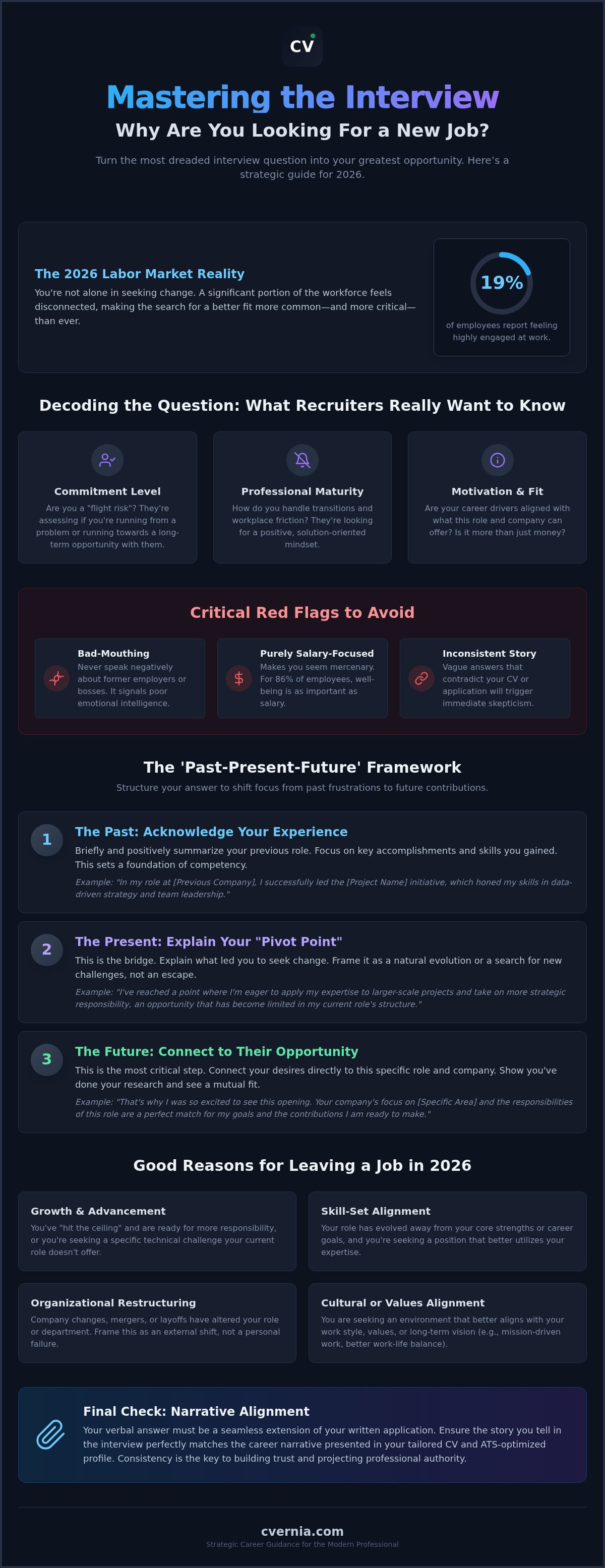
What if the most dreaded question in your interview was actually your biggest opportunity to prove you're the perfect hire? Crafting a polished why are you looking for a new job answer often feels like walking a tightrope between transparency and professional risk. You probably worry that mentioning a toxic culture or a recent layoff will mark you as a "flight risk" in the eyes of a recruiter. It's a valid concern, especially in a 2026 labor market where only 19% of employees report feeling highly engaged at work. You deserve a role that prioritizes your well-being, but explaining that desire requires a strategic touch.
We promise to help you master this high-stakes moment with expert frameworks and sample answers that turn your past experience into a compelling, future-focused narrative. You'll gain the confidence to handle tough questions about career gaps or salary motivations with ease. This article provides a step-by-step breakdown of how to align your verbal answers with your digital application, ensuring you project consistency and professional authority from start to finish.
Key Takeaways
- Shift the focus from past frustrations to future contributions using the "Past-Present-Future" framework to demonstrate professional maturity.
- Discover how to craft a professional why are you looking for a new job answer that addresses sensitive topics like layoffs or toxic cultures without sounding negative.
- Ensure your interview narrative matches your tailored CV and ATS analysis to project a consistent, high-value professional identity.
- Identify the specific "good reasons" for leaving in 2026, such as seeking better skill-set alignment or pursuing roles that prioritize well-being.
- Master the art of turning external shifts, like organizational restructuring, into strategic talking points that highlight your adaptability and resilience.
Decoding the Question: What Recruiters Really Want to Know
When a hiring manager asks about your motivations, they aren't conducting a deposition. They're evaluating your professional maturity. Within the job interview process, this specific question serves as a diagnostic tool to see how you handle transitions and conflict. Your why are you looking for a new job answer shouldn't be a list of grievances. Instead, it should demonstrate that you're moving toward a goal, not just running away from a problem. Recruiters primarily assess three specific areas: your potential as a flight risk, your ability to handle workplace friction, and whether you're motivated by the right professional drivers.
Master the balance between "push" factors and "pull" factors. Push factors are the reasons you're leaving, such as a lack of growth or a shifting company culture. Pull factors are the reasons this specific new company excites you. CVernia’s philosophy of "Truthful Representation" encourages you to be honest but strategic. This approach builds long-term career trust. It ensures your verbal narrative perfectly matches the professional story told by your tailored CV and ATS-optimized profile. Crafting a strategic why are you looking for a new job answer ensures you remain in control of the conversation from the start.
The Red Flags Recruiters Guard Against
Avoid bad-mouthing former employers at all costs. In 2026, emotional intelligence is a top-tier requirement. If you speak poorly of a past boss, the recruiter assumes you'll eventually do the same to them. Similarly, focusing purely on salary is risky. Research from June 2026 by WebMD Health Services shows that 86% of employees consider well-being as important as salary. Appearing "mercenary" suggests you'll jump ship for the next highest bidder. Finally, ensure your story is consistent. Vague answers that contradict your resume history trigger immediate skepticism. Use your Interview Notes to rehearse a clear, unified message.
Shift Your Perspective from Defensive to Proactive
Stop viewing this question as a trap. It's actually a bridge. Use it to pivot from why you're leaving to why you want this specific role. Professional confidence isn't about having a perfect past; it's about how you frame your evolution. Your tone should remain calm and solution-oriented. Focus on the "Pivot Point," which is the exact moment you realized a change was necessary for your growth.
The Pivot Point: "I realized I needed a new challenge when my current role no longer allowed me to apply my expanding expertise in data-driven strategy to high-impact projects."
Good Reasons for Leaving a Job in 2026
The 2026 job market has shifted toward a skills-first economy. Identifying a valid reason for leaving isn't about finding an excuse; it's about demonstrating alignment between your current abilities and your future goals. When you refine your why are you looking for a new job answer, start with skill-set alignment. Use your CV compatibility analysis to pinpoint where your current role lacks the specific challenges you're ready to tackle. This proactive approach shows you're interested in professional optimization rather than just escaping a desk.
Organizational restructuring and layoffs are frequent in 2026, often driven by rapid AI integration. Frame these events as strategic external shifts. They aren't reflections of your personal worth. If you're pivoting to a new industry, your verbal story must align with the narrative in your career change resume to maintain credibility. We're seeing a massive rise in the "conscious career," where candidates prioritize cultural and values alignment as much as their base salary.
Growth and Advancement Scenarios
You might find yourself "hitting the ceiling" when your professional growth outpaces the company's evolution. This is a powerful narrative. It proves you're ready for more responsibility than your current employer can provide. You might also be seeking a specific technical challenge or methodology that only a new environment offers. Whether you're moving from a startup to a corporate giant or vice versa, explain the move through the lens of environment fit. Using a professional framework for a winning answer ensures you highlight your ambition while remaining respectful of your previous employer's contributions.
External and Personal Factors
Logistics matter. With 2026 "return to office" mandates becoming more rigid across several industries, seeking a role that offers better hybrid flexibility is a common and accepted reason for a move. Company stability is another valid point. If your current organization is facing headwinds, focus on your desire to bring your skills to a more stable platform for long-term impact. Don't forget the power of upskilling. If you've finished a new certification in the Career Academy, use that new knowledge as your catalyst. It shows you aren't just looking for a job; you're looking for the right application of your latest expertise. This level of preparedness makes your why are you looking for a new job answer stand out to modern recruiters.
The 'Past-Present-Future' Framework for a Winning Answer
Structure provides clarity. When you're under the pressure of an interview, a reliable template prevents rambling and ensures you hit the right professional notes. The 'Past-Present-Future' framework is your most effective tool for crafting a why are you looking for a new job answer that feels both authentic and strategic. This method allows you to honor your history while keeping the spotlight on your potential. It also helps you adhere to the 70/30 rule: spend only 30% of your response on why you're moving on, and dedicate 70% to why you want to join this specific organization.
- Step 1: The Past. Start with a single sentence that acknowledges the value of your current or most recent role. This demonstrates gratitude and professional maturity.
- Step 2: The Present. Identify the specific gap or catalyst for change. This is the "pivot point" where you explain what is currently missing from your professional landscape.
- Step 3: The Future. Connect that gap directly to the opportunity at hand. Show the recruiter exactly how their role solves your need for growth or a new challenge.
Step-by-Step Implementation
Draft a 'Value Statement' for your past role to avoid sounding ungrateful. For example, you might say, "I've truly appreciated the opportunity to lead the digital transformation team at my current firm." Next, identify the 'Bridge.' This is a specific skill or project that links your past experience to the new job's requirements. If the new role requires advanced AI implementation, your bridge should focus on your readiness to scale those specific skills. End on a high note with a 'Closing Hook.' This is a statement that invites the recruiter to ask about your future contributions, such as, "I'm eager to bring that same efficiency to your upcoming global expansion."
Refining Your Delivery
Use the 'Mirroring' technique to make your answer resonate. Incorporate specific keywords from the job description into your 'Future' segment. This proves you've done your research and are already thinking like a member of their team. Your non-verbal cues are just as important as your words. Maintain steady eye contact and a composed posture to project confidence, even when discussing a difficult exit like a layoff or a toxic culture. Consistency is the foundation of trust in the hiring process. You should use a job search management system to store these scripts and rehearse them before every interaction. Having a centralized place for your why are you looking for a new job answer ensures your narrative remains stable across multiple interview rounds.
Sample Answers for Common (and Difficult) Scenarios
Translating theory into practice is where many candidates stumble. Your why are you looking for a new job answer needs to be more than a script; it must be a reflection of your professional integrity. If you're leaving a toxic workplace, avoid the "toxic" label. Instead, focus on culture alignment. Say: "I've realized that I thrive best in environments that prioritize cross-functional collaboration and transparent communication, which is why your team's values resonated with me." This reframes a negative situation into a positive search for a better fit.
When dealing with a layoff, leverage the "Smart Reapplication" logic. This is especially useful if you're interviewing at a firm where you've applied before or are returning to a previous industry. Acknowledge the external shift: "Due to a company-wide restructuring, my role was eliminated. However, this has given me a unique opportunity to return to the fintech space with the advanced leadership skills I've developed over the last two years." This proves you aren't just looking for any job, but the right job where your matured skills can shine.
Handling Sensitive Exits
Sometimes a role simply isn't what was promised during the hiring process. If you have a short tenure, explain it as a "misalignment of expectations." You might say, "The scope of the role shifted significantly shortly after I joined, and I'm now looking for a position that more closely aligns with my core expertise in project management." If you have a career gap, be direct. Use your interview notes management system to track the certifications and freelance projects you've completed during that time. Showing that you've stayed sharp turns a gap into a period of intentional growth.
Advanced Scripts for Senior Roles
At the executive level, the why are you looking for a new job answer often centers on strategic vision. If you're leaving because you and the board have different directions, frame it as a "mutual parting based on long-term strategy." Alternatively, use the "Mission Accomplished" narrative. If you've just guided a company through a successful acquisition or a major product launch, it's natural to seek a new "Day One" challenge. Focus on scale and impact. Explain that you've reached the goals you set out to achieve and are now ready to apply that blueprint to a larger or more specialized organization.
Ready to refine your narrative? Start building your interview preparation strategy with CVernia today to ensure your answers are as polished as your CV.
Narrative Alignment: Syncing Your Answer with Your CV
Recruiters view your application as a single, cohesive data set. Your verbal why are you looking for a new job answer must function as the spoken version of your CV’s "Professional Summary." If your resume positions you as a growth-oriented specialist, but your interview answer focuses on escaping a toxic environment, you create a narrative disconnect. This inconsistency triggers skepticism. To build trust, ensure your verbal story mirrors the strategic goals you’ve already put in writing. Alignment proves that your career move is a calculated step forward rather than a reactive flight.
Utilize ATS Compatibility tools to verify this alignment. These tools help you ensure that your "Future" goals are firmly supported by "Past" keywords in your experience section. For example, if you claim you're seeking a role in AI implementation, your CV must contain the technical keywords that justify that transition. This data-driven approach ensures that when you speak, you're reinforcing the evidence already on the page. Use an Application Tracking Dashboard to manage different versions of your story for various industries. This centralized hub prevents you from losing track of which narrative you presented to which company.
The Power of Consistency
Audit your digital footprint before every interview. Your LinkedIn profile, CV, and verbal answers must tell the same story. Recruiters often cross-reference these sources during the hiring process. Use your interview notes to track which version of your "why" resonated most during initial screenings. This helps you avoid "Story Drift," a common issue where your narrative becomes vague or inconsistent across multiple interview rounds. Keeping your story tight ensures you project professional authority from the first recruiter call to the final board interview.
Leveraging CVernia for Interview Prep
Prepare for success by storing your refined scripts in your centralized dashboard. This allows for quick review and mental rehearsal before you enter the room. You should also align your verbal answer with the tailored cover letter generated for the specific role. If your cover letter highlighted a passion for sustainable tech, your interview answer should echo that same motivation. Finally, use your research notes within the platform to prepare for the "Why us?" follow-up question. Smart Reapplication Detection can even help you refine your answer if you're returning to a company where you previously interviewed, allowing you to highlight the growth you've achieved since your last interaction.
Master Your Narrative and Land the Offer
You now have the tools to transform a high-pressure question into a strategic advantage. By applying the Past-Present-Future framework, you shift the recruiter's focus from your exit to your immense potential. Remember that your verbal why are you looking for a new job answer must stay perfectly synced with your ATS-optimized CV to maintain professional credibility. This consistency is what separates top-tier candidates from the rest of the applicant pool in 2026. You don't need to fear the "why"; you just need to frame it as the logical next step in your professional evolution.
Preparation is the ultimate antidote to interview anxiety. Thousands of professionals in 2026 already use our platform to maintain narrative alignment and stay organized throughout their career journey. Track your interview notes and refine your narrative with CVernia's Application Dashboard to benefit from empathetic, expert-backed guidance at every step. You've done the hard work of building your skills; now it's time to tell your story with the authority and self-assurance you deserve. Your next great opportunity is waiting, and you're ready for it.
Frequently Asked Questions
Is it okay to say I'm leaving for more money in 2026?
Yes, but frame it as seeking a role that matches your current market value and level of responsibility. In 2026, while 86% of employees prioritize well-being, salary remains a key factor in professional transitions. Avoid sounding mercenary by connecting the increase in pay to an increase in the complexity of the work you'll perform. This ensures your why are you looking for a new job answer remains focused on value and impact.
How do I explain leaving a job after only 6 months?
Focus on a misalignment between the role described during the interview and the actual day-to-day responsibilities. Be specific about what changed without blaming the company. You might explain that the project scope shifted shortly after you joined, making it impossible to utilize the core strengths you were hired for. This demonstrates that you value your time and are committed to finding a role where you can make a long-term impact.
What if I was fired? How do I answer then?
Acknowledge the situation briefly and pivot immediately to what you learned or how you’ve grown since. If it was a performance issue, explain the steps you've taken to improve those skills. If it was a cultural mismatch, focus on the specific environment where you now know you thrive. Keeping your explanation concise prevents the interview from stalling on the past and allows you to return to your future-focused narrative.
Should I tell the truth if my boss was the reason I left?
Avoid speaking negatively about a former manager even if they were the primary reason for your departure. Recruiters often view bad-mouthing as a lack of professional maturity. Instead, frame the situation as a search for a different leadership style or a more collaborative team culture. This approach allows you to stay honest about your needs while maintaining a positive, solution-oriented tone that projects confidence to your potential new employer.
How long should my answer to 'Why are you looking for a new job' be?
Aim for a response that lasts between 30 and 90 seconds. This is enough time to provide context without losing the recruiter's attention. Follow the 70/30 rule by spending only 30% of your time on the reasons for your exit and the remaining 70% on why this new role is the perfect fit. This structure ensures your why are you looking for a new job answer remains proactive and focused on your potential contribution.
Can I say I'm looking for a better work-life balance?
Yes, seeking better work-life balance is a perfectly acceptable reason in the 2026 labor market. Many professionals now prioritize well-being and hybrid flexibility as much as their salary. Frame your answer by explaining that you're looking for a more sustainable environment where you can maintain high performance over the long term. This shows you're a responsible professional who understands how to manage your energy and output for maximum organizational impact.
What if I'm currently unemployed and looking for a job?
Focus on the catalyst for your unemployment and highlight the specific ways you've stayed sharp during your time away. Whether you were affected by a layoff or chose to take a career break, emphasize the certifications or freelance projects you've completed. This proves that you haven't just been waiting; you've been intentionally preparing for your next challenge. Use your interview notes to keep these details organized and consistent during the conversation.
How do I answer if I'm overqualified for the new role?
Explain that you're looking for a role where you can have a direct, hands-on impact or pivot into a mission that truly excites you. Being overqualified often means you can hit the ground running with minimal training, which is a huge benefit for the employer. Reassure the recruiter that you aren't just looking for a stop-gap job, but a place where you can apply your deep expertise to solve their specific problems.


