

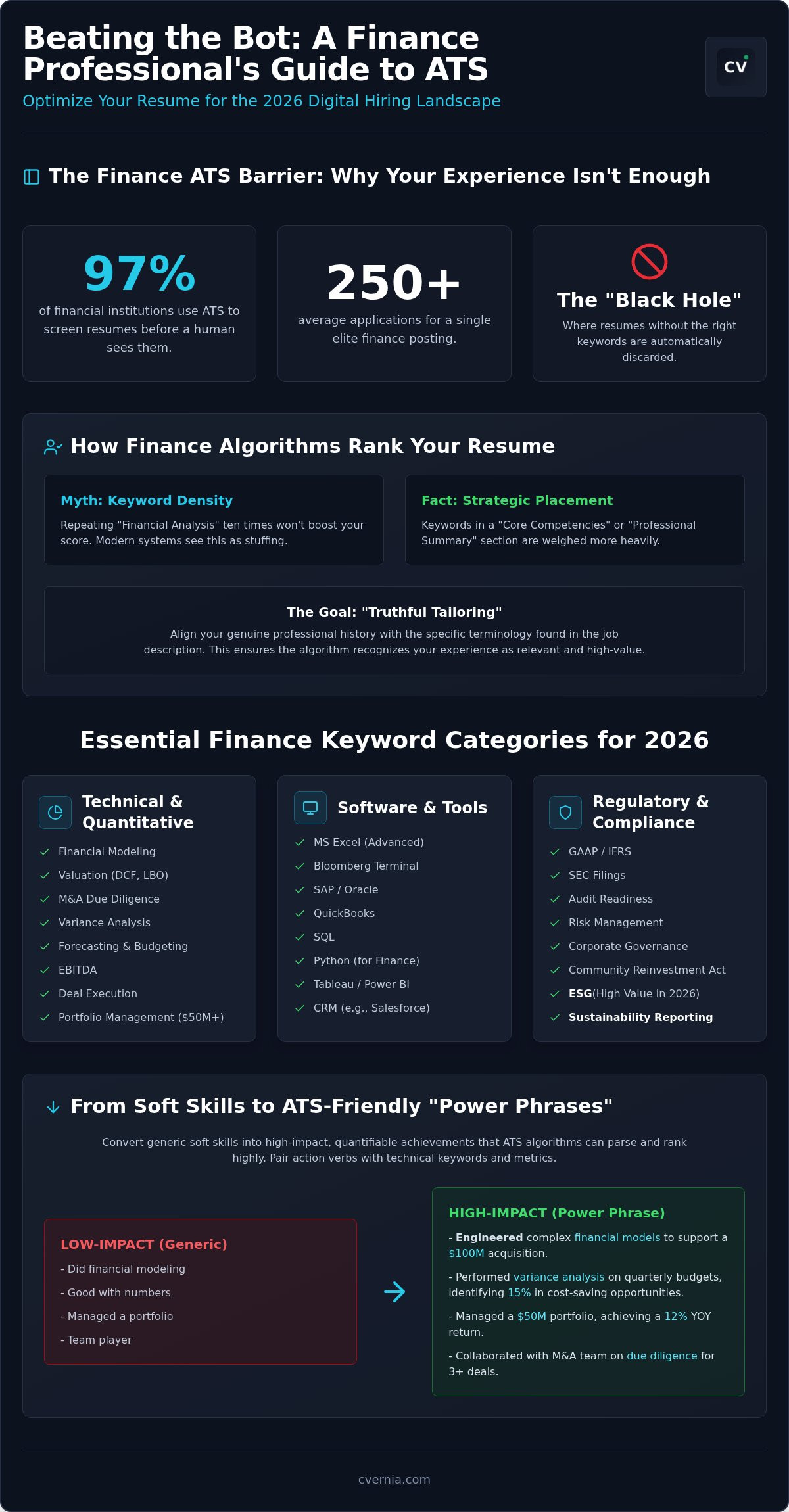
Did you know that 97% of financial institutions now use automated systems to screen your resume before a human ever sees it? With elite postings attracting over 250 applications on average, the digital gatekeeper is your first and most difficult hurdle. It's exhausting to submit high volumes of applications only to receive zero response. You're likely struggling to balance technical precision with professional prose, worrying that the right ATS keywords for finance professionals might look like "stuffing" rather than expertise. We understand that confusion. It's stressful to guess which skills will actually trigger a "yes" from the software.
This guide empowers you to master the strategic alignment of quantitative metrics and technical terminology. You'll learn how to integrate essential terms like Financial Modeling, DCF, and IFRS alongside 2026 regulatory trends such as the proposed Community Reinvestment Act revisions. We'll provide a curated list of high-value finance keywords and a clear template for your skills section. By the end of this article, you'll have the exact strategy needed to increase your compatibility scores and secure those elusive elite interviews. Let's transform your resume from a hidden document into a high-performing asset.
Key Takeaways
- Stop your resume from falling into the digital "Black Hole" by understanding how algorithms rank your relevance in the 2026 hiring market.
- Identify the most critical ATS keywords for finance professionals within technical, software, and regulatory categories to ensure your expertise is seen.
- Learn the secret to converting low-priority soft skills into high-impact "Power Phrases" that trigger positive responses from automated systems.
- Master the strategic placement of your technical competencies to ensure your most valuable qualifications are parsed correctly every time.
- Discover how tailoring your CV for specific finance niches like Private Equity or Corporate Finance creates a significant strategic advantage over other applicants.
The Finance ATS Barrier: Why Your Experience Isn't Enough in 2026
Passing the initial screen requires more than just a list of past employers. In the current hiring environment, your resume must communicate effectively with an Applicant Tracking System (ATS). These digital gatekeepers use ATS keywords for finance professionals; specific technical terms, regulatory standards, and financial metrics; to determine if you're a match. Without these precise markers, even the most qualified candidates fall into the "Black Hole," a phenomenon where resumes are discarded by algorithms before a human recruiter ever sees them.
The technology has evolved significantly. By 2026, AI-driven systems look beyond isolated words to understand the context of your achievements. It's no longer enough to mention "Financial Analysis" ten times. You must practice "Truthful Tailoring," which involves aligning your genuine professional history with the specific terminology found in the job description. This ensures the algorithm recognizes your experience as relevant and high-value while maintaining the integrity of your professional brand.
How Finance Algorithms Rank Your Resume
Modern systems prioritize hard skills during the initial filtering phase. While many believe that repeating a term increases their score, keyword density is largely a myth. Instead, keyword placement is what matters most. Algorithms often weigh terms found in your "Core Competencies" or "Professional Summary" more heavily than those buried in older job descriptions. Parsing is the automated process where the software scans your document to extract specific data points and convert them into a searchable candidate profile. If your formatting or terminology is non-standard, the system may fail to recognize your "LBO Modeling" or "GAAP Compliance" expertise.
The Cost of Generic Resumes in a Competitive Market
Using a single, generic document for diverse roles is a recipe for rejection. An Investment Banking role demands a different linguistic profile than Corporate Accounting. For instance, the former might prioritize "Deal Execution" and "M&A Advisory," while the latter focuses on "General Ledger" and "Audit Readiness." If you're moving between these sectors, check our career change resume guide to learn how to bridge the gap between different financial specializations.
Centralized application management allows you to track which keyword combinations are yielding interviews. By monitoring different versions of your CV, you can identify exactly which technical markers resonate with specific finance niches. This data-driven approach to selecting ATS keywords for finance professionals removes the guesswork from your job search and positions you as a prepared, strategic candidate ready for the next step in your career.
Essential Finance Keyword Categories for 2026
Organizing your resume into logical categories helps both human recruiters and digital scanners quickly identify your value. To effectively use ATS keywords for finance professionals, you must understand how algorithms prioritize specific technical and regulatory markers. Systems are often programmed to look for standardized terminology like "EBITDA" rather than the full phrase. If your resume uses non-standard language, you risk being filtered out despite your expertise.
In 2026, "ESG" (Environmental, Social, and Governance) and "Sustainability Reporting" have emerged as high-value keywords. These terms signal that you're prepared for modern reporting requirements and evolving stakeholder expectations. Additionally, quantitative metrics act as anchor keywords for finance bots. These systems look for the "%" sign, "$" symbols, and "#" counts to validate your claims. For example, "Managed a $50M portfolio" carries significantly more weight than "Managed a large portfolio."
Technical & Quantitative Keywords
Your technical section should feature high-priority terms that define your core financial capabilities. Focus on including Financial Modeling, Valuation, Variance Analysis, Forecasting, and M&A Due Diligence. These are the specific functions recruiters search for when filling mid-to-senior level roles. To maximize impact, pair these keywords with strong, action-oriented verbs. Instead of stating you "did financial modeling," write that you "Engineered complex financial models" or "Optimized IRR by 15% through strategic asset reallocation."
Acronyms are essential for passing the initial screen. Ensure your resume includes ROI, NPV, and Internal Rate of Return (IRR). These standardized terms are easily parsed by modern software and immediately signal your technical proficiency to human readers. If you want to ensure your document is perfectly aligned with these requirements, running an ATS CV Compatibility Analysis can provide the final quality control check you need before hitting submit.
Regulatory, Compliance, and Software Keywords
The regulatory landscape is shifting, and your resume must reflect current standards. Essential regulatory keywords for 2026 include GAAP, IFRS, and Sarbanes-Oxley (SOX). If you're applying for roles in banking or international finance, mention SEC Filings and Basel IV compliance. These terms act as "must-haves" for roles involving financial reporting or risk management. Without them, your application may be flagged as incomplete by the tracking system.
Software proficiency has moved beyond basic spreadsheets. While Excel remains vital, "Advanced Excel" is no longer a differentiator; it's a baseline expectation. You should specifically mention VBA and Power BI to demonstrate high-level data manipulation skills. For enterprise-level roles, include keywords like SAP S/4HANA, Bloomberg Terminal, and Oracle NetSuite. If you have coding experience, "Python for Finance" is a high-value marker that distinguishes you as a modern, tech-forward professional in a competitive market.
Hard Skills vs. Soft Skills: Navigating the Finance ATS Hierarchy
Finance is a discipline built on precision. While your ability to collaborate is vital, the initial digital screen operates on a strict hierarchy that prioritizes hard skills. To successfully use ATS keywords for finance professionals, you must dedicate roughly 80% of your resume's keyword real estate to verifiable, technical capabilities. Modern algorithms rank these "Hard Keywords" as primary indicators of your ability to perform the job. If your resume leans too heavily on personality traits, the system may categorize you as underqualified before a human recruiter can assess your potential.
This doesn't mean soft skills are irrelevant. In 2026, many sophisticated systems use "Culture Fit" algorithms to scan for interpersonal competencies. However, these bots don't look for generic adjectives. They look for evidence of those skills in action. By transforming vague traits into technical "Power Phrases," you satisfy both the requirement for hard data and the need to demonstrate your leadership or communication style. This approach ensures your resume remains professional while maximizing its algorithmic reach.
The 'Buzzword' Trap: Words to Avoid or Transform
Generic terms like "Team Player" or "Hard Worker" are effectively invisible to a finance ATS. These words occupy valuable space without contributing to your search ranking. Instead, you should transform these concepts into industry-standard terminology that reflects actual business functions. For example, replace "Leader" with "Cross-functional Team Management" or "Stakeholder Engagement." These phrases are searchable and provide a clearer picture of your professional scope.
Strategic Thinking must be backed by a specific financial outcome, such as identifying cost-saving opportunities that improved operating margins by 12%. When you anchor a soft skill to a hard result, you create a keyword-rich statement that appeals to both bots and humans. This method moves you away from empty buzzwords and toward a narrative of high-impact contribution.
Quantifying Your Impact for Modern Parsers
Modern parsers are designed to identify and prioritize numerical data. A statement like "Managed a $50M portfolio" acts as a powerful, keyword-rich anchor for your application. It provides the system with a "Hard Skill" (Portfolio Management) and a "Quantitative Metric" ($50M). This combination is exactly what high-level finance bots are programmed to find. To ensure your document meets these standards, consult our ats compliant resume guide for a breakdown of the best tools to test your formatting.
Use the "X-Y-Z" formula to structure your bullet points for maximum impact. Accomplished [X] as measured by [Y], by doing [Z]. For example: "Reduced month-end closing time by 20% (X) as measured by reporting deadlines (Y), through the implementation of automated reconciliation scripts (Z)." This structure naturally incorporates ATS keywords for finance professionals while proving your expertise through concrete results. It demonstrates that you don't just possess the skills; you know how to apply them to drive institutional success.
Adding a Financial Skills Section: The 2026 Resume Template
Many finance resumes fail because they present a "wall of words" that bots struggle to categorize. Instead of a messy list, use a structured "Core Proficiencies" section. Place this within the top 1/3 of your document. This placement ensures maximum parsing impact, as modern systems prioritize information found early in the file. Group your ATS keywords for finance professionals logically. For instance, create a "Financial Reporting" group for terms like GAAP and Consolidation, and a separate "Systems" group for expertise like SAP S/4HANA or Python.
Keep your formatting clean and predictable. Use simple bullet points and standard fonts like Arial or Calibri. Avoid complex tables, graphics, or multiple columns that can confuse older parsing engines. A clean, linear structure ensures the bot extracts your data accurately every time, preventing your "Internal Rate of Return" expertise from being read as garbled text.
The 'Core Proficiencies' Grid Template
A 3x3 grid is a highly effective way to display your top qualifications. Select the nine most critical keywords from the specific job description you're targeting. If the role emphasizes M&A, your grid should feature "Due Diligence" and "Valuation." If it's a controller role, prioritize "Audit Management" and "Internal Controls." Always maintain truthfulness; only include skills you can defend in an interview. This strategic selection signals to the algorithm that you're a high-match candidate for that specific opening while keeping the document readable for human eyes.
Integrating Keywords into Professional Experience
Don't stop at the skills section. You must weave these terms into your professional experience to provide context. Link every keyword to a specific achievement. For example, if you list "Variance Analysis," your bullet point should describe how you used it to identify a 5% budget leak. This dual approach proves your capability to both the bot and the hiring manager. It shows you don't just know the terminology; you know how to apply it to drive institutional success.
As you optimize these descriptions, keep track of the specific terminology you've used. This preparation is essential for the human phase of the hiring process. You can use our guide on interview notes management to bridge the gap between your digital application and the face-to-face conversation. To verify your layout is technically sound, build your tailored CV with CVernia to ensure every section is perfectly parsed by 2026 standards.
Optimizing Your Finance Application with CVernia
Take the guesswork out of your application process by using specialized technology designed for the modern hiring landscape. CVernia’s ATS CV Compatibility Analysis serves as the final stress test for your document. It ensures that your ATS keywords for finance professionals are not only present but perfectly formatted for the specific algorithms used by top-tier institutions. Our Tailored CV & Cover Letter Creation feature automates the alignment process. It helps you map your technical skills to the unique requirements of every job description, ensuring you remain a high-match candidate for every role you pursue.
Finance professionals often apply to the same elite firms for various openings. Our Smart Reapplication Detection is a vital tool in this scenario. It prompts you to re-optimize your document for each specific submission, preventing the "duplicate content" flags that some systems use to filter out repetitive applicants. To stay ahead of shifting 2026 regulations like the proposed Community Reinvestment Act revisions or the upcoming Saver’s Match program, visit our Career Academy. This resource center provides the latest industry insights to keep your terminology current and your professional profile sharp.
Data-Driven Resume Auditing
Access your centralized Application Tracking Dashboard to gain a clear view of your progress. Before you hit submit, check your Compatibility Score to see exactly how an algorithm will rank your relevance. This data-driven approach allows you to make precise adjustments to your technical sections. Managing multiple versions of your CV is essential in a high-volume search. You can easily maintain distinct, optimized profiles for "Hedge Fund" roles and "Corporate Treasury" positions within the same interface. This level of organization ensures that your ATS keywords for finance professionals are always contextually accurate for the specific niche you're targeting.
Beyond the Bot: Preparing for the Human Interview
Your optimization efforts shouldn't end once you pass the digital screen. Use your keyword-optimized resume as a strategic script for the human interview phase. The technical terms and quantitative metrics you've highlighted are the same points hiring managers will use to verify your expertise. When you're asked difficult questions, such as why are you looking for a new job, you can pivot back to these core competencies to demonstrate your readiness for a greater challenge. This consistency builds trust and proves that your digital profile matches your professional reality.
Don't let a technicality stand between you and your next elite finance role. Secure your strategic advantage and ensure your expertise is recognized by both bots and bankers. Optimize your finance resume with CVernia today.
Take Control of Your Financial Career Path
Navigating the modern hiring landscape requires a blend of technical mastery and strategic communication. You've learned how to bypass the digital gatekeeper by prioritizing hard skills and transforming vague traits into high-impact power phrases. By structuring your expertise within a clear, 2026-ready template, you ensure that your most valuable contributions are immediately visible to both bots and human recruiters. Integrating the right ATS keywords for finance professionals isn't just about passing a scan; it's about presenting your career with the precision that elite financial institutions demand.
Don't let your experience get lost in a sea of generic applications. Utilize advanced tools to verify your document's strength before you hit submit. CVernia provides the strategic edge you need through AI-powered ATS Analysis and 100% Truth-focused CV Tailoring. Our Smart Reapplication Detection keeps your iterative improvements organized and effective. Scan your finance resume for ATS compatibility now and move forward with the confidence that your profile is fully optimized. You've done the hard work of building your career. It's time to ensure the world sees it.
Frequently Asked Questions
What are the most important ATS keywords for a Financial Analyst in 2026?
Focus on "Financial Modeling," "Scenario Analysis," and "Data Visualization" to pass the initial screen. In 2026, including "Sustainability Reporting" and "Predictive Analytics" will help you stand out from the competition. Mention software like "Power BI" or "Tableau" alongside traditional "Excel VBA." These specific ATS keywords for finance professionals signal that you're ready for modern, data-driven decision-making. Lead with the technical terms found in current job descriptions to ensure your profile ranks high.
Can I get penalized for 'keyword stuffing' my finance resume?
Yes, you'll face penalties from both algorithms and human recruiters if your resume lacks natural flow. Modern AI-driven systems in 2026 detect context and semantic relevance; they don't just count words. If a term appears out of place or is repeated excessively without supporting achievements, the system may flag your document as low-quality. Focus on "Truthful Tailoring" by integrating keywords into meaningful accomplishment statements that prove your expertise rather than just listing it.
How do I include 'soft skills' on a finance resume without being ignored by the ATS?
Transform vague soft skills into "Power Phrases" that demonstrate action and measurable results. Instead of writing "Team Player," use "Cross-functional Stakeholder Engagement" or "Collaborative Project Management." This approach satisfies the "Culture Fit" algorithms while providing the technical context that finance bots require. By anchoring your interpersonal abilities to specific financial outcomes, you ensure your professional personality is recognized without compromising your technical ranking during the digital screening phase.
Should I use a 'Skills' section or integrate keywords into my work history?
You should utilize both strategies for maximum impact. A dedicated "Core Proficiencies" section in the top third of your page allows for quick parsing of ATS keywords for finance professionals. However, you must also integrate these terms into your work history to provide essential context. Linking a skill to a specific achievement proves to the human recruiter that you can apply your technical knowledge to drive institutional success.
Does the ATS read text within images or charts on a finance resume?
No, most Applicant Tracking Systems cannot reliably read text embedded in images, charts, or complex graphics. If you place your key achievements inside an infographic, the bot will likely see a blank space. Stick to standard text formats and simple bullet points to ensure every word is parsed correctly. Save the visual flair for your portfolio or the actual interview where a human can appreciate the design and data presentation.
How often should I update the keywords on my resume for the finance industry?
Update your keywords for every single application you submit to ensure maximum relevance. The finance industry moves quickly, and a role in Corporate Treasury requires a different linguistic profile than one in Private Equity. Review the job description for each new opening and adjust your terminology to match the specific requirements. This iterative improvement ensures your resume remains aligned with the needs of the hiring manager and the current regulatory environment.
What is a 'good' ATS compatibility score for a senior finance role?
Aim for a compatibility score of 80% or higher for senior-level positions. At this level, the competition is fierce, and algorithms look for a high degree of specialization. A score in this range suggests that your document contains the specific technical, regulatory, and leadership markers required for high-stakes decision-making. Use specialized analysis tools to identify any gaps in your profile and make precise adjustments before you finalize your submission.
Are there specific keywords for Fintech vs. Traditional Banking?
Fintech roles prioritize keywords like "API Integration," "Blockchain," and "Agile Methodology." In contrast, Traditional Banking often focuses on "Risk Mitigation," "Regulatory Compliance," and "Asset-Liability Management." While both sectors value core financial proficiency, the software and operational frameworks differ significantly. Tailor your terminology to the specific sub-sector to demonstrate that you understand the unique challenges and technologies of that environment, positioning yourself as a specialized and prepared candidate.


