
Did you know that 99% of Fortune 500 companies now use automated software to decide if a human ever sees your resume? It's incredibly frustrating to spend hours perfecting every bullet point only to feel like your application disappeared into a digital void. You've likely experienced the confusion of receiving an instant rejection despite being perfectly qualified for the role. This happens because understanding how applicant tracking systems work is no longer optional; it's the foundation of a modern job search. You deserve to have your hard work recognized by a real person rather than being sidelined by a technical parsing error.
We'll show you how to turn these "black box" algorithms into your greatest strategic advantage. This guide breaks down the internal mechanics of 2026 recruitment tech, from semantic matching to the latest AI regulations like the EU AI Act. You'll learn how to use data-driven analysis to ensure your CV achieves a high compatibility score every time. We'll walk through the technical journey of a resume, explain how to avoid common formatting traps, and provide a roadmap for landing more interviews through precise alignment. It's time to stop guessing and start applying with total confidence.
Key Takeaways
- Understand the evolution of recruitment technology to see how applicant tracking systems work as sophisticated relational databases rather than simple file storage.
- Eliminate invisible barriers by identifying formatting choices that trigger parsing errors and prevent your qualifications from being indexed correctly.
- Optimize your content for semantic matching algorithms that prioritize the context of your achievements over simple keyword frequency.
- Protect your professional reputation with smart reapplication detection tools that ensure consistency across all your application versions.
- Gain a strategic advantage by using CV compatibility analysis to measure your alignment against specific job descriptions before recruiters even open your file.
The Mechanics of Modern Recruitment: How ATS Processes Your Data
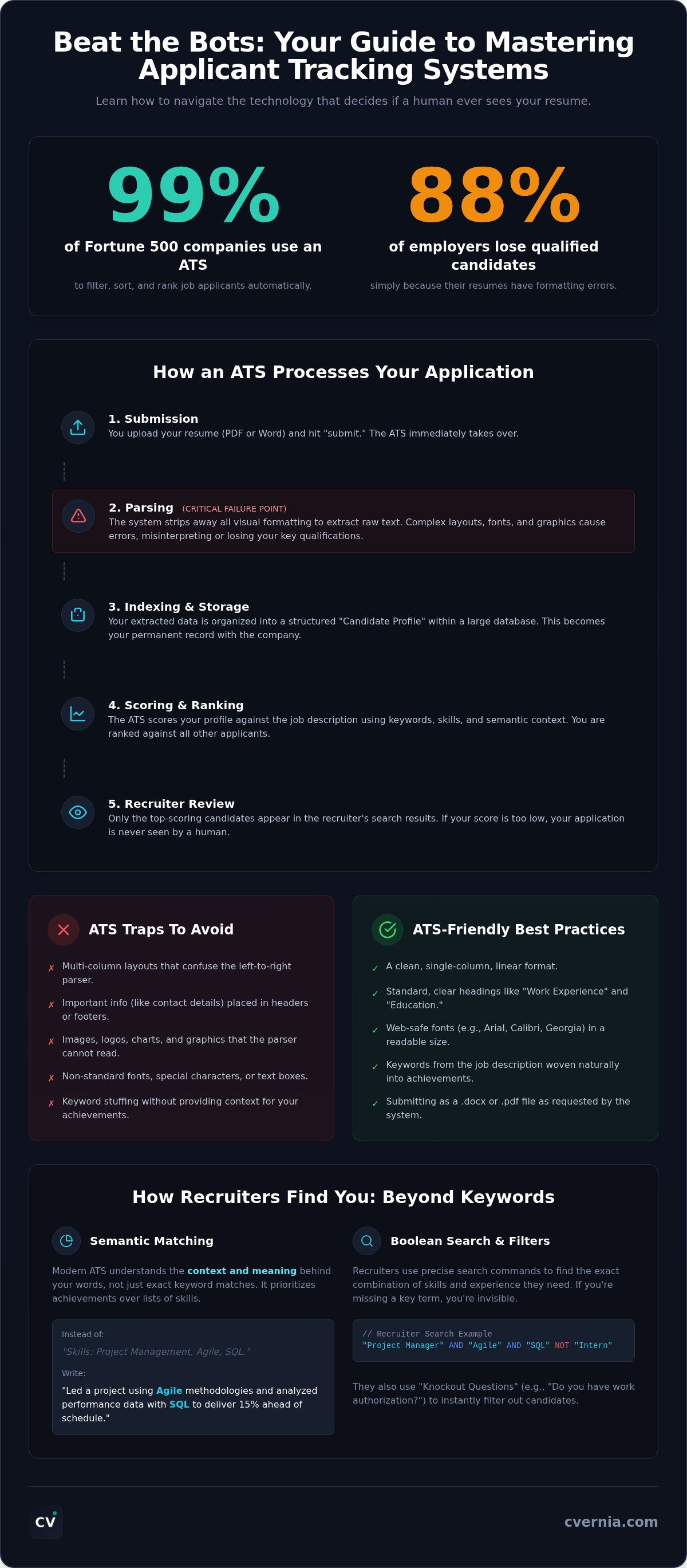
Think of the Applicant Tracking System (ATS) as the digital gatekeeper of your career. In 2026, nearly 99% of Fortune 500 companies rely on these systems to manage the sheer volume of talent entering their pipelines. When a single job posting attracts hundreds or thousands of applicants, human recruiters can't manually review every file. They use these platforms to filter, sort, and rank candidates based on specific data points. To grasp the full scope of what an Applicant Tracking System is, you must view it as a sophisticated data engine rather than a simple mailbox. Understanding how applicant tracking systems work is the first step to ensuring your professional story isn't lost in the digital shuffle.
Modern HR technology has shifted from basic document storage to complex relational databases. Your resume isn't just a file sitting in a folder. It's a collection of data entries that the system compares against other candidates and the job's specific requirements. This shift means recruiters don't just "look" at your CV; they query it. They run searches to find the exact combination of skills, years of experience, and location that fits their current need. If your data isn't structured correctly, you remain invisible to the person holding the "hire" button.
From Document to Data: The Digital Transformation
The moment you hit "submit," the ATS begins a process of deconstruction. It strips away your carefully chosen fonts, colors, and layouts to extract raw text. This transformation turns your PDF or Word document into a standardized Candidate Profile. This profile becomes your permanent record within the company's database. It's a digital shadow that follows you through every interaction with that employer.
Your application history matters just as much as your current resume. Recruiters can see every role you've applied for and every version of the CV you've submitted. This long-term data retention makes consistency vital. If your skills or titles fluctuate wildly between applications, the system flags these discrepancies. We focus on truth-based tailoring because these databases are designed to reward professional clarity and steady career progression.
Recruiter Search Behavior
Hiring managers interact with the ATS through search bars and filters. They often use Boolean strings, which are specific combinations of keywords and operators like AND, OR, and NOT, to narrow down thousands of applicants to a manageable shortlist. If a recruiter searches for "Project Manager" AND "Agile" AND "SQL," and your profile lacks one of those terms, you won't appear in their results. They also set "Knockout Questions" during the application process. These are simple yes or no filters regarding things like work authorization or minimum years of experience that can eliminate you before a human ever sees your name.
ATS Parsing is the process of converting unstructured resume text into structured database fields. This is why formatting is so critical to how applicant tracking systems work. If the parser can't identify where your "Work Experience" ends and your "Education" begins, it will misfile your data. You might have ten years of experience, but if the system records it as zero due to a parsing error, you'll be automatically ranked at the bottom of the pile.
The Parsing Phase: Why Resume Formatting Still Breaks in 2026
The parsing phase is the exact moment your application succeeds or fails. Even with the advancements in AI, a parsing error can still occur when the system misinterprets your professional data. This happens because the software struggles to convert complex visual layouts into structured database fields. If the system misreads your job dates as your phone number or fails to identify your most recent job title, your profile will be ranked incorrectly. Understanding how applicant tracking systems work at this granular level helps you avoid the "black hole" of automated rejection. In fact, 88% of employers believe they lose highly qualified candidates simply because their resumes aren't formatted for these systems.
To ensure your data remains intact, you must prioritize a clean, linear structure. While a multi-column layout might look modern to a human, it often confuses the reading order of a parser. Most systems read from left to right across the entire page. If you have two columns, the bot may merge the text from both sides into a single, nonsensical string of words. Stick to standard .docx or text-based PDF files to maintain compatibility. These formats preserve the metadata and text layers that 2026 algorithms require for accurate indexing.
Common Formatting Traps to Avoid
Avoid placing critical information like contact details or skills inside headers, footers, or floating text boxes. Many standard parsers simply skip these sections, leaving your profile incomplete. Similarly, images, icons, and charts are invisible to the software. A beautiful graphic representing your proficiency in Python might look great, but the ATS sees nothing but blank space. Use standard section headings that the system recognizes immediately, such as "Work Experience" or "Education," rather than creative alternatives like "My Professional Path." You can verify your document's integrity by using CV Compatibility & ATS Analysis to see exactly how a recruiter's system sees your data.
The Truth-First Approach to Tailoring
Truthful representation is your most effective strategy for long-term career growth. Modern systems now include sophisticated AI detectors that can identify "keyword stuffing" or exaggerated skills. We advocate for truth-focused CV tailoring because it builds trust with human recruiters later in the process. Instead of inventing experience, align your real achievements with the job description by using appropriate synonyms. If a job asks for "Strategic Planning" and you have "Long-term Roadmap Development," use both terms to bridge the gap. Always include both acronyms and full titles, such as "Project Management Professional" and "PMP," to ensure you appear in every possible search query. This balanced approach satisfies the algorithm while maintaining your professional integrity.
Decoding the Scoring Algorithm: Keywords, Context, and Semantic Matching
Modern recruitment technology has evolved far beyond simple "find and replace" logic. In 2026, understanding how applicant tracking systems work requires a look into Natural Language Processing (NLP) and semantic search capabilities. Older systems relied on exact keyword matches, meaning if a job description asked for "Customer Relationship Management" and you wrote "CRM," you might be ignored. Today's algorithms are smarter. They recognize that these terms are synonymous. However, they've also moved from tracking keyword frequency to evaluating contextual relevance. Simply repeating a skill fifty times won't help you; the system now analyzes the words surrounding your skills to determine your actual level of expertise.
The system calculates a Compatibility Score by comparing your profile data against the specific weightings assigned to a job description. Recruiters often "weight" certain skills as mandatory and others as preferred. To maximize your score, use strong action verbs and quantifiable impact. Instead of stating you were "responsible for sales," write that you "exceeded sales targets by 22% over six months." This data-driven approach tells the algorithm that you didn't just perform a task; you delivered a measurable result. High-impact language signals to the bot that you're a high-performer, which directly boosts your search ranking within the recruiter’s dashboard.
Hard Skills vs. Soft Skills in the Eyes of the Bot
Applicant tracking systems prioritize hard skills because they are binary and easy to verify. Technical certifications, specific software expertise, and foreign language proficiencies act as solid anchors for your profile. Soft skills like "leadership" or "communication" are much harder for a bot to measure accurately. To prove these, you must wrap them in context and data. Semantic matching looks for the relationship between words, not just the words themselves. If you claim to have "leadership skills," the algorithm will look for related terms like "mentored," "managed," or "led a team of ten" to validate that claim. Use our CV Compatibility & ATS Analysis to see how your current phrasing stacks up against these sophisticated contextual checks.
Ranking and Tiering of Candidates
The "Top 10%" rule is a harsh reality of modern hiring. Because recruiters are overwhelmed with applications, many only ever look at the candidates who fall into the highest-scoring tier. If the ATS doesn't rank you in that top bracket, your application may never be opened by a human. Beyond your skills, the system uses hard-coded mathematical filters to tier candidates. These include:
- Years of Experience: If a role requires five years and the system parses your history as four, you may be automatically tiered lower.
- Geographic Location: Systems often filter by zip code or "willingness to relocate" to prioritize local talent and reduce hiring costs.
- Education Level: Specific degree requirements can act as an immediate knockout filter if the data isn't clearly parsed.
By aligning your professional data with these specific algorithmic preferences, you ensure your profile stays in the visible tier where human recruiters spend their time.
Beyond the Scan: Managing Your Application Ecosystem for Success
Your application journey doesn't end once the parser has finished its work. Because of how applicant tracking systems work as long-term relational databases, they retain every document, note, and version you've ever submitted to a specific employer. This historical record creates a digital footprint that recruiters can access at any time. If you apply for multiple roles at the same company, "Smart Reapplication Detection" immediately alerts the hiring manager to your previous attempts. This feature ensures that you remain consistent across all touchpoints, preventing the red flags that arise when a candidate presents conflicting professional stories or wildly different skill sets across applications.
Effective version control is critical when you're targeting different types of roles or industries. You need to know exactly which CV led to a specific interview invite so you can replicate that success. Relying on disorganized folders or messy spreadsheets often leads to application fatigue, where you lose track of which tailored file belongs to which vacancy. Understanding how applicant tracking systems work as historical archives helps you maintain a cohesive professional image. By managing your application ecosystem centrally, you ensure that the version the recruiter sees on their screen matches the one you're preparing to discuss in the room.
Version Management for Strategic Pivots
Strategic pivots require specialized documentation. If you're shifting industries, your CV must highlight transferable skills while still satisfying the algorithmic needs of the ATS. You can't just hope for the best; you must track which specific iterations of your resume are gaining traction. This organized approach prevents you from sending the wrong version to a high-priority employer. For those navigating a professional shift, our 2026 Career Change Resume Guide provides a deeper look into aligning your past experience with new career goals. A centralized dashboard replaces the chaos of scattered files with a clear, visual record of your progress, allowing you to pivot with confidence rather than guesswork.
The Power of Interview Notes
The data you used to beat the initial scan becomes the foundation of your interview strategy. Every keyword and quantifiable achievement you included in your CV is a potential talking point for the recruiter. By keeping detailed interview notes and managing your attachments, you can track which aspects of your profile resonated most with the hiring team. This feedback loop allows you to refine your CV compatibility for future roles, creating a cycle of continuous improvement. We recommend using The Best Job Interview Tracker for 2026 to manage your insights beyond simple spreadsheets. This level of organization ensures that you're always prepared, whether you're on a first-round screener or a final panel interview.
Take control of your professional data and start managing your journey with our Application Tracking Dashboard today.
Winning the Matching Game with CVernia’s CV Compatibility & ATS Analysis
You have already explored the technical theory behind how applicant tracking systems work; now it is time to apply that knowledge with total precision. CVernia’s CV Compatibility & ATS Analysis acts as your personal recruiter-eye simulator. This tool allows you to see your application exactly as the algorithm does before you hit submit. Instead of crossing your fingers and hoping for a response, you can now measure your compatibility score against specific job descriptions in real time. This data-driven approach empowers you to make strategic adjustments that ensure your professional story remains visible to human hiring managers.
A successful job search requires more than just a single optimized document. It demands a centralized management strategy for all your career assets. Our platform provides a secure environment where you can organize your tailored CVs, cover letters, and interview notes. This centralized dashboard ensures that your version control remains flawless, which is vital for maintaining the consistency that 2026 algorithms reward. You are no longer just a participant in a mysterious hiring process; you are the sophisticated manager of your own professional data ecosystem.
Real-Time Compatibility Feedback
Our analysis engine identifies missing keywords and formatting errors instantly. It highlights the specific technical skills and industry terminology that the system expects to find within your profile. If the analysis detects a gap in your qualifications, you don't have to guess how to improve. You can turn to our Career Academy to find the learning resources needed to bridge those gaps and refine your expertise. This shift from guessing to knowing transforms your application readiness. You can move forward with the certainty that your document is technically sound and contextually relevant to the role you want.
Your Trusted Companion in the Job Search
The modern job search often feels like navigating a black box, but transparency changes everything. CVernia serves as your trusted companion, stripping away the mystery of recruitment technology to reveal a clear path toward your goals. We provide the tools you need to build professional confidence and take decisive action. Understanding how applicant tracking systems work is the first step, but using that data to your advantage is how you win. You have the experience and the drive; we simply ensure the technology accurately reflects your value to the world. Ready to see how you rank? Analyze your CV compatibility with CVernia today and take control of your career journey.
Take Command of Your Professional Narrative
You now possess the technical blueprint to navigate the most sophisticated hiring gates of 2026. By mastering the nuances of semantic matching and avoiding the common formatting traps that trigger parsing errors, you've shifted from being a passive applicant to a strategic candidate. Understanding how applicant tracking systems work is no longer a mystery; it's your new competitive advantage. You have the skills and the experience. Now, you have the data to prove it.
Success in the modern landscape requires more than just a great resume. It demands a centralized approach to your entire career ecosystem. Our platform provides the infrastructure for centralized application tracking and smart reapplication detection, ensuring your professional history remains consistent and compelling. We focus on truth-focused CV tailoring to build long-term trust with recruiters while satisfying the most rigorous algorithmic checks. You don't have to navigate this transition alone.
Start your data-driven job search with CVernia's ATS analysis tools today. Your next great opportunity is waiting for you to unlock it with confidence and clarity.
Frequently Asked Questions
Can an ATS read PDF files, or should I only use Word?
Yes, modern systems read both, but text-based PDFs are superior for preserving your layout. Avoid saving your resume as an image-only PDF, as the parser cannot extract text from pictures. If a job portal specifically asks for a Word document, follow those instructions exactly to ensure your data transfers correctly into their database fields.
How do I know if a company is using an Applicant Tracking System?
Look for specific software names like Workday or Lever in the application URL or at the bottom of the page. Understanding how applicant tracking systems work is essential because nearly 99% of Fortune 500 companies utilize this technology. If you see a structured portal instead of an email address, you can be certain your data is being processed through an automated system.
Does 'white-fonting' keywords actually help my ATS score?
No, white-fonting is an outdated trick that modern algorithms flag as a deceptive practice. These systems convert your document into plain text, making hidden keywords visible to the recruiter. This often results in an automatic rejection. Instead, focus on how applicant tracking systems work by naturally integrating relevant skills into your professional experience and achievements.
What is a 'good' ATS score for a job application?
Aim for a compatibility score of 80% or higher to secure a spot in the top tier of applicants. While a perfect 100% is difficult to achieve, falling below the 70% threshold usually means your profile won't be prioritized for human review. Use data-driven analysis to identify missing keywords and boost your ranking before you submit your final application.
How can I make my resume ATS-friendly without losing its visual appeal?
Prioritize a single-column layout with standard headings to maintain perfect parsing. You can still use bolding, professional colors, and horizontal lines to create a visually appealing document for human eyes. Avoid using tables, text boxes, or graphics to represent skills, as these elements often break the software's reading order and hide your qualifications.
Will an ATS reject me if I apply to multiple roles at the same company?
Applying to multiple roles won't trigger an automatic rejection, but it does create a visible trail in the recruiter's dashboard. Smart Reapplication Detection allows hiring managers to see every role you've targeted. Ensure you only apply for positions where your skills truly align. Applying for dozens of unrelated roles at once can signal a lack of career focus.
How often should I update my resume for ATS compatibility?
Tailor your resume for every single job posting to maximize your alignment with the unique requirements of each role. A generic resume rarely scores high enough to pass the initial screening. By updating your CV for every application, you ensure the specific keywords and achievements the recruiter is searching for are front and center in your profile.
Can an ATS detect if I used AI to write my resume?
Yes, many 2026 recruitment systems utilize AI-detection algorithms to identify generated text and repetitive patterns. While using AI for brainstorming is helpful, you must personalize the final content. Focus on truth-focused CV tailoring to reflect your unique achievements. This ensures your application passes the technical scan while still sounding human and authentic to the hiring manager.


