

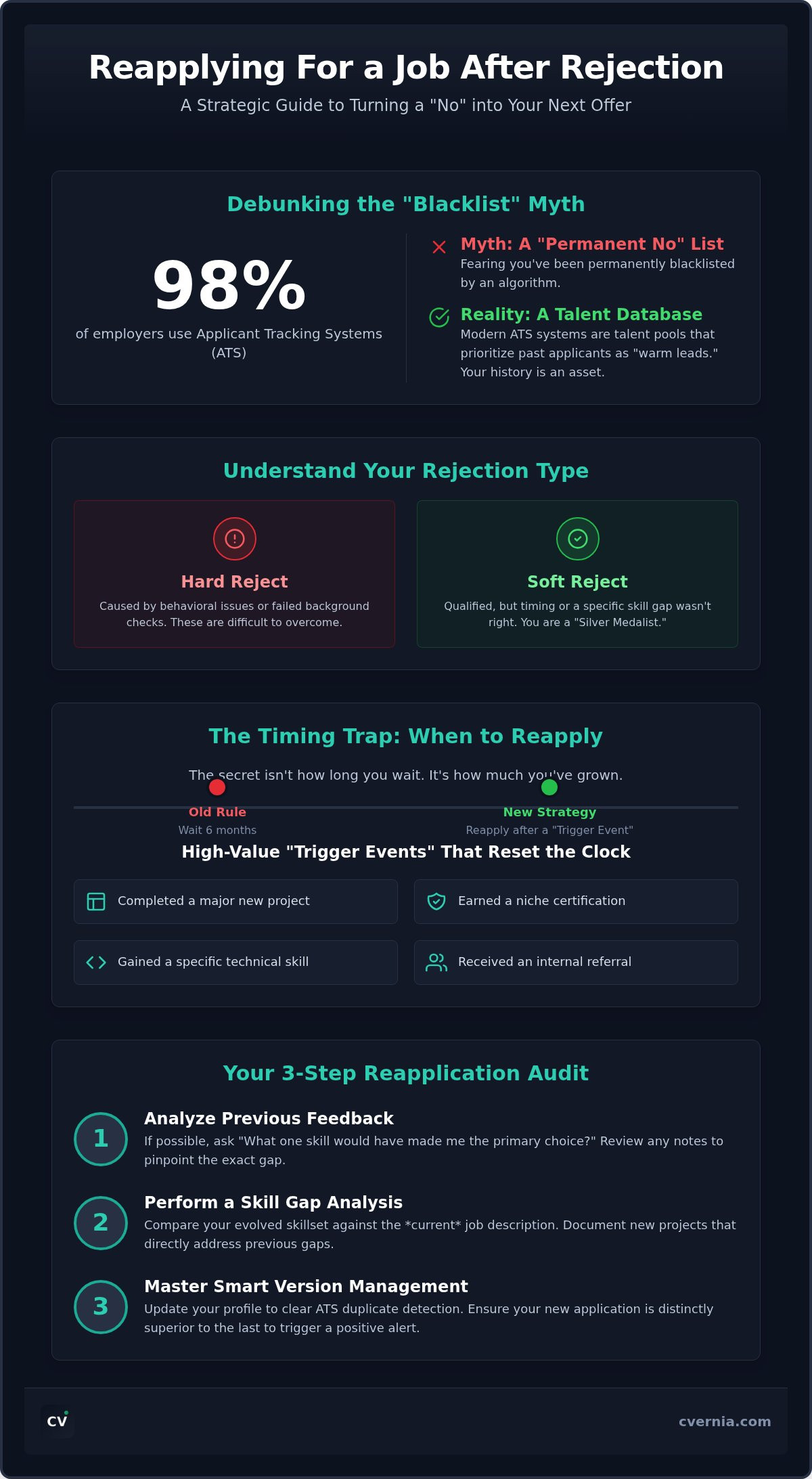
What if your previous rejection wasn't a "no," but actually a vital data point for your next successful application? It's completely normal to feel a sting of frustration when you meet every requirement but still receive that automated "thanks, but no thanks" email. You might worry that reapplying for a job after rejection makes you look desperate or that you've been permanently blacklisted by an invisible algorithm. In reality, 98% of employers use Applicant Tracking Systems that function more like talent databases than permanent "no" lists. Your history with a company is an asset, not a liability, when you know how to manage your professional narrative.
You can transform a past setback into a future offer by mastering the art of the strategic pivot. This guide provides a clear framework for when to try again, including why the industry consensus often points to a three-month cooling-off period to demonstrate growth. We'll show you how to use smart version management to bypass previous ATS flags and present a "New and Improved" professional self. Learn the exact steps to navigate modern hiring algorithms and leverage data-driven strategies to ensure your next application stands out from the hundreds of others.
Key Takeaways
- Shift your perspective from being "rejected" to being a "silver medalist" by understanding how modern recruitment databases actually prioritize past applicants.
- Identify high-value "Trigger Events" that allow you to bypass traditional cooling-off periods and reapply the moment your professional qualifications improve.
- Master the technical nuances of reapplying for a job after rejection by learning how to update your profile to clear modern ATS duplicate detection.
- Conduct a precision Reapplication Audit to analyze previous feedback and perform a thorough skill gap analysis against current job requirements.
- Leverage smart version management to maintain a clear history of your professional evolution, ensuring every new application is distinctly superior to the last.
Debunking the "Blacklist" Myth: Why Companies Want You to Reapply
Stop worrying about a secret HR blacklist. It doesn't exist for high-quality candidates. Modern recruitment is expensive, and companies are actually incentivized to hire from their existing talent pools. When you consider reapplying for a job after rejection, you're doing the recruiter a favor by remaining in their ecosystem. They've already spent time and money vetting you. If you were a strong cultural fit before, you're a low-risk asset now.
Recruiters use "Smart Reapplication Detection" to identify returning talent who have improved their profiles. They prefer candidates who show persistence and professional growth. Hiring a known entity reduces the cost-per-hire and shortens the onboarding process. Your previous application isn't a mark against you; it's a foundation for your next attempt.
The "Silver Medalist" Phenomenon
Being the runner-up is the strongest position for a future reapplication. A silver medalist is a candidate who met every professional bar but lost the role to a specific niche requirement or an internal transfer. You've already proven you can do the job. Now, you just need to prove you've closed the tiny gap that separated you from the top spot last time.
- Request specific feedback. Ask: "What one technical skill would have made me the primary choice?"
- Maintain the connection. Follow the hiring manager on professional networks to stay updated on company needs.
- Document your growth. Keep a record of new projects that directly address the gaps mentioned in your previous interview.
HRIS and Talent Pools in 2026
Modern databases like Workday and Greenhouse are designed to flag returning applicants as "warm leads." Your profile lives within an Applicant Tracking System (ATS), which helps companies build long-term relationships. This data isn't a threat. It's an opportunity to show a clear trajectory of improvement over time.
Understand the difference between rejection types. A "Hard Reject" usually stems from behavioral issues or failed background checks. These are difficult to overcome. However, most candidates receive a "Soft Reject." This simply means you were qualified, but the timing or a specific skill gap wasn't right. By reapplying for a job after rejection with a fresh set of skills, you trigger a positive alert in the system that proves you're a proactive problem solver. Your data staying in the system ensures that when the right role opens, you're already at the front of the line.
The Timing Trap: When to Reapply for Maximum Impact
Many candidates believe they must wait exactly six months before trying again. This arbitrary timeline often leads to missed opportunities. While some corporate policies suggest a cooling-off period, it's often a guideline rather than a law. Official platforms, such as USAJOBS, explicitly confirm that you can reapply for a job as long as the announcement remains open. The real secret isn't how long you wait. It's how much you've changed since the last attempt.
Timing your comeback requires a blend of data and intuition. If you reapply too quickly without new qualifications, you risk being seen as someone who doesn't take feedback seriously. However, waiting too long might mean the department has already evolved past your current skill set. Balance is essential. You want to arrive at the recruiter's desk when you are at your professional peak.
The 6-Month Rule vs. Skill Acquisition
A "Trigger Event" resets the clock immediately. If you've completed a major project, earned a niche certification, or gained a specific technical skill mentioned in your previous interview, you're effectively a new candidate. You don't need to wait half a year to show this growth. In the fast-paced 2026 market, waiting too long might mean the role is filled by someone else who was more proactive.
When reapplying for a job after rejection, focus on proving a "significant change." This could be a 15% increase in your portfolio performance or a new leadership credential. If you have an internal referral, they can often help you bypass automated filters that might flag a quick reapplication. A warm introduction from a current employee proves that you've addressed previous gaps and are ready for a second look.
Strategic Patience: Avoiding the "Spam" Flag
Applying to ten different roles at the same company in one week is a mistake. This triggers "Spam" flags in the ATS and suggests a lack of professional focus. It's better to target one or two roles where your skills align perfectly. If you apply to a completely different department, the cooling-off period is usually non-existent because you're being evaluated by a different hiring manager with different criteria.
Use historical notes to ensure your timeline makes professional sense. You should be able to explain exactly what happened between your first attempt and your second. Tracking these details is easier when you use a job search management system to monitor your interactions. By keeping a log of every touchpoint, you avoid the trap of appearing disorganized. Maintain your professional brand by showing strategic patience. If you're ready to organize your timeline and avoid repeating past errors, consider using CVernia's application tracking dashboard to stay ahead of the curve.
Smart Reapplication Detection: How ATS Sees Your Second Attempt
When you submit a new application, the software doesn't treat you as a complete stranger. Modern systems automatically detect duplicate contact information and merge your new data into your existing profile. This creates a timeline of your interactions with the company. If you are reapplying for a job after rejection, your goal is to ensure the system highlights your progress rather than your previous status. Understanding how applicant tracking systems work is the first step toward controlling this professional narrative.
Recruiters in 2026 use "Smart Reapplication Detection" tools that explicitly flag candidates who have returned with updated credentials. These systems analyze the delta between your old CV and your new version. If your updated submission shows a significantly higher "Compatibility Score," you trigger an automated alert for the hiring team. With 75% of employers now using AI-powered screening, showing a clear upward trajectory in your skills is the fastest way to get noticed. This ranking mechanism rewards growth and persistence.
Version Management for CVs
Don't delete your old CV files. They serve as the baseline for your professional improvement. Instead, iterate on your existing story to show clear progression. Identify exactly which keywords or skills were missing in your first round to ensure they are prominent now. By using CVernia to manage multiple versions of your CV, you can track which iterations gained traction and which ones stalled. This methodical approach ensures you aren't just guessing what works. You're building a data-driven path to an interview by comparing what failed before with what is required now.
Overcoming Historical ATS Flags
Previous "knock-out" answers, such as years of experience or specific software proficiency, can often be refreshed in the system. If you've gained the necessary expertise since your last attempt, update your candidate profile in the company portal directly before you hit submit. This forces the software to re-evaluate your base eligibility. Remember that ATS compatibility is a moving target based on the specific job description, not a fixed score. Every role has different weights for different skills. Refreshing your profile ensures you meet the specific requirements of the current opening, regardless of your history with the company.
The Reapplication Audit: Tailoring Your Strategy for 2026
Success in reapplying for a job after rejection depends on your ability to conduct a cold, objective audit of your previous attempt. Don't fall into the trap of simply changing your font and resubmitting. You need to identify exactly where the friction occurred. Start by analyzing the timing of your last rejection. If you received an automated email within 48 hours, your CV likely failed an initial keyword scan. If you were rejected after a final interview, the issue was likely a specific skill gap or a cultural alignment nuance. Once you know the "why," you can build a targeted plan to fix it.
Perform a rigorous "Skill Gap Analysis" by mapping the current job description against your old application. Requirements often shift every few months as team needs evolve. Use an ats compliant resume builder to ensure your new formatting doesn't create an invisible barrier for the software. Finally, update your value proposition with concrete wins from the last quarter. Showing that you've delivered a 15% increase in efficiency or mastered a new software suite proves you aren't the same candidate who applied before. Ready to see how your new version stacks up? Use CVernia's ATS analysis tools to audit your compatibility before you hit submit.
The "What’s New?" Cover Letter Strategy
Your cover letter shouldn't ignore your history with the company. Acknowledge your previous application briefly and with confidence. Use the "Bridge Technique" to connect past feedback to your current readiness. For example, state: "Since our last discussion regarding the Senior Analyst role, I have completed a certification in advanced data modeling to specifically address the technical requirements we discussed." This shows you listen and take professional development seriously. You can use a tailored cover letter generator to help frame this growth without sounding defensive. Focus on the value you add today, not the "no" you received yesterday.
Interview Note Integration
If you made it to the interview stage previously, your past notes are gold. Review your job interview tracker to find the specific questions that felt difficult. Use that historical data to build more robust responses using the STAR (Situation, Task, Action, Result) method. Address the exact pain points the hiring manager mentioned in the first round. By preparing for the specific challenges of that department, you demonstrate a level of "insider" readiness that external candidates simply don't have. You're not just reapplying for a job after rejection; you're presenting a refined, high-resolution version of your professional self.
Optimizing Your Comeback with CVernia’s Version Management
Strategy is only as effective as the tools you use to execute it. When you're reapplying for a job after rejection, you cannot rely on memory or disorganized folders to track your progress. CVernia provides a centralized dashboard that acts as a permanent record of every interaction you've had with a company. This system allows you to manage multiple iterations of your professional story with precision. You'll never have to guess which version of your CV a specific recruiter is looking at because every file is logged and dated for immediate reference.
Our Smart Reapplication Detection system goes beyond simple tracking. It actively monitors your target companies and identifies when a new role is posted that matches your history. This feature ensures you never miss a "rebound" opportunity. Before you hit submit for the second time, use our Compatibility and ATS Analysis tools to predict your success. These tools score your updated CV against the current job description, highlighting exactly where you've improved and where you still need to bridge a gap. This data-driven approach removes the guesswork from your second attempt.
Winning a reapplication in 2026 requires "truthful tailoring." This means you aren't just rearranging keywords to trick a bot; you're authentically aligning your new skills with the company's evolving needs. CVernia helps you visualize this alignment by showing you the "delta" between your rejected application and your new, improved version. By presenting a clear trajectory of growth, you prove to recruiters that you're a proactive professional who treats feedback as a catalyst for excellence.
Centralized Application Memory
Organization is your greatest competitive advantage. CVernia allows you to manage interview notes, cover letters, and technical attachments in one secure place. This centralized memory prevents "story contradictions" where your second-round answers might accidentally conflict with what you said six months ago. By reviewing your historical interview notes, you can maintain a consistent and evolving professional narrative. This level of preparedness builds deep trust with hiring managers, as it shows you are methodical, organized, and deeply invested in the role.
Ready for the Rebound?
Before you finalize your next move, run through this essential checklist to ensure your comeback is as strong as possible. Your goal is to enter the process with total confidence in your updated materials. Use these steps to verify your readiness:
- Verify the Delta: Is your new CV at least 20% different or better than the version that was rejected?
- Audit Your Skills: Have you explicitly added the certifications or projects you've completed since the last round?
- Check Compatibility: Does your new ATS score reflect a significant improvement over your previous attempt?
- Set Smart Alerts: Are your notifications active for your top five target companies to ensure you're the first to know about new openings?
Don't let a past rejection define your career path. You have the skills and the persistence to succeed; you just need the right system to manage your evolution. By treating your job search as a data-driven journey, you turn every "no" into a stepping stone toward the right "yes." Start your reapplication strategy with CVernia today and take control of your professional future.
Turning Yesterday's "No" Into Tomorrow's Offer
Rejection is rarely the end of the road. It's a strategic pivot point that provides you with the exact data needed to succeed on your next attempt. By debunking the blacklist myth and mastering the technical nuances of modern hiring software, you position yourself as a resilient, high-growth professional. Remember that reapplying for a job after rejection is a common practice among top-tier talent who understand that timing and skill alignment are moving targets. You've already done the hard work of identifying a company you love; now you just need the right system to prove you're their best choice.
Take control of your professional narrative by using tools designed for the modern job market. Our platform offers Smart Reapplication Detection and ATS Compatibility Analysis to ensure your second attempt is technically flawless. With dedicated Version Management for Job Seekers, you can track every iteration of your journey and avoid repeating past errors. Master your reapplication with CVernia’s Smart Detection tools and turn your career goals into reality. You have the persistence; we have the technology to make it count. Your next chapter starts today.
Frequently Asked Questions
Is it okay to reapply for the same job after 3 months?
Yes, it's perfectly acceptable to reapply after three months if you've gained a significant new skill or completed a major project. While some companies suggest a six-month wait, a three-month window is often enough when reapplying for a job after rejection if you can prove your qualifications have changed. Ensure your new application explicitly highlights this growth to justify the shorter wait.
Will the recruiter see my previous rejected application?
Recruiters will see your previous application history because modern hiring systems merge your data into a single candidate profile. This isn't a disadvantage if you show clear professional evolution between your attempts. Use this transparency to your benefit by demonstrating how you've addressed previous feedback in your updated submission. It shows you're a candidate who takes professional development seriously.
Should I mention my previous rejection in my new cover letter?
You should briefly acknowledge your previous interest without dwelling on the rejection itself. Focus on the "Bridge Technique" by stating that your continued interest in the company has driven you to master new skills that align with their current goals. This approach shows persistence and professional maturity. It's better to frame your history as a journey toward readiness rather than a past failure.
How do I know if I was rejected by the ATS or a human?
Timing is the biggest indicator of who rejected your application. If you received an automated rejection within 48 hours, it was likely an ATS filter or a "knock-out" question. A rejection that comes after a week or following a phone screen usually indicates a human recruiter or hiring manager reviewed your qualifications. Knowing this helps you decide whether to fix your formatting or your interview technique.
Can I use the same resume when reapplying for a job?
Avoid using the exact same resume when reapplying for a job after rejection. Resubmitting identical documents tells the recruiter that you haven't grown or learned from the previous attempt. Update your CV to include new achievements, better keyword alignment, and a refreshed value proposition. This ensures the system sees a higher compatibility score than your previous version.
Does reapplying too many times make me look desperate?
Reapplying only looks desperate if you submit multiple applications for different roles in a very short timeframe. This behavior can trigger spam flags in the system and damage your professional brand. However, returning to a role after a reasonable cooling-off period shows dedication and genuine interest. Aim for quality over quantity to show you're a strategic and focused applicant.
What is the best "cooling-off" period for most corporate jobs?
The standard cooling-off period for corporate roles is typically six months. This timeframe is generally accepted by HR departments as long enough to acquire new skills or for company needs to change. If you have a significant "Trigger Event," such as a new degree or high-level certification, you can often ignore this rule. The key is being able to demonstrate a 20% improvement in your qualifications.
How do I bypass the "already applied" message in a job portal?
Update your existing candidate profile to bypass the "already applied" message in most job portals. Most systems allow you to "withdraw" an old application and submit a new one if the job posting has been refreshed. If the system still blocks you, contact the recruiter directly or use an internal referral. A direct connection can often override automated portal restrictions and get your updated materials noticed.


