

What if the best time to reapply has less to do with the calendar and more to do with what’s changed? If you’re asking, “how long should I wait to reapply for a job,” a rejection or a stretch of silence can leave you unsure whether another application would show persistence or poor judgment. There’s no single waiting period that fits every situation.
It’s understandable to want a clear number. But reapplying with the same experience and materials may not strengthen your case, while a genuinely different opening could be worth considering sooner. The key is to assess whether the role, your qualifications, or the evidence in your application has meaningfully changed.
This guide will help you decide when to reapply, what to improve first, and how to make your next application more relevant and organized. You’ll learn how to assess a new opening, use feedback or silence as context, and review your CV, cover letter, and previous application notes before applying again. Focus on readiness, not an arbitrary countdown.
Key Takeaways
- To answer “how long should I wait to reapply for a job,” start with any employer-stated restriction, then assess whether the opportunity and your candidacy are a stronger match.
- Prioritize updates that address a specific vacancy requirement, such as relevant experience, training, or clearer evidence of a skill.
- Compare responsibilities, essential qualifications, and seniority across vacancies. A different job title alone doesn’t make a role a better fit.
- Review your previous application alongside the new job description before tailoring your CV and cover letter.
- Keep application notes, attachments, and document versions organized so you can make each reapplication more intentional.
How Long Should You Wait to Reapply for a Job? Start With the Employer’s Rules
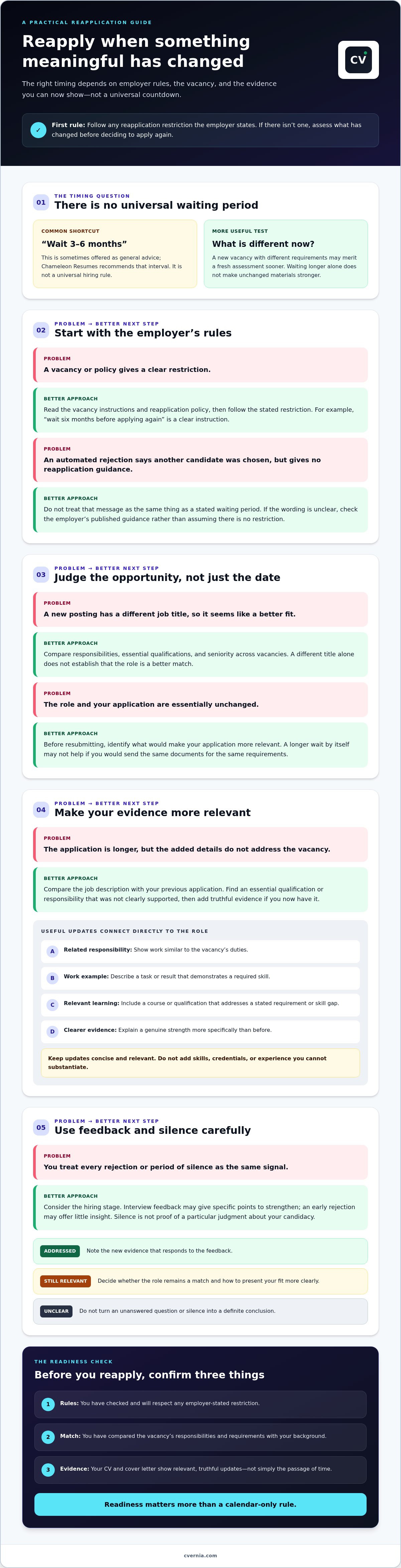
Follow any reapplication restriction the employer states. If there isn’t one, decide based on how well the current vacancy fits and whether something meaningful has changed in your candidacy. There’s no single waiting period for every employer, role, or outcome. A rejection after an interview, an automated decline, and no response at all don’t necessarily call for the same next step.
Three to six months is sometimes offered as general advice. For example, Chameleon Resumes recommends that interval, but it isn’t a universal hiring rule. A new vacancy with different requirements may justify applying sooner, while a longer wait won’t automatically make an unchanged application more compelling. Focus on the circumstances, not just the date.
What should you do if the employer specifies a waiting period?
Read the vacancy instructions and any reapplication policy, then follow the stated restriction. A clear instruction such as “wait six months before applying again” is different from an automated rejection message that simply says the employer has chosen another candidate. If the wording is unclear, don’t assume that means you can ignore a possible restriction. Use the employer’s published guidance to inform your decision.
Why is there no universal number of weeks or months?
Employers use different hiring stages and processes, from an initial application review to interviews and a final decision. The Job interview process can involve several steps, so the stage at which you receive a rejection may shape what you know about your fit. Silence, an early decline, and a late-stage decision offer different amounts of information, but none creates a standard reapplication timeline.
Compare what’s different now. Has the employer posted a new vacancy, changed the essential requirements, or described responsibilities that better match your background? Have you gained relevant experience or training since your previous application? If so, the new opportunity may deserve a fresh assessment. If nothing has changed and you’d submit essentially the same documents, waiting longer by itself may not help.
Readiness matters more than a calendar-only rule: reapply when the opportunity or your evidence has meaningfully changed, and respect any employer-set restriction.
- New vacancy: Check whether its responsibilities and requirements differ from the earlier posting.
- Updated candidacy: Identify relevant experience, training, or evidence that strengthens your fit.
- Same role, same materials: Decide what would make a new application more relevant before resubmitting.
Use the rejection as context, not as a verdict on every future opening at the company. A different role may call for a different assessment, while a nearly identical vacancy makes the employer’s policy and your application history especially relevant. The next sections will help you judge what has changed and prepare a more targeted reapplication.
What Should Change Before You Reapply for the Same Job?
A longer wait doesn’t automatically make a second application stronger. If you’re wondering, “how long should I wait to reapply for a job,” first ask what you can now show that you couldn’t show before. New relevant responsibilities, training, or clearer evidence of an existing skill can help when they connect directly to the vacancy. The goal isn’t to collect updates for their own sake. It’s to address a real requirement or gap.
Which improvements make a repeat application more relevant?
Compare the job description with your previous application. Identify an essential qualification or responsibility that wasn’t clearly supported, then consider whether you now have truthful evidence that addresses it. For example, if the role requires coordinating projects, a new assignment where you tracked deliverables could be relevant. A course or completed qualification may also help if it matches a stated requirement.
Use this relevance test for each potential update:
- Role-related responsibility: Does it show you’ve handled work similar to the vacancy’s duties?
- Work example: Can you describe a result or task that demonstrates a required skill?
- Relevant learning: Does a course or qualification address a stated requirement or skill gap?
- Clearer evidence: Can you explain an existing, genuine strength more specifically than you did before?
Leave out accomplishments that don’t help demonstrate your fit. Don’t add a skill, credential, or experience you can’t substantiate. A concise, relevant update is more useful than a longer CV filled with unrelated details.
How should previous feedback influence your decision?
Review any feedback alongside the stage you reached. Specific comments from an interview may point to a skill or example to strengthen; an early rejection may offer little insight into the decision. Sort each point as addressed, still relevant, or unclear. This gives you a practical way to decide what to revise without assuming you know more than the employer told you.
- Addressed: Note the new evidence that responds to the feedback.
- Still relevant: Decide whether the role remains a match and how you can present your fit more clearly.
- Unclear: Don’t turn an unanswered question or silence into a definite conclusion about your candidacy.
No response can be frustrating, but it doesn’t prove that a particular qualification, CV detail, or interview answer caused the outcome. Treat silence as limited information. Focus on what the vacancy asks for and what you can honestly demonstrate now.
Evidence of improvement changes your application; waiting longer only changes the date. Before resubmitting, ask whether you can point to a relevant update and explain how it supports the role. Keeping previous materials and notes organized makes that comparison easier. Application version tracking tools can help you review what you submitted before preparing a new version.
Reapply for the Same Role or a Different One?
A new opening at the same company isn’t automatically the same opportunity. Compare the actual work, not just the title. Look at day-to-day responsibilities, essential qualifications, seniority, and the requirements the employer emphasizes. A “project coordinator” role at one level may differ substantially from one focused on leading complex programs.
This comparison can help answer how long should I wait to reapply for a job: if the vacancy is genuinely distinct and your experience matches its requirements, it may be reasonable to apply sooner than you would for the same role. But a title change alone doesn’t make a new application a better fit. Check whether the core duties and qualifications have changed.
| Opportunity | What to assess | How to approach it |
|---|---|---|
| Same vacancy | Is it still open, and do you have new relevant evidence? | Follow the employer’s instructions; don’t send an unchanged application. |
| Reposted vacancy | Have the requirements, responsibilities, or instructions changed? | Review the posting carefully and tailor your materials to it. |
| Meaningfully different vacancy | Do the duties, essential qualifications, or seniority fit your background? | Assess it as a separate opportunity and prepare role-specific materials. |
When does a reposted or still-open vacancy justify another application?
First, confirm that the employer is accepting applications and review the current posting for changes. A repost might reflect an ongoing search, an updated listing, or a hiring process that’s still underway. It doesn’t necessarily mean every earlier candidate was rejected, nor does it invite duplicate submissions. If the instructions don’t explain whether previous applicants should apply again, avoid sending a second copy without a clear reason. Make any new submission reflect relevant evidence or changed requirements.
Can you apply to another position at the same company right away?
A distinct opening can be worth considering without waiting for the same-role interval if you meet its actual requirements. For example, after applying for a customer support position, you might also be a fit for a separate training role if you can demonstrate relevant experience developing learning materials. Treat each application as its own case: highlight the experience that fits that position, and write a cover letter that addresses its responsibilities rather than reusing one unchanged.
Before applying, check the employer’s instructions for any limits or guidance that apply across roles. Then make a quick side-by-side comparison:
- Responsibilities: Are the central tasks substantially different?
- Qualifications: Do you meet the essential requirements for this opening?
- Seniority: Does the level match your experience and scope of responsibility?
If the answers support a distinct fit, prepare a focused application. If the roles are nearly identical, or the employer sets a restriction, follow that guidance and avoid treating a new title as a workaround.
How to Prepare a Stronger Reapplication: A Practical Checklist
A stronger reapplication starts with the new vacancy, not with the old documents. Before editing, place your previous CV and cover letter beside the current job description. This makes it easier to see what still fits, what needs updating, and which relevant evidence you didn’t highlight the first time. Use this sequence to prepare a focused, accurate application.
- Confirm the vacancy and instructions. Check that applications are still being accepted, then review the requirements and any guidance for previous applicants. Note changes in duties, qualifications, or submission instructions before reusing any material.
- Compare the job description with your last application. Mark the essential requirements and identify where your previous documents already provide evidence. Highlight gaps or details that could be clearer. Don’t assume the same CV suits a reposted or adjusted vacancy.
- Choose relevant, truthful evidence. Select genuine responsibilities, outcomes, skills, or qualifications that address the role’s requirements. Make examples easy to find and describe them precisely. Leave out claims you can’t support.
- Tailor your CV and cover letter. Bring the most relevant experience forward in your CV. In the cover letter, explain why your background fits this specific vacancy instead of repeating a generic introduction. If you want to review document compatibility, use an ATS resume checker guide as one resource, alongside a careful check of relevance and accuracy.
- Decide whether to mention your earlier application. If it helps clarify your history or the employer asks, acknowledge it briefly and professionally. For example: “I previously applied for this position and am submitting an updated application that reflects my relevant experience.” Keep the focus on your fit for the current opening, not on defending the earlier outcome.
- Proofread and save the final versions. Check names, dates, contact details, formatting, and consistency across documents. Review any ATS compatibility feedback as a guide, not a prediction of hiring decisions. Save the final CV and cover letter with clear labels tied to the role.
Keep a record of the application date, employer, role, instructions, previous outcome, and changes you made. Store each role’s CV and cover letter separately so an older version doesn’t slip into a new submission. Organized notes can also help you keep track of follow-up details; the job interview tracker guide explores ways to manage that information.
Preparing this way gives you a practical answer to “how long should I wait to reapply for a job”: apply when you’re permitted to and can submit materials that accurately reflect the vacancy and your evidence. Use CVernia’s application tools to organize your materials and document versions as you prepare.
Make Your Next Reapplication More Deliberate With CVernia
A well-organized application history helps you decide what to change next. CVernia’s application tracking dashboard keeps roles and related materials together, including notes, attachments, and document versions. Review what you submitted for a previous opening before preparing an application for a new or reposted role.
How can an application tracker help you avoid repeating the same approach?
It’s easy to forget which CV version went with which vacancy, especially when you’re applying to several roles. Use your application record to capture the employer, job title, application date, previous outcome, and any feedback or instructions you received. Add a short note about what you emphasized in the earlier application and what you plan to revise.
CVernia’s Smart Reapplication Detection can alert you when you’re preparing to apply to a company you’ve applied to before, so you can review your previous application versions. It supports your decision-making; it doesn’t submit another application for you or predict how an employer will respond. Compare the earlier version with the current vacancy, then make intentional changes based on the role and your genuine qualifications.
Keep each CV and cover letter version tied to the relevant role. For instance, a CV prepared for a customer service opening may emphasize client communication, while one for an operations role may foreground coordination experience. Clear labels and organized attachments help you distinguish those materials and reduce the chance of selecting an outdated file.
How can you tailor your next application while staying accurate?
Start with the job description. CVernia’s tailored CV and cover letter tools help align your application content with the vacancy, while CV compatibility and ATS analysis offer another review aid. Check the results against the actual requirements: make relevant experience easy to find, use clear language, and verify every detail. A compatibility review is not a hiring decision or a guarantee of progression.
Keep the application truthful. If a posting asks for a skill you haven’t used, don’t add it just to make your CV appear closer to the role. Instead, highlight related experience you can substantiate, or decide whether the requirement is essential to your fit. A focused, accurate application is more useful than one that overstates your background.
If you’re still weighing “how long should I wait to reapply for a job,” organized records can help you assess what has actually changed. Review the past version, compare it with the new vacancy, and update only where you have relevant evidence. CVernia brings your application materials and versions together to support that deliberate process. Organize your applications with CVernia.
Make Your Next Application a Confident Step Forward
Your next move doesn’t have to be driven by worry that you’ve waited too long or applied too soon. Ask instead whether the opportunity fits, whether you can show relevant evidence, and whether your application presents that evidence clearly. If you’re still asking “how long should I wait to reapply for a job,” use readiness and the employer’s instructions to guide your decision, not a date alone.
Keep your job search organized as you move forward. CVernia brings application tracking, notes, and attachments together, while document version management and smart reapplication detection help you review earlier materials before making changes. Tailored CV and cover letter tools, alongside ATS compatibility analysis, can support a more focused review. Your experience and every claim in your application remain yours to verify.
Take the next step with a clear record and a truthful, role-specific application. Organize your applications and prepare your next step with CVernia. Each thoughtful application can help you move forward with greater clarity and confidence.
Frequently Asked Questions
Is it okay to reapply for a job after being rejected?
Yes, reapplying can be appropriate if the employer allows it and you have a clear reason to try again. Before starting, check whether the rejection message or vacancy mentions restrictions, then review any feedback and the role’s requirements. For example, a new qualification relevant to an essential duty may strengthen your case. If your experience and documents are unchanged, pause and consider what a new application would add.
Can I apply for a different job at the same company right away?
Yes, you can consider a different opening if you meet its requirements and the employer’s application instructions allow it. Assess the actual work, not just the title. A communications role and a content role might share skills but require different evidence. Build your application around the specific opening, and don’t assume that applying for another position reverses or challenges the company’s earlier decision.
Should I reapply if I never received a response?
You can consider applying again, but first check whether the original posting is still active, has been replaced, or gives new instructions. No response doesn’t reveal whether the employer reviewed your application or why you didn’t hear back. If you submit again, use the correct process and note the date and file names. That record can help you avoid accidentally sending the same application twice.
Should I mention my previous application in a new cover letter?
Mention it only if it gives useful context, such as a relevant qualification or experience you’ve gained since applying. Keep the reference brief, then turn to the current role and your fit. For example, one sentence can note that you applied previously and have since completed training related to a stated requirement. Don’t use the letter to revisit the rejection or expect the hiring reader to recall your earlier submission.
Is three to six months the right amount of time to wait before reapplying?
Not necessarily. A career guide may recommend three to six months, but that interval isn’t a universal hiring rule. First follow any waiting period stated by the employer. If no restriction applies, assess whether the role has changed or whether you can now show relevant experience or qualifications. If you’re asking “how long should I wait to reapply for a job,” time alone isn’t a reliable measure of readiness.
What should I change before sending a second job application?
Start by identifying one or two requirements your earlier application didn’t make easy to assess. Add accurate examples that demonstrate those points, such as a relevant responsibility or completed course, and remove details that distract from your fit. Check dates, contact information, and consistency between your CV and cover letter. Save the revised files with clear labels so you can distinguish them from versions prepared for other vacancies.
Can applying more than once hurt my chances of getting hired?
It can create a poor impression if you ignore the employer’s instructions, apply repeatedly to the same opening, or submit materials that don’t fit the role. A thoughtful application for a genuinely different position is not the same as sending duplicate submissions. Before applying, check for stated limits and make sure you can explain why your background fits that specific vacancy. Apply with purpose, not simply to stay visible.


