

What should you write in a thank you note after second interview when you’ve already followed up once? The second message doesn’t need to repeat the first. Build it around a specific point from the conversation and show how your experience relates to what the team needs.
It’s easy to worry about sounding generic, overly eager, or unsure what to mention. A concise, personalized note can reinforce your interest without re-selling your qualifications. Send it promptly, focus on one useful detail from the discussion, and keep the tone professional and natural.
This guide includes second-interview thank-you note templates, tips for tailoring your message to each interviewer, and advice on what to do if you don’t hear back. You’ll also learn how organized interview notes and application tracking can help you capture key details and manage next steps.
Key Takeaways
- Use a second-interview thank-you note to express appreciation and reinforce relevant interest, not to pressure the hiring team.
- Build your message around a clear subject, a specific conversation detail, and a genuine connection to the role.
- Choose email, a handwritten note, or LinkedIn based on your existing relationship and communication channel.
- Adapt a template to real interview details so your thank-you note after second interview sounds personal, not scripted.
- Keep interview notes and next steps organized, then verify details and proofread before sending.
Why a Thank-You Note After a Second Interview Still Matters
A second conversation can leave you wondering whether another follow-up will feel repetitive. A brief, thoughtful thank-you note after second interview lets you recognize the interviewer’s time and reflect on what you learned, without asking them to hurry a decision. The goal isn’t to make a dramatic new case for yourself. It’s to leave a clear, professional impression that follows naturally from the conversation.
Thank-you notes are a customary way to express appreciation, but the strongest follow-up does more than offer a polite sign-off. It connects your thanks to the substance of the discussion. For a general overview of The importance of a thank you note, consider how purpose and etiquette shape the message. In a second-interview context, show that you listened closely and can relate a genuine strength or experience to something the interviewer raised.
In brief: A second-interview thank-you is specific to the new conversation. Thank the interviewer, mention one genuine discussion point, and connect it to a relevant, truthful strength. Keep the tone appreciative and measured, without pressing for a decision.
A considered note supports clear communication, but it can’t guarantee an offer or control the hiring outcome. Your part is to make your interest and fit easy to understand; the employer makes its own decision. Focus on what you can communicate accurately and professionally.
What a second-interview follow-up should accomplish
Use the message to do three things: thank the interviewer for their time and the deeper discussion, refer to one topic that genuinely came up, and explain how it connects to a strength or experience you can honestly claim. Specificity makes the follow-up feel attentive rather than copied from a template.
For example, if the conversation explored how the role works across teams, refer to that topic and briefly connect it to your real experience coordinating work with colleagues. Don’t add an achievement, skill, or detail you didn’t discuss or can’t support. One relevant connection is more credible than a list of claims.
How to avoid repeating your first thank-you
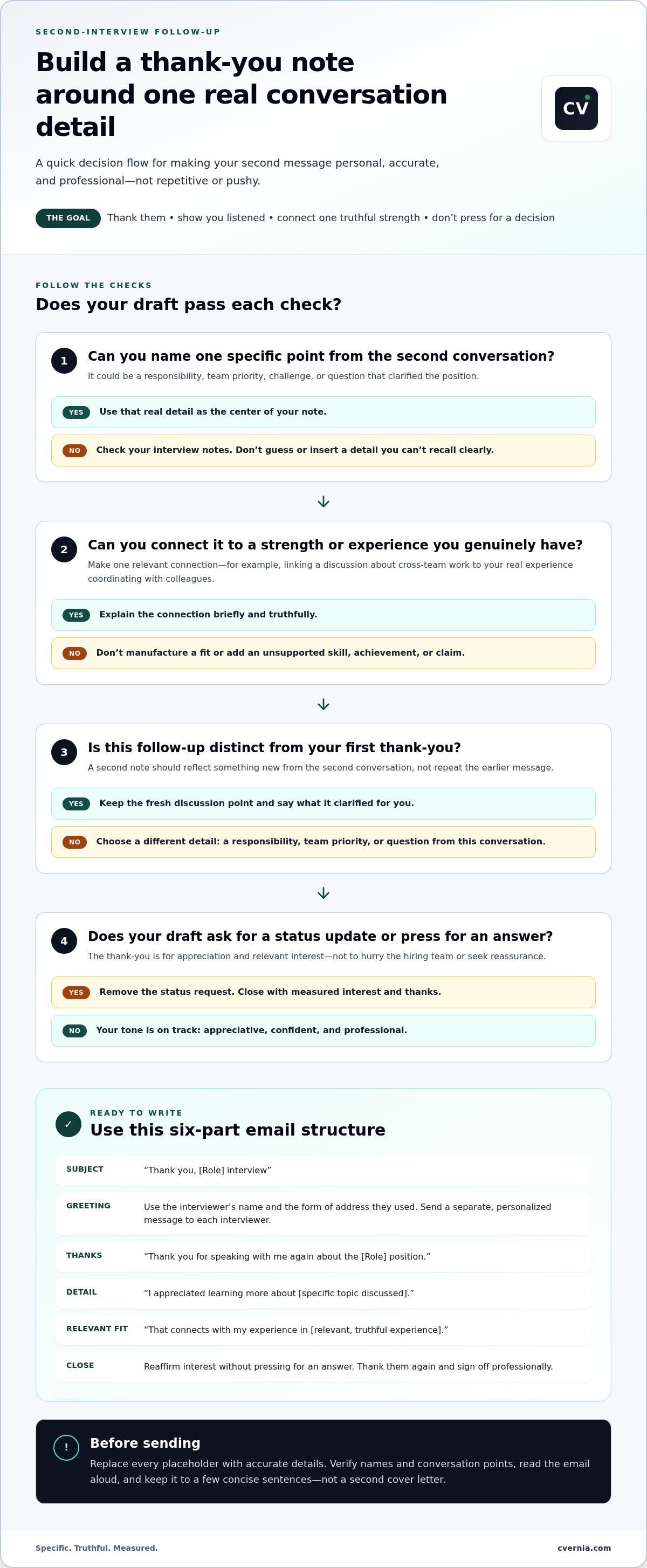
Before drafting, recall what you already said. Choose a different detail from the second conversation, such as a responsibility, team priority, or question that gave you a clearer picture of the position. Then explain what that detail clarified for you. It may have strengthened your understanding of the role’s priorities or shown how a particular part of your background could be useful.
Keep the tone appreciative, confident, and measured. You can reiterate your interest, but avoid repeating a broad statement like “I’m very excited about this opportunity” without adding context. Don’t use the note to ask for a status update or press for reassurance. A fresh discussion point and a concise reflection are enough to make this follow-up distinct and sincere.
How to Write a Thank-You Email After a Second Interview
Make the message easy to read and personalize. A useful structure keeps the thank-you note after second interview focused: identify the role, appreciate the interviewer’s time, refer to one real detail, and close by expressing clear interest. Aim for a few concise sentences rather than a second cover letter.
A simple structure for a polished follow-up
Draft each part in order, then read the email aloud. Replace every placeholder with accurate details before sending.
- Subject: Use a clear line that identifies the conversation and position, such as “Thank you, [Role] interview.”
- Greeting: Address the interviewer by the name and form of address they used. If you met with several people, prepare a separate, personalized message for each.
- Thanks: Thank them for their time and refer naturally to the second conversation. For example: “Thank you for speaking with me again about the [Role] position.”
- Specific detail: Mention one topic, team priority, or challenge that came up. Keep it precise: “I appreciated learning more about [specific topic discussed].”
- Relevant fit: Connect that detail to a strength or experience you genuinely have. For instance: “That connects with my experience in [relevant, truthful experience].”
- Closing: Reaffirm interest without pressing for an answer, then sign off professionally: “I remain interested in the role and appreciate your consideration. Best, [Your name].”
Personalize the message with one real conversation detail
Specificity comes from accuracy, not from adding extra claims. Choose a point the interviewer actually raised, then briefly explain why it matters to you or how it relates to your background. If you can’t recall a detail clearly, check your interview notes rather than guessing. A message based on the real discussion will sound more natural than a polished line that could fit any company.
Here’s how the pieces can flow together without turning into a long pitch:
Subject: Thank you, [Role] interview
Hi [Interviewer name],
Thank you for taking the time to speak with me again about the [Role] position. I appreciated our conversation about [specific topic from the interview]. It was helpful to learn [what the discussion clarified]. My experience with [relevant, truthful strength or experience] relates to that priority, and I’m still very interested in the opportunity to contribute to [team or organization].
Thank you again for your time.
Best,
[Your name]
Keep only the sentences that fit your actual conversation. Remove the bracketed prompts, check names and details, and leave status requests out of a thank-you message. The templates in the next section can help you adapt this structure to different interview situations.
To personalize accurately, record key discussion points while they’re fresh. CVernia helps you keep interview notes and application details organized. A job interview tracker can also help you keep each conversation and next step together. Use your notes to shape the message, then proofread before sending.
Email, Handwritten Note, or LinkedIn Message: Which Follow-Up Fits?
The best channel is the one that feels professional and natural in the context of your conversations. If the interview was arranged by email, email is usually the clearest default: it’s timely, easy to reference, and keeps your follow-up in a familiar place. A handwritten note or LinkedIn message may also fit, but neither is automatically more thoughtful. Consider how you’ve communicated so far and how quickly your message needs to arrive.
| Channel | Speed | Formality | Best suited to | Use when the channel is established? |
|---|---|---|---|---|
| Fast | Professional and flexible | Most interview follow-ups, especially when timing matters | Yes, particularly if interview logistics were handled by email | |
| Handwritten note | Slower to arrive | More traditional and personal | Contexts where a physical note feels consistent with the relationship | Best when a written note suits the professional setting |
| LinkedIn message | Fast | Usually conversational | A brief follow-up when LinkedIn has already been part of your exchange | Yes, if the interviewer has communicated with you there |
When email is the clearest choice
Email gives you a direct way to send a polished, timely message without adding a new communication channel. If the interviewer contacted you by email to schedule the conversation, replying in that thread can keep your name, the role, and the context together. It also makes it easier for the interviewer to refer back to the exchange.
Check the thread before replying. If it has a clear subject and contains the relevant interview details, continue there. If the subject is vague, the thread includes unrelated topics, or the message is difficult to identify, start a new email with a concise subject such as “Thank you, [Role] interview.” The goal is to make your note easy to place, not to follow a rigid rule.
When another channel may make sense
A handwritten note can feel considered when it suits the established professional context, but its slower delivery may make it less practical for a timely follow-up. It can work as a personal gesture in settings where that approach feels natural. Keep the message brief and focused, just as you would in an email.
Use LinkedIn if communication there is already appropriate and welcome, such as when the interviewer has contacted you through the platform. Keep the message professional and don’t treat a connection request as a substitute for an established communication channel. If you’re unsure, choose the channel used for interview arrangements.
Choose one channel and send one considered message. Don’t copy the same thank-you across email, LinkedIn, and a handwritten note to force a response. A thank you note after second interview should feel like a courteous continuation of your existing communication, not a campaign to get noticed.
Second-Interview Thank-You Note Templates for Common Situations
Use these templates as a starting point, not a script. Replace every bracketed prompt with accurate information from your interview, and remove anything that doesn’t fit. A thank you note after second interview has one clear purpose: show appreciation and reflect on a real part of the conversation. Keep any mention of your fit grounded in experience you actually have.
Template for a second conversation with one interviewer
This version keeps the focus on your conversation with one person. Choose a detail that wasn’t the focus of your first follow-up, then connect it briefly to relevant experience.
Subject: Thank you, [Role] interview
Hi [Interviewer name],
Thank you for taking the time to speak with me again about the [Role] position. I appreciated learning more about [specific topic, responsibility, or team priority discussed]. Our conversation clarified [what you learned about the role or team], and it connects with my experience in [relevant, truthful experience or strength].
I remain interested in the opportunity and appreciate your time and consideration.
Best,
[Your name]
For a warmer tone, change “I appreciated learning more” to “I enjoyed hearing more,” if that reflects how you genuinely felt. For a more formal exchange, keep the original wording and use the interviewer’s preferred form of address. Either way, avoid assuming you’ll move forward or asking for a decision in the thank-you itself.
Template for a panel or multi-person interview
For a panel, address each person by name when appropriate, and verify spelling and titles before sending. If you’re writing individually, refer to a shared discussion point only when it genuinely applies to that person. Add a distinct detail if you had a separate exchange with them.
Subject: Thank you for the [Role] conversation
Hello [Name or panel members],
Thank you for the thoughtful conversation about the [Role] position. I especially appreciated the discussion about [shared topic raised during the interview]. It helped me understand [specific insight about the role or team]. My experience with [relevant, truthful experience] relates to that area, and I remain interested in the opportunity.
Thank you again for your time.
Best,
[Your name]
If you send separate notes, personalize each one rather than copying the same message to everyone. For example, thank one interviewer for clarifying a team priority and another for explaining a specific responsibility. Keep each message concise; don’t combine appreciation, a long sales pitch, and a request for hiring updates.
Check before you send
Review the message once more before sending. A quick accuracy check helps the note feel personal and professional, not rushed.
- Confirm the interviewer’s name, spelling, and role title.
- Make sure the conversation detail is accurate and specific to this interview.
- Check that any skill or experience you mention is truthful and relevant.
- Remove wording that assumes an offer, demands a response, or pressures the interviewer.
Keep your interview notes organized so you can personalize each message with confidence. Organize your interview notes with CVernia as you manage application details and follow-up tasks.
Organize Interview Notes and Send a Confident Follow-Up with CVernia
A personalized message is easier to write when you don’t have to reconstruct the interview from memory. Accurate notes help you identify what mattered to the interviewer, choose a relevant detail, and avoid mixing up conversations when you’re managing several applications. Use your notes as a reference, not a substitute for your own judgment: the message should reflect what you genuinely heard and what you can truthfully say about your experience.
Turn interview notes into an accurate message
After the conversation, capture the interviewer’s priorities, topics you discussed, and any next steps. Keep brief, factual notes rather than trying to record every word. For example, note a team priority in the interviewer’s language, then record your own related experience separately. That distinction helps you avoid presenting an assumption as something the interviewer confirmed.
Before drafting your thank you note after second interview, check your notes against the role and application. Confirm the job title and interviewer’s name, then select one discussion point that genuinely belongs in this follow-up. Keeping interview notes and related application details together makes it easier to find the right context later, especially when preparing messages for different interviewers or employers.
Keep your job-search follow-up organized
Track practical details such as the interview date, who you spoke with, whether you’ve sent a thank-you, and any next step the employer shared. A clear record helps you distinguish a follow-up you’ve already sent from one you still need to prepare. It also keeps role information close to your notes, so details from one application don’t slip into another message.
If you’re coordinating multiple applications, a job search management system can help keep application progress and interview follow-ups in one workflow. CVernia’s application tracking dashboard and interview notes and attachment management help you organize those details. You choose what to include and describe your experience accurately. The platform keeps information together while you write in your own voice.
Send-ready checklist
Before you send, take a final pass through these essentials:
- Verify: Check names, role title, and the interview detail you mention against your notes.
- Proofread: Read the message for typos, clarity, and a professional tone.
- Choose: Use a suitable communication channel, ideally the one already established with the interviewer.
- Send: Once the message is accurate and ready, follow through without adding extra messages across other channels.
A consistent routine makes follow-up a manageable part of your application process. Keep the notes, role details, and next steps organized, then write the message in your own words. To bring application progress and interview details together, explore CVernia’s application management platform and organize your applications with CVernia.
Make Your Next Application Step with Confidence
Once you’ve sent your thank you note after second interview, let the follow-up stand on its own. You’ve made your interest clear; now give the hiring team room to respond while keeping your broader search moving. A thoughtful message is one part of a professional process, not a measure of your worth or a promise of a particular outcome.
Use the pause to prepare for what comes next. Keep your application details current, save relevant interview materials, and make sure the claims in your application reflect your real skills and experience. CVernia brings application tracking, interview notes and attachments, and tools for creating tailored, truthful application materials into your job-search workflow.
Organize your applications and interview notes with CVernia to keep your next steps clear and your materials aligned. You’ve already taken the time to follow up with care. Keep moving forward with the same clarity and confidence.
Frequently Asked Questions
Is it too late to send a thank-you note after a second interview the next day?
No, sending it the next day can still be useful. Send it as soon as reasonably possible rather than spending extra time perfecting every sentence. A concise note that accurately refers to your conversation is better than one sent in a rush with errors or delayed because you’re overthinking it. Hiring processes differ, so don’t treat the interview day as a universal cutoff or imply that you sent the message sooner than you did.
What should I do if I do not have the interviewer’s email address?
First, review the messages you received about scheduling and attending the interview. The interviewer’s address may already be included in an email thread or calendar invitation. If a recruiter or coordinator has been your established contact, send them a brief thank-you and ask them to pass it along. Keep the request simple, and don’t search for private contact information or send the same note through several channels.
Should I mention a concern or question that came up during the second interview?
You can briefly clarify a genuine point if your response adds useful information about your fit for the role. For example, if you were asked about a relevant responsibility and your answer was incomplete, add a concise, factual clarification. Keep the thank-you central, and avoid turning the note into a long defense or a new pitch. Don’t make claims you can’t support, and leave unrelated questions for a separate conversation.
Can I send a thank-you note after a second interview if I already sent one after the first?
Yes. A thank you note after second interview can acknowledge a different conversation and show that you listened to what was discussed later in the process. Make the new message distinct by referring to a fresh topic, insight, or question. Don’t copy your first note and change only the greeting, or repeat general enthusiasm without context. A short, relevant message will feel more considered than a second version of the same email.
What if the interviewer does not reply to my thank-you email?
A thank-you note doesn’t require a reply, and silence by itself doesn’t tell you the hiring decision. If the interviewer shared a date or process timeline, allow that period to pass before checking in. Then send one brief status inquiry through the contact channel already used for the process. Keep it courteous and focused on the update. Avoid repeated messages, which can add pressure without providing new information.
Can I ask about the hiring timeline in my thank-you note?
Keep appreciation and a genuine conversation detail at the center of the note. If the interviewer gave you a timeline, you can acknowledge it with a simple line such as, “I look forward to hearing from you after [stated milestone].” If no timeline came up, a short process question may be reasonable when you need clarity. Otherwise, save the status inquiry for a separate follow-up, and don’t ask for an immediate decision.


