

Does the often-repeated claim that ATS rejects 75% of resumes tell you more about online career advice than hiring software? If you’re wondering what percentage of resumes are rejected by ATS, the honest answer is that there’s no reliable evidence for one universal rejection rate. Conflicting statistics can make it hard to know whether an automated system might screen out your application before a recruiter sees your experience.
In practice, many ATS platforms organize and rank applications for recruiter review. Some employers use knockout questions to screen for requirements such as work authorization or a necessary license. A low ranking can also make a resume less likely to be noticed. These outcomes are different from a system automatically rejecting three-quarters of applicants.
This article separates the 75% claim from what the available evidence can show. You’ll learn how resume parsing, screening, and human review differ, and how to make your qualifications clearer to both software and recruiters. We’ll also cover how to tailor your resume to a job description without keyword stuffing or overstating your experience.
Key Takeaways
- The answer to “what percentage of resumes are rejected by ATS” depends on what a study counts. Check its sample, method, and definition of rejection before trusting a figure.
- Understand how a resume moves from submission to text extraction, screening or sorting, and recruiter review so you can spot where issues may arise.
- Use clear headings, a readable layout, and accurate details to help software interpret your experience. Use job-description language only when it truthfully reflects your background.
- Use ATS compatibility analysis to identify alignment and readability issues, not as a pass-or-fail verdict or a promise of a hiring outcome.
What Percentage of Resumes Are Rejected by ATS? The Short, Evidence-Based Answer
No reliable, universal statistic establishes that applicant tracking systems reject 75% of resumes. The figure is widely repeated, but repetition isn’t proof of a measured hiring outcome. To establish a true rejection rate, research would need to define “rejected,” identify the employers and roles studied, and track what happened to applications. A compatibility score or estimate from one company’s resume analysis doesn’t show how often employers reject applicants across the market.
So, what percentage of resumes are rejected by ATS? There’s no trustworthy single percentage that applies to every employer. Outcomes can vary with the role, applicant pool, employer’s screening rules, and hiring process. A study that counts resumes below a particular score measures that threshold, not necessarily applications rejected by employers.
Where did the 75% ATS rejection claim come from?
The claim’s origin is difficult to verify from accessible evidence. Davron challenges the figure and says strong empirical support is lacking. ResumeAdapter also calls it unsupported, but attributes it to Preptel. These accounts describe its history differently, and neither establishes a representative, independently validated hiring statistic or provides enough evidence to confirm the original source trail. One often-repeated account traces the number to a sales claim by a now-defunct company, but that history should be treated cautiously without the original material.
Many websites repeating the same percentage don’t amount to many independent studies. If pages cite one another or omit the underlying sample and method, they may simply amplify a claim rather than verify it. Look for the original research, who was measured, when it was conducted, and whether the outcome was an ATS score, a recruiter decision, or an employer rejection.
Does “rejected by ATS” mean the same thing everywhere?
No. The phrase can refer to several different stages, each with a different meaning for an application:
- Parsing: Software extracts text and details from a submitted file. If information is misread, it may be harder to find, but that alone doesn’t prove the application was rejected.
- Eligibility screening: Knockout questions can screen out applicants who don’t meet an employer’s stated requirement, such as work authorization or a necessary license.
- Sorting or ranking: A system may organize applications to help a recruiter prioritize review. A low position could reduce visibility without being a formal rejection.
- Recruiter review and employer decision: People may assess applications and decide who advances, though the exact process differs by employer.
Employers configure hiring workflows differently, so don’t assume every application is automatically rejected before a person sees it. For background on the software’s broader role, see the Applicant Tracking System (ATS) overview on Wikipedia.
A resume compatibility score measures alignment or readability. It is not a universal hiring rejection rate. Keep those measures separate, and assess claims by what they actually count.
How ATS Screening Works Before a Recruiter Reviews Your Resume
An application usually moves through several steps, but an applicant tracking system (ATS) doesn’t perform the same role at every employer. It’s software within a company’s hiring workflow, configured to help manage applications and candidate information. Depending on the setup, it may organize records, extract resume details, support screening, or help recruiters sort applications. It isn’t one universal decision-maker applying identical rules everywhere.
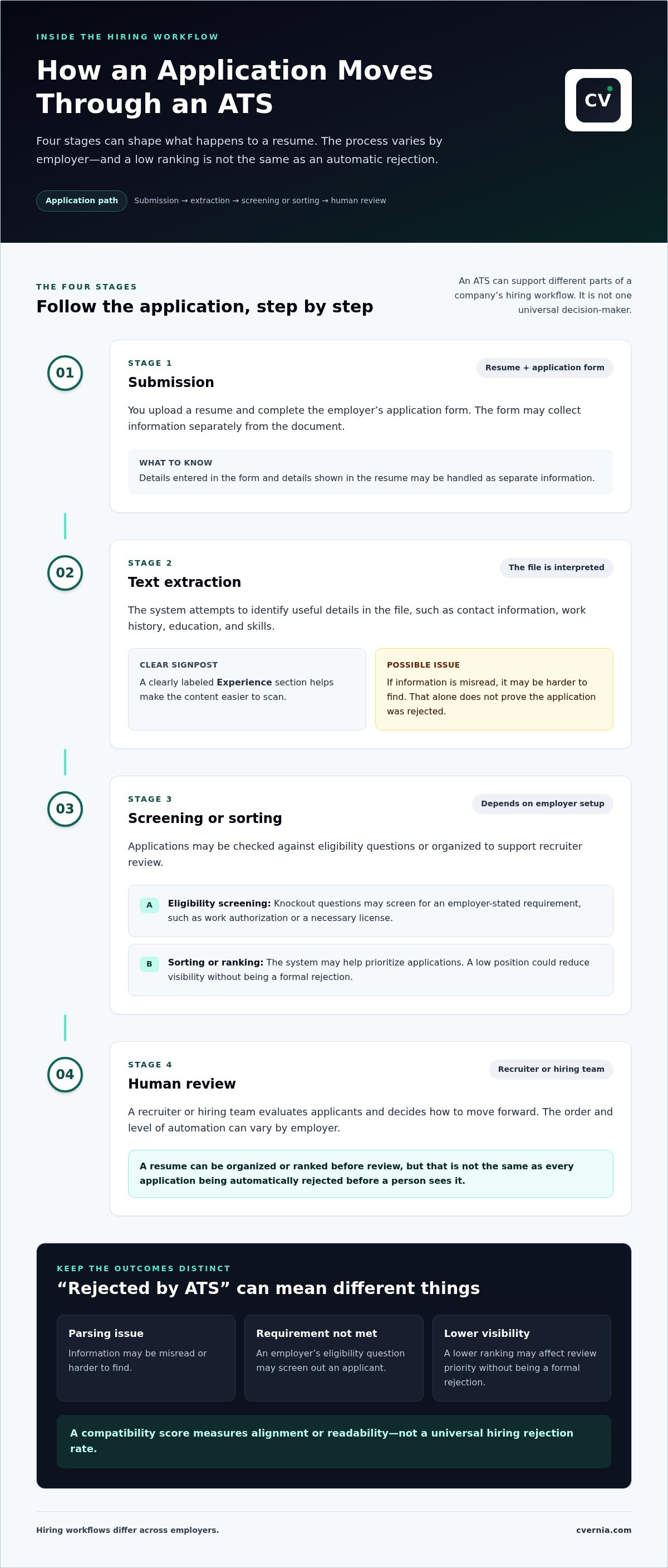
Here’s a simple view of the process:
- Submission: You upload a resume and complete the employer’s application form. The form may collect information separately from the document.
- Text extraction: The system processes the file and attempts to identify useful details, such as your contact information, work history, education, and skills.
- Screening or sorting: Depending on the employer’s workflow, applications may be checked against eligibility questions or organized to support review.
- Human review: A recruiter or hiring team evaluates applicants and decides how to move forward. The order and level of automation can vary.
This sequence helps explain why “the ATS rejected me” can be an imprecise description. An issue could arise when the system reads a document, when an answer fails an employer-defined requirement, or later during human evaluation. Understanding how applicant tracking systems work can help you distinguish these stages and focus on what you can control.
What happens when an ATS parses a resume?
Parsing means software extracts information from a submitted document and tries to place it into useful fields. It may identify section headings, dates, employers, job titles, and skills, but systems don’t all process files or formatting in the same way. Clear headings and a straightforward layout make a document easier to scan, whether by software or by a person reviewing it later.
For example, a clearly labeled “Experience” section gives readers an immediate signpost. In a complex layout, the order or meaning of information may be less obvious to some systems. That doesn’t mean every design element causes a parsing problem. It’s a practical reason to prioritize legibility and check that extracted details still make sense.
Can an ATS rank a resume without rejecting it?
Yes. Sorting or ranking can influence which applications a recruiter reviews first without being a final rejection. Screening questions or employer-defined criteria may also affect an application’s progress. ATS behavior depends on the system’s setup and the employer’s hiring workflow, so a ranking, filter, or parsing result isn’t automatically a final hiring decision.
If you’re asking what percentage of resumes are rejected by ats, remember that a resume’s compatibility with a job description can’t reveal the employer’s full process or decision. Use CVernia’s CV compatibility and ATS analysis to review alignment with a role, then confirm that every detail in your tailored resume accurately reflects your experience.
What ATS Statistics Can Prove, and Where the Evidence Falls Short
A percentage is only as useful as the method behind it. To decide whether a statistic answers what percentage of resumes are rejected by ATS, check who collected the data, which applicants or documents were included, when the analysis took place, and what counted as rejection. A score below a vendor’s chosen threshold is not the same outcome as an employer rejecting an application.
Evidence also varies in strength. Peer-reviewed research can provide detailed methods and independent scrutiny, but it still needs to measure the specific hiring outcome in question. Employer surveys describe what respondents report, not necessarily what happens in every application workflow. Vendor analyses can reveal patterns in the resumes or scores they assess, but their sample and scoring rules may not represent all applicants. An unsourced percentage repeated across websites offers the least basis for a universal conclusion.
How to evaluate an ATS rejection statistic
Look for a transparent sample, collection dates, population, and method. Then ask what the percentage actually counts: a file that parsed poorly, a score below a cutoff, an application filtered by a question, a recruiter’s decision, or a final hiring outcome. If a source uses “rejected” without defining it or doesn’t disclose where its numbers came from, treat the claim cautiously rather than as a market-wide rate.
| Statistic or evidence | Source and scope | Measured outcome | Limitation |
|---|---|---|---|
| 75% rejection claim | Repeated online; no transparent representative sample, study dates, or method established in the accounts discussed here | Often described as resumes automatically rejected by ATS | Without a verifiable source trail and a clear definition of rejection, it can’t establish a reliable universal rate. |
| 71.4% below a 75-point threshold | ResumeAdapter’s company-generated analysis of 10,000 resumes in Q1 2026 | Resumes scored below the company’s “qualified” threshold | This is a vendor-defined scoring result, not a count of employer rejections. Its sample and scoring model don’t automatically represent all applicants or ATS platforms. |
| Median compatibility score of 52 out of 100 | ResumeAdapter analysis from June to August 2026 | Scores assigned to first-submission resumes | A median score describes that analysis, not the probability of rejection. Model or methodology changes can also limit comparisons across analyses. |
| Employer survey findings | Survey of a stated recruiter or employer population | Respondents’ reported practices or opinions | Interpret results in light of the sample, dates, question wording, and response method. Survey answers aren’t a record of every hiring decision. |
Why a resume score is not a rejection probability
A compatibility score reflects the criteria and matching method chosen by the tool that generated it. Different tools can assess job-description alignment differently, so the same resume may receive different scores. Treat the result as diagnostic feedback. It can point to details worth reviewing, but it can’t tell you how a particular employer will rank or decide on your application. The evidence above doesn’t support replacing the 75% claim with another universal rejection percentage.
How to Improve ATS Readability Without Chasing a Fake Pass Rate
Focus on a resume that software can interpret and a recruiter can scan quickly. You don’t need to guess at a magic score or cram in every phrase from a job ad. The question “what percentage of resumes are rejected by ats” doesn’t change the practical goal: make your relevant experience clear, accurate, and easy to find.
Which resume changes help ATS readability?
Use a straightforward structure with familiar section headings. Keep your name and contact details in the document body, and make work history, education, and skills easy to distinguish. Avoid relying on graphics, icons, text boxes, or elaborate columns to communicate essential details. Some systems may process layouts differently, so clarity is a safer choice than visual complexity.
- Choose conventional headings: Label sections clearly, such as “Experience,” “Education,” and “Skills,” rather than using creative titles that may be less immediately recognizable.
- Keep the reading order logical: Present roles and dates consistently, with your most relevant or recent experience easy to locate.
- Use accurate contact and experience details: Check names, dates, job titles, and contact information for errors or inconsistencies.
- Review the exported file: Open the final version and check that spacing and text appear as intended. You can also copy the text into a plain-text document to see whether headings, dates, and details remain in a sensible order.
Follow the employer’s instructions for file type and application fields. Before submitting, make sure the resume you intended to send is attached and that information entered into the form matches the document. For more context on assessing tools, explore this ATS resume checker guide.
How should you tailor a resume to one job?
Start with the job description. Identify the responsibilities, skills, and qualifications that genuinely match your background, then make the relevant evidence easier to notice. If the listing asks for experience preparing reports and you’ve done that work, describe the reporting tasks and their context clearly. Use the employer’s terminology when it accurately describes your work, but don’t claim a skill or responsibility you don’t have.
Tailoring means selective emphasis, not copying the entire job ad. A long list of disconnected keywords can make a resume harder to read and may not explain what you actually contributed. Instead, revise a relevant bullet to describe work, tools, or results you can truthfully support. Keep your meaning precise, even when the job description uses different wording.
Create a distinct, truthful version for each application, then review it before submission. Check that the role-specific details are relevant, every claim is accurate, and the version matches the position. CVernia’s CV compatibility and ATS analysis can help you review alignment with a job description while keeping your final decisions and claims grounded in your experience.
Use ATS Analysis as a Resume Check, Not a Hiring Guarantee
The evidence doesn’t establish one universal percentage of resumes rejected by ATS. That uncertainty isn’t a reason to abandon resume improvements. A clear, relevant CV can make your experience easier to understand, even though no score or formatting choice can guarantee how an employer will assess your application. The useful question isn’t only “what percentage of resumes are rejected by ats?” It’s whether your qualifications are represented clearly and accurately for the role you want.
What a useful ATS compatibility check should help you review
Use compatibility feedback to spot specific opportunities to improve alignment and readability. Compare the job description with your CV’s truthful content, then check whether relevant experience and qualifications are easy to locate. A missing term may be a prompt to review your wording, but it isn’t a reason to claim a skill or responsibility you don’t have.
- Look for relevant gaps: Identify role requirements that your experience supports but your CV doesn’t explain clearly.
- Check visibility: Make sure relevant job titles, skills, and accomplishments are easy to find and understand.
- Review the wording: Use the job description’s terminology when it accurately describes your background, and keep your meaning precise.
- Make the final call: Treat analysis as an editing aid. You’re responsible for checking accuracy and approving the final wording.
A score reflects a tool’s assessment, not an employer’s decision. If feedback suggests a gap, verify it against the role and your experience before editing. Keep the strongest evidence of your qualifications in view rather than changing your CV just to chase a higher number.
Keep tailored applications organized and truthful
Save a separate version of your CV and cover letter for each role. Before submitting, confirm that the documents match the position, the details are accurate, and the application form is consistent with what you’ve written. This review helps prevent you from sending a version tailored for a different opportunity.
Track where you applied, which document versions you used, and any follow-up or interview notes. A clear record makes it easier to prepare for later conversations and refine future applications without losing sight of what you’ve already shared with each employer. CVernia brings together tailored CVs and cover letters, compatibility analysis against job descriptions, application tracking, version management, and interview notes to support a more organized process.
Use ATS analysis for practical feedback on alignment and readability, not as a prediction of hiring outcomes. Explore CVernia’s career application tools to organize your documents and review how they match a role. Then make one careful, truthful improvement at a time.
Make Your Next Application More Deliberate
Put your attention where it can help: make your experience clear and your application relevant to the role. Rather than getting stuck on what percentage of resumes are rejected by ats, choose one position and review your documents against its requirements. Highlight evidence you can stand behind, remove anything that distracts from your fit, and keep every claim accurate.
A thoughtful application is easier to manage when you can see what you sent and what comes next. Use tailored CV and cover letter tools to prepare truthful, role-specific documents, compatibility analysis to review alignment with a job description, and application tracking to keep versions and interview notes organized. These tools support a more focused process, while hiring decisions remain with employers.
Take the next step with a clear plan. Explore CVernia’s tools for tailored applications and ATS analysis, then shape each application around the experience you genuinely bring. You don’t need a perfect score to move forward. You need a clear, honest case for why your background fits.
Frequently Asked Questions
What percentage of resumes are rejected by ATS?
There’s no reliable universal answer to what percentage of resumes are rejected by ATS. Employers use different systems and hiring rules, and “rejected” can mean different things. A figure based on a resume score doesn’t tell you how many employers declined those applicants. To assess a percentage, look for evidence that tracks real applications and clearly defines the outcome, not just resumes assessed by a tool.
Is it true that 75% of resumes are rejected by ATS?
No credible, representative evidence establishes that 75% of resumes are rejected by ATS. The number is widely repeated, but repetition doesn’t verify its origin or prove it applies across employers and roles. Be cautious if an article gives no original study, sample details, or definition of rejection. A vendor’s analysis may offer insight into its own scoring process, but it can’t establish a market-wide rejection rate.
Do ATS automatically reject resumes?
Some application workflows can automatically screen candidates based on answers to required questions. For example, an employer may use a question about a required license or work authorization to identify applicants who don’t meet a stated condition. That’s different from assuming every ATS discards resumes based on formatting or a low match score. Read application questions carefully and answer accurately, since your responses may affect whether your application moves forward.
Can a resume be ATS-friendly and still get rejected?
Yes. A resume can be readable by software and still not progress because the employer’s needs, the role’s requirements, or the applicant pool influence decisions. For instance, a clearly formatted CV may describe relevant experience but not meet a position’s required qualification. ATS readability helps present your information, but it can’t make you a fit for every role or determine the employer’s final choice.
What happens if an ATS cannot parse my resume?
If information isn’t extracted correctly, details may be missing or appear under the wrong fields in the employer’s system. That doesn’t always mean the application is automatically rejected, but it could make important information harder to review. After uploading, check any application preview or populated fields. If your job title or dates look scrambled, correct the form where possible and submit a clean, readable document that follows the employer’s file instructions.
Does an ATS score tell me whether I will get an interview?
No. An ATS score is feedback from a particular tool, not a forecast of an employer’s decision or an interview invitation. A strong result can still miss context, such as how your experience relates to a team’s specific needs. Use the score to identify a detail to review, then decide whether the suggested change accurately represents your background. Don’t add claims just to raise a number.
How can I make my resume easier for ATS to read?
Use a simple, consistent layout and familiar labels such as “Work Experience” and “Education.” Keep essential details in selectable text, not only in a graphic, and check that your name, email, phone number, employers, and dates are correct. Before applying, inspect the saved file and copy its text into a plain document to check the reading order. Tailor relevant wording to the role only when it truthfully describes your experience.


