

What if the strongest resume for a job isn’t a new resume at all? If you’re wondering how much tailoring should a resume have, focus on changing the evidence and emphasis, not rewriting your career history. A few targeted edits can make relevant experience easier to spot while keeping your story consistent.
It’s understandable to feel torn between customizing every application and saving time. You may also worry that matching keywords will make your resume sound forced or suggest experience you don’t have. The goal isn’t to mirror a job description word for word. It’s to show, truthfully, how your skills and achievements connect to the role.
This guide explains which sections to adjust, what to keep consistent, and how to create a repeatable process without starting from scratch each time. You’ll learn how to prioritize high-impact changes, use job-description language naturally, and manage tailored versions while preserving an accurate, coherent work history.
Key Takeaways
- Learn how much tailoring should a resume have by matching the role’s priorities without rewriting your entire career story.
- Prioritize the sections that best demonstrate your fit, especially relevant experience and skills.
- Review the job description to choose relevant language and evidence without forcing keywords.
- Keep your application process manageable with clearly named resume versions and records for each role.
- Make every edit truthful: highlight relevant qualifications without adding skills or experience you don’t have.
How Much Tailoring Should a Resume Have for Each Job?
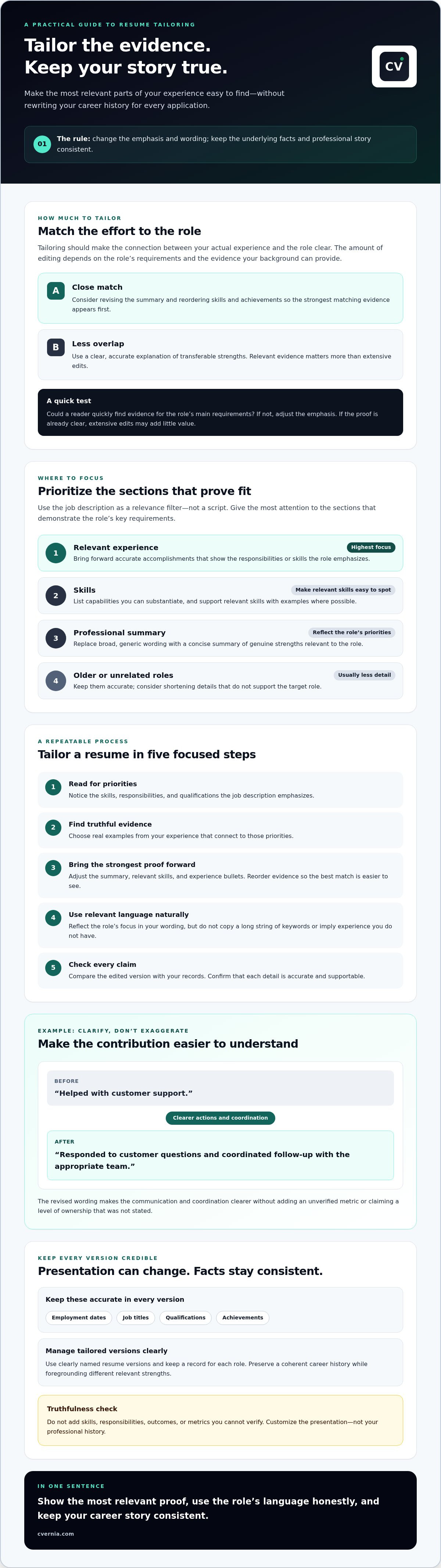
Customize the emphasis and wording, not every detail of your career history. The right amount depends on the role’s requirements, which parts of your experience provide relevant evidence, and how much effort makes sense for the application. A close match may call for a revised summary and a different order for your skills and achievements. A role with less overlap may need only a clear, accurate explanation of your transferable strengths.
Resume tailoring is the truthful alignment of your relevant experience with a target role, so an employer can quickly see why your background fits. A resume presents a person’s experience and qualifications; this overview of what a resume is offers useful context. Tailoring improves how that information is selected and presented. It doesn’t mean creating a different professional history for every application.
That distinction matters. Swapping a few terms from the job description into your resume, without showing how your experience relates, is keyword editing, not meaningful tailoring. Instead, choose accurate examples that demonstrate the skills or responsibilities the employer emphasizes. If the role calls for client communication, for instance, bring forward a real accomplishment involving client updates or issue resolution. Don’t imply you’ve handled a responsibility you haven’t.
What should change from one resume version to another?
Start with the sections that make your fit easiest to recognize: your summary, relevant skills, and experience bullets connected to the role. Reorder those bullets so your strongest matching evidence appears first. You can describe the same verified project using language that reflects the job’s focus, as long as the wording accurately represents what you did. Change what improves relevance; leave unrelated details alone unless they distract from your application.
Ask yourself: Could a reader quickly find evidence for the role’s main requirements? If not, adjust the emphasis. If the relevant proof is already clear, extensive edits may add little value. How much tailoring should a resume have? Enough to make the connection between your actual experience and the role clear, without turning the document into a collection of borrowed phrases.
What should stay consistent across applications?
Keep employment dates, job titles, qualifications, and achievements factually accurate in every version. Preserve a coherent career history and professional identity, even as you foreground different strengths for different roles. Customization changes presentation, not the underlying facts. Before submitting, compare the edited version with your records and confirm that every claim is accurate and supportable.
Which Resume Sections Need the Most Tailoring?
Give the most attention to the sections that prove you can meet the role’s key requirements. For many applicants, that means the professional summary, relevant skills, and recent experience bullets. Older or unrelated roles usually need less detail, unless they contain evidence that transfers directly to the job.
Use the job description as a relevance filter, not a script. If an employer emphasizes project coordination, bring forward accurate examples of planning, communication, or delivery. If the role prioritizes a technical skill, make that skill easy to spot and support it with a real example where possible. The goal is to help the reader find your strongest evidence quickly.
How should you tailor your summary and skills section?
Replace a broad opening such as “experienced professional seeking a challenging opportunity” with a concise summary that reflects the role’s genuine priorities. For a project coordinator opening, for example, you might highlight your experience coordinating timelines, communicating with stakeholders, or tracking deliverables, but only if those strengths match your background.
Keep the skills section focused on capabilities you can substantiate. Avoid copying a long string of job-description keywords or listing tools you’ve never used. A relevant skill is more convincing when your experience section shows how you applied it.
How should you tailor experience and achievements?
Choose existing accomplishments that best demonstrate the employer’s stated requirements. Then clarify your actions, the scope of your work, and the outcome, without adding responsibilities or metrics you can’t verify. For example:
- Before: “Helped with customer support.”
- After: “Responded to customer questions and coordinated follow-up with the appropriate team.”
The second version makes the communication and coordination involved clearer. It doesn’t claim a particular response time, satisfaction score, or level of ownership. If a measurable result is documented, include it. Otherwise, precise wording can still show what you contributed.
Keep less relevant experience accurate, but consider shortening older bullets that don’t support the target role. How much tailoring should a resume have? Prioritize the sections that make your qualifications easiest to recognize, then stop when further edits would only repeat what’s already clear.
Wording can adapt to the role; the facts behind it must stay unchanged. Keep job titles, dates, qualifications, and achievements consistent across versions. If you’re preparing several applications, a career application management platform such as CV version management tools can help you keep tailored documents organized without changing the truth of your work history.
Does Tailoring Every Resume Take Too Much Time?
It can, if you treat every application as a reason to rebuild your resume. But tailoring doesn’t have to mean starting over. A generic resume may leave your most relevant qualifications buried, while a full rewrite can spend time changing details that don’t affect your fit. Focused edits offer a practical middle ground: adjust the emphasis, wording, and order of information that matter for the role.
Not every opening deserves the same effort. Prioritize roles that align with your goals and qualifications you can demonstrate. If a position closely matches your experience, you may only need to refine the summary and bring the strongest relevant evidence forward. If the role differs substantially, first decide whether your background genuinely supports the move. Tailor enough to make relevant evidence clear, rather than aiming for an arbitrary share of rewritten content.
How much time should you spend tailoring a resume?
There’s no universal time limit. The work depends on how closely the role matches your existing resume, how complex your experience is, and how much needs clarification. Begin with the requirements that matter most. Identify the qualifications you can support, then check whether they’re easy to find in your summary, skills, and experience.
Before submitting, pause for an accuracy and readability check. Make sure each change reflects your actual background, the document is easy to scan, and no edit has introduced an inconsistency. If you’re maintaining several versions, an application tracker or document version management tool can help you connect each resume to the right opportunity.
When is a light edit enough, and when is more needed?
A light edit is often enough when the role is a close match and your resume already shows the key qualifications. You might adjust the opening summary, reorder a few skills, and move relevant accomplishments higher. Leave the rest alone if it already supports your application.
Make broader changes to emphasis when the role highlights responsibilities or skills that your resume currently underplays. For example, an experienced individual contributor applying for a team lead role may need to bring forward genuine examples of mentoring, coordination, or decision-making. That’s a change in presentation, not permission to claim formal management experience they haven’t had.
Don’t use tailoring to cover a qualification gap with invented or exaggerated claims. If you can’t support a required skill or responsibility with real experience, consider whether the role is a suitable match or whether transferable evidence honestly addresses the requirement. No fixed percentage of changed resume content guarantees better screening or hiring outcomes. Aim for relevance, accuracy, and a version you can confidently discuss.
How to Tailor a Resume to a Job Description Step by Step
Use the job description as a guide to what deserves emphasis, not a script to copy. This repeatable process helps answer how much tailoring should a resume have by connecting the role’s priorities to evidence you can genuinely support.
- Review the full description. Note qualifications that appear repeatedly, core responsibilities, and relevant terminology. Separate essential requirements from preferred skills and general descriptions of the role. Repeated language can signal priorities, but not every phrase needs to appear in your resume.
- Identify your strongest evidence. For each important requirement, find a relevant skill, project, responsibility, or achievement from your background. If the posting asks for stakeholder communication, for example, look for a real instance where you coordinated updates or resolved questions. If you can’t identify truthful evidence for a requirement, don’t claim it.
- Choose focused edits. Bring the most relevant evidence into the summary, skills section, or experience bullets where it belongs. Use the employer’s terminology when it accurately describes your experience. Clarify vague wording, but preserve the meaning of what you did.
- Check relevance and readability. Confirm that the important qualifications are easy to find in standard resume sections. Keep formatting simple, then open the exported file and check that the text is readable, complete, and in the right order. Correct any layout or text issues before submitting.
- Verify the final version. Read the resume against the job description and your own records. Check that every claim is accurate, the document is easy to scan, and the correct version is ready for this application.
Think of ATS review as a readability and alignment check, not a pass-or-fail verdict. ATS compatibility is useful to check, but it can’t guarantee selection or an employer response. A compatibility analysis can help you spot areas to review, while your resume still needs clear, relevant evidence that reflects your real experience.
For another review of how your CV aligns with a job description, explore CVernia’s CV compatibility and ATS analysis as part of its career application management platform. Use the results as a prompt to check clarity and relevance, not as a promise of a hiring outcome.
How to Manage Tailored Resume Versions Without Losing Track
Once you’ve tailored a resume, keep it connected to the application it was made for. Clear filenames and a simple application record help you avoid sending the wrong version, especially when several roles have similar titles. They also make it easier to revisit an application and remember what you submitted.
How should you save and compare resume versions?
Keep a comprehensive master resume separate from the versions you send. Use it as a record of your experience and a source for selecting relevant evidence, not as the file you submit unchanged to every employer. Name each tailored file clearly, for example, Jordan-Lee-Project-Coordinator-Northstar-Resume. Avoid including private details in filenames, and use a consistent naming pattern you can scan quickly.
Record the key application details in a spreadsheet or tracker:
- Role and employer: Identify the specific opening and organization.
- Submission date and resume version: Note when you applied and the exact file you sent.
- Follow-up notes: Save relevant reminders or context so you can pick up where you left off.
If you reapply, review the previous version rather than sending it automatically. Check whether the role or your experience has changed, then update the document only with accurate new information. That way, your application history stays useful without letting an old version misrepresent your current qualifications.
How can an application platform support truthful tailoring?
A career application management platform can bring application records, resume versions, notes, and job-description compatibility checks into one workflow. CVernia provides tools for organizing those materials and revisiting earlier versions. You remain responsible for reviewing and choosing edits. A compatibility check can highlight alignment to examine, but it can’t create missing qualifications or guarantee an employer response.
For broader workflow ideas, look for CVernia’s guide to the ultimate job search management system. Keep your process simple, whether you use a platform or your own spreadsheet: each application record should point to the right resume and preserve enough context to review your choices.
There’s no required tool for staying organized. Choose a method you’ll maintain, then use it to keep each tailored version accurate and easy to find. If you want one place to manage applications and document versions, CVernia’s career application management platform is one option to support that process.
Make Your Next Resume Version More Intentional
The answer to how much tailoring should a resume have is simple: enough to make your most relevant, truthful qualifications clear for the role. Focus your edits where they matter, and keep the facts of your career consistent. A repeatable review of the job description, your evidence, and the final document can help you stay relevant without rebuilding your resume each time.
Keep each tailored version connected to the right application so you can review what you sent and make informed updates later. CVernia brings application tracking and document version management together with tailored CV and cover letter tools and CV compatibility analysis. These tools can support your process, while you remain in control of every edit and claim.
Organize your applications and tailor each resume with confidence. Your experience is yours to present clearly. Make the next version accurate, focused, and ready to represent you.
Frequently Asked Questions
How much should you tailor a resume for each job?
Tailor your resume enough to make your most relevant, truthful qualifications clear for the specific role. The right amount depends on how closely your experience matches the requirements and whether the key evidence is already easy to find. You might adjust the summary and reorder skills for a close-fit position, while a role with different priorities may call for broader changes in emphasis. Keep the facts of your career consistent.
Should you change your resume for every job application?
You don’t need to rewrite your resume for every application, but review it against each job description before submitting. For a similar role, a focused check may confirm that your existing version already highlights the right qualifications. For a different position, revise the sections that affect relevance. If you apply to several roles with similar requirements, a suitable version may need little adjustment, provided it remains accurate for each opening.
What parts of a resume should you tailor?
Start with your professional summary, relevant skills, and the experience bullets that show how you meet the role’s priorities. Reorder evidence so the strongest match is easy to find, and adjust wording where it accurately reflects the employer’s terminology. Keep unrelated experience factual, but consider reducing detail that distracts from your fit. Employment dates, job titles, qualifications, and achievements must remain accurate across every version.
How long should it take to tailor a resume?
There’s no fixed amount of time that suits every application. The effort depends on how closely your experience matches the role, how much of your resume needs to be reorganized, and how complex your work history is. Begin with the most important requirements, then make focused edits to the sections that demonstrate your fit. Leave time to confirm the file is readable and every claim is accurate.
Should you use the exact keywords from a job description on your resume?
Use job-description terms when they accurately describe your skills, experience, or qualifications. Matching relevant language can make your fit clearer, but copying every phrase or listing skills without evidence can make a resume feel unnatural. For example, if a posting asks for “project coordination,” use that phrase only if it reflects work you’ve actually done. Support important skills with relevant responsibilities or achievements, and don’t add qualifications you lack.
Can tailoring a resume improve its chances with an ATS?
Tailoring can help make relevant qualifications and terminology clearer in your resume, while an ATS compatibility check can flag areas to review. Neither a tailored document nor a compatibility score guarantees that an employer will select or respond to you. Keep the document readable, use standard section headings, and connect job-description terms to evidence from your background. Treat ATS analysis as one review aid, not a prediction of hiring outcomes.
Is it okay to have multiple versions of your resume?
Yes. Separate tailored versions can help you present relevant experience for different types of roles, as long as each version reflects the same accurate career history. Save files with clear names that identify the role or application, and record which version you submit to each employer. Keep a master resume as a source for accurate information. Before reusing an older version, review it and update only details that have genuinely changed.


