

What if a job rejection could still help you make your next application stronger? If the message offers no explanation, it’s natural to wonder how to get feedback after a job rejection without sounding confrontational or risking a future opportunity. The key is to ask briefly, respectfully, and with realistic expectations.
You don’t need to challenge the hiring decision or ask for a detailed review. A thoughtful note can show that you value the opportunity and want to improve. It can also be hard to know whether to contact the recruiter or hiring manager, especially if you’re unsure who can offer the most useful insight.
This guide explains when to reach out, who to ask, and what to say, with a concise message you can adapt. You’ll also learn how to respond to feedback, put specific comments to use, and move forward if you hear nothing. Keep useful responses with your application notes, then apply relevant lessons to a future CV, cover letter, or interview. A reply isn’t guaranteed, but a professional request can still give you a clear next step.
Key Takeaways
- Treat feedback as optional insight, not an explanation the employer owes you.
- Choose the recruiter, hiring manager, or existing communication channel that best fits your experience with the employer.
- Make your request easy to answer: thank them, acknowledge the decision, ask one focused question, and close courteously.
- Learn how to get feedback after a job rejection, then separate specific, actionable comments from general remarks.
- Record useful feedback with your application notes and use it to guide relevant updates to future materials or interview preparation.
How to Get Feedback After a Job Rejection Without Making It Awkward
A rejection can sting, especially when the message gives no reason. Wanting to understand what you could improve is reasonable. Treat feedback as optional insight, not an explanation the employer is required to provide. Hiring decisions can involve several stages, from screening to interviews, as an overview of the recruitment process explains. The person who contacts you may not be able to share every factor behind the final decision.
Keep your goal modest and forward-looking. You’re not asking the employer to reconsider or defend its choice. Ask about one or two areas you can strengthen, such as how you presented relevant experience or explained an interview example. A focused question is easier to answer than a request for a full evaluation.
A respectful feedback request is a brief, courteous message asking for optional guidance you can use to improve future applications, not to challenge the hiring decision.
Is it appropriate to ask for feedback after rejection?
Yes, a polite request is generally reasonable, but there’s no guarantee you’ll receive a reply. Employer policies, limited time, or confidentiality considerations may restrict what someone can share. That doesn’t mean your request was inappropriate. The contact may simply be unable to provide specific details.
Make your purpose clear: you’d appreciate a suggestion for future development. Avoid arguing that you were the stronger candidate, asking the employer to revisit its decision, or sending repeated messages if there’s no response. A calm request keeps the exchange professional and leaves the recipient free to share what they can.
Who should you contact after a rejection?
Start with the person who shared the outcome. If a recruiter sent the rejection, reply to that message. They can tell you whether feedback is available or direct your request appropriately. If the hiring manager communicated with you directly, respond in that thread instead.
Keep the conversation with the original contact when possible. Messaging several employees or bypassing that person can feel like pressure rather than a request to learn. One courteous note is enough. If you’ve kept application or interview notes, use them to make your question specific. Record any response so you can apply relevant lessons to your next opportunity.
When to Ask and What Feedback Employers Can Realistically Share
Timing can shape how your request comes across. Respond while the hiring process is still familiar, but not while disappointment is driving your words. Once the decision is clear and your initial reaction has settled, reread the rejection and write a calm, considered reply. If the outcome arrived by email, responding in the same thread is a practical way to keep the context together.
There’s no guaranteed response window. The recruiter or hiring manager may be handling other priorities, and some employers may not provide individual feedback. Send one concise request, then give them room to respond. Repeated messages are unlikely to produce more detail and can make a professional exchange feel pressured.
What feedback can you reasonably ask for?
Focus on one aspect you can work on, rather than asking for a complete account of the decision. For example, ask whether there’s one experience or interview answer you could present more clearly in a similar role. A specific question gives the recipient a clear direction and makes any response easier to put into practice.
Depending on what they observed, an employer may be able to comment on role alignment, relevant experience, the examples you used, or how clearly you communicated your strengths. The detail available may depend on the hiring stage and the person responding. Someone who reviewed your CV may have different insight from someone who met you in an interview.
Keep your request within those limits. Don’t ask how you compared with another candidate, what another applicant said, or for details about internal deliberations. Those matters may be confidential. Don’t imply that you expect the employer to reverse its choice, either. You’re looking for a useful pointer, not a full explanation of every factor behind the decision.
Useful feedback versus a full hiring explanation
Useful feedback identifies a possible improvement you can act on. A full hiring explanation would require the employer to account for its entire decision. You may learn that a different example would have shown a skill more clearly without learning how every candidate was assessed. This distinction helps you ask fairly and interpret any reply without expecting more detail than the employer can share.
Before sending, note what you want to learn and keep the wording focused. If you track applications and interview notes in an application tracking dashboard, you can record the request and any reply alongside the role. Revisit relevant feedback when preparing future materials or interviews.
Email, Phone, or LinkedIn: Choose the Best Way to Request Feedback
Choose the channel the employer already used unless your relationship makes another option more natural. If a recruiter sent the decision by email, reply there so your request is easy to identify and answer. A call may suit an established conversation, while LinkedIn can work if you already communicate with the contact there. No channel guarantees a response. Choose the one that feels professional and convenient for both of you.
| Channel | Best fit | Keep in mind |
|---|---|---|
| A clear, considered request | Easy to keep brief and reply to in the existing thread | |
| Phone | An existing call-based relationship | Ask if they have time before raising your question |
| An established professional connection | Keep it private and concise |
What should a feedback request email say?
Use a straightforward subject line, such as “Thank you for the update.” Thank the recipient for letting you know, acknowledge the decision, then ask one focused question about improving for similar roles. For example: “If you’re able to share, is there one skill or interview example I could communicate more clearly in future?” Close graciously and make clear that a brief reply is appreciated but optional.
A concise note is easier to review than a long account of your qualifications or a list of questions. Keep the tone appreciative, not persuasive. You’re seeking a practical observation, not reopening the application.
How should you adapt the message to a call or LinkedIn?
For a call, first ask whether the person has a moment. If they do, briefly thank them and ask whether they can share one observation that might help you in a similar interview. If they’re busy or unable to comment, accept that without pressing.
On LinkedIn, message someone you already have a professional connection with or have been communicating with about the role. Don’t turn the rejection into a public post, send repeated messages, or frame a new connection request as urgent. Whatever the channel, note your follow-up and any response so useful insights don’t get lost among applications. An application tracking dashboard can help you organize job-search notes and follow-ups.
How to Write a Feedback Request: Steps and a Message Template
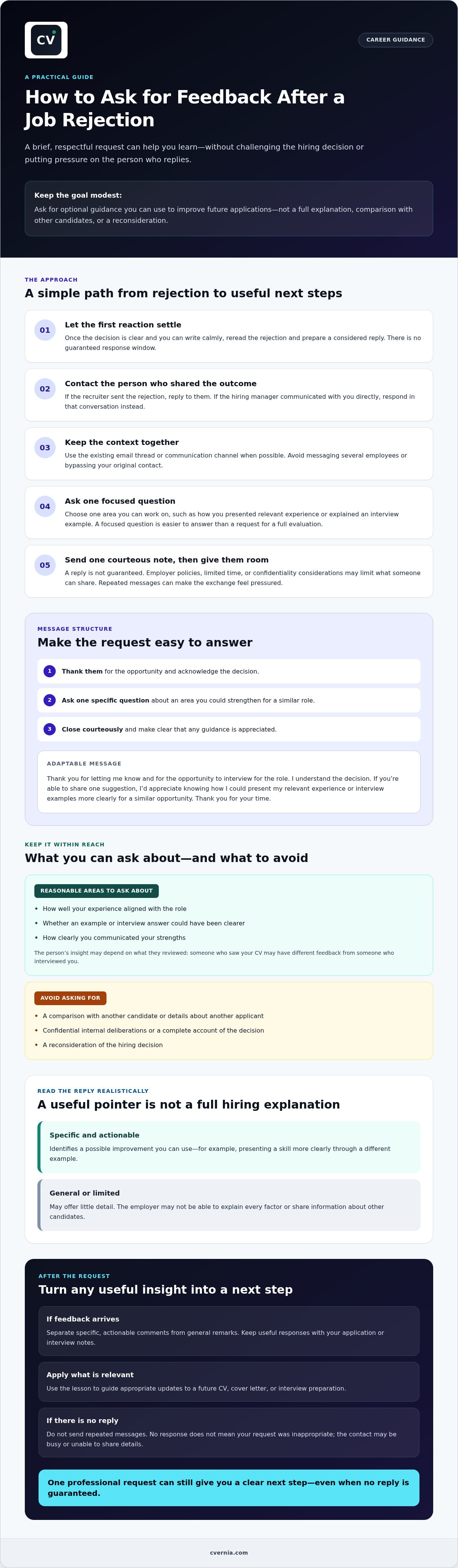
A clear structure helps you sound professional without overthinking every sentence. Use this four-step approach to make your request easy to understand and answer:
- Thank the recipient for sharing the decision and for the opportunity to apply or interview.
- Acknowledge the outcome without questioning or challenging it.
- Ask one focused question about an area you could strengthen for similar roles.
- Close courteously and recognize that the recipient may not be able to provide feedback.
This format keeps the emphasis on learning. It also helps you decide how to get feedback after a job rejection without turning a brief follow-up into a lengthy appeal.
A simple email template to request feedback
Adapt the placeholders to your situation. Keep the message brief, warm, and specific.
Subject: Thank you for the update
Hi [Name],
Thank you for letting me know about the decision and for the opportunity to [interview for/apply for] the [Role Title] position. I understand and respect the outcome.
If you’re able to share, is there one area of my experience or interview responses I could strengthen for similar opportunities in the future? I understand if you’re unable to provide feedback, and I appreciate your time either way.
Best,
[Your Name]
If you didn’t interview, remove the reference to interview responses and ask about your application or relevant experience instead. That small adjustment keeps your request accurate and relevant to the stage you reached.
What should you avoid saying in your message?
Don’t argue that the employer made the wrong choice, demand a detailed explanation, or ask leading questions designed to prompt praise or reverse the decision. Avoid emotional accusations, lengthy justifications, comparisons with other candidates, and requests for confidential information. These can distract from your genuine aim: learning something useful for next time.
Before sending, proofread for tone, clarity, and placeholders you forgot to replace. Remove extra questions, then read the message as if you were the recipient. Does it sound appreciative and curious rather than defensive? A short, thoughtful note is usually stronger than a long explanation.
Keep a copy of what you sent and record any reply alongside your application notes. Organize your job-search notes so you can revisit relevant feedback when tailoring future application materials or preparing for interviews.
What to Do With Feedback or No Reply After a Job Rejection
A response is useful when it points to something you can act on. Separate specific guidance, such as “give a clearer example of how you handled competing priorities,” from broad comments like “we chose someone who was a closer fit.” The first suggests a practice step. The second may reflect factors you can’t see, so don’t treat it as a complete assessment of your ability or potential.
As you work out how to get feedback after a job rejection, focus on what’s within your control. Record the employer’s exact wording, note what it relates to, and decide whether it suggests a reasonable adjustment. You don’t need to change your approach based on every comment, especially if it’s vague or doesn’t fit your experience.
How do you turn feedback into a stronger next application?
Translate actionable feedback into one specific next step. If you’re told that your examples didn’t make your contribution clear, prepare a more structured, truthful example for future interviews. If the feedback points to role alignment, review how your real experience connects to the requirements and make that connection clearer in your CV or cover letter.
Keep changes grounded in what you’ve genuinely done. Don’t add skills or experience you can’t support. Track what you changed and why, so you can distinguish useful feedback from edits made without a clear purpose. An organized job interview tracker guide can help you keep interview notes and follow-ups together.
What if the employer does not respond?
Silence isn’t a reliable verdict on your ability, potential, or performance. The employer may be unable to offer individual comments or may not have time to respond. If you’ve already sent a courteous request, don’t keep messaging or read a hidden judgment into the lack of reply.
Move forward with your own review instead. Compare the role requirements with the experience you highlighted, and consider whether your interview examples clearly showed your relevant skills. Choose one area to refine for the next suitable opportunity, then keep applying.
Keep your applications and notes organized with CVernia as you turn each hiring experience into a more intentional next step.
Turn Each Rejection Into a Clear Next Step
A rejection may not come with an explanation, and a feedback request may not receive a reply. Still, knowing how to get feedback after a job rejection can help you learn without challenging the decision. Ask one focused question, consider any specific advice, and decide what you can realistically improve.
Keep useful feedback with your application and interview notes. Then use it to guide intentional updates to your CV, cover letter, or interview preparation, grounded in your real experience. If no response arrives, reflect on the role requirements and your examples, then move forward without treating silence as a verdict on your potential.
CVernia helps you keep applications and interview notes organized, track next steps, manage application versions, and tailor CVs and cover letters to your experience. Organize your applications, interview notes, and next steps with CVernia. Each thoughtful adjustment can help you approach the next opportunity with greater clarity and confidence.
Frequently Asked Questions
Is it okay to ask for feedback after a job rejection?
Yes, a brief, respectful request is generally appropriate, though the employer may not be able to respond or share details. To understand how to get feedback after a job rejection, keep your message focused on learning: thank the person for the update, acknowledge the decision, and ask one question about improving for similar roles. Make clear that you’re not demanding an explanation, disputing the choice, or seeking confidential information.
How soon should I ask for feedback after a job rejection?
Ask once you’ve received the decision and can write calmly. You don’t need to send a message immediately if you’re upset. Take time to collect your thoughts, then keep the request timely and concise. If the rejection came by email, replying in the same thread is often straightforward. The employer may have limited time, so don’t expect an instant response or send repeated follow-ups.
What should I say when asking for feedback after an interview rejection?
Thank the interviewer or recruiter for the opportunity, acknowledge the decision, and ask whether they can share one area to strengthen in future interviews. For example, ask if there’s one skill or answer you might communicate more clearly next time. Close by thanking them for their time and noting that you understand if they can’t provide feedback. Keep the tone appreciative and curious, not defensive.
Should I ask the recruiter or hiring manager for feedback?
Start with the person who communicated the decision or managed your application. A recruiter is a practical contact if they handled your updates; a hiring manager may be appropriate if you communicated directly with them. Use the existing channel when possible, such as replying to the rejection email. Avoid messaging several people at once. Choose the contact best placed to respond, then give them space to do so.
What if an employer refuses to give feedback or does not reply?
Accept the lack of response without sending repeated requests. An employer may have limited time or may not be able to share individual feedback, and silence isn’t a reliable assessment of your ability. You can still compare the role requirements with your CV, cover letter, and interview notes to identify changes within your control. Record any useful lessons, then focus on preparing for the next suitable opportunity.
Can asking for feedback after rejection hurt my chances of applying again?
A polite, concise request is different from arguing with the hiring decision, but no message can guarantee how an employer will interpret it. Keep your tone appreciative, avoid pressure, and respect any response or non-response. If you apply to the organization again, use relevant feedback to improve your materials or interview examples. Show your genuine qualifications clearly rather than simply resending an unchanged application.
How do I ask for feedback without sounding defensive?
Make your purpose learning, not proving that the decision was wrong. Thank the recipient, acknowledge the outcome, and ask one open, specific question about an improvement for future applications or interviews. Avoid lengthy explanations, arguing against possible concerns, or requesting a point-by-point defense. A calm message that respects the recipient’s time gives them room to share what they can while keeping the exchange professional.


