

Tailoring your resume isn't about reinventing your career history from scratch; it's about reframing your genuine achievements with strategic precision. Even so, tailoring resume for every job application often turns into an exhausting marathon of rewriting bullet points, untangling desktop files, and dreading silent rejections from automated screening systems. With the average corporate job posting attracting roughly 250 applicants, spending hours on a single submission simply isn't sustainable, especially when you worry that automated tools might accidentally fabricate experience you don't have.
You deserve an efficient, ethical approach that protects both your valuable time and your professional credibility. In this guide, you will master a sustainable system to tailor your resume for every role rapidly without starting from scratch or compromising truthfulness. We'll show you how to architect a modular master resume structure, align your verifiable skills to satisfy automated parsers consistently, and keep your custom versions neatly organized as you move confidently through each interview stage.
Key Takeaways
- Build a comprehensive master document containing your verifiable milestones to streamline tailoring resume for every job application without rewriting history.
- Decode employer job postings methodically to pinpoint core technical and operational priorities within the top bullet points.
- Optimize document structure and terminology to satisfy automated screening systems while maintaining strict ethical accuracy.
- Eliminate file chaos by replacing messy desktop folders with centralized version tracking across every hiring stage.
- Leverage dedicated career application management platforms to scale truthful submissions and ensure polished interview readiness.
The Real Cost of Generic Resumes in Automated Hiring
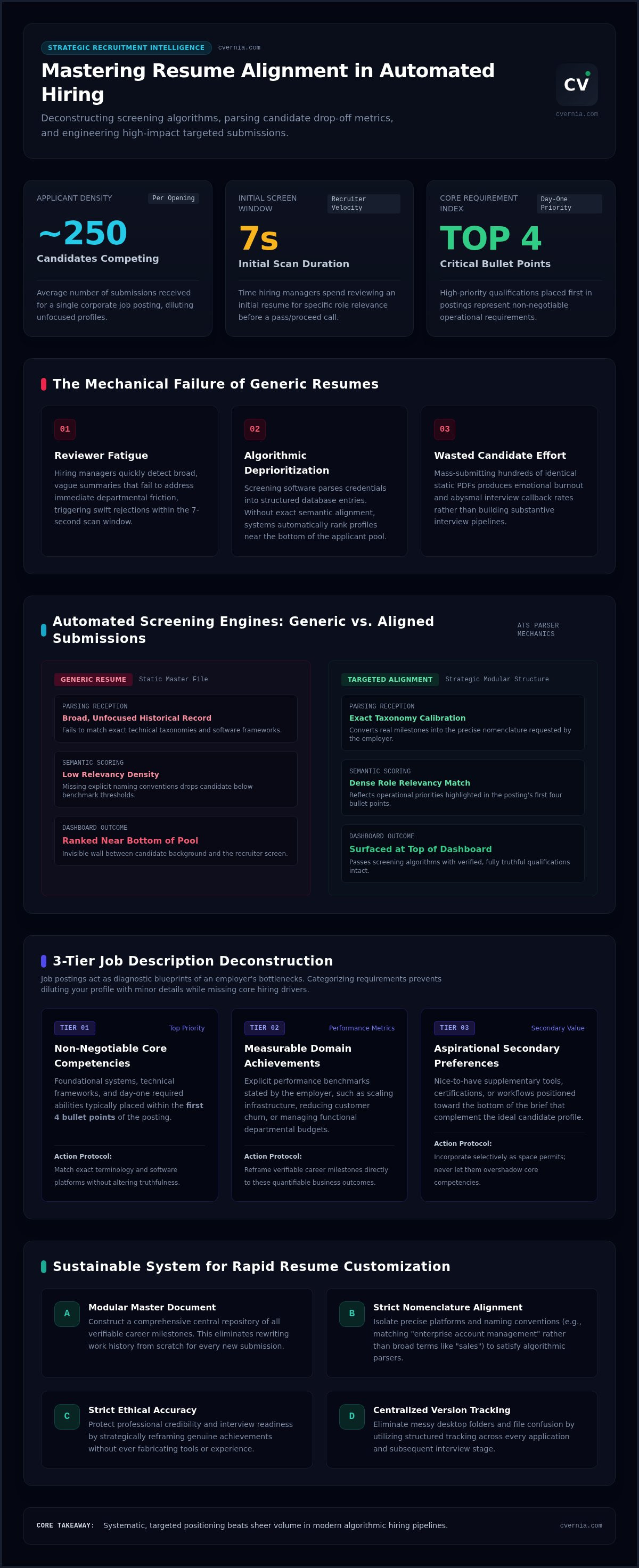
Submitting the same static document to dozens of openings creates an invisible wall between your talent and hiring teams. At its core, tailoring a resume means realigning your verified career milestones to match explicit job qualifications. While traditional definitions of what a resume is emphasize a broad historical record, modern recruitment demands sharp, targeted positioning. Recruiters spend roughly seven seconds scanning an initial resume for specific role relevance before deciding whether to pass or proceed.
Unfocused submissions cause immediate friction for applicant tracking parsers scoring candidate relevancy. When your credentials lack contextual alignment, automated systems rank your profile near the bottom of the applicant pool. Over time, mass-applying with generic documents damages candidate confidence and produces abysmal interview callback rates.
Why the Spray-and-Pray Strategy Fails Completely
Blasting identical documents across the web burns your energy without creating interview pipelines. Consider what happens behind the screen:
- Reviewer fatigue: Hiring managers immediately spot broad, vague summaries that do not address their immediate departmental friction.
- Algorithmic deprioritization: Job platforms prioritize candidates whose career documents demonstrate dense semantic alignment with postings.
- Wasted effort: Firing off hundreds of generic PDFs leads to emotional burnout rather than substantive conversations.
Systematic discipline delivers better traction than sheer submission volume.
Understanding Modern Screening Algorithms and Recruiter Filters
Before a human recruiter reviews your background, applicant tracking software parses your file into structured database entries. Exploring how applicant tracking systems work reveals how these engines extract technical skills, evaluate job titles, and rank candidate profiles against predetermined benchmarks. Synthesizing job-specific phrases from the employer's brief guarantees your truthful qualifications surface at the top of their dashboard.
This automated reality makes tailoring resume for every job application an operational necessity rather than an optional chore. Strategic keyword alignment connects your legitimate background directly to what an organization needs right now, helping you pass digital gatekeepers with total confidence.
Deconstructing Job Descriptions: How to Extract What Recruiters Actually Want
Job postings aren't administrative wishlists. They serve as diagnostic blueprints detailing an organization's specific technical bottlenecks and cultural deficits. Instead of treating every requirement equally, successful candidates dissect the text to understand what the hiring team desperately needs solved. High-priority qualifications typically appear within the first four bullet points of a posting, representing the core competencies required on day one.
Categorize the remaining requirements into distinct tiers before modifying your resume:
- Non-negotiable core competencies: Foundational skills and industry-standard systems listed near the top of the description.
- Measurable domain achievements: Explicit performance goals, such as scaling infrastructure, cutting customer churn, or managing budgets.
- Aspirational secondary preferences: Nice-to-have tools or certifications placed near the bottom that round out an ideal profile.
Separating these tiers prevents you from overloading your document with minor details while missing the central criteria that drive hiring decisions.
Isolating Critical Hard Skills and Technical Proficiencies
Extract exact software platforms, compliance frameworks, methodologies, and technical certifications directly from the text. Match your real proficiencies using the employer's precise naming conventions. If a company asks for "enterprise account management," avoid labeling your background simply as "sales." To ensure your formatting and vocabulary meet modern scanning standards, run your text against an ats compliant resume protocol before sending.
Reading Between the Lines for Soft Skills and Team Context
Pay close attention to working environment cues embedded throughout the description. Language highlighting "rapid iteration" points to autonomous execution, while phrases mentioning "stakeholder engagement" emphasize cross-functional diplomacy. Translate generic buzzwords like leadership into concrete operational milestones, such as mentoring junior staff or unblocking stalled delivery pipelines. Note recurring departmental objectives so you can position your authentic background as their direct operational remedy.
Mastering this breakdown transforms tailoring resume for every job application into an organized, repeatable exercise. Rather than guessing what recruiters want, you build documents with deliberate architectural clarity. When you need to accelerate this workflow and verify your alignment, consider using CVernia to deconstruct job postings and audit your materials seamlessly.
The 5-Step System for Rapid, Truthful Resume Customization
Most career guides suggest writing custom documents entirely from scratch every single time. That advice leads directly to exhaustion. You don't need to reinvent your background to make an impression. Instead, implement a sustainable, repeatable sequence that turns tailoring resume for every job application into a rapid fifteen-minute workflow:
- Build an exhaustive master resume: Document every project, promotion, software tool, and measurable metric across your entire career in one centralized repository.
- Audit target role qualifications: Extract non-negotiable requirements from the job posting and identify the strongest corroborating evidence in your master archive.
- Reflect target phrasing: Mirror the employer's specific naming conventions in your professional title, skills list, and primary bullet points.
- Prune irrelevant background details: Remove low-priority achievements and secondary tasks that dilute focus away from the role's core priorities.
- Verify data integrity: Confirm every metric, date, and technical proficiency represents verifiable personal experience.
Reframing Bullet Points Around Tangible Business Outcomes
Structure your experience points around the challenge-action-result format. Start with strong active verbs, explain the operational obstacle you tackled, and finish with a quantifiable outcome. Integrate the employer's technical keywords directly into these performance narratives. If you are changing sectors, review the career change resume framework to translate your past accomplishments into the terminology of your new domain.
Customizing the Header Summary to Anchor Candidate Positioning
Replace generic objective statements with a targeted executive summary. Pair your target title directly with the specific value proposition the employer seeks. Summarize your career impact in three punchy, metric-backed sentences that immediately answer why you are qualified to solve their primary challenges.
Maintaining Absolute Truthfulness: Why Fabricating Details Destroys Careers
Never invent credentials, technical proficiencies, or leadership scope to satisfy automated screening filters. Experienced hiring teams easily uncover exaggerated claims during deep technical interviews, practical assessments, and professional reference calls. Effective customization isn't about fabricating missing capabilities; it's about spotlighting your genuine, relevant wins so decision-makers see your value instantly.
Eliminating Document Chaos: Managing Multiple Resume Versions
Creating customized applications solves the relevance problem, but it introduces an administrative trap. Juggling dozens of files across desktop folders inevitably triggers submission errors and interview blunders. Picture joining a final-round interview only to realize you are discussing a completely different set of bullet points than the hiring committee is holding. Mismatched documents damage your credibility in seconds.
Disciplined version control prevents these errors. Connecting each tailored document to a structured job search management system ensures you always reference the exact submission an interviewer sees. Clean record-keeping protects your professional reputation while keeping your active search running smoothly.
Systematic Naming Conventions and Master Profile Maintenance
Ditch generic labels like Resume_Final_v2.pdf. Adopt a rigid naming standard such as Firstname_Lastname_TargetCompany_TargetRole_2026.pdf. Keep your workflow synchronized by following these core practices:
- Bi-weekly master updates: Feed new technical skills, metrics, and project outcomes back into your central master record as they happen.
- Routine folder hygiene: Archive superseded iterations to avoid accidentally sending outdated summaries to active openings.
- Contextual tracking: Save job descriptions alongside submitted files so you preserve the original context for future reference.
Connecting Resumes to Interview Preparation and Submission Records
Pairing each tailored file with its corresponding stage in your hiring funnel eliminates guesswork. Store recruiter messages, tailored cover letters, and submission timestamps together. Immediately before any phone screen, review the specific achievements you submitted using a dedicated job interview tracker. Maintaining strict submission history also alerts you to previous application dates, ensuring you never submit conflicting career details to different teams at the same company.
When you commit to tailoring resume for every job application, manual file management quickly collapses under its own weight. You need a dedicated command center rather than scattered local folders. To keep your documents organized, track hiring funnels, and maintain complete control over every submitted iteration, manage your application versions with CVernia today.
Scaling Your Applications with Centralized Management Technology
Executing an active job search requires infrastructure, not just isolated files. When you commit to tailoring resume for every job application, manual tracking quickly creates administrative drag. Sustainable campaigns rely on centralized career application management platforms that integrate document creation, automated compatibility analysis, and pipeline tracking into a single ecosystem. Rather than toggling between disconnected text editors and spreadsheets, a dedicated workflow keeps your search moving forward with minimal friction.
Choose platforms that prioritize factual accuracy over generative fiction. Effective hiring technology shouldn't hallucinate missing skills or inflate your background. It should evaluate how effectively your legitimate credentials map to an employer's requirements while keeping your entire search history organized in one secure place.
Unifying Resumes, Cover Letters, and Application Tracking
A tailored resume performs best when supported by a coherent narrative across all submitted materials. Crafting a complementary letter reinforces your core qualifications and contextualizes your career trajectory. Explore our tailored cover letter generator guide to discover how to align your introductory narrative directly with the achievements highlighted on your customized CV.
Unifying these documents within an application tracking dashboard gives you immediate visibility into your search metrics:
- Stage monitoring: Track which document variations yield the highest interview conversion rates across different target industries.
- Attachment management: Keep role-specific portfolio samples, references, and submitted files attached directly to the specific job entry.
- Reapplication intelligence: Maintain clear records of past outreach dates to avoid sending repetitive inquiries to the same hiring teams.
The CVernia Advantage: Intelligent, Truthful Application Workflows
CVernia serves as your digital mentor and command center throughout the modern recruitment cycle. The platform empowers you to generate tailored CVs and cover letters rapidly while auditing their alignment against hiring algorithms using built-in CV compatibility and ATS analysis tools. Because the platform strictly enforces truthful representation, your professional reputation remains protected; it never fabricates qualifications or invents experience.
Beyond document creation, CVernia's application tracking dashboard, smart version management, and interview note tools keep you prepared for every recruiter conversation. Replace scattered desktop clutter with an organized, high-conversion career pipeline. Streamline your job search and tailor your documents with CVernia today.
Take Control of Your Career Trajectory
Mastering modern recruitment doesn't mean spending late nights rewriting documents from scratch or fabricating qualifications to beat digital gatekeepers. Sustainable success comes from strategic alignment. By establishing a comprehensive master record, deconstructing employer priorities, and implementing clean version control, you turn tailoring resume for every job application into a fast, repeatable system that showcases your verifiable impact.
You don't have to manage this operational shift alone or wrestle with scattered desktop files. CVernia delivers a centralized career application management platform designed specifically for modern professionals. Access strictly truthful optimization tools that evaluate ATS compatibility, coordinate tailored cover letters, and track interview notes from a unified dashboard. Your real achievements deserve to be recognized. Take control of your application workflow with CVernia and enter your next interview with complete confidence.
Frequently Asked Questions
Is tailoring resume for every job application truly necessary in 2026?
Yes, submitting tailored documents is essential because corporate postings regularly attract hundreds of applicants. Automated screening filters and time-pressed recruiters quickly discard generic profiles that fail to address explicit requirements. Tailoring resume for every job application ensures your genuine accomplishments match the vocabulary of the hiring team, elevating your profile to the top of review queues.
How long should it take to tailor a resume for an open role?
Customizing your materials should take no more than ten to fifteen minutes once your master document is established. Starting from scratch every time creates burnout, but pulling verified achievements from a comprehensive career archive streamlines the entire effort. You simply reorder key bullet points, integrate core technical keywords, and align your executive summary to mirror the employer's priorities.
Can applicant tracking systems detect when a resume is tailored?
Screening algorithms evaluate contextual alignment rather than penalizing customization. These systems parse documents to identify matches between candidate achievements and open requisitions. Tailoring demonstrates that your experience satisfies the job's parameters. As long as your claims remain strictly truthful and reflect genuine career accomplishments, targeted formatting works entirely in your favor.
What is the difference between keyword stuffing and authentic resume tailoring?
Authentic tailoring embeds relevant technical terminology directly into verifiable business outcomes. Keyword stuffing, by contrast, blindly pastes blocks of disconnected phrases into margins or summaries to trick digital parsers. Human screeners spot stuffed keywords immediately and disqualify those candidates. Real customization focuses on explaining your legitimate milestones using the precise naming conventions requested by the employer.
Should I tailor my resume if I am applying for multiple roles at the same company?
Yes, you should customize your resume for each role while maintaining complete consistency across your employment timeline. Enterprise hiring systems store every version you submit. If your job titles, dates, or core qualifications contradict each other across separate openings, recruiters will question your integrity. Tailor the emphasis of your accomplishments without altering historical facts.
How do I tailor my resume when attempting an industry career pivot?
Structure your experience around universal, transferable skills such as cross-functional project delivery, technical implementations, or budgetary oversight. Reframe your past bullet points using the operational vocabulary of your target sector while removing insular industry jargon. Pairing this revised narrative with a tailored cover letter helps hiring teams understand exactly how your proven background solves their immediate challenges.


