
You join a video interview, the recruiter quotes an achievement from your experience section, and your stomach drops because you don't know which document they're reading. If your desktop is buried under files named "Resume_Final_v2_Edited.pdf," you're not alone. Establishing clear resume version control for job seekers isn't about learning complex software code; it's about keeping your professional story straight in an era of targeted applications.
Tailoring your CV for different roles and applicant tracking systems works, but juggling dozens of variations often creates document chaos. You shouldn't have to worry about accidentally contradicting an earlier submission or losing your strongest bullet points during edits. In this guide, you'll learn how to build a reliable tracking system to eliminate desktop clutter, preserve your tailoring insights, and enter every interview with complete confidence in your records. Here is how to take control of your applications from first draft to final offer.
Key Takeaways
- Understand how systematic resume version control for job seekers protects your application history and guarantees complete alignment during multi-stage interviews.
- Eliminate document chaos and prevent contradictory submissions by matching every conversation directly to the exact CV variant your interviewer sees.
- Compare the practical trade-offs between developer-focused tools like Git and dedicated career platforms to streamline your document management workflow.
- Implement a repeatable five-step framework to preserve high-performing bullet points and organize tailored applications without manual file clutter.
- Discover how centralized application tracking ensures truthful career records and audit-ready submission histories for every role you pursue.
What Is Resume Version Control for Job Seekers?
At its core, resume version control for job seekers is a structured methodology for tracking, organizing, and archiving every customized curriculum vitae you submit. In software engineering, version control documents source code changes over time so developers can inspect past iterations and prevent conflicting updates. Applied to your career, it provides a transparent paper trail for every targeted adjustment you make to match specific job descriptions.
Many candidates manage their search through pure reactive chaos. They download an old file, hastily tweak three bullet points, hit export, and send it into the void. Without document governance, you risk confusing your application records and losing sight of your own narratives. Version control is never about exaggerating skills or inventing unearned credentials. Instead, it protects your authentic professional truth, ensuring that every tailored document stays verifiable, coherent, and instantly accessible whenever a recruiter calls.
The Breakdown of the 'Resume_Final_v2.docx' Workflow
Desktop clutter is the fastest path to unforced errors during a job hunt. Most applicants know the pattern: files titled Resume_Tech_Final.pdf, Resume_Tech_Final_v2.pdf, and Resume_Tech_REALFinal.docx pile up in local downloads folders. This haphazard approach carries serious risks:
- Submitting unfinished drafts: Sending half-edited sentences, unresolved tracked changes, or working notes directly to an executive hiring team.
- Erasing top achievements: Overwriting a high-converting, metric-heavy bullet point to fit a short-term word count, losing that valuable copy forever.
- Severe productivity drain: Wasting 20 minutes opening seven separate files just to find how you phrased an accomplishment from two roles ago.
Core Principles of Professional Document Versioning
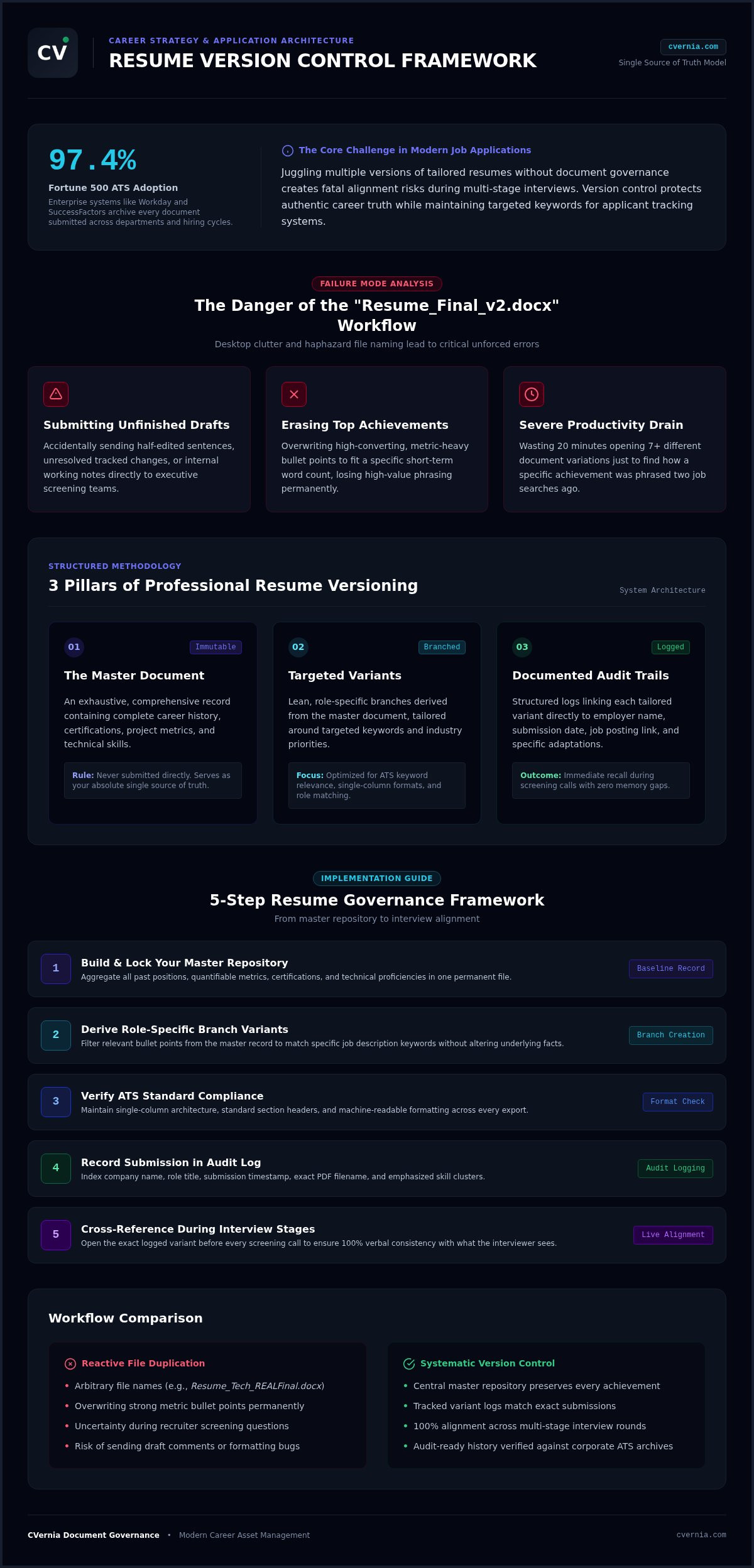
Regaining control requires shifting from random file duplication to structured governance. A robust system relies on three interconnected pillars:
- The Master Document: An immutable, exhaustive record containing your complete career history, certifications, project metrics, and technical skills. You never submit this document directly; you use it as your single source of truth.
- Targeted Variants: Lean, role-specific branches derived from the master document, deliberately structured around targeted keywords and specific industry priorities.
- Documented Audit Trails: Clear tracking logs that link each tailored variant directly to the employer, submission date, job posting link, and specific adaptations made for candidate screenings.
Adopting systematic resume version control for job seekers transforms your career assets into a synchronized database. You eliminate costly guesswork, protect past high-impact phrasing, and preserve complete integrity across every hiring touchpoint.
Why Every Modern Job Search Requires Strict Resume Versioning
Submitting an application is only the first step in a complex hiring journey. According to Jobscan data from August 2026, 97.4% of Fortune 500 companies use an applicant tracking system, with systems like Workday and SuccessFactors processing the majority of corporate talent pools. These enterprise databases archive every document you upload. Without strict resume version control for job seekers, you operate blind, leaving yourself vulnerable to discrepancies that derail interviews before they even begin.
Understanding how applicant tracking systems work reinforces why clean candidate records matter. Corporate recruiters do not just read your latest PDF; they cross-reference your submission history against internal talent archives. Versioning turns your tailored documents into a reliable audit trail, keeping your story consistent across every department and hiring cycle.
Tracking ATS Keyword Tailoring and Relevance
Tailoring a CV requires targeted keyword integration, but manual edits often introduce unintended formatting glitches. When adapting phrasing to match niche job descriptions, consult guidelines for an ats compliant resume to ensure standard headers and single-column structures stay intact. A disciplined versioning log tracks exactly which hard skills you prioritized for each submission, showing you what drove specific interview invitations.
Eliminating Risks During Corporate Reapplications
Enterprise databases retain historical records for years. If you applied to an organization six months ago and submit a new application today, recruiters see both profiles side by side. Basic discrepancies immediately raise red flags:
- Shifting employment start and end dates across different submissions
- Conflicting official job titles for the exact same previous role
- Contradictory revenue or efficiency metrics between revisions
Version control prevents these accidental mismatches. It lets you highlight genuine professional growth and newly acquired skills while preserving absolute continuity with past submissions.
Interview Preparation and Candidate Confidence
Picture receiving an unannounced phone screening from a corporate recruiter while running errands. They reference an operational metric featured under your second job role. If you don't know which variant they are holding, panic sets in. Robust version tracking allows you to pull up the exact submitted document in seconds.
Reviewing the precise variant before panel interviews aligns your spoken talking points with the written page. It eliminates second-guessing, cuts cognitive fatigue over long search campaigns, and ensures you walk into every conversation fully prepared. To remove the guesswork from tracking customized documents, exploring a dedicated career tool like CVernia keeps every tailored asset organized and ready for interview day.
Developer Git Repositories vs. Dedicated Career Management Platforms
When implementing resume version control for job seekers, technical forums often suggest treating your CV like software code. Software engineers turn to Git commits and Markdown to manage document branches, while other applicants rely on nested cloud folders. Both approaches tackle versioning, but both introduce friction that can disrupt an active job search. Choosing the right mechanism comes down to balancing technical control against daily workflow efficiency.
Managing an active job hunt across 20 or 30 opportunities quickly exposes the limits of improvised setups. Text repositories and local drives track text diffs, yet they remain disconnected from the broader hiring ecosystem. A truly functional versioning system must manage your career narrative alongside interview dates, job specs, and company responses.
The Developer Route: Git, GitHub, and YAML
Coding your CV in plain text files like Markdown or LaTeX offers granular change tracking. You branch for specific positions, commit line-item tweaks, and compile clean PDFs automatically. This appeals to programmers wanting to showcase CLI literacy, but it leaves critical gaps:
- Zero native integration with employer job descriptions or ATS keyword scoring tools
- Inability to centralize external application materials like references, cover letters, and portfolio links
- Total detachment from recruiter emails, interview notes, and status milestones
You solve text tracking, yet you still need external tools to handle the rest of your job search.
The Manual Route: Spreadsheets and Cloud Folders
Pairing cloud storage services like Google Drive or Dropbox with a tracking spreadsheet is the standard default for non-technical candidates. While accessible, this manual setup requires constant discipline to avoid disintegration. Read the best job interview tracker guide to see why spreadsheets fall short as your pipeline scales. A single broken hyperlink, a missed spreadsheet entry, or an accidental file overwrite quickly compromises your application records.
The Integrated Platform Route: Built for Job Seekers
Career application platforms bridge this gap by uniting document versioning with active search workflows. Instead of manually maintaining folder structures, these systems automatically connect each CV variant directly to the corresponding company listing.
They log tailoring adjustments, retain your baseline master resume, and track ATS match analytics under one umbrella. Effective resume version control for job seekers should simplify your life, not require learning command-line syntax or maintaining fragile spreadsheets. A purpose-built platform ensures every past variant stays tied to its hiring context, giving you an organized, audit-ready record from initial submission to signed offer.
How to Build an Effective Resume Version Control System in 5 Steps
Executing systematic resume version control for job seekers does not require complex code. Instead, it relies on an organized, repeatable operational framework that transforms scattered edits into an audit-ready library. Whether you use local drives, cloud storage, or a dedicated platform, these five structured steps will safeguard your application history.
Step 1 & Step 2: Establish the Master Repository and Structured Taxonomy
Start by compiling an exhaustive, unedited master CV. Document every responsibility, metric, publication, credential, and tool you have used across your career. This file serves solely as a source archive, so never submit it directly.
Next, enforce a strict, standardized file naming convention across all derivative files. Use this format:
FirstName_LastName_TargetRole_CompanyName_Year.pdf- Example:
Alex_Chen_ProductManager_Stripe_2026.pdf
Ban subjective adjectives entirely. Labels like "Updated," "New," "Final," or "Draft" inevitably breed confusion. A clear, objective naming taxonomy guarantees you know exactly which file was sent to which employer at a glance.
Step 3 & Step 4: Map Tailored Derivatives to Specific Job Descriptions
When preparing an application, branch a new derivative directly from your master repository. Cut irrelevant bullets to meet length requirements, but keep your core factual metrics consistent. Tailor phrasing directly to the employer's operational requirements.
Immediately archive the verbatim text of the job description in the same location as your customized CV. Job postings frequently get taken down once applications close. Retaining the original requirements ensures you can verify which specific qualifications and industry terms prompted your targeted adjustments.
Step 5: Maintain a Centralized Application and Audit Log
Record every submission in a dedicated tracking register. Log the company name, position title, date submitted, login portal credentials, and the exact filename delivered. Review the ultimate job search management system to see how continuous logging turns chaotic searches into structured pipelines.
Conduct a monthly review of your response metrics. Identify which specific variants, phrasing choices, and skill clusters generated interview requests. Tracking this performance data turns your version control system into an active feedback loop that refines your approach over time.
If you prefer to automate this entire workflow instead of managing manual files, organize your job search with CVernia to streamline document versioning and interview tracking in one platform.
Centralize Document Governance with CVernia's Smart Application Platform
Manual spreadsheets and nested desktop folders inevitably break down under the weight of an active career search. CVernia eliminates this friction by serving as a dedicated career application management platform designed specifically for modern hiring demands. Instead of risking accidental file overwrites or misplaced text, you gain an automated command center that keeps your records organized, verifiable, and ready for immediate review.
By automating document administration, you protect your authentic professional record while meeting enterprise screening expectations. True governance frees your time, allowing you to focus on high-impact interview preparation rather than file maintenance.
Automated Version Management and Attachment Tracking
Managing multiple iterations manually takes mental energy away from your actual search strategy. CVernia links every tailored CV and customized cover letter directly to the targeted job requisition. You can inspect complete revision histories instantly, avoiding desktop clutter while ensuring you never lose high-impact bullet points. The system also consolidates portfolio links, reference lists, and interview notes within a single dashboard, keeping all relevant candidate collateral in one accessible location.
Smart Reapplication Detection and ATS Compatibility
Submitting conflicting details to the same employer can quietly derail your candidacy. CVernia includes built-in smart reapplication detection that flags repeat submissions, prompting you to review previous documents before sending a new variant. Built-in ATS compatibility checks assess how well your materials align with specific job descriptions without compromising integrity. The platform reinforces authentic career storytelling, ensuring every metric and qualification remains 100% factual and audit-proof.
Seamless Progression from Application to Interview
Effective resume version control for job seekers proves its value the moment a hiring manager reaches out. Having your submitted variant immediately accessible lets you review your exact talking points before high-stakes screening calls or panel interviews. You can log recruiter communications, track follow-up dates, and record interviewer feedback in real time.
Eliminate application chaos and approach hiring teams with absolute clarity. Explore CVernia's Career Application Management Platform to take control of your document governance across every stage of your job search.
Step into Every Interview with Total Confidence
Navigating a competitive hiring process requires absolute clarity, not guesswork. Implementing systematic resume version control for job seekers protects your authentic career history, eliminates desktop clutter, and ensures your spoken stories perfectly match your written submissions. When you link every tailored iteration directly to its target job description, you banish file chaos and focus entirely on interview readiness.
CVernia streamlines this process through a centralized Application Tracking Dashboard offering instant document retrieval, built-in ATS compatibility analysis, and smart reapplication detection. With a strict foundation of 100% truthful, verifiable career storytelling, you can pursue new opportunities knowing your records are completely aligned. Take control of your job search with CVernia's version management tools and step forward into your next career chapter with quiet confidence.
Frequently Asked Questions
What is the difference between a master resume and a tailored resume version?
A master resume is an exhaustive internal document containing your complete professional history, every metric, and all technical proficiencies. In contrast, a tailored resume is a focused, derivative document customized for a specific job listing. You never send your master document to hiring managers. Instead, you extract relevant achievements from it to build tailored variants that match the employer's specific requirements.
How should I name my resume files when sending them to hiring managers?
Name your files cleanly using your full name, the targeted role, and the company name, separated by underscores. A standard format like FirstName_LastName_TargetRole_Company.pdf ensures absolute clarity. Never include internal draft labels like "v2," "Updated," or "Final" in files sent to recruiters. Clear naming demonstrates professional polish and helps hiring teams immediately identify your application in their candidate tracking downloads.
Can applicant tracking systems detect if I submit different resume versions?
Yes, modern applicant tracking systems automatically merge submissions under a single candidate profile using your email, phone number, or LinkedIn URL. Recruiters can view all historical files attached to your profile across various hiring cycles. Implementing disciplined resume version control for job seekers prevents embarrassing timeline contradictions or conflicting metrics between past submissions and new applications.
Is Git or GitHub suitable for non-technical job seekers managing resumes?
Git is generally unsuitable for non-technical applicants due to its steep learning curve and reliance on plain-text formats like Markdown or LaTeX. While developers use Git branches effectively, non-programmers spend excessive time learning command-line tools without gaining application-specific benefits. A dedicated career application platform provides the version tracking and auditability you need without the technical friction of managing software code repositories.
How many different versions of my resume should I maintain simultaneously?
You only need to actively maintain one comprehensive master resume alongside the specific derivative variants submitted to open roles. Rather than juggling dozens of loose drafts, keep your core master file updated with recent accomplishments. When a new opportunity arises, generate a tailored variant directly from that source. Centralizing this process ensures you never lose track of active variations currently being reviewed by hiring teams.
What happens if I submit contradictory work history across two different applications?
Contradictory work history immediately damages your credibility and can disqualify you from consideration. Enterprise ATS platforms flag discrepancies in past job titles, employment dates, or quantified metrics across multiple submissions to the same employer. Recruiters view conflicting accounts as a red flag regarding honesty. Systematic version tracking keeps your factual foundation consistent so your career details remain truthful, verified, and aligned across every opportunity.
How does automated version control improve my interview preparation performance?
Automated resume version control for job seekers eliminates interview anxiety by linking the exact document version submitted directly to your application record. When an interviewer asks about a specific accomplishment or bullet point, you won't scramble to guess what they're looking at. You can review your exact submission beforehand, aligning your verbal storytelling with written metrics to project authority and poise.


