

The final two sentences of your application often carry more weight than the entire middle page. It's the last impression you leave, yet most candidates treat it as a mere formality. You've likely felt that familiar pang of anxiety while staring at a blinking cursor, wondering if "Sincerely" is too stiff or if a direct request for an interview sounds desperate. Learning how to end a cover letter shouldn't feel like a high-stakes guessing game that stalls your progress.
We know that the uncertainty of the job search is stressful, and you deserve a strategy that works. This guide provides the exact formula for a high-impact closing that turns a passive reader into an active interviewer. You'll gain a clear, repeatable framework for professional sign-offs that align with 2026 hiring trends. We'll show you how to project confidence through a strategic call to action while ensuring your contact details are positioned perfectly for a quick response. From modern closings to professional etiquette, we're breaking down everything you need to finish your application with authority and ease.
Key Takeaways
- Learn how to leverage the "Recency Effect" to ensure your final paragraph leaves a lasting, positive impression on hiring managers.
- Discover a repeatable three-step formula for how to end a cover letter that transforms your professional profile into an irresistible interview request.
- Select the most effective professional sign-off for 2026, navigating the nuances between traditional formality and modern corporate culture.
- Avoid the common "ghosting" mistake by including a proactive next step that encourages immediate recruiter engagement.
- Use application tracking and version management to refine your closing strategy based on real-world response data.
Why the Final Paragraph of Your Cover Letter is a Strategic Opportunity
The final paragraph isn't just a place to park your contact information. It is your closing argument. Recruiters often skim the middle of a document, but the Recency Effect dictates that the last few sentences carry disproportionate weight in their memory. If you've spent three paragraphs building a compelling case, a weak or generic finish can dilute that entire effort. You need to understand how to end a cover letter so your application doesn't just fade into the background. A strong finish ensures your name stays at the top of their mental shortlist long after they've closed the file.
Think of the closing as a strategic bridge. While the body of your letter focuses on who you are and what you've achieved, the ending must pivot toward what you will do next. It's the transition from a historical record to a future-focused partnership. A strong finish reinforces your professional brand voice, leaving the hiring manager with a clear sense of your personality and your potential impact on their team. When you finish with purpose, you demonstrate that you're already thinking like an employee rather than just an applicant.
The Psychology of a Strong Finish
Your final sentences create a halo effect that colors the recruiter's perception of your entire candidacy. A confident closing suggests that your previous claims of expertise are backed by genuine self-assurance. Conversely, passivity kills momentum. When you use phrases like "I hope to hear from you," you place the burden of the next move entirely on the recruiter. Shift your focus to employer-centric language instead. Focus on the value you'll bring to their specific challenges. This subtle shift transforms you from a seeker of a job into a provider of a solution, making the decision to interview you feel like a logical next step.
Aligning the Ending with Modern Hiring Standards
By 2026, hiring managers increasingly prioritize authenticity over rigid, outdated scripts. They want to see a balance of professional distance and genuine enthusiasm for the company’s specific mission. This is where understanding what is a cover letter becomes critical to your success. It isn't a formality; it's a strategic tool. When deciding how to end a cover letter, choose language that reflects the culture of the company you're targeting. A tech startup might appreciate a bold, direct closing, while a law firm might require more traditional etiquette. Matching this tone proves you've done your research and already fit the team culture before you've even walked through the door.
The 3-Step Formula for a High-Impact Cover Letter Closing
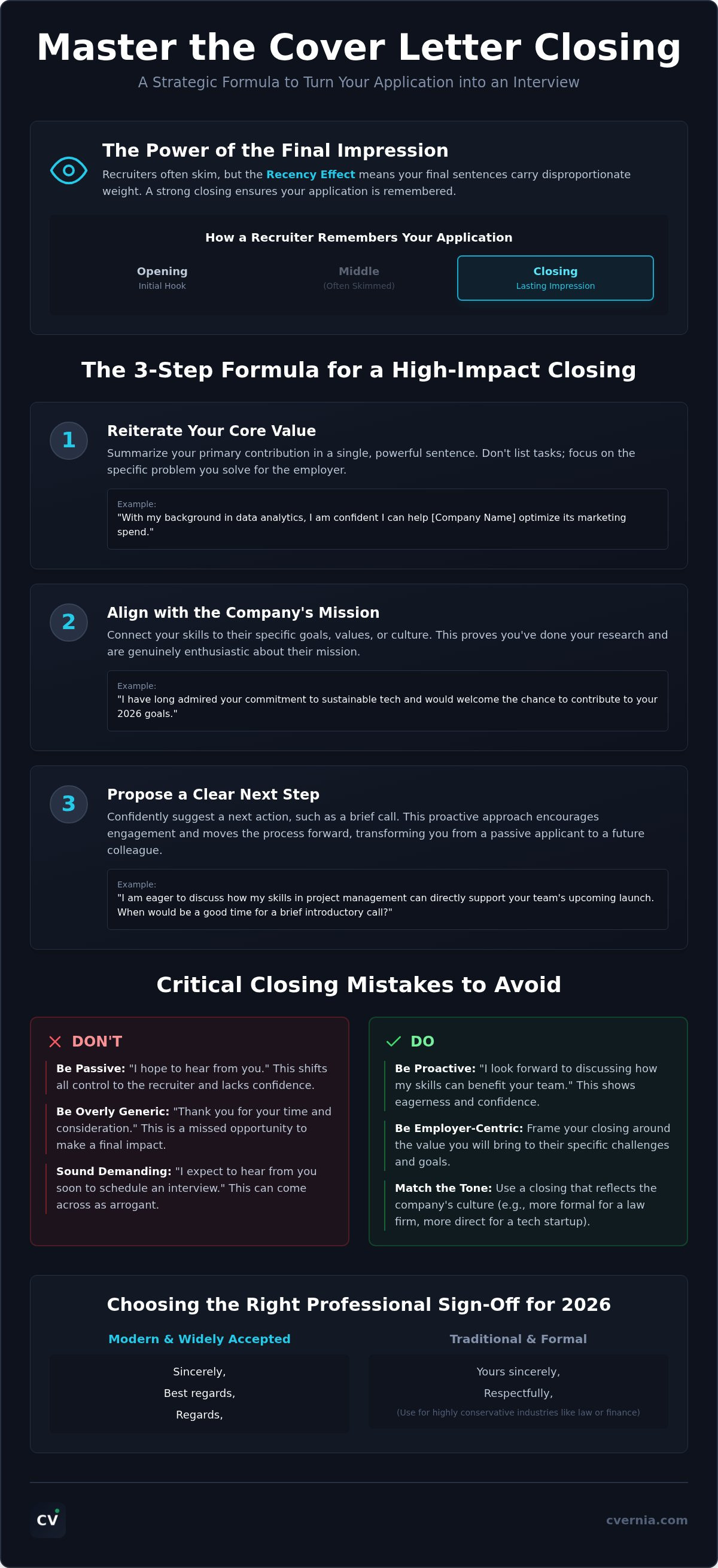
Closing your application shouldn't be an afterthought. It requires a structured approach that leaves no room for doubt about your suitability. To master how to end a cover letter, follow this three-step formula: reiterate your core value, align with the company mission, and suggest a clear next step. When these elements work together, they transform a standard sign-off into a persuasive closing argument. This method ensures you finish with the same level of professionalism you used in your opening, maintaining a high-impact narrative from start to finish.
When you combine these steps, your closing paragraph should feel like a natural progression. It moves the reader from evaluation to action. A cohesive ending might look like this: "With my background in data analytics, I am confident I can help [Company Name] optimize its marketing spend. I have long admired your commitment to sustainable tech and would welcome the chance to discuss how my skills can contribute to your 2026 goals. Please let me know when you might be available for a brief introductory call." This structure provides a logical conclusion that invites engagement without appearing pushy.
Crafting the Value Reiteration
Your final paragraph must remind the reader exactly why you're the right fit without sounding repetitive. Summarize your primary contribution in a single, punchy sentence. This isn't just for the human reader; it's a vital step for maintaining keyword density and ensuring your application passes through modern filtering systems. By using a tailored cover letter generator, you can ensure your closing remains consistent with the professional tone established in your header and body paragraphs. Focus on the specific problem you solve rather than a list of generic tasks.
The Art of the Professional CTA
The call to action is the most overlooked element of the closing. A soft CTA invites interest, such as "I look forward to discussing how my experience in project management can support your upcoming product launch." A hard CTA is more direct: "I am available for an interview next Tuesday to share my strategy for increasing your team's efficiency." Avoid the outdated tactic of promising to call the recruiter on a specific day. This often feels intrusive in the digital-first hiring environment of 2026. Instead, invite a conversation. You want to make it as easy as possible for the recruiter to say yes to a meeting. If you're feeling stuck on the phrasing, you can use our application management tools to track which closing variations generate the most interview requests.
Professional Sign-offs: Choosing the Right Complimentary Close
The complimentary close is your final professional handshake. It serves as the punctuation mark on your entire narrative. While it might seem like a minor detail, choosing the wrong sign-off can disrupt the flow and tone you've carefully built. When you decide how to end a cover letter, your choice should reflect the specific culture of the organization you are targeting. A mismatch here can make you appear out of touch with the company's internal communication style. You want to leave the reader with a sense of alignment and readiness.
Consistency is the hallmark of a strong application. Your sign-off shouldn't just be an afterthought; it needs to match the energy of your opening and the depth of your body paragraphs. If you have presented yourself as a bold innovator, a standard "Sincerely" might feel a bit too traditional. Conversely, if you're applying for a role in a highly regulated industry, a modern "Best" might seem overly casual. Aim for a closing that feels like a natural extension of your professional persona.
The Formal vs. Modern Debate
Hiring standards in 2026 vary significantly across different sectors. A legal firm often still expects the traditional "Sincerely," while a creative agency might find it overly stiff. Maintaining cover letter vs resume tone consistency is essential for your personal brand. If your resume uses a sleek, modern layout, an archaic sign-off like "Respectfully yours" creates a jarring disconnect for the recruiter.
| Sign-off | Best For | Tone Perception |
|---|---|---|
| Sincerely | Legal, Finance, Government | Highly Formal, Traditional |
| Best regards | Corporate, Tech, Marketing | Modern, Professional, Safe |
| Thank you for your time | Healthcare, Education, Non-profit | Appreciative, Polished |
Avoid overly casual closings like "Cheers," "Best wishes," or "Talk soon." These might work in internal Slack channels, but they are too informal for an initial application. You want to appear approachable but never unprofessional. Stick to the "safe middle ground" of "Best regards" if you're unsure about the specific company culture. It strikes the perfect balance for most modern corporate roles and ensures you don't accidentally offend a more traditional hiring manager.
Digital Signatures and Contact Blocks
In a digital-first hiring landscape, your contact block needs to be as functional as it is professional. Format your name and contact information clearly so it's easy to read on both mobile and desktop screens. Don't force a recruiter to hunt for your phone number or email address. When considering how to end a cover letter effectively, include active links to your LinkedIn profile or digital portfolio. This encourages immediate exploration of your professional background and gives the recruiter a reason to keep clicking.
Ensure your contact details are ATS-scannable. Some automated systems struggle with complex footers, columns, or graphics. Use plain text for your name, phone number, and email. If you include a link, make sure the anchor text is clear and the URL is functional. A clean, well-organized sign-off block demonstrates your attention to detail and your technical literacy. It's the final proof that you're prepared for the modern workplace and ready to hit the ground running.
Common Mistakes to Avoid When Ending Your Cover Letter
Even the most polished professional narrative can crumble if the final lines feel forced, clumsy, or outdated. While the body of your letter builds your case, the conclusion must seal the deal without triggering any red flags. Many candidates unknowingly sabotage their efforts by falling into common traps that signal either a lack of confidence or a disregard for modern etiquette. Understanding how to end a cover letter effectively means identifying these subtle errors before you hit submit. Precision in your closing reflects your overall attention to detail and your readiness for a high-stakes role.
Avoid the "Desperation Trap" at all costs. Phrases like "I really need this opportunity" or "I am willing to do anything to prove myself" undermine your authority. They shift the dynamic from a professional partnership to a plea for help. You want to appear as a peer who provides solutions, not a candidate who is begging for a chance. Maintain your professional composure by focusing on mutual benefit. If you feel your closing lacks that punchy, confident edge, use the CVernia Career Application Management Platform to refine your tone and ensure your final impression is one of strength.
Brevity is your ally in the final paragraph. Aim to keep your closing under 60 words. Over-explaining your qualifications in the final lines suggests you didn't trust your body paragraphs to do the work. Similarly, avoid presumptive gratitude like "Thanks in advance." While intended to be polite, many 2026 hiring managers perceive this as arrogant or demanding. It assumes you will get the interview before they've even finished reading. Stick to a simple "Thank you for your time and consideration" to remain respectful and professional.
Addressing the "No Name" Problem
Finding a specific hiring manager's name is always the goal, but it isn't always possible. Don't revert to the archaic "To Whom It May Concern" vibe in your closing if you couldn't find a recipient. This feels cold and detached. Instead, maintain professional warmth by addressing the "Hiring Team" or the specific "Department Manager." This shows you understand the organizational structure and are speaking to the group responsible for the decision. It keeps the tone human-centric even when the recipient remains anonymous.
Formatting and Spacing Errors
Visual presentation is just as important as your word choice. Ensure there is exactly one single line of space between your final paragraph and your complimentary close. This creates a clean, readable layout that is easy on the eyes. If you are using a digital format where a physical signature isn't possible, simply type your full name. Avoid using script fonts to mimic a signature, as these can look unprofessional or clutter the document. Finally, check your page breaks. Never let your sign-off become "orphaned" on a second page. If your letter is running long, trim the body text to ensure the closing and sign-off remain together on a single sheet.
Optimizing and Tracking Your Application Success with CVernia
Mastering the theory of how to end a cover letter is only the first step toward securing your next role. To truly succeed in the 2026 hiring market, you need to treat your job search like a data-driven project. CVernia provides the tools necessary to move beyond guesswork and into a space of professional certainty. Our Application Tracking Dashboard allows you to monitor your response rates with precision, helping you identify which closing strategies are actually landing you interviews. By centralizing your application journey, you avoid repetitive mistakes and ensure every document you send is a refined version of the last.
Testing different approaches is the fastest way to improve your results. Our platform focuses on truthful representation and ATS compatibility analysis to ensure your tailored cover letter reaches human eyes. You can experiment with various calls to action or sign-offs and see which ones generate the most engagement from recruiters. This strategic advantage allows you to pivot quickly if a specific industry requires a different tone than you originally anticipated. You're no longer shooting in the dark; you're using a sophisticated system designed for your personal success.
Version Control for Better Results
Different industries demand different levels of formality. Use our Smart Reapplication Detection and Version Management features to save specific endings for tech, traditional corporate, or creative roles. This ensures you always have the right closing ready to go without having to rewrite it from scratch every time. CVernia prevents version fatigue by keeping your history organized and accessible throughout even the longest career transitions. You'll always know exactly which version of how to end a cover letter you used for a specific company, making your follow-up conversations much more natural and informed.
The CVernia Advantage: Beyond the Document
Your journey doesn't end when you hit the submit button. Our platform integrates Interview Notes and Attachment Management directly with your application tracking. This means you can reference your original cover letter closing during your interview preparation to maintain a consistent professional brand. Additionally, our Career Academy provides learning resources to help you refine your overall communication style as you progress through different hiring stages. We are your strategic ally, standing by you from the first draft to the final job offer. Start managing your career journey with CVernia today!
Master the Final Impression of Your Professional Journey
Your final paragraph serves as the bridge between a static document and a live conversation. By mastering how to end a cover letter, you ensure your application concludes with the same strategic precision found in your opening lines. A high-impact closing combines a clear reiteration of your value with a proactive call to action. This simple shift transforms a standard sign-off into a powerful tool for engagement. You've done the hard work of building your case; now it's time to invite the recruiter to take the next step.
Success in the 2026 job market requires more than just good writing. It's about organization and technological alignment. Verify your document's performance before you hit submit to stand out from the competition. Tailor your cover letter and track every application with CVernia to leverage our ATS Compatibility Checker and Smart Reapplication Detection. Our Centralized Application Tracking ensures you stay organized and never lose momentum during your career transition. You have the skills and the strategy to reach your goals. Take the final step toward your next role with total confidence.
Frequently Asked Questions
What is the best professional sign-off for a cover letter in 2026?
"Best regards" is currently the most versatile professional sign-off for modern applications across most industries. It strikes a perfect balance between traditional formality and modern corporate culture. For highly conservative sectors like law or finance, "Sincerely" remains the safer, more traditional choice. Always match your sign-off to the specific industry tone you've identified during your initial research.
Should I include my phone number and email at the end of the cover letter?
Yes, you should always include your phone number and email address in a clear contact block directly below your typed name. This makes it as easy as possible for a recruiter to contact you the moment they finish reading your closing. While these details are often in the header, repeating them at the end ensures they are accessible at the exact moment the reader decides to reach out.
Is "Sincerely" too old-fashioned for a modern cover letter?
"Sincerely" is not old-fashioned; it is a timeless professional standard that still carries significant weight in formal sectors. While tech startups might prefer "Best" or "Regards," conservative organizations still value the traditional etiquette of "Sincerely." If you're unsure about how to end a cover letter for a specific role, "Best regards" offers a safe, modern middle ground for almost any application.
How long should the closing paragraph of a cover letter be?
The closing paragraph should be concise, ideally between two to four sentences and under 60 words total. This section should focus on reiterating your value, expressing enthusiasm, and providing a clear call to action. Keeping it brief ensures that your final message remains punchy and doesn't dilute the impact of the achievements you've shared in your body paragraphs.
Can I use "Thank you in advance" as a closing?
No, you should avoid using "Thank you in advance" because it can come across as presumptive or even arrogant to some hiring managers. It assumes you will be granted an interview before the recruiter has finished evaluating your candidacy. Use "Thank you for your time and consideration" instead to show genuine appreciation for the recruiter's effort and professional courtesy.
How do I end a cover letter if I am applying through an online portal?
End your letter with a standard business closing even when applying through a digital portal or plain-text box. Type your full name clearly below your complimentary close to serve as your digital signature. Maintaining this structure proves your professional literacy and ensures your application remains polished regardless of the submission platform you are required to use.
Should I mention my LinkedIn profile in the cover letter closing?
Include your LinkedIn profile link in the contact block directly below your typed name rather than in the paragraph text itself. This provides a clean, professional way to encourage recruiters to explore your extended professional network and portfolio. It turns your sign-off into a functional tool that drives deeper engagement with your personal brand without cluttering your final sentences.
What happens if I forget to sign my cover letter?
Forgetting a physical signature is rarely a deal-breaker in 2026, as most recruiters expect digital-first documents. Ensure your full name is typed correctly at the bottom of the page to maintain professional standards. If you realize the mistake after submission, focus on the quality of your content and your prompt follow-up instead of worrying about a missing physical signature. Learning how to end a cover letter with a typed name is usually sufficient for most modern portals.


