
Stop treating your application like a carbon copy of your resume. Most job seekers ask, "what is a cover letter ," while staring at a blank screen and hoping a bot doesn't delete their hard work. You've likely felt the exhaustion of rewriting the same three paragraphs for the tenth time this week. It's frustrating to feel like you're shouting into a digital void where an algorithm decides your fate before a human even sees your name.
We understand that the modern hiring landscape feels like a maze of hidden rules. This guide changes that. You'll discover how to transform a standard document into a strategic narrative that clears ATS hurdles and wins interviews. We'll show you exactly how to align your story with recruiter needs without simply repeating your resume. By the end, you'll have a repeatable template for success, a clear understanding of ATS scores, and a strategy to finish applications faster than ever. Let's turn your uncertainty into readiness.
Key Takeaways
- Understand exactly what is a cover letter in the modern hiring landscape and how it functions as a strategic bridge between your resume and a recruiter's specific needs.
- Master ATS compatibility strategies to ensure your narrative clears digital hurdles and reaches human decision-makers with precision.
- Build a high-impact narrative using a structured framework that captures professional interest in the first ten seconds through a clear value statement.
- Shift from chaotic document creation to a centralized application strategy that reduces stress and optimizes your version management for every role.
- Apply a repeatable tailoring process to align your unique experience with specific job requirements without the burnout of starting from scratch.
Defining the Cover Letter in the Modern Hiring Landscape
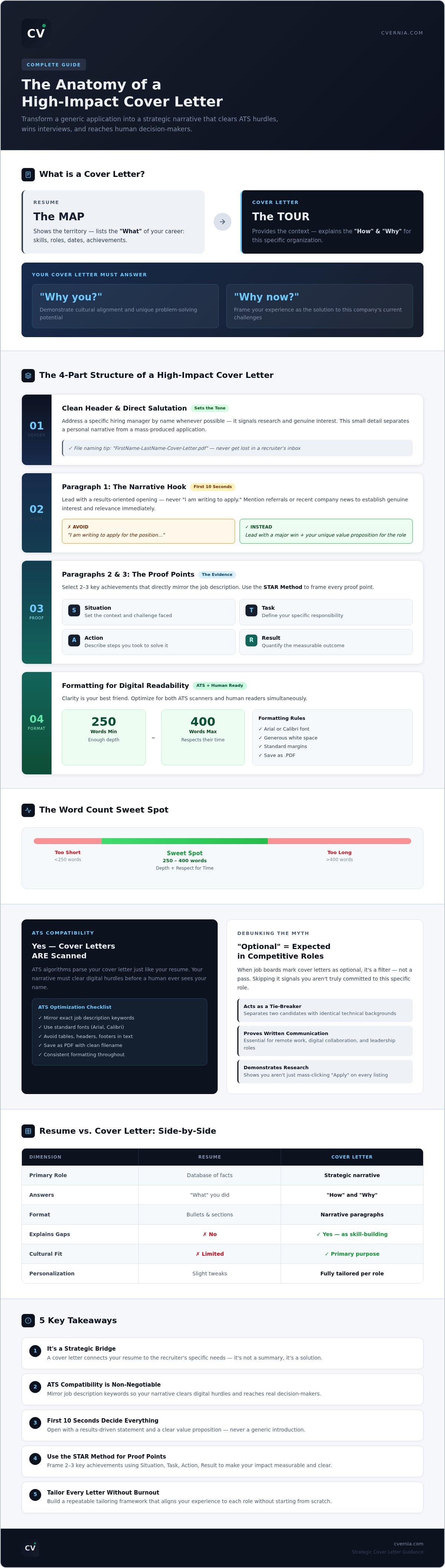
A cover letter is a one-page narrative that connects your resume to a specific job description. While your resume lists the "what" of your career, the cover letter explains the "how" and the "why." To truly grasp **what is a **professional cover letter in the current market, you must view it as a strategic bridge. It's your chance to answer the two most critical questions in recruitment: "Why you?" and "Why now?" for this specific organization.
Think of the difference between a cv letter and a standard resume as the difference between a map and a guided tour. The resume shows the territory, but the cover letter provides the context. Hiring managers in 2026 aren't just looking for a list of skills. They're searching for cultural alignment and problem-solving potential. By framing your experience as a solution to the company's current challenges, you move from being a candidate on paper to a strategic partner in waiting. This shift in perspective is what separates a generic application from a high-impact strategy.
The Strategic Purpose: Beyond the Resume
Your resume is a database; your cover letter is a story. Use this space to bridge the gap between your qualifications and the company's specific pain points. If a firm is struggling with scaling their operations, don't just say you're an operations manager. Tell them how you led a team through a growth phase. This humanizes your professional data through specific achievements. It also provides a vital platform to explain career pivots or employment gaps truthfully. Instead of leaving recruiters to guess, you can frame your transition as a period of intentional skill-building. This level of clarity builds immediate trust and demonstrates a high degree of self-assurance.
Is it Still Necessary? The 'Optional' Myth
Many job boards label the cover letter as "optional," but in competitive corporate roles, "optional" usually means "expected." A well-crafted letter acts as a tie-breaker between two candidates with similar technical backgrounds. It demonstrates your written communication skills, which are essential in a world of digital collaboration and remote leadership. When you skip this step, you miss a primary opportunity to show you've done your research. A tailored letter proves you aren't just clicking "apply" on every listing. It shows you're committed to this specific role and have the clarity to explain why you belong there. Understanding **what is a **cover letter document and why it matters is the first step toward a more efficient, successful application process.
The Anatomy of a High-Impact Cover Letter
Building a document that commands attention requires more than just filling in blanks. To understand **what is **your letter in a practical sense, you must view it as a high-conversion sales page for your career. Professionalism begins with a clean header and a direct salutation. Address a specific person whenever possible; it shows you've done the work to find the hiring manager. This small detail sets the stage for a narrative that feels personal rather than mass-produced.
Paragraph 1: The Narrative Hook
The first ten seconds are everything. Avoid the "I am writing to apply" cliché. Instead, lead with a results-oriented opening that highlights a major win. If a former colleague referred you or you recently read about the company's expansion, mention it immediately. This establishes relevance and genuine interest. Your goal is to draft a single sentence that summarizes your unique value proposition for the role. It should tell the recruiter exactly how you'll make their life easier from day one.
Paragraphs 2 & 3: The Proof Points
The middle paragraphs are where you deliver the evidence. Select two or three key achievements that directly mirror the job description requirements. Don't just list duties. Use the STAR method—Situation, Task, Action, Result—to frame your narrative. This approach ensures your impact is measurable and clear. Focus on truthful representation by highlighting existing skills strategically rather than inventing new ones. If you're struggling to align your history with a new role, using tailored cover letter creation tools can help identify the strongest links between your past and their future.
Formatting for Digital Readability
Clarity is your best friend in a digital-first hiring world. Use standard fonts like Arial or Calibri and plenty of white space to keep the document readable for both human eyes and digital scanners. Aim for a length between 250 and 400 words. This is the "sweet spot" for engagement; it's long enough to provide depth but short enough to respect a recruiter's time. Finally, use clear file naming conventions like "FirstName-LastName-Cover-Letter.pdf". This level of organization is essential for centralized application tracking and ensures your materials never get lost in a digital pile.
Close your letter with a confident Call to Action. Suggest a specific next step, like a brief call to discuss how your background fits their upcoming projects. This proactive stance shows you're ready to move from applicant to contributor with self-assurance and purpose.
The ATS Factor: Does Your Cover Letter Get Scanned?
Many applicants treat their cover letter as a secondary document, but in 2026, it serves as a vital data source for Applicant Tracking Systems (ATS ). If you're still wondering what is a cover letter in the context of modern tech, think of it as a searchable extension of your resume. Systems like Greenhouse now have the capability to scan and parse cover letter attachments to find specific matches for job requirements. This means your narrative needs to be as technically sound as it is persuasive. When a machine is your first reader, clarity and structure become your greatest advantages.
CV Compatibility & ATS Analysis has become a non-negotiable step before you hit send. If your document is filled with complex columns, tables, or images, the scanner may fail to read your text entirely. This results in a "blank" profile in the recruiter's view, effectively ending your candidacy before it begins. Stick to a clean, single-column layout. Use standard section titles so the software knows exactly where your introduction ends and your evidence begins. Avoid putting essential contact information in headers or footers; some older systems still struggle to extract data from those zones.
Keyword Optimization vs. Natural Language
Identify the "hard skills," such as software proficiency, and "soft skills," like leadership style, embedded in the job posting. Weave these industry terms into your story naturally. Don't just list them at the bottom. Truthful tailoring outperforms generic templates because it provides the context that automated rankings value. This isn't about "keyword stuffing," which can actually trigger red flags in sophisticated software. It's about demonstrating that you speak the company's language. When you describe a specific project using the same terminology the company uses, you signal alignment to both the machine and the human recruiter who follows.
Smart Reapplication and Version Control
Modern ATS platforms store every document you've ever submitted to a company. If you reapply for a different role six months later with the exact same letter, it signals a lack of effort or stagnant growth. Use Smart Reapplication Detection to manage your versions effectively. This ensures your new version shows professional progress and specific interest in the new position. Sending a duplicate letter is a common danger that can lead to an automatic rejection. Instead, maintain a centralized application strategy where every version is tracked and optimized for the current opportunity. This methodical approach ensures your history with a company works for you, not against you.
Tailoring Without the Burnout: A Strategic Framework
Stop wasting hours on manual customization for every single role. High-volume applications often lead to writing fatigue, but the solution isn't sending generic documents. Instead, adopt a methodical workflow that prioritizes impact over effort. This framework ensures you understand **what is an **application letter in a strategic sense: a tool for precision, not a test of endurance. Understanding what is a cover letter in 2026 means recognizing it as a dynamic document that evolves with every role you pursue through a repeatable, efficient process.
Follow these five steps to build a high-converting application strategy without the burnout:
- Step 1: Analyze the job description. Look for core requirements and company values. Identify recurring themes; if they mention "cross-functional collaboration" multiple times, your narrative must reflect that specific strength.
- Step 2: Identify the overlap. Pinpoint the specific achievements in your history that solve the company's current problems.
- Step 3: Build the skeleton. Use a tailored cover letter generator to establish a professional structure quickly.
- Step 4: Inject personal anecdotes. Add one or two specific stories that prove your cultural fit and humanize your data.
- Step 5: Run a final check. Perform a CV Compatibility & ATS Analysis to ensure your formatting is flawless before submission.
Truthful Tailoring: The CVernia Standard
Integrity is your best long-term career strategy. While modern tools provide structure and clarity, your voice must remain authentic. Use technology to refine your narrative, but ensure every claim is backed by your actual history. Truthful representation builds a foundation of trust that carries through to the interview stage. Recruiters can sense when a story is fabricated; they value candidates who can speak with self-assurance about real results. Refine your story until it feels both polished and deeply personal, ensuring you're ready to back up every sentence during a live conversation.
Managing Multiple Versions Efficiently
Organization is the antidote to application stress. You need a centralized dashboard to keep track of which letter went to which hiring manager. Tracking your versions prevents the embarrassment of mentioning the wrong company goals in a follow-up call. Organizing interview notes alongside your submitted cover letters creates a powerful knowledge base. You can quickly reference exactly what you promised in your application when a recruiter calls for a surprise screening. For a deeper dive into scaling your efforts, explore our job search management system.
Ready to streamline your process? Use our Application Tracking Dashboard to manage your entire strategy and maintain total control over your professional journey.
Centralizing Your Application Strategy for Success
The era of saving mismatched Word documents in random desktop folders is over. Successful candidates in 2026 treat their job search like a project rather than a series of chores. This requires a fundamental shift from simple document creation to holistic application management. When you understand what is a cover letter as a dynamic asset within a larger data-driven strategy, you gain a massive competitive edge. It's no longer just a one-off letter; it's a tracked component of your professional brand that needs to be organized, analyzed, and refined.
Centralizing your efforts reduces the inherent stress of the job search. It transforms a chaotic process into a streamlined workflow where every piece of data is at your fingertips. Instead of feeling overwhelmed by the volume of your applications, you can focus on the quality of your connections. This organized approach doesn't just save time; it directly improves your interview performance by ensuring you're always prepared with the right context for every conversation.
The Benefits of a Centralized Dashboard
A centralized dashboard serves as the command center for your career transition. It allows you to track deadlines, interview notes, and specific attachment versions in one secure location. You'll never lose track of the specific "hook" or value proposition you used for a high-priority role. This level of clarity is vital when a recruiter calls for an unscheduled screening. You can immediately reference the exact narrative you submitted, which helps you speak with consistency and confidence. Furthermore, using data to see which versions of your letter are getting the most hits allows you to double down on what works. If a specific achievement-based narrative leads to more interview requests, you can adapt that strategy for future opportunities with precision.
Your Path Forward with CVernia
CVernia provides the sophisticated infrastructure needed for this modern approach. Our tools help you maintain truthful, ATS -optimized professional documents that represent your history accurately. You're not just building a document; you're managing a career pivot. You can also access the Career Academy for deeper guidance on professional branding and long-term growth. This ensures you're always aligned with the hidden rules of the hiring landscape. We believe in empowering you to move from uncertainty to total readiness through smarter technology and better organization.
Your next step is a 2026 readiness audit. Review your current materials and ask if they function as a strategic bridge or just a list of facts. If your process feels scattered, it's time to upgrade your toolkit. Start your journey with a Career Application Management Platform that puts you in control of your professional narrative and your future success. By the time you finish your next application, you should feel prepared, aligned, and ready to win the interview.
Take Control of Your Professional Narrative
Mastering your application strategy means moving beyond the basic question of what is a cover letter. You now understand how to transform this document into a strategic bridge that connects your unique history to a company's specific future. By prioritizing ATS-optimized structure and a centralized management workflow, you eliminate the guesswork that often stalls a job search. You have the framework to clear digital hurdles and speak directly to a recruiter's needs with confidence.
Don't let writing fatigue or technical confusion hold you back from your next career milestone. CVernia provides the tools you need to stay organized and impactful, offering ATS-optimized templates and smart reapplication tracking. Access empathetic, expert-led guidance to ensure every version of your story shows intentional growth. You deserve an application process that feels efficient and empowering.
Build your tailored cover letter with CVernia today and turn your professional uncertainty into interview readiness. Your next big opportunity is waiting for a narrative only you can tell.
Frequently Asked Questions
Should a cover letter be a PDF or a Word document?
Submit your document as a PDF unless the job posting specifically requests a Word file. PDF ensures your formatting remains identical across different devices and software versions. It also prevents digital scanners from misreading your layout. Use a professional naming convention like "FirstName-LastName-Cover-Letter.pdf" to help recruiters find your file quickly in their centralized application tracking systems.
How long should a cover letter be in 2026?
Aim for a length between 250 and 400 words to maximize impact. This sweet spot ensures you answer what is a cover letter in a way that respects a recruiter's time while providing enough depth. Focus on three or four punchy paragraphs. Use your space to highlight specific achievements that solve the company's pain points rather than listing every duty you've ever had.
Can I use AI to write my cover letter?
Utilize AI tools to build your document's skeleton and identify relevant keywords. They're incredibly efficient for structure and clarity. However, you must always audit the final text to ensure truthful representation. Inject your own voice and specific anecdotes to prove your cultural fit. AI is a powerful assistant, but your personal story is what ultimately wins the interview.
What if I don't know the name of the hiring manager?
Address your letter to "Hiring Manager" or "Lead of [Department Name]" if a specific name isn't available. Avoid using "To Whom It May Concern," as it feels outdated and impersonal. Spend a few minutes on the company's LinkedIn page to find the likely manager. If you can't find a name, don't stress. Focus on crafting a compelling value proposition that speaks to the team's goals.
Is a cover letter required if I'm applying through LinkedIn?
Include a cover letter even when using LinkedIn's one-click application features. Attaching a tailored document immediately separates you from the hundreds of applicants who only submit a standard profile. It's your best opportunity to explain your interest in the specific company. This extra effort signals a high level of preparedness and genuine motivation that recruiters value in a competitive market.
How do I explain an employment gap in my cover letter?
Explain an employment gap briefly and truthfully without over-explaining. Use one or two sentences to mention professional development, personal projects, or caregiving responsibilities. Pivot the conversation immediately back to your current readiness. Focus on how the skills you maintained or gained during that time make you a stronger candidate for this specific role today. Self-assurance is key to building trust.
What is the difference between a cover letter and a resume?
A resume is a historical list of facts, while a cover letter is a strategic narrative. Many job seekers asking what is a cover letter struggle with this distinction. Your resume proves you have the technical skills for the job. Your letter proves you have the context, cultural alignment, and motivation to use those skills specifically for their organization's current challenges.
Should I include my salary expectations in the letter?
Avoid including salary expectations unless the job description explicitly asks for them. Discussing compensation too early can limit your negotiating leverage or lead to an early rejection. Wait until the interview stage to talk about numbers. If you must include it, provide a broad range based on current industry data to show you're informed while remaining flexible for the right opportunity.


