
Nearly all Fortune 500 companies use Applicant Tracking Systems (ATS) to screen applications before a recruiter reviews them. In 2026, the debate of cover letter vs resume isn't about which one matters more; it's about how they work together to bypass digital gatekeepers. It's exhausting to spend hours agonizing over your experience only to feel like you're repeating the same points in two different files. You want to stand out, but the fear of ATS rejection or being flagged for generic content often leads to application paralysis.
We understand that stress, and we're here to help you turn it into a strategic advantage. You'll discover the distinct roles of cover letters and resumes so you can build a cohesive application strategy that captures hiring manager attention. We'll show you how to present your objective data in your resume while using your cover letter as a narrative bridge for your future potential. This guide provides a clear roadmap to make your documents complement each other, ensuring faster application completion with better results.
Key Takeaways
- Define the distinct roles of your documents to avoid repetitive content and ensure every sentence adds new value to your application.
- Position your resume to prove professional performance while using your cover letter to demonstrate cultural fit and personal motivation.
- Optimize the cover letter vs resume dynamic for 2026 ATS standards by strategically aligning keywords across both files.
- Establish a consistent visual brand using matching headers and layouts to project professional authority and attention to detail.
- Leverage centralized application management to track document versions and maintain a streamlined, stress-free hiring workflow.
What is a Cover Letter vs. a Resume? The Fundamental Differences
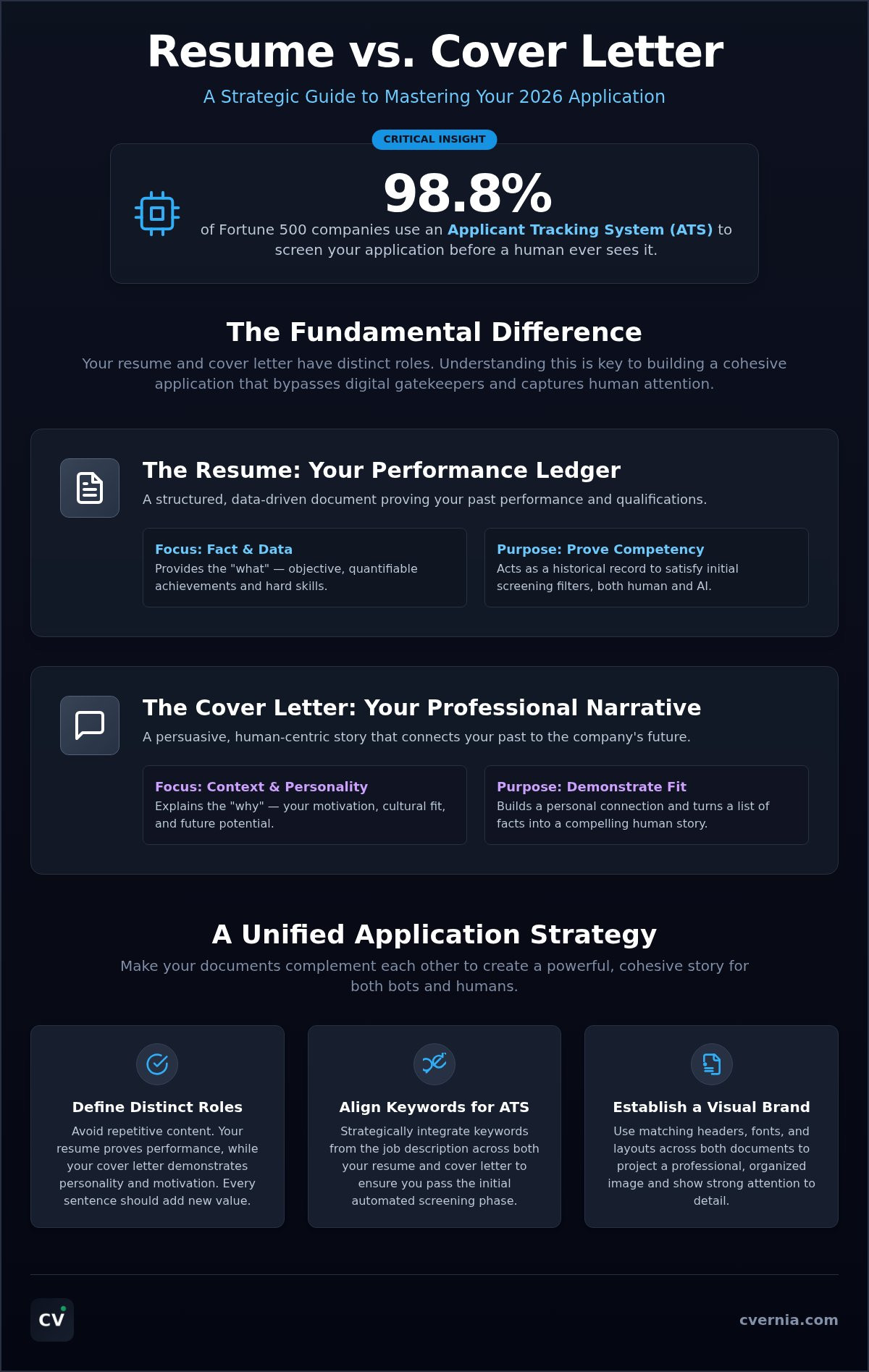
Understanding the core distinction between a cover letter vs resume is your first step toward a successful application. While they share the same goal of landing you an interview, they serve entirely different masters within the hiring process. Your resume is a historical record, while your cover letter is a future-focused pitch. One documents your past achievements; the other translates those achievements into a solution for your next employer's specific problems. Think of the relationship as "Fact vs. Context." Your resume provides the raw data, while your cover letter gives that data meaning and purpose.
The Resume: Your Professional Record
A Résumé acts as your official professional transcript. It’s a formal, structured document that provides a high-level overview of your work history, education, and technical skills. In 2026, its primary function is efficiency. Recruitment teams and AI screening tools need to see your qualifications at a glance. Focus on quantifiable results and hard skills that prove your competency for the role. Use clean layouts and bullet points to ensure both humans and machines can extract your value in seconds. It’s the foundational document that proves you have the "what" required for the job.
The Cover Letter: Your Professional Narrative
If the resume is the skeleton of your application, the cover letter is the muscle and heart. It provides a personalized introduction and a persuasive narrative that your resume simply cannot capture. By exploring what is a cover letter , you'll see it’s your chance to address the "why" behind your career moves. Use this space to demonstrate culture fit, explain a career pivot, or showcase the soft skills that make you a great teammate. It acts as a direct communication line to the hiring manager, turning a list of facts into a compelling human story that resonates with their specific company goals.
While the resume is almost always a hard requirement, the cover letter is frequently the differentiator that moves you from the "maybe" pile to the "must-interview" list. Your resume states the fact that you managed a team of ten. Your cover letter provides the context of how your leadership style helped that team exceed targets during a challenging merger. Mastering the cover letter vs resume dynamic ensures you present a complete, professional image that leaves no room for doubt. Aligning these documents allows you to show up with confidence, knowing you've addressed both the technical requirements and the personal connection hiring managers crave.
Personality vs. Performance: The Strategic Role of Each Document
Many applicants treat these two documents as identical twins. They aren't. Your resume proves you have the skills to execute the role, while your cover letter explains why you're the right person to join the team. This distinction is vital for understanding the Key Differences in how a hiring manager perceives the cover letter vs resume dynamic in your total application. Achieving narrative alignment means your documents work in tandem to tell a single, powerful story without boring the reader with repetitive information.
Why Resumes are Data-Driven
Resumes function as your performance ledger. They rely on cold, hard metrics to build immediate credibility with recruiters. When a hiring manager sees that you "increased team efficiency by 15%," they're seeing objective evidence of your ability to deliver. Precise job titles and accurate dates provide a timeline of growth that proves you can handle technical responsibilities. Data-driven resumes satisfy initial screening filters by providing the objective evidence required to move forward. Without these facts, your application lacks the weight needed to survive the first six seconds of a manual review.
Why Cover Letters are Human-Centric
While your resume lists the "what," your cover letter explores the "who." It’s your opportunity to build an emotional connection that a list of bullets cannot achieve. If you have a career gap or are attempting a pivot, this document allows you to explain the transition with confidence. Demonstrating research into the company's specific pain points shows that you aren't just looking for any job. It humanizes your application, turning a static profile into a living personality. This human-centric approach proves your motivation and cultural alignment, which are often just as important as technical skill in 2026.
Don't fall into the trap of making your cover letter a "resume in paragraph form." This redundancy wastes the hiring manager's time and misses a chance to showcase your unique value. Instead, pick one or two key achievements from your resume and tell the story of how you reached those goals. This creates a cohesive cover letter vs resume strategy that highlights both your talent and your drive. If you find it difficult to manage different versions for multiple roles, using a Career Application Management Platform can help you organize your documents and ensure your narrative remains consistent across every submission.
Structural Comparison: Formatting Your Application for Success
Visual consistency is your silent advocate. When you align the design of your cover letter vs resume, you project a level of professional polish that immediately signals attention to detail. Use the exact same header, font, and contact information layout for both documents. This "visual branding" ensures that when a hiring manager switches between files, the transition feels seamless and intentional. While their internal structures differ, their outward appearance should clearly belong to the same candidate.
The primary structural difference lies in how information is digested. Your resume thrives on bulleted lists that allow for rapid scanning of achievements and skills. In contrast, an effective cover letter uses short, punchy paragraphs to build a narrative. In 2026, brevity is the ultimate sign of respect for a recruiter's time. Aim for high-impact layouts that prioritize white space, making your most important qualifications impossible to miss.
Resume Layout Essentials
Stick to the reverse-chronological format unless you're making a radical career shift. This structure remains the gold standard because it highlights your most recent growth first. While the one-page rule was once absolute, a two-page resume is perfectly acceptable for professionals with over five years of experience. Ensure your layout includes these four pillars: a compelling professional summary, a results-oriented experience section, a dedicated skills block, and your educational background.
Cover Letter Flow Essentials
Master the three-paragraph flow to keep your message focused. Start with a hook that identifies the specific role and your enthusiasm. Move into the value paragraph, where you connect your past wins to the company's future needs. Conclude with a strong call to action and a professional sign-off. Keep the total count under 300 words. This ensures your message remains sharp and persuasive without overwhelming the reader with unnecessary filler.
Aligning these structures doesn't just help the human reader; it helps you stay organized. When you treat your application as a unified package, you reduce the risk of sending mismatched versions or outdated information. Focus on clarity over complexity to ensure your expertise remains the star of the show.
The ATS Factor: How Modern Systems Process Your Documents
As of 2026, the digital gatekeepers have evolved far beyond simple keyword matching for resumes. Modern Applicant Tracking Systems now scan every attachment you upload, meaning the cover letter vs resume distinction is irrelevant to a scanner's ability to index your data. These systems analyze both documents simultaneously to build a comprehensive profile of your candidacy. Because 98.8% of Fortune 500 companies rely on this technology according to Merit America, your strategy must involve optimizing both files. Consistency is critical here. If your resume claims four years of experience but your cover letter mentions three, the ATS might flag the discrepancy, casting doubt on your application's integrity before a human ever sees it.
Resume Optimization for Scanners
Stick to standard headings like "Work Experience" and "Technical Skills" to ensure the parser correctly categorizes your background. Avoid complex graphics, tables, or multi-column layouts that can confuse systems and lead to parsing errors. Place your most important keywords near the top of your experience section to satisfy initial algorithms. You can measure your success before you hit submit by using a friendly ATS to see exactly how your document ranks against specific job descriptions.
Cover Letter Optimization for Context
View your cover letter as a secondary opportunity to integrate industry-specific terminology that didn't naturally fit into your resume's bullet points. This isn't an invitation for a "keyword dump," which modern systems can now identify and penalize. Instead, weave these terms into your narrative to provide context for your skills. Modern AI-driven ATS evaluates the sentiment and tone of your writing to determine if your professional voice aligns with the company's culture. This sophisticated analysis means your writing needs to be both technically optimized and authentically human.
Use the exact terminology found in the job description across both files. If the posting asks for "Strategic Project Management," don't just write "led projects." Mirroring the employer's language shows the system you're a direct match for their needs. This unified approach ensures that your cover letter vs resume combo works as a powerful, search-friendly package. By aligning your terminology, you prove your expertise to the machine while preparing a compelling story for the human recruiter.
Mastering Your Application Strategy with CVernia
Stop juggling disconnected files and start building a unified strategy. Managing the cover letter vs resume balance becomes significantly easier when you utilize a centralized Career Application Management Platform. CVernia eliminates the chaos of your job search by providing a single, secure source of truth for every document you create. This organized approach ensures you always project professional confidence, knowing your narrative is aligned and your data is accurate. Move from the stress of uncertainty to a state of total readiness with tools designed for the modern professional.
Centralized Tracking and Organization
Move beyond messy desktop folders and confusing file names that lead to application errors. Our digital dashboard allows you to link specific CV versions to individual job applications instantly, ensuring you never send the wrong file to a recruiter. You can also manage interview notes and important attachments alongside your primary documents. This level of organization transforms your workflow from reactive to strategic. By centralizing your materials, you maintain a clear overview of your progress and can pivot your tactics based on real-time tracking data.
Tailoring at Scale
Customizing materials for 10 or more applications shouldn't mean sacrificing your personal brand or document quality. Utilize our tailored cover letter generator to create role-specific narratives that maintain perfect consistency with your resume. If you feel your strategy needs a refresh, our Career Academy offers expert learning resources to help you sharpen your competitive edge. This combination of advanced technology and educational support empowers you to apply faster while achieving better response rates from hiring managers.
Refine your approach over time using Smart Reapplication Detection. This feature helps you manage different versions of your expertise, allowing you to iterate on your documents based on which ones capture the most attention. You deserve a partner that stays by your side throughout your entire professional journey. Start organizing your career journey with CVernia today and experience the advantage of a truly streamlined application process.
Take Command of Your Professional Narrative
Mastering the strategic balance of your cover letter vs resume is your most effective path to a 2026 career breakthrough. You now understand how to use your resume as a performance ledger and your cover letter as a narrative bridge. By aligning your visual brand and optimizing for modern AI scanners, you ensure that every part of your application works toward a single goal: getting you into the interview room. This cohesive approach removes the uncertainty of the job search and replaces it with a clear, actionable plan.
Don't let the complexity of modern hiring slow your momentum. Optimize your application strategy with CVernia's management tools to leverage advanced ATS compatibility analysis and tailored document generators. Our centralized application tracking keeps your versions organized and your strategy sharp. You've done the hard work of building your skills. Let our platform do the heavy lifting of presenting them perfectly. Your next professional chapter starts with a single, well-prepared step. You're ready for this.
Frequently Asked Questions
Is a cover letter still necessary in 2026?
Yes, a cover letter is still necessary because it serves as the essential narrative bridge between your past experience and your future potential. In the cover letter vs resume debate, remember that the resume proves you can do the job, while the letter proves you want it. This document allows you to address specific company pain points that a standard list of skills cannot reach. It remains your best tool for humanizing your application.
Can I use the same cover letter for every job application?
Avoid using the same cover letter for every application to prevent being flagged as a generic applicant. Recruiters in 2026 are highly sensitive to AI-generated or copy-pasted content that lacks specific company research. Tailor each letter to highlight how your unique skills solve the employer's current challenges. This individualization proves your genuine interest and significantly increases your chances of moving to the interview stage.
Should my cover letter be a PDF or a Word document?
Submit your cover letter as a PDF file to ensure your professional formatting and layout remain consistent across all platforms. While some older systems once preferred Word, 2026 ATS technology parses PDF text with high accuracy. This format protects your document from accidental edits and ensures the hiring manager sees exactly what you intended. Always check the job posting for specific file requirements before uploading your materials.
What happens if I don't include a cover letter when it's optional?
Missing an optional cover letter often signals a lack of effort to hiring managers who are looking for motivated candidates. Even when it isn't required, providing a letter gives you a distinct competitive advantage over applicants who only submit a resume. Use this space to explain career gaps or pivots that might otherwise confuse a recruiter. It’s your chance to provide the context needed to turn a "maybe" into a "yes."
How do I avoid repeating my resume in my cover letter?
Focus on the "how" and "why" of your achievements rather than just listing the "what" already found in your resume. Select one or two high-impact results from your history and expand on the specific actions you took to reach them. This storytelling approach provides deeper insight into your problem-solving abilities and leadership style. It ensures your cover letter adds new value to your application instead of being a repetitive summary.
Does the ATS score include the cover letter content?
Modern Applicant Tracking Systems scan all uploaded attachments to build a complete candidate profile, including your cover letter. This means your keyword density is calculated across both files to determine your final compatibility score. Strategic keyword placement in the cover letter vs resume dynamic ensures you satisfy the digital screening algorithms. It also prepares a compelling story for the human recruiters who will eventually review your full application package.
Should the design of my resume and cover letter match?
Coordinate the visual design of both documents to establish a strong personal brand that signals high professional standards. Use the same header, contact information layout, and font choices to create a unified package. This visual alignment makes it easy for recruiters to identify your documents as a matching set. It projects an image of organized efficiency and attention to detail that sets you apart from less prepared candidates.
What is the ideal length for a resume vs. a cover letter in 2026?
Limit your resume to one or two pages and keep your cover letter under 300 words to respect the recruiter's time. In 2026, brevity is a sign of professional maturity and clear communication. Use your resume for a comprehensive data-driven history and your cover letter for a sharp, persuasive pitch. This balance ensures your most important qualifications are immediately visible without overwhelming the reader with unnecessary filler text.


