
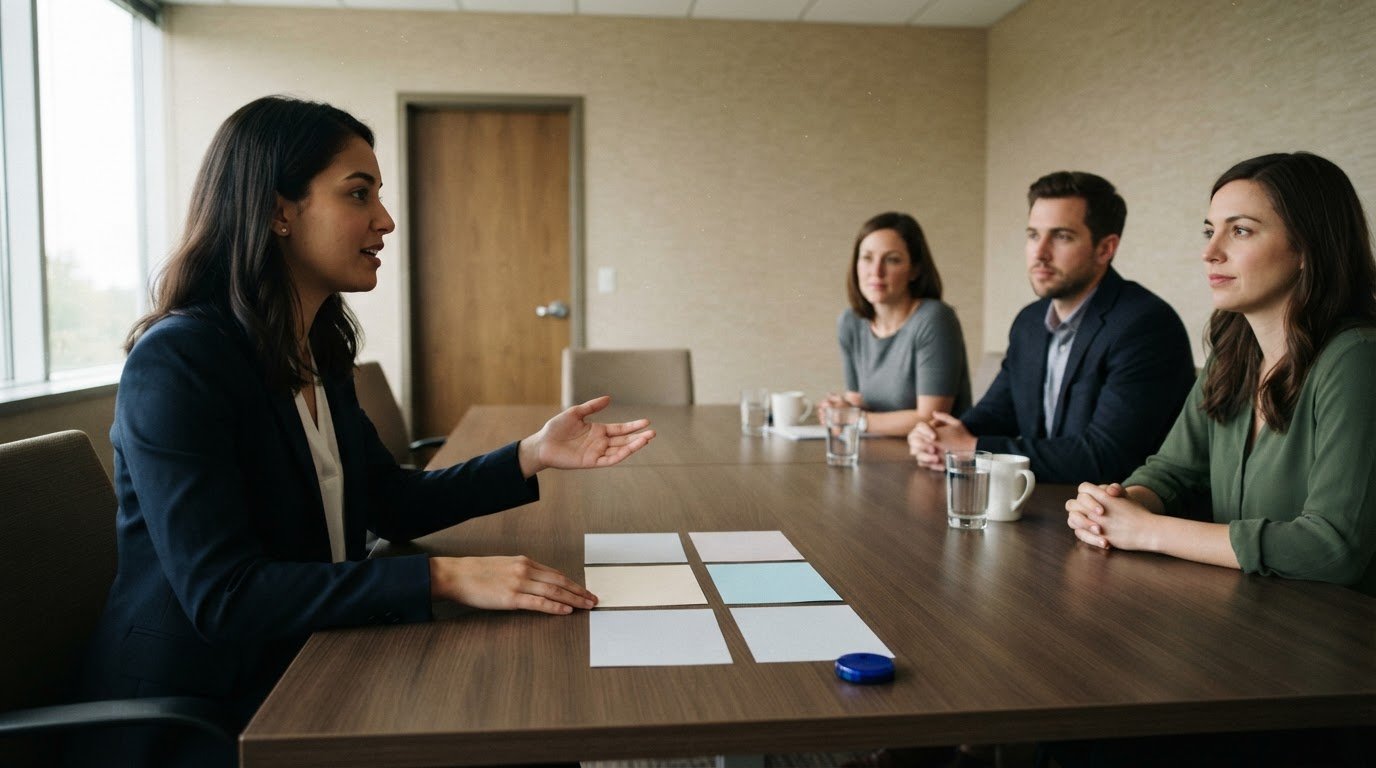
Understanding how to prepare for a panel interview starts with knowing who is in the room: several interviewers assess one candidate, while a group interview brings multiple candidates together. Build clear STAR answers around the situation, task, action and result, then practise delivering them to more than one listener.
A row of interviewers can feel more demanding than a one-to-one conversation, especially when each person brings a different perspective. To prepare for a panel interview, organise your examples and practise sharing them clearly. Learn how panel interviews differ from group interviews, and shape STAR stories that show your contribution and results. You can also prepare ways to engage interviewers and ask thoughtful questions.
Key Takeaways
- Distinguish a panel interview, where several interviewers assess you, from a group interview, where multiple candidates take part.
- Shape your experience into STAR stories that make your contribution and outcomes clear.
- Research the interviewers and organization so you can tailor your examples and prepare relevant questions.
- Use interview preparation tools to keep your application details and practice notes organized.
What Is a Panel Interview?
- Start by identifying who is being interviewed. A panel interview brings two or more interviewers together to assess one candidate; a group interview usually includes multiple candidates. A panel often has two to five interviewers, while a group format lets candidates respond in front of one another. This distinction helps you direct your answers to the panel rather than compete with other applicants.
- Prepare examples for behavioural and situational questions. Behavioural questions ask about past actions, such as, “Tell us about a time you resolved a conflict.” Situational questions describe a possible challenge, such as handling a missed deadline. For each, choose a specific situation, explain your task and action, then share the result. Keep your CV nearby as you prepare, so your examples align with the experience you have presented.
- Plan two or three questions that invite useful discussion across the panel. Ask how the role works with each interviewer’s team, what success looks like, or how the organisation approaches a challenge relevant to the job. Avoid asking every panelist the same question in sequence. Instead, direct each question to the person best placed to answer, then invite other perspectives when appropriate.
- For a virtual panel, test your camera, microphone, speakers and internet connection before joining. Position the camera at eye level, choose a quiet setting, and keep your CV and notes within reach. Avoid looking only at one interviewer or reading prepared answers. Pause after a question, address the person who asked it, and include the rest of the panel with occasional eye contact.
- Prevent common mistakes by listening to the full question, sharing balanced attention, and keeping answers focused. Don’t interrupt or direct every response to the most senior interviewer; acknowledge quieter panelists too. Afterward, ask who should receive follow-up rather than sending separate messages to everyone. Send a brief thank-you letter; according to the U.S. Bureau of Labor Statistics, preferably send it within 2 days of the interview.
Definition and purpose of panel interviews
- Use the format to understand who is evaluating you. In a panel interview, several interviewers assess one candidate in the same conversation. Each may focus on a different part of the role, such as technical knowledge, collaboration or leadership. For example, a project manager and a future teammate may both ask how you handle changing priorities. Listen for each person’s perspective before shaping your response.
- Recognise why employers bring interviewers together. A panel can save time, help decision-makers form their own impressions, and show how a candidate engages with a group. It also lets the organisation compare responses to the same experience or workplace challenge. In a healthcare role, for example, interviewers could explore how you communicate across teams and respond when priorities shift. Treat each exchange as part of one career conversation.
- Prepare for a format that may involve more than questions. Panel interviews can take place in an early or final round, depending on the organisation. They may include a presentation or job-related task alongside questions about your experience and approach to work challenges. Plan to explain your reasoning as you complete a task, not just present the final answer. This gives interviewers a clearer view of how you work.
- Practice adapting your delivery to several listeners. Panel interviews commonly last 45 to 60 minutes, while senior-level interviews can last up to 90 minutes. If each panelist takes a turn, keep your examples focused and leave room for follow-up. Pause to consider the full question, then answer the person who asked while including the rest of the room. This format rewards clear communication, attentive listening, and steady pacing.
Preparing answers with the STAR method
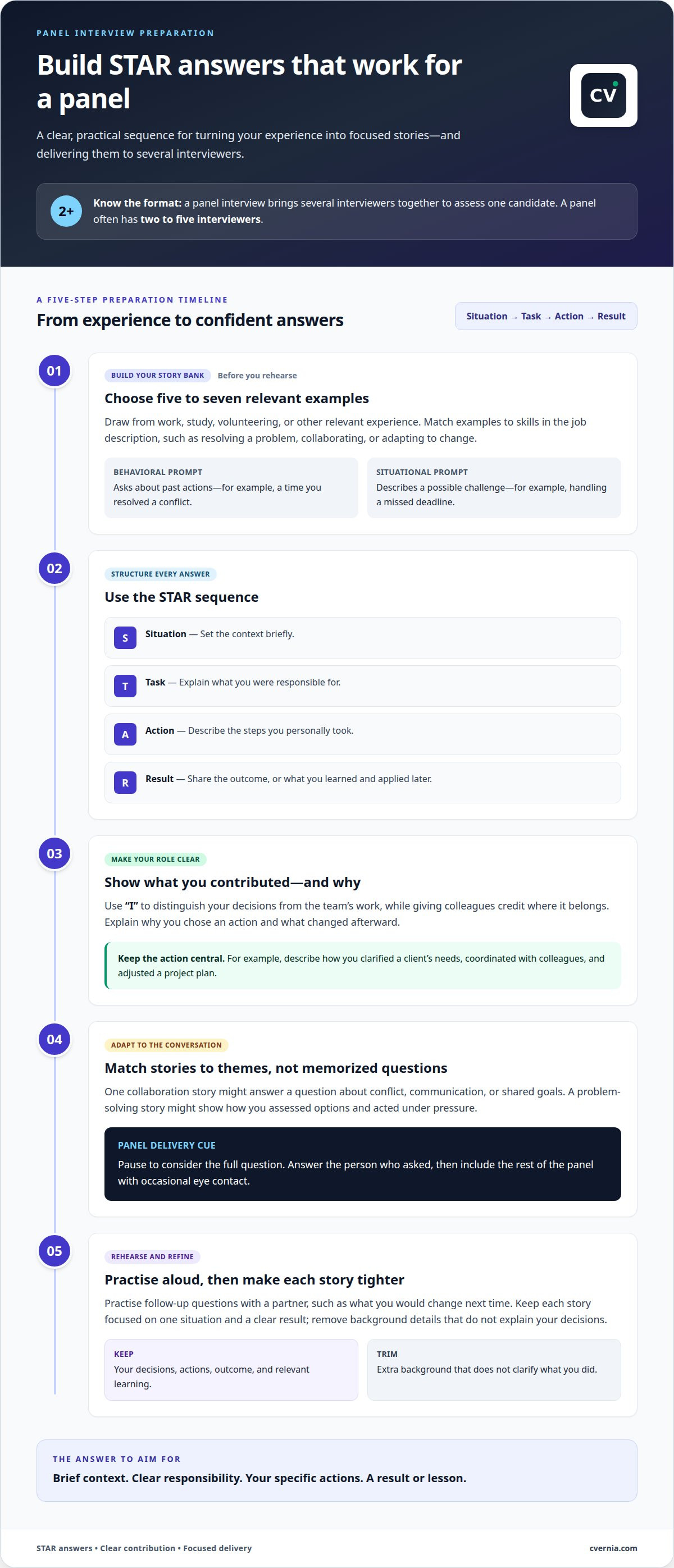
- Build a bank of stories before you rehearse. Prepare five to seven examples from work, study, volunteering or other relevant experience. Choose situations that show skills named in the job description, such as resolving a problem, collaborating or adapting to change. A varied set helps you respond naturally when panelists explore the same competency from different angles.
- Shape each example using STAR: Situation, Task, Action and Result. Set the context briefly, explain what you were responsible for, describe the steps you personally took, then share the outcome. Keep the action central. For example, explain how you clarified a client’s needs, coordinated with colleagues and adjusted a project plan.
- Make your contribution easy to evaluate. Use “I” to distinguish your decisions from the team’s work, while giving colleagues credit where it belongs. Explain why you chose a particular action and what changed afterwards. If the result was a lesson rather than a measurable achievement, say what you learned and how you applied it later.
- A practical way to prepare for a panel interview is to match stories to likely themes, rather than memorise questions. An example of collaboration might answer a question about conflict, communication or shared goals. A problem-solving story could show how you assessed options and acted under pressure. Practise adapting the emphasis to each prompt, so your answer fits the conversation instead of sounding rehearsed.
- Rehearse aloud, then refine your answers for clarity. Preparing for a panel interview also means practising follow-up questions with a partner, such as what you would change next time. Keep each story focused on one situation and a clear result; remove background details that do not explain your decisions. This helps you stay composed when panelists ask for more detail or a different perspective.
How do you research the interviewers and company before a panel interview?
- Start with the job description and mark its main responsibilities, skills and priorities. Compare those details with the organisation’s products, services and stated mission. For example, if the role involves customer support, note how the company describes its customer experience. This gives your research a focus and helps you connect your examples to the work.
- Find out who will be on the panel, if names are available. Review each interviewer’s role, department and professional background through public profiles or the organisation’s team pages. A hiring manager may focus on priorities and performance, while a potential teammate may ask about collaboration. Use those roles to anticipate useful topics, not to guess personal opinions.
- Study the organisation’s recent public updates, such as announcements, product changes or published reports. Note one development that relates directly to the position. For instance, a company expanding a service may need employees who can support changing customer needs. Use this detail to frame a relevant question or explain how your experience could contribute.
- Connect your research to the panel’s likely areas of interest. If the interview includes a technical lead and a department manager, prepare to explain both your process and its impact on team goals. Keep the distinction clear: research supports thoughtful questions, but it cannot tell you exactly what interviewers will ask. Let their wording guide your answers during the conversation.
- Prepare a concise page of notes with interviewer names, role-related details and questions. Write each person’s name beside a topic they may know well, such as team priorities or cross-functional work. Bring the notes discreetly and refer to them without reading prepared statements. This structure helps you address panelists accurately and keeps your questions specific to the organisation.
CVernia
CVernia helps you connect interview preparation with the rest of your job search. Its career management platform brings application tracking and interview preparation into one place, so you can organise role details and stay focused as you prepare. Use CV compatibility and ATS analysis to assess how your CV aligns with a job description, then keep application progress visible in the tracking dashboard.
Turn to these tools when you want a clearer process for managing applications, reviewing your CV, and preparing for upcoming conversations. They support your preparation; your examples and interview answers remain grounded in your own experience. For help choosing a useful next step for your job search, contact CVernia.
Carry Your Preparation Into the Next Opportunity
Knowing how to prepare for a panel interview is part of a broader effort to present a focused, credible professional story. Use each interview to notice which examples resonate, where your explanations need more clarity, and what skills you want to strengthen before your next conversation. That reflection makes preparation an ongoing career practice, rather than a task you leave behind after one meeting.
CVernia supports that wider process with its career management platform, tailored CV and cover letter tools, and CV compatibility and ATS analysis. These tools help you align application materials with roles and manage the steps leading to interviews, while your answers remain rooted in your own experience.
After each interview, jot down which questions challenged you and what you’d improve in your response. Use those notes to make your next round of preparation more targeted and personal. Contact CVernia for interview support and keep building confidence for the opportunities ahead.
Frequently Asked Questions
How Do You Actually Manage Multiple Interviewers in Real Time?
Manage the exchange by treating each question as a conversation with the whole panel, not a sequence of separate tests. Start with the person who asked, then briefly include others through eye contact. If interviewers ask related questions, address the new point rather than repeating yourself. For a multi-part prompt, confirm which part you are answering, then invite a follow-up if needed.
How Should You Prepare?
Review your application materials so you can explain any detail an interviewer may ask about. Check that role titles, dates and accomplishments are consistent across your CV and application. Identify a project or decision you would like to discuss in greater depth, and prepare to explain your reasoning. This helps you clarify your contribution if a panelist asks about a specific claim or outcome.
What Questions Will They Probably Ask?
Expect questions about your motivation, role-specific skills, teamwork and how you respond to workplace challenges. One panelist might ask what interests you about the position, while another explores how you prioritise competing requests. Prepare to explain your choices, not just describe what happened. For technical roles, review core concepts from the job description and be ready to talk through your approach.
What is a panel interview and how does it differ from a one-on-one interview?
A panel interview gives several decision-makers a shared opportunity to assess your fit, while a one-to-one conversation centres on one interviewer’s perspective. This can mean more varied follow-up questions and less time to build context with each person. Listen for what each interviewer wants to understand, and tailor your answer without changing the facts of your experience.
What questions are commonly asked in panel interviews?
Common prompts cover your interest in the role, relevant strengths, collaboration, problem-solving, and how you handle pressure or setbacks. Interviewers may explore one topic from different angles: a manager could ask about your decision, while a teammate asks how you communicated it. Answer the specific question asked, then connect your response to the role’s responsibilities.
How should you prepare answers using the STAR method for a panel interview?
Choose examples that can adapt to related questions, then emphasise the detail most relevant to each prompt. Keep sensitive company or customer information confidential by describing the context without identifying people or revealing private details. Make your personal contribution clear and explain the outcome honestly. If a result was not measurable, describe the observable change or lesson instead of inventing a metric.


