
The strongest final interview question isn’t the one that sounds most impressive; it’s the one that reveals what the role really needs. Prepare four or five questions to ask in a final interview, starting with the biggest challenge the person in the role is expected to solve. Then ask about responsibilities, team dynamics, and how success is measured.
It’s natural to focus on making a strong final impression, but this conversation is also your chance to decide whether the opportunity fits your strengths and goals. The right questions help you look beyond surface details and understand where you could contribute. This guide covers how to ask about the role’s biggest challenge, clarify divided responsibilities, explore team fit and growth, and prepare thoughtful questions that show your engagement. You’ll also find practical ways to keep the conversation focused, confident, and useful, even when time is limited.
Key Takeaways
- Lead with a question that uncovers the role’s most important challenge and helps you understand what the team needs.
- Clarify how responsibilities are shared, especially when the position spans different skills or areas of work.
- Explore who you’ll work with, how success is measured, and what growth could look like in the role.
- Prepare thoughtful, open-ended questions and use your research and interview notes to make your final conversation count.
1. Asking about the role’s biggest problem
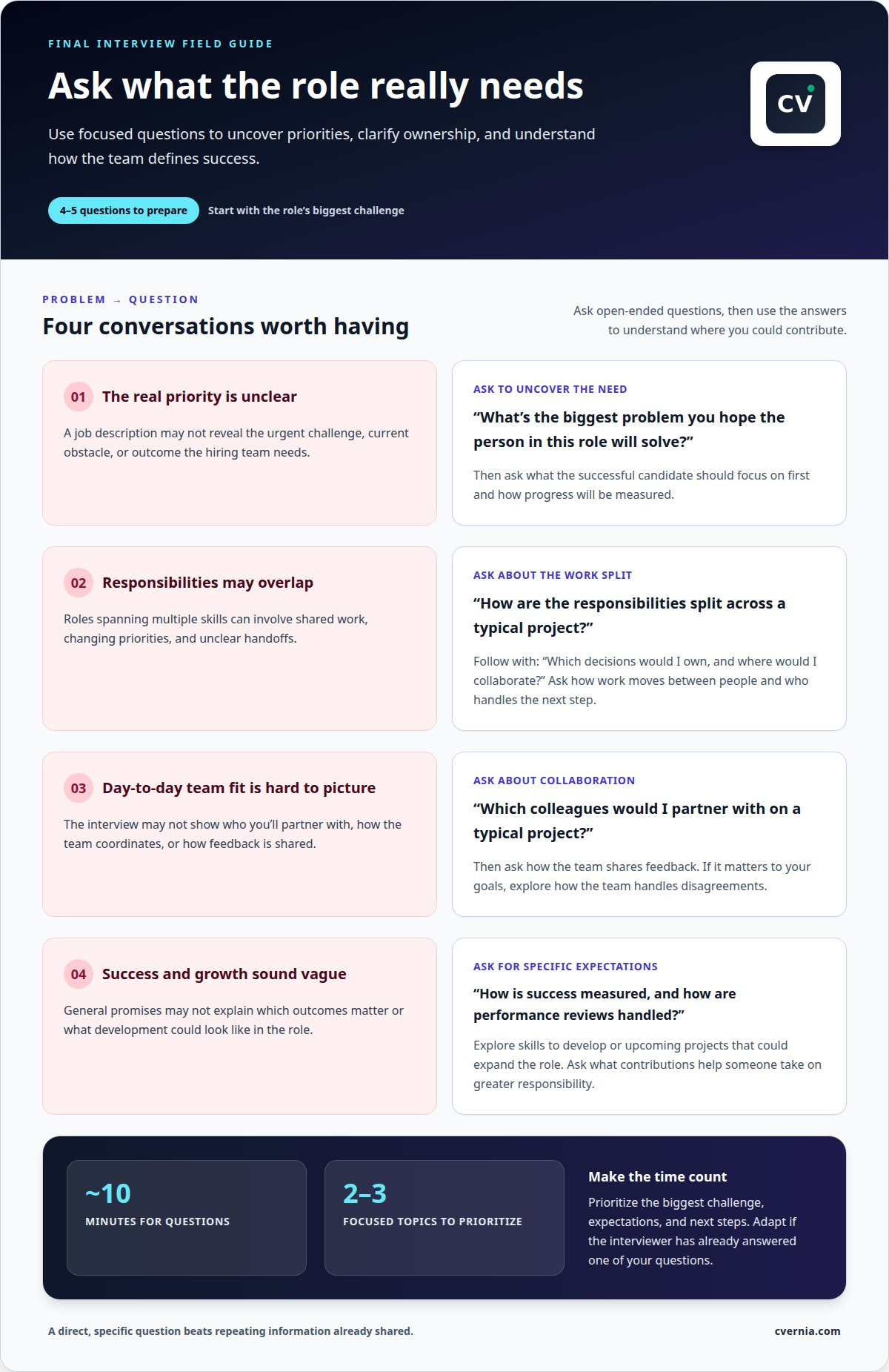
Use the final interview to learn which challenge matters most, rather than simply repeating the job description. Ask, “What’s the biggest problem you hope the person in this role will solve?” The answer can reveal urgent priorities, current obstacles, and the outcome the hiring team needs. It also gives you a clearer basis for explaining how your experience could help.
To clarify priorities and expectations, ask, “What would you want the successful candidate to focus on first, and how would you measure progress?” This connects immediate tasks with the role’s broader goals. If the interviewer mentions a specific issue, such as a delayed project or a process that needs improvement, follow up by asking what has made it difficult to resolve.
Listen for the emphasis in the answer. A challenge involving a tight handoff between teams may call for strong communication; a backlog may point to prioritization and planning. Don’t assume the job description covers these details. Use the interviewer’s response to identify which strengths to highlight, then share a relevant example from your work or studies.
Keep follow-up questions focused. For instance, ask, “Which people or teams would this role work with to address that challenge?” or “What resources are already in place?” These questions help distinguish the role’s responsibilities from wider team dependencies. They also show you’re thinking about how to contribute realistically, rather than promising a quick fix without understanding the context.
Ask, “What are the next steps in the hiring process, and when do you expect to share an update?” This clarifies the timeline and when you might hear back. Before the conversation ends, raise any open question that could affect your decision, such as the role’s main priority or how progress will be assessed.
You may have about 10 minutes for questions, enough for roughly 2-3 focused topics. Prioritize the biggest challenge, expectations, and next steps; adapt if the interviewer has already answered one. A direct, specific question makes better use of that time than asking something broad that repeats information shared earlier.
2. Clarifying how responsibilities are divided
Some roles combine two skill sets or areas of responsibility, such as analysis and client communication. Clarify how the work is divided before assuming both areas carry equal weight. Ask, “How are the responsibilities split across a typical project?” The answer can show whether the role involves regular work in both areas or shifts focus according to team needs.
Then explore ownership. A position covering content and marketing analytics, for example, might involve writing campaign material, reviewing performance, or both. Ask, “Which decisions would I own, and where would I collaborate with another team member?” This distinguishes independent responsibilities from shared work and clarifies where your judgment will matter.
Pay attention to handoffs, too. When a task moves between design, sales, and account management, unclear ownership can affect delivery. Ask, “How does work move between the people involved, and who handles the next step?” A practical example from the interviewer can reveal how teams coordinate and where the role fits into the process.
Use the answers to understand what good performance means in each area. Ask whether priorities change by project, who sets them, and how competing requests are resolved. For a role combining customer support with product feedback, for instance, find out how urgent customer needs are balanced with documenting recurring issues. These details help you decide whether the mix suits your strengths and working style.
Listen for clear distinctions between your responsibilities and those owned by colleagues. If the interviewer describes overlapping duties, follow up with a specific scenario: “If two teams need support at once, who sets the priority?” The response can clarify decision-making without implying that shared work is a problem. It also helps you explain relevant experience accurately, rather than overstating ownership. A tailored CV and cover letter can help connect experience across different responsibilities to the role’s specific mix.
3. How to assess team fit and growth opportunities
Ask who you would work with most closely and how the team coordinates its work. For example, “Which colleagues would I partner with on a typical project?” can reveal whether the role involves regular collaboration with design, sales, or operations. Follow up with, “How does the team share feedback?” The answers help you picture everyday interactions, decision-making, and how people work through different styles.
Get specific about performance expectations. Ask, “How is success measured in this position, and how are performance reviews handled?” This can clarify which outcomes matter, how progress is discussed, and whether feedback supports practical development. If the interviewer mentions a target, ask how it relates to the role’s day-to-day work. Clear criteria help you understand strong performance beyond a general promise to “do well.”
Explore growth through skills, responsibilities, and future projects, rather than focusing only on promotion. Ask, “What skills could someone in this role develop?” or “Are there upcoming projects that might expand the role’s scope?” The response can show whether growth means learning new tools, taking ownership of more complex work, or contributing to broader team goals. It also helps you assess whether the opportunity aligns with your longer-term direction.
Keep promotion questions measured. Asking how often people get promoted may sound as though advancement is your only priority, especially if you expect a promotion after 6-12 months. Instead, ask what kinds of contributions help someone take on greater responsibility. This invites a clearer discussion of progression while keeping attention on learning and results.
Use the interviewer’s answers to test alignment with your goals. If collaboration matters to you, ask how the team handles disagreements; if learning is a priority, ask how employees build expertise through current projects. Open-ended questions invite examples rather than simple yes-or-no replies. Before moving on, consider whether the team’s approach and growth paths match the kind of work you want to do.
4. Preparing to stand out in a final interview
Prepare four or five questions, then choose the ones that fit the conversation. Review the job description and notes from earlier interviews, so your questions build on what you’ve already learned. Research the company’s history, mission, values, and leadership to connect your interests with its direction. Prepare behavioral examples, too. A concise example of solving a problem or adapting to change can make your experience memorable.
If salary, benefits, or compensation haven’t come up, ask how the package is structured and when those details will be discussed. Keep the tone professional and frame the question around understanding the full opportunity. If you’re still at an early interview stage, save questions about salary, benefits, vacation time, and company perks until a formal offer.
Avoid questions already answered in the job description or earlier conversations. Don’t put the interviewer on the defensive with accusatory wording or raise concerns that distract from assessing your fit. Replace yes-or-no questions with open-ended ones. For example, instead of asking whether the role is collaborative, ask how colleagues typically work together on a project.
Close by inviting useful feedback: “Is there anything about my experience I haven’t covered that you’d like to discuss?” You could also ask, “What would a strong contribution look like during my first few months?” These questions give the interviewer a chance to raise remaining concerns and explain expectations. If it feels relevant, ask how the role contributes to the company’s main goals or where the company hopes to be in five years.
Make your questions specific to the conversation. If the interviewer mentioned a recent company accomplishment, ask how the role could support similar work. Raise any unclear points before the interview ends. Then confirm the next steps and expected timeline so you leave knowing what happens next.
Build confidence with interview preparation and guidance that helps you organize your notes, refine your examples, and prepare questions relevant to the role.
CVernia
CVernia helps you manage the steps around an interview, from preparing your application to organizing your notes. Its career management platform brings application tracking and interview preparation together, helping you keep role details, questions, and interview notes organized throughout the hiring process.
Use CV Compatibility & ATS Analysis to assess how your CV aligns with a job description, and Interview Preparation & Guidance to plan for conversations like a final interview. The Application Tracking Dashboard can help you follow your applications and keep relevant details accessible when it’s time to prepare thoughtful questions.
If you’d like support organizing your job search and interview preparation, contact CVernia.
Carry your preparation into the next opportunity
A final interview is also a chance to decide whether the opportunity fits the work you want to do next. Let your questions guide that decision, then use what you learn to sharpen how you describe your strengths and priorities. The most useful questions to ask in a final interview help you make a considered choice, not simply leave a polished impression.
Keep your preparation connected across each application. CVernia’s Career Application Management Platform helps organize your job search, while tailored CV and cover letter creation and CV Compatibility & ATS Analysis support application materials aligned with specific roles. When you want help preparing for an upcoming interview, contact CVernia for interview support.
Move forward with clear priorities, specific examples, and confidence in the questions you choose. You’re ready to make the conversation count.
Frequently Asked Questions
What is a final interview, and what should you expect?
A final interview is a later-stage conversation where the employer often explores how you would work in the role and whether the opportunity suits both sides. You might meet a decision-maker or future colleague, revisit your experience, or discuss a realistic work scenario. Be ready to explain your thinking, ask for clarity about anything unresolved, and evaluate the role as carefully as the employer evaluates you.
Why do employers care about the questions you ask during an interview?
Your questions show what you pay attention to and how you approach decisions. A thoughtful follow-up about a project mentioned earlier, for example, demonstrates active listening and interest in the actual work. Employers can also see whether your expectations align with the role. Focus on questions that help you understand the opportunity, rather than trying to impress with complicated wording.
What are the best questions to ask at a final job interview?
The best questions to ask in a final interview address details you still need to make an informed decision. Consider asking what could make the role challenging, how decisions affecting the position are made, or what the interviewer enjoys about working on the team. Choose questions that build on the discussion, rather than reciting a prepared list without regard for what has already been answered.
What questions should I ask the hiring manager in a final interview?
Ask the hiring manager how they set priorities when urgent requests compete, what decisions you could make independently, and how they prefer to share feedback. For example: “If a deadline changes midway through a project, how would you want me to flag the impact?” The answer can clarify expectations for communication and support beyond what’s in the job description.
What questions reveal team culture and management style?
Ask for a real example: “How did the team handle a recent disagreement about project direction?” You could also ask how a manager responds when someone raises a concern or suggests a different approach. Specific examples reveal more than labels such as “collaborative” or “fast-paced.” Notice whether the answers explain how people communicate, make decisions, and resolve problems together.
How do final interview questions differ from earlier interview questions?
Earlier conversations often focus on your background, skills, and basic fit for the position. At the final stage, questions can be more specific to the work and decision-making, and help you assess what you still need to know before accepting an offer. For example, ask how the team handles shifting priorities or how the role connects with a current project. Use what you learned earlier to make each question more precise.


