

Tailoring a resume for senior roles means showing how your leadership and results address the specific business needs behind the position. Start with the job description, then prioritize relevant achievements, skills, and language that demonstrate the value you can bring.
A senior resume needs more than a list of responsibilities. Connect your decisions and leadership to outcomes such as growth, operational improvement, transformation, or stronger stakeholder relationships. Choose examples that are specific, credible, and relevant to the role.
Choosing which accomplishments to foreground can be challenging, especially when your experience spans teams, functions, or industries. Learn to identify what matters in a job posting, use relevant keywords naturally, and show the business value you offer. You’ll also find practical ways to refresh your format and replace empty buzzwords with evidence that helps hiring teams understand your impact.
Key Takeaways
- Read each job description for its priorities, then foreground the leadership results and expertise that match the role.
- Use relevant wording from the posting naturally so your skills and experience are clear to applicant tracking systems and recruiters.
- Replace vague buzzwords with specific accomplishments, and choose a clean, readable resume format.
- Connect your achievements to the business outcomes the employer needs, from operational improvement to stronger client relationships.
How to tailor your resume for a specific job?
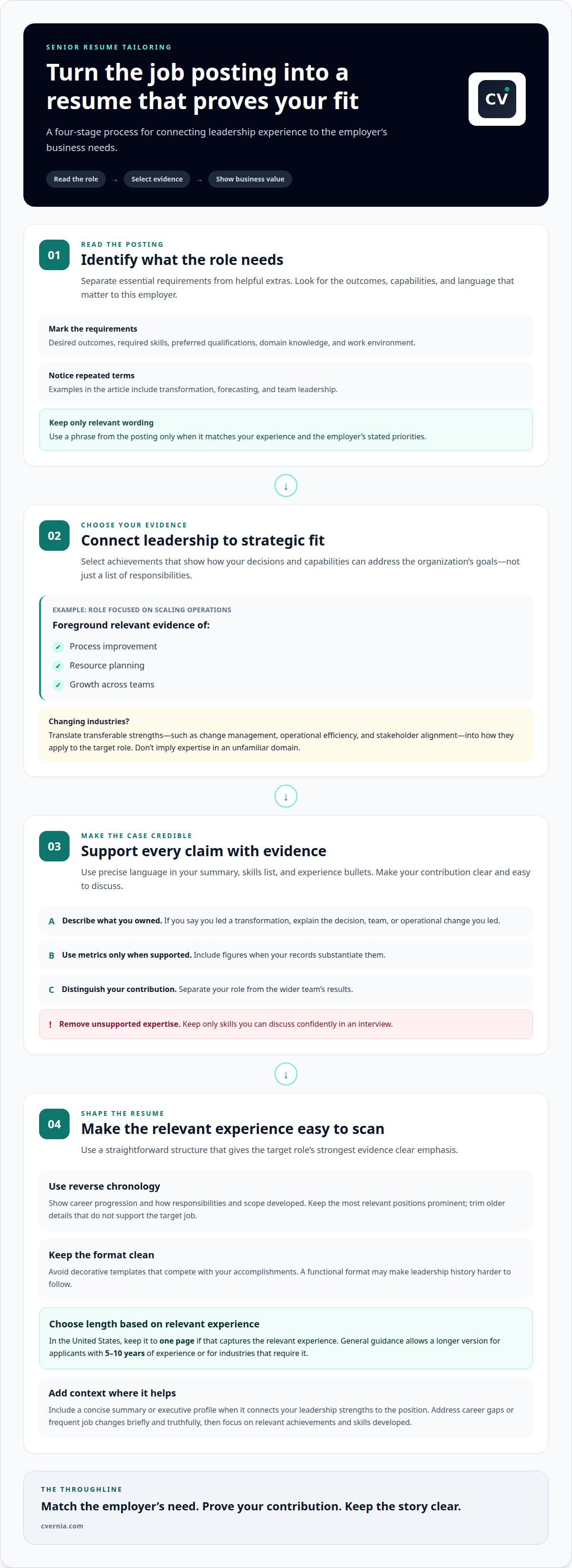
Use the posting to identify the position’s priorities, then select evidence that demonstrates your fit. For senior roles, connect leadership decisions to business outcomes, not just responsibilities.
-
Analyze the Role’s Outcomes and Requirements
Mark the posting’s desired outcomes, required skills, preferred qualifications, domain knowledge, and work environment. Separate must-have capabilities from helpful extras, then note repeated terms such as transformation, forecasting, or team leadership. For a data-focused position, prioritize relevant reporting tools and measurable analysis results. Don’t copy every phrase: retain only requirements that match your experience and the employer’s stated priorities.
-
Connect Experience to Strategic Fit
Choose achievements that show how your leadership can address the organization’s goals. A role focused on scaling operations, for example, calls for evidence of process improvement, resource planning, or growth across teams. If you’re changing industries, translate transferable strengths such as change management, operational efficiency, and stakeholder alignment. Tailoring your resume for senior roles means explaining how those capabilities apply, not implying expertise in an unfamiliar domain.
-
Keep Claims Supported
Support every claim in your summary, skills list, and experience bullets with precise language and evidence. If you say you led a transformation, describe the decision, team, or operational change you owned. Include metrics only when your records support them, and distinguish your contribution from the wider team’s results. Remove skills you can’t discuss confidently in an interview; unsupported expertise can weaken an otherwise credible application.
-
Shape the Senior-Level Resume Details
In the United States, keep your resume to one page if that captures the relevant experience; general guidance allows a longer version for applicants with 5-10 years of experience or industries that require it. Include a concise summary or executive profile when it connects your leadership strengths to the position. Address career gaps or frequent job changes briefly and truthfully, then focus on relevant achievements and the skills each role developed.
Optimizing resume keywords for applicant tracking systems
Use the job posting to identify terms for the position’s skills, tools, and responsibilities. Include relevant keywords only where they accurately reflect your experience.
-
Identify Keywords in Job Descriptions
Scan the posting for repeated skills, job titles, competencies, certifications, and software tools. Separate essential requirements from preferred qualifications, then note the exact wording. If a senior operations role requests “process improvement” and “change management,” for example, check whether your achievements demonstrate both. Applicant tracking systems may scan for keywords before a recruiter reviews your application, so make relevant experience easy to find.
Look beyond the qualifications list. Responsibilities can reveal the employer’s priorities, such as forecasting, team development, or client relationships. Note terms that describe the work itself, not just the candidate profile. Don’t add every phrase from the posting; include a keyword only when your background supports it.
-
Analyze Keywords with AI Tools
Use an AI resume tool to compare your document with a specific posting and identify missing or underused terms. These tools can analyze keywords, assess job matches, and suggest phrasing based on the job description. Treat suggestions as prompts, not facts. A tool might flag “strategic planning,” for instance, but include it only if your experience supports that competency.
Check every recommendation against your actual work history. Confirm that suggested job titles, skills, and tools describe tasks you performed. AI can speed up comparison, but it can’t supply experience or replace your judgment. Remove suggestions that overstate your role, misrepresent a team result, or make an accurate achievement sound unfamiliar.
-
Integrate Keywords Naturally
Place supported terms in your professional summary, skills section, and relevant experience bullets. Use keywords in context: “Led strategic planning for a regional expansion” explains both the skill and its application. A tracking system may scan for specific terms, but repeating keywords without context makes a resume harder for people to read.
Use the posting’s language when it matches your background, including common alternatives where appropriate. If it asks for “people leadership,” describe the teams you led and the work you oversaw. Don’t list a tool or competency solely to match an algorithm. A hiring manager may ask about each claim, so every keyword should connect to evidence you can explain.
Avoiding buzzwords and outdated resume formats
Choose a clean layout that helps recruiters find your career progression and strongest results. Replace vague phrases such as “visionary leader” with specific evidence.
-
Choose a Format for Senior Roles
Use a straightforward format that makes your recent leadership experience easy to scan. A reverse-chronological structure shows how your responsibilities and scope developed across roles. Keep the most relevant positions prominent, and trim older details that don’t support the target job. Avoid decorative templates that compete with your accomplishments.
Answer: A clean, reverse-chronological resume is a practical choice for senior professionals. It presents career progression clearly, while a functional format may make your leadership history harder to follow. Choose the version that gives the target position’s most relevant experience the clearest emphasis.
Replace unsupported labels with evidence. Instead of calling yourself a “results-driven change agent,” describe the change you led and its documented outcome. Use “strategic” or “innovative” only when the surrounding example makes the claim clear. Recruiters should be able to connect each leadership statement to a role, decision, or result.
-
Apply Clear, ATS-Readable Formatting
Build your resume with familiar section headings, readable text, and consistent formatting. Use simple bullets for achievements, and keep dates, job titles, and employer names in the main document body. Applicant tracking systems may ignore headers, footers, and page numbers, so place essential contact details and career information in the regular text area.
Avoid columns and text boxes in online applications because they can create parsing problems. Keep fonts and spacing consistent, and use bold sparingly to guide readers. Before submitting, review the saved version to ensure its text remains in the intended order. A straightforward layout helps tracking systems and recruiters follow your experience.
Maintain a master resume, then save a tailored version for each position. Give each file a clear name, such as “Operations Executive Resume,” and remove outdated claims before sending it. This simple version-control step helps prevent an old summary or formatting choice from slipping into a later application.
Tailoring resumes to role-specific business needs
Connect your experience to the business problem behind the position. A senior candidate should show not only what they led, but why the results matter to the manager’s priorities.
- Identify the business outcome. Translate the posting’s responsibilities into the result the organization needs. A company seeking operational efficiency may value process redesign, resource planning, or shorter delivery cycles. A growth-focused role may call for market expansion, revenue development, or scaling teams. Choose achievements that speak directly to the outcome, rather than listing every responsibility from your career.
- Show the scale and your contribution. Describe the scope of a relevant initiative, the decisions you owned, and the outcome you helped achieve. For example, explain how you aligned teams around a new operating model, then state the result your records support. Distinguish your work from the wider team’s contribution. Clear ownership helps a hiring manager understand the level at which you operate.
- Adapt proof to the function. The same achievement can show different value depending on the position. For a client-facing role, emphasize relationship-building and communication that strengthened customer outcomes. For a transformation role, foreground change leadership and stakeholder alignment. Keep the underlying facts consistent, but select details that explain your fit for this specific business need.
- Connect keywords to evidence. Applicant tracking systems may scan for job titles, skills, and competencies, but your resume still needs to persuade a person. Use relevant language from the posting in a summary or achievement bullet, then provide a supporting example. If “strategic planning” is a requirement, show where you set direction or guided execution instead of adding the phrase without proof.
Build each version around a clear business case: the employer’s need, your relevant action, and the evidence of impact. Create a tailored CV and cover letter that aligns your experience with the role’s priorities.
CVernia
CVernia helps you manage the practical work of adapting senior-level applications to different business needs. Use the CVernia career management platform to organize tailored CV versions, assess alignment with job descriptions through CV Compatibility & ATS Analysis, and track applications in one place.
This is useful when you’re targeting distinct leadership roles and need each resume to align with its posting. Reviewing your application history can also help you prepare for interviews, and Interview Preparation & Guidance supports the next step after submitting an application. The platform helps you present your experience clearly; your achievements and decisions remain the foundation of every tailored resume.
Manage your senior-level applications with CVernia’s career management platform.
Make Your Next Application More Intentional
Your next senior application is an opportunity to make a clear case for the work you want to lead. Before sending it, check that your experience tells a focused story about the business needs you can address. A thoughtful approach to tailoring resumes for senior roles also makes it easier to discuss your decisions and impact in interviews.
When you’re ready to refine your application materials, CVernia brings tailored CV and cover letter creation together with a career management platform. Its CV Compatibility & ATS Analysis helps you assess how your resume aligns with a job description. Use these tools to prepare a version that accurately reflects your experience and presents your value clearly.
Contact CVernia for resume support and take your next step with confidence.
Frequently Asked Questions
What should a senior executive resume include?
A senior executive resume should include a focused profile, relevant leadership experience, strategic strengths, and evidence of organizational impact. Add board, governance, budget, or P&L responsibilities when they relate to the target role. Include education and credentials that support your candidacy, along with industry expertise or major transformations you’ve led. Prioritize details that help decision-makers understand your scope and leadership approach.
How can I quantify leadership impact and business results on a resume?
Use documented business measures that reflect your contribution, such as revenue growth, cost control, retention, delivery speed, or team performance. State the action you took and connect it to the result. If results are confidential, describe the outcome without disclosing sensitive figures, or use a clear qualitative measure. Distinguish your decisions from broader team outcomes so each claim remains accurate and credible.
How do I tailor a senior resume to a specific job description?
Identify the role’s central challenge, then choose experience that demonstrates your ability to address it. For a turnaround position, foreground recovery, prioritization, and change leadership. For a growth-focused post, emphasize expansion and organizational capacity. Adjust your profile and strongest examples for each application, while keeping titles, dates, and achievements consistent with your work history.
How can I showcase executive leadership, strategy, and team management on a resume?
Show leadership through decisions, direction, and outcomes rather than labels such as “visionary” or “strategic.” Explain how you set priorities, aligned stakeholders, developed leaders, or guided teams through change. For example, describe how you established a new operating direction and brought functional leaders into execution. Clarify the scope you owned, including team or budget responsibility when relevant to the role.
What common resume mistakes should senior candidates avoid?
Don’t bury recent impact beneath lengthy descriptions of early-career duties. Remove unexplained acronyms, inconsistent job dates, and claims that exceed your actual responsibility. Avoid confidential business details and naming former colleagues without a clear reason. Check that your contact information is current and that your profile matches the role you’re pursuing. Every detail should support a credible, relevant leadership story.
How can I optimize a senior-level resume for applicant tracking systems (ATS)?
Use conventional section labels, searchable text, and job-relevant wording that accurately describes your experience. Spell out an important acronym alongside its full term when both versions may appear in the posting. Keep essential information in the document body, and review the final file to confirm its text reads in the right order. A compatibility analysis can flag potential alignment issues, but it can’t replace accurate content.


