
Prepare to prove, not just repeat. Preparing for a second interview means reviewing the role and your CV, refreshing your company and industry research, and practising specific stories that support your claims. Have at least three thoughtful questions ready, including one about what success looks like in the role.
It’s natural to focus on what the interviewer might ask, especially when the next conversation may go deeper than the first. You’ll feel more prepared when you can explain how your experience fits the role and support your answers with clear examples.
Use these focused steps to revisit your first interview, shape concise stories with the STAR method, and prepare questions for managers, peers, or HR. You’ll also learn how to connect your research to the role, so your answers are specific, confident, and grounded in what the employer needs.
Key Takeaways
- Use the role requirements and your resume to pinpoint the experience you’ll want to explain clearly.
- Refresh your understanding of the company and industry so you can connect your answers to the employer’s priorities.
- Shape work examples with the STAR method, then practise explaining the actions and results behind your claims.
- Prepare thoughtful questions for the people you meet, including one about how success in the role is measured.
Questions to ask supervisors, peers, and HR
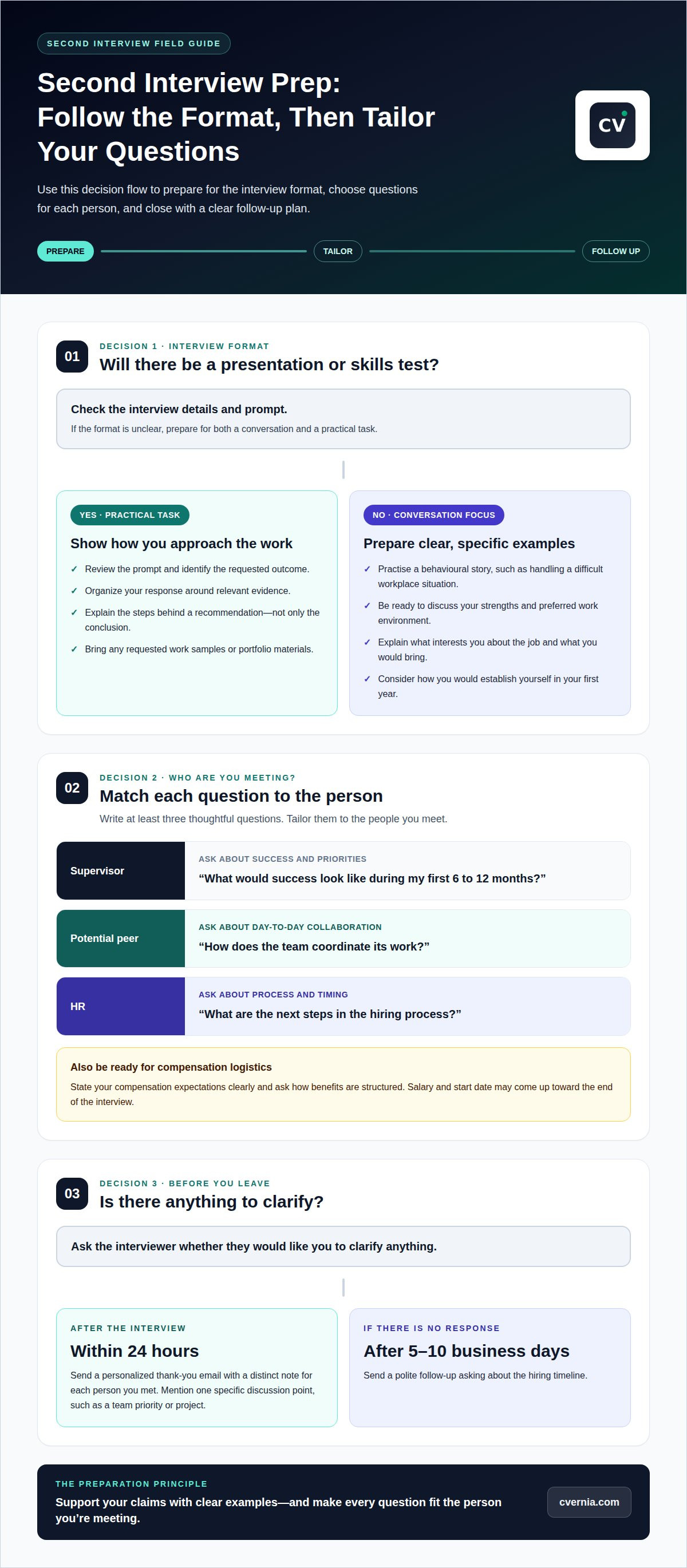
- Use the second interview to explore details beyond the first conversation. It may include more senior staff, a prospective manager, potential colleagues, or several interviewers. Questions often examine the role and company objectives in greater depth. Prepare for behavioural prompts too, such as “Tell me about a time you handled a difficult workplace situation.”
- Prepare for common questions about your strengths, preferred work environment, and professional decisions. You might be asked what interests you about the job, what you would bring, or how you would establish yourself in your first year. For salary and benefits, state your compensation expectations clearly and ask how the employer structures benefits. Salary and start date may come up towards the end of the interview.
- Write at least three questions, then tailor them to each person you meet. Ask a supervisor, “What would success look like during my first 6 to 12 months?” Ask a peer, “How does the team coordinate its work?” Ask HR, “What are the next steps in the hiring process?” These questions help you understand priorities, daily collaboration, and timing.
- If the interview includes a presentation or skills test, treat it as a chance to show how you approach the work. Review the prompt, identify the requested outcome, and organize your response around relevant evidence. For example, explain the steps behind a recommendation instead of presenting a conclusion without context. Bring any requested work samples or portfolio materials.
- Close by asking whether the interviewer would like you to clarify anything. Afterward, send a personalized thank-you email within 24 hours, with a distinct note for each person you met. Mention one specific discussion point, such as a team priority or project. If the employer hasn’t responded after five to ten business days, send a polite follow-up about the hiring timeline.
Reviewing the job description and resume
- Read the job description again and note its main responsibilities, required skills, and stated priorities. Sort each item into “direct experience,” “related experience,” or “area to explain.” For example, a role requiring client presentations may connect to a project update you delivered, even if presentations weren’t your main responsibility.
- Match each priority to a specific CV entry. Note the project, your contribution, and the result you can explain clearly. If the description emphasizes process improvement, prepare an example showing what you changed and why. This comparison helps you support your qualifications with details instead of relying on broad claims like “strong communicator.”
- Review every title, date, responsibility, and achievement on your CV before the meeting. Interviewers may ask you to expand on a brief bullet, so be ready to explain the context behind “managed client accounts” or “improved reporting.” Keep your spoken explanation consistent with the document, and clarify your own contribution when a team delivered the work.
- Prepare a concise description of a typical workday in your current or most recent role. Choose concrete tasks, such as reviewing requests, coordinating with colleagues, or presenting project updates, then connect relevant duties to the new position. You may be asked how your routine compares with the job’s requirements, so explain both the overlap and the skills you’re ready to develop.
- Identify one change you made in your current or most recent job. Explain the original challenge, the action you took, and how the work changed afterward. Then practise connecting that example to a responsibility in the job description. If your resume needs clearer alignment with a target role, explore ways to sharpen your resume before the interview.
A question about your typical workday helps the interviewer compare your current or most recent routine with the job’s requirements. Ground your answer in the duties you’ve reviewed, and make the connection explicit rather than assuming the overlap is obvious. You may also be asked how you changed your current or most recent job. Explain the challenge, your action, and the result, then relate that experience to a responsibility you could take on.
Company and industry research
- Refresh your company research before the meeting. Review its website, recent announcements, product pages, and stated goals. Note one business priority, such as expanding a service or improving customer support. Then connect that priority to the role: explain how your experience could help with a relevant task, without assuming you know the company’s internal plans.
- Study where the role fits within the organization. Look at how it supports the company’s objectives and which teams it may work with. If the position involves customer onboarding, for example, consider how it connects with sales, product, or support teams. This context helps you explain why the responsibilities matter, rather than simply repeat them.
- Review the industry through credible company announcements, trade publications, and professional associations. Note a development that could affect the employer, such as a changing customer need or a new market challenge. Prepare a balanced observation and relate it to the role. Avoid presenting a broad trend as a fact about the specific employer.
- If possible, speak with current or former employees to learn about the organization’s structure and culture. Ask how teams collaborate, how decisions are shared, or what a typical project handoff involves. Treat each conversation as one perspective. Use it to shape thoughtful questions rather than make assumptions about every team or manager.
- Turn your notes into a concise research brief for the interview. Record the company’s objective, one relevant industry development, and a practical question about the role. For example, ask how the team’s priorities connect with a recently announced initiative. Review the brief beforehand so your answers reflect current research and stay focused on the employer’s needs.
Practicing answers and preparing stories
Practise to make your answers clear, specific, and consistent with your experience. Review the first interview and prepare examples that show how you work.
-
Practice Interview Answers
Revisit your notes from the first interview and mark answers that felt incomplete. Be ready to clarify an earlier point or add evidence when an interviewer asks you to expand. Practise answering aloud, then check whether your response addresses the question directly. Pause briefly before difficult answers, and avoid memorized scripts that feel detached from the conversation.
Prepare for questions about your greatest weakness, a difficult work decision, or an achievement you value. For a weakness, explain how you’re addressing it with a concrete example. For an achievement, identify your contribution and why the result mattered. If asked whether you want to revisit anything, add a useful detail instead of repeating your earlier answer.
-
Prepare Stories
Choose work examples that demonstrate different strengths, such as resolving a disagreement, improving a process, or adapting to a setback. Structure each story using STAR: Situation, Task, Action, and Result. Briefly explain the context, clarify your responsibility, describe the steps you took, and finish with the outcome. Distinguish your own actions from the team’s contribution.
Practise adapting each example to the question instead of forcing one story into every answer. A challenging workplace relationship, for instance, can show how you listened, adjusted your approach, and learned from the experience. Be ready to discuss what you could have done differently. Support claims from the first interview with specific evidence, and don’t add details to make a story sound stronger.
Turn your examples into focused interview practice with guided interview preparation.
Use your notes from the first interview to identify which answers were strong or weak, where your experience was less relevant, and which topics were not covered. For every claim you made, prepare supporting evidence and a clear explanation or additional detail in case the interviewer asks you to expand.
Be ready if asked whether you want to revisit anything from the first interview, and consider what useful information you could add. You may also be asked to identify your greatest weakness, describe a professional achievement you’re especially proud of, or explain what you could have done to improve a challenging workplace relationship. Choose examples that show reflection and learning without overstating your role.
CVernia
CVernia helps you connect interview preparation with the wider job application process. Its career management platform brings application tracking and interview preparation into one organized workflow, keeping role details and preparation notes together.
Use Interview Preparation & Guidance to support your practice, and the Application Tracking Dashboard to keep track of each opportunity. CV Compatibility & ATS Analysis can also help you assess how your CV aligns with a job description before an interview. These tools help you see your applications more clearly and prepare consistently.
For your next interview, bring together your role research, relevant examples, and questions in one preparation routine. Explore how CVernia can support your application journey.
Take Your Preparation Into the Next Conversation
Make your preparation useful beyond one meeting. The notes and examples you develop can also sharpen how you present your experience in future applications. Preparing for a second interview becomes more focused when your role research, CV, and evidence all support the same professional story.
CVernia’s career management platform helps organize your application journey. Its Tailored CV & Cover Letter Creation tools support role-specific application materials, while CV Compatibility & ATS Analysis helps you assess how your CV aligns with a job description. Together, these tools help you keep your application strategy consistent as you prepare for conversations with employers.
If you’d like support organizing your next steps, contact CVernia for interview support. Bring your experience into the conversation with clarity, and take the next step with confidence.
Frequently Asked Questions
How else can you prepare for a second interview?
Plan how you’ll manage the conversation, not just what you’ll say. Practise a brief introduction that connects your experience to the role, and prepare a natural transition to questions about the team’s priorities. Before leaving, thank the interviewers and confirm any agreed next step. These small moments help you communicate thoughtfully throughout the meeting, from the opening to the close.
Common second interview questions and sample answers
Common questions include what interests you about the job, what strengths you would bring, your greatest weakness, a difficult work decision, and an achievement you value. A sample structure is: “I’m interested because company growth connects with my experience in project management; I would bring strategic vision, as shown by leading a team to boost sales by twenty percent.” Use STAR to explain behavioural examples when preparing for a second interview.
What to wear and bring to a second interview
Dress one level more formally than the company’s everyday dress code and arrive on time. Bring extra copies of your CV, relevant work samples or a portfolio, and a list of professional references in case they’re requested.


