

What if a low interview rate isn’t proof that your CV is failing? Tracking job application to interview ratio can reveal useful patterns, but only if you compare similar applications and give each one enough time to receive a response. A handful of unanswered applications isn’t a verdict on your prospects.
It’s understandable to wonder whether your applications are working, especially when results vary across roles, employers, and weeks. Calculate your ratio consistently, then read it in context rather than comparing it with a universal benchmark. Treat the result as a signal to investigate, not a judgment of your abilities.
In this article, you’ll learn how to calculate your application-to-interview ratio, choose a consistent tracking method, and compare results across role types and time periods. You’ll also learn how to use the pattern to decide whether to adjust your targeting, application materials, or approach, without overreacting to a short-term dip. Organized application records, document versions, and interview notes can help you see what’s changing and choose your next steps with more confidence.
Key Takeaways
- Define a clear application cohort before calculating so the applications and interview invitations you compare are relevant to each other.
- Use tracking job application to interview ratio to spot patterns, not to judge your prospects from a short-term result.
- Record details such as role, employer, application source, and document version so you can investigate what may be influencing results.
- Test one change at a time, then compare it with a similar group of applications to see whether it may be helping.
- Choose a tracking method you can maintain, and review your records regularly to ground your next step in evidence.
What Is the Job Application-to-Interview Ratio, and What Does It Measure?
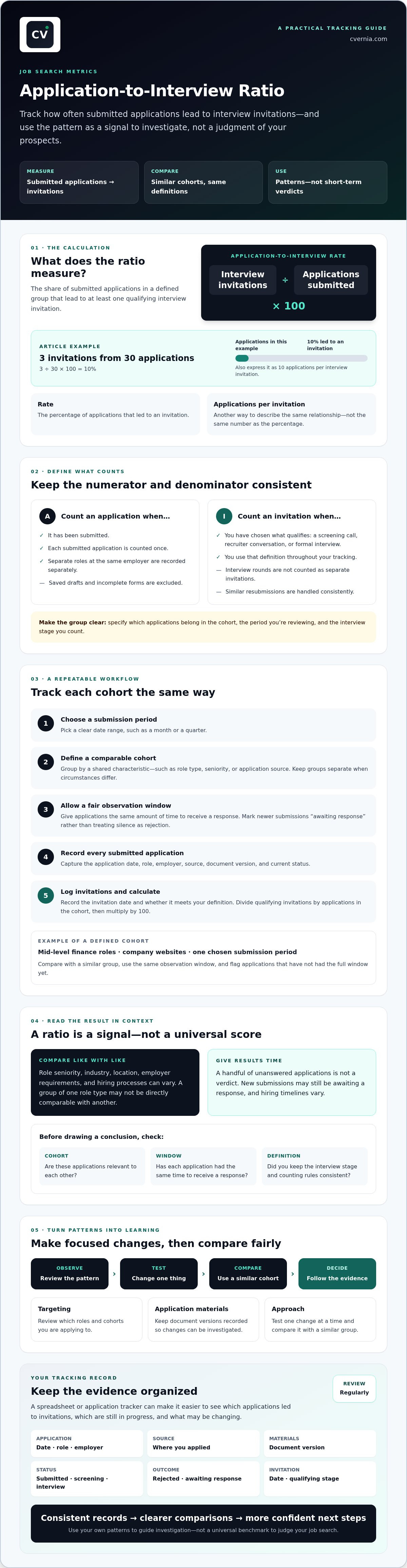
Your application-to-interview ratio shows how often submitted applications lead to interview invitations within a defined group. It measures one part of the recruitment process: the move from applying to receiving an interview invitation. To make the result meaningful, specify which applications belong in the group, the period you’re reviewing, and what you count as an interview invitation.
Formula: interview invitations ÷ applications submitted × 100 = application-to-interview rate.
For example, if 3 of 30 submitted applications lead to an invitation, the rate is 3 ÷ 30 × 100, or 10%. You can also express the result as 10 applications per interview invitation. The percentage shows the share of applications that led to an invitation; applications per interview shows how many applications correspond to one invitation. These are two ways of describing the same relationship, not interchangeable numbers.
What Counts as an Application and an Interview?
Count an application only after you’ve submitted it. Saved drafts, bookmarked jobs, and incomplete forms don’t belong in the denominator. Decide whether an invitation means a screening call, a recruiter conversation, or a formal interview, then use that definition throughout your tracking.
For a clean comparison, count each submitted application once and record whether it led to at least one qualifying invitation. Don’t count every interview round as a separate invitation. If you apply for separate roles at the same employer, record each application separately. If you resubmit for the same role, decide in advance whether to count it as a new application or a duplicate, and handle similar cases consistently.
Quotable definition: “Your application-to-interview rate is the percentage of submitted applications in a defined cohort that lead to at least one invitation to your chosen interview stage.”
Why the Ratio Is a Personal Tracking Metric
Use the ratio to understand your own patterns, not to grade your job-search performance against a universal threshold. Outcomes can vary with role seniority, industry, location, employer requirements, and hiring processes. A group of applications for one type of role may not be directly comparable with a group for another.
For consistent tracking job application to interview ratio, define the cohort by application date or another clear rule, and connect each invitation to the application that prompted it. Keep your definition of an interview stage unchanged when comparing periods. This gives you a more reliable trend to investigate without treating one result as proof that your CV or approach is failing.
Step-by-Step: Track Your Application-to-Interview Ratio
A consistent record makes it easier to see which applications led to invitations and which are still in progress. Start with a spreadsheet or application tracker, then follow the same process each time you review results.
- Choose a submission period. Pick a clear date range for the applications you’ll review together, such as a month or a quarter.
- Define the cohort. Group applications by a shared characteristic, such as role type, seniority, or application source. Keep groups separate when their circumstances differ, so the comparison is more useful.
- Set a fair observation window. Give each application the same amount of time to receive a response before comparing results. Hiring timelines vary, so mark newer submissions as “awaiting response” instead of treating silence as a rejection.
- Record every submitted application. Capture the application date, role, employer, source, document version, and current status. Exclude saved drafts and incomplete forms.
- Log invitations and calculate. Add the invitation date and note whether it meets your definition of an interview. Divide qualifying invitations by the applications in the cohort, then multiply by 100.
Choose a Cohort and a Fair Measurement Window
For example, you might review applications submitted for mid-level finance roles through company websites during one period. Compare that group with a similar cohort, rather than combining it with unrelated roles or referral applications. Use the same observation window for both groups, and flag applications that haven’t had the full window yet. This prevents recent submissions from unfairly lowering the apparent rate.
Record Applications, Invitations, and Outcomes Consistently
Keep status labels simple and consistent: submitted, screening, interview, rejected, or awaiting response. Record an invitation separately from a completed interview, and track later stages, such as an offer, as separate outcomes. This preserves the distinction between receiving an invitation and progressing through the hiring process. For context on how metrics describe different recruitment stages, see AIHR’s overview of key recruiting metrics.
Example record: Date: May 6 | Role: Financial analyst | Employer: Example Co. | Source: Company website | Version: Finance CV 2 | Status: Interview | Invitation date: May 19
Link each application to the CV and cover letter you actually submitted. That record won’t predict an employer’s decision, but it can help you investigate patterns later. A spreadsheet may be enough to start. If you want application details and document versions organized in one place, an application tracking dashboard can support a consistent workflow.
How to Interpret the Ratio Without Misleading Yourself
Read your ratio as a clue, not a verdict. A lower result may prompt you to review how closely roles match your experience, whether your application demonstrates relevant qualifications, and whether your materials reflect the role’s requirements. It doesn’t prove your CV is the problem. A higher result is encouraging, but it doesn’t predict offers or establish overall job-search success.
Treat each possible explanation as a hypothesis to investigate. Check comparable groups of applications, make sure they’ve had a similar amount of time to receive responses, and look for supporting evidence before changing your approach.
| Pattern | Possible explanation | What to check next |
|---|---|---|
| Fewer invitations in one cohort | The roles may be less aligned with your background, or your evidence of relevant experience may be harder to find. | Compare role requirements with your application, including the qualifications and examples you clearly demonstrate. |
| More invitations from one source | That channel may connect you with roles that are a closer fit, or applications may reach employers through different screening steps. | Check that the cohorts cover similar roles, seniority, and time periods before drawing a conclusion. |
| Rate shifts sharply between reviews | The number of applications may be small, or some applications may still be awaiting a response. | Review cohort size, application age, and pending statuses before treating the change as a trend. |
| More invitations, but no later progress | Your application-to-interview results may be improving while later hiring stages remain a separate challenge. | Track interview outcomes separately and review notes from those conversations for recurring themes. |
What a Lower or Higher Ratio May Suggest
Compare like with like. Combining unrelated industries, seniority levels, locations, or application channels can hide useful differences. For example, a change in your overall rate may reflect a shift in the roles you applied for rather than a change in your materials. When tracking job application to interview ratio, keep the details behind each cohort so you can investigate what changed instead of guessing.
Why Generic Benchmarks Can Mislead
Use an external benchmark only if its source is relevant, dated, and clear about how the figure was measured. Occupation, market conditions, experience level, employer screening practices, and the definition of “interview” can all affect comparisons. An average without that context may not tell you whether your results are typical or what action to take.
Keep this in mind: “Your personal trend is more useful than an unsupported average because it reflects your roles, application channels, and tracking rules.” A short tracking period or small cohort can shift sharply when even one invitation arrives, so wait for more comparable evidence before making a major change.
Improve Application-to-Interview Trend with Focused Tests
Use your tracking results to decide what to test, not to overhaul every part of your search at once. Change one controllable factor, such as role targeting or how you present relevant experience, then compare the next similar group of applications. That makes it easier to assess whether the adjustment may be helping.
Review Role Fit and Tailor Application Materials
Start with the role requirements. Prioritize vacancies where you can show evidence for the essential qualifications, and make that evidence easy to find in your CV and cover letter. Use accurate, role-relevant language, but don’t add skills or experience you can’t support.
Check that your documents are readable and key information is easy to locate. An ATS compatibility review can flag potential formatting or keyword alignment issues, but a score doesn’t predict an interview. For a closer compatibility check, explore this ATS resume checker guide. If you’re adapting supporting documents to a specific role, see the guidance on tailored cover letters.
Run Small, Trackable Job-Search Experiments
Choose one adjustment and document it before sending applications. For example, revise how you connect relevant achievements to role requirements while keeping your target role type and application source similar. Then compare that cohort with an earlier, comparable group. Avoid changing your CV, target roles, and application channel all at once, or you won’t know which change may have influenced the pattern.
- Compare similar groups: Keep role type, seniority, and application source as consistent as practical.
- Allow time for replies: Hiring timelines vary, so separate pending applications from those with a clear outcome.
- Review the pattern: Note interview invitations by role type and source, then decide whether there’s enough comparable evidence to continue, refine, or stop the test.
Keep your conclusions measured. A changed ratio may be associated with your adjustment, but other factors, such as employer screening practices or differences between vacancies, may also affect results. Consistent records of application details and document versions make comparisons more useful. A structured approach to tracking job application to interview ratio can help you learn from each cohort without treating any single result as proof.
To keep applications, document versions, and outcomes organized as you test changes, use CVernia’s application tracking tools.
Build a Reliable Tracking Workflow for Your Next Applications
A tracking system is useful only if you keep it current. Set aside time each week to update application statuses, record new interview invitations, and review comparable cohorts using the same counting rules. Then choose one practical next action, such as checking whether a particular role type is producing relevant responses or refining how you present a qualification you can document.
Keep applications awaiting a reply separate from those with a confirmed outcome. Hiring timelines vary, so don’t read silence as a rejection or let recent submissions distort your comparison. Regular updates make tracking job application to interview ratio useful as an ongoing process, rather than a number you check once and forget.
Keep Application Records Useful After an Interview
An interview invitation adds context beyond the ratio itself. Record the invitation date, stage, preparation notes, and any follow-up status alongside the original application. Link these details to the CV and cover letter you submitted, so you can review what you shared and prepare accurately for later conversations.
After interviews, note questions that came up more than once or topics you’d like to prepare more thoroughly. Treat these as prompts for future preparation, not proof that one answer caused a particular outcome. For ideas on organizing stages and interview details, see this job interview tracker guide.
Choose a Tracking Method You Will Maintain
A spreadsheet may be sufficient if you can update it reliably, find application details, and connect each submission to the right document versions. Use clear column headings and consistent status labels. As your records grow, separate files may make it harder to find the correct CV, cover letter, or interview notes. Centralized records can help reduce version confusion.
CVernia’s application tracking, interview notes, and version management tools can keep those job-search details organized in one workflow. They support consistent record-keeping, not a promise of interviews or hiring outcomes.
- Update: Add applications, invitations, outcomes, and follow-up details.
- Review: Recalculate comparable cohorts and leave pending applications clearly marked.
- Choose: Select one evidence-based action to guide your next review.
Build a workflow you can sustain, whether that’s a spreadsheet or a centralized platform. Explore CVernia’s career application tools to organize application records, document versions, and interview notes.
Turn Your Application Data Into a Clearer Next Step
Tracking job application to interview ratio is most useful when you apply the same counting rules to comparable groups and allow time for responses. Treat the result as a personal trend, not a universal score or a verdict on your CV. Then use what you’ve recorded to decide what to review or test next.
Keep your process manageable: update application statuses regularly, separate pending applications, and change one part of your approach at a time. Tailored, truthful CVs and cover letters can help you show how your experience aligns with a role, while organized document versions and interview notes make each application easier to review.
CVernia offers an application tracking dashboard, interview notes, and tools for tailoring CVs and cover letters. Organize your applications, document versions, and interview notes with CVernia as you build a more consistent job-search workflow. Keep reviewing your records and let the evidence guide your next move.
Frequently Asked Questions
How do you calculate the job application-to-interview ratio?
Divide the number of applications that led to a qualifying interview invitation by the number of submitted applications in the same defined cohort, then multiply by 100. For example, 4 invitations from 40 applications gives a 10% rate. Decide whether screening calls count before you calculate, and apply that rule consistently. You can also express the result as applications per invitation: in this example, 10 applications per interview invitation.
What is a good application-to-interview ratio?
There’s no single “good” ratio that applies to every job seeker. Results can differ by role, industry, seniority, location, application source, and employer screening practices. Rather than judging yourself against an unsupported average, compare similar groups of your own applications over time. A change can help you decide what to investigate, but it can’t guarantee future interviews, offers, or overall job-search success.
Should screening calls count as interviews in the ratio?
They can, as long as you define the metric to include them and use that definition consistently. If you want to measure invitations to formal interviews only, record screening calls separately. Keep the stages distinct in your tracker so you can calculate each measure clearly. Don’t count multiple rounds for one application as separate application-to-interview successes if your chosen measure is whether that application produced an invitation.
How many applications should I track before interpreting my ratio?
There’s no universal number that makes a ratio reliable. A small cohort can shift noticeably after one invitation, and recent applications may not have had enough time to receive a response. Track applications with consistent details, group comparable roles, and review the pattern across successive cohorts. Mark pending applications separately, then look for a sustained direction before making a major change to your search approach.
Why am I applying for jobs but not getting interviews?
Several factors may be involved, so a low response pattern doesn’t prove your CV is the cause. Check whether each role matches your experience and qualifications, whether your application clearly shows evidence for essential requirements, and whether your documents are readable and truthfully tailored. Also compare results by role type and application source. Test one adjustment at a time, and give comparable applications time to receive responses.
How often should I update my job application tracker?
Update it whenever you submit an application or receive a response, so details stay accurate and document versions are easy to identify. Then set a regular weekly review to update statuses, record invitation dates and interview notes, separate pending applications, and recalculate comparable cohorts. A spreadsheet may be enough if you maintain it consistently. If records become difficult to search or document versions get confusing, consider centralizing them.


