

A bad interview doesn't have to be the final word. Knowing what to do after a bad job interview starts with identifying what you wish you’d answered differently, then sending a concise, professional follow-up that thanks the interviewer and clarifies a relevant point. Send a thank-you email within 24 hours; if you’re writing a recovery note, aim for the day of the interview or no later than 9:00 AM the next day.
It’s natural to replay a difficult conversation and worry that nerves overshadowed your qualifications. Focus on what you can still communicate clearly: acknowledge one specific point you missed, reinforce your fit with relevant experience, and restate your interest without a lengthy apology. This guide explains how to follow up, reflect on what happened, and choose a practical next step, whether that means asking for another conversation or moving forward with your search.
Key Takeaways
- Pinpoint the moments that felt unclear so you can turn a difficult interview into focused preparation for the next one.
- Decide whether a follow-up conversation makes sense, and respond professionally if the interviewer declines.
- Use interview preparation guidance to strengthen your confidence and practice communicating your qualifications.
- Keep applications, interview notes, and role-specific materials organized to make each next step more intentional.
What to do after a bad job interview
Take a brief reset, then write down what happened before reflection turns into self-criticism. Note the questions that felt difficult, the answers you gave, and what you wanted to communicate. For example: “I described the project but forgot to explain my role.” That gives you a useful point to clarify. “I ruined everything” does not.
Debrief with three columns: question, answer given, and stronger point to add. Include details such as the project, skill, or result you left out. If nerves interrupted your response, distinguish that from a knowledge gap. A missed example calls for clearer preparation; an unfamiliar technical question calls for focused learning. This distinction helps you choose a practical next step.
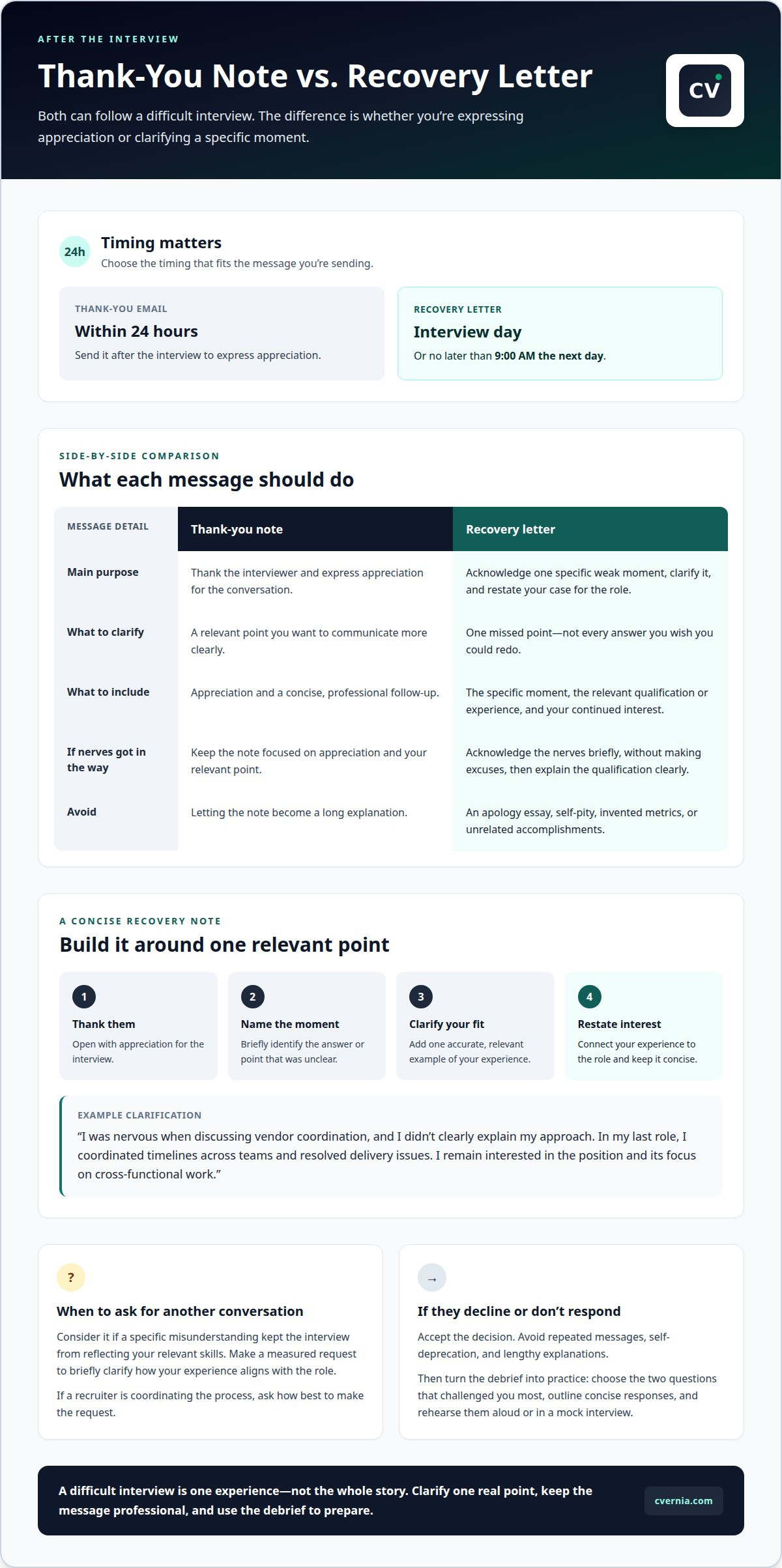
Send a thank-you email within 24 hours of the interview. If you need a recovery letter, send it on the interview day or no later than 9:00 AM the next day. Keep the message concise and professional. A thank-you note expresses appreciation; a recovery letter also acknowledges a specific weak moment and restates your case for the role. Neither message should become an apology essay.
Build your email around one missed point, not every answer you wish you could redo. Thank the interviewer, briefly identify the moment, and clarify the relevant qualification. If nerves affected your response, acknowledge that without making excuses. Then connect your experience to the role. For example: “I was nervous when discussing vendor coordination, and I didn’t clearly explain my approach. In my last role, I coordinated timelines across teams and resolved delivery issues. I remain interested in the position and its focus on cross-functional work.”
Include an achievement only if it strengthens your fit and is accurate. If you didn’t explain how you handled a project delay, clarify what you did and the outcome. Don’t invent a metric after the interview or add unrelated accomplishments. One relevant example is easier to assess than a long list. Keep the message focused on what the interviewer needs to understand about your qualifications.
Consider asking for another conversation if a specific misunderstanding kept the interview from reflecting your relevant skills. Keep the request measured: say you’d welcome a brief opportunity to clarify how your experience aligns with the role. If a recruiter is coordinating the process, ask how best to make the request. If the interviewer declines or doesn’t respond, accept the decision. Avoid repeated messages, self-deprecation, or lengthy explanations.
An interview that ends early can feel like a clear verdict, but timing alone doesn’t reveal the interviewer’s reasoning. A company might schedule a 45-minute interview that ends after 15 minutes because the interviewer has lost interest or decided to move on. Still, don’t treat those minutes as proof. Send a professional follow-up, then base your next decision on the response and any feedback you receive.
After sending your note, consider a personalized connection request if appropriate. Mention a specific discussion topic, such as the team’s approach to onboarding, rather than sending a generic message. If you don’t progress in the process, keep the connection courteous and focused on professional interest. A respectful follow-up leaves room for future opportunities without pressuring the interviewer.
Turn the debrief into practice before your next interview. Choose the two questions that challenged you most, outline concise responses, and rehearse them aloud or through a mock interview. Graham Weaver, founder of Alpine Investors, later described his first Stanford lecture as a failure. Weaver has taught at Stanford for over 10 years, showing that one difficult performance can become a prompt to prepare and improve.
Before writing a recovery letter, identify the answers that went poorly so your clarification addresses a real gap rather than reopening the whole interview. Keep the note short and professional, without self-pity. If nerves affected your performance, acknowledge that briefly, then focus on the qualifications that matter for the role. Use the letter to clarify a relevant achievement that didn’t come across in the conversation. Unlike a thank-you note, a recovery letter acknowledges the poor interview performance while restating your case for the role. The National Library of Medicine reports that procedural fairness ratings for the group selection interview were high.
CVernia
CVernia helps you carry lessons from a difficult interview into a more organized job search. Its career management platform brings application activity and interview preparation together, helping you keep role-specific details organized as you move forward.
Use Interview Preparation & Guidance to practice explaining the experience you want hiring teams to remember. The Application Tracking Dashboard helps you keep application progress visible, while CV Compatibility & ATS Analysis supports tailoring your CV to a role’s requirements. These tools can help as you prepare for another interview or manage several opportunities and follow-up tasks.
A difficult conversation can reveal what to refine, but it doesn’t define your qualifications. If you’d like support organizing your next steps, contact CVernia.
Turn the Experience Into Your Next Step
A difficult interview can give you a clearer target for your next opportunity. Choose one skill or example you want to explain more effectively, then apply that lesson in your preparation. Progress comes from making your experience easier to communicate, not from replaying every moment of the conversation.
When deciding what to do after a bad job interview, focus on the next action that strengthens your candidacy. CVernia’s career management platform helps organize your application journey. Tailored CV and cover letter tools and CV Compatibility & ATS Analysis help align your application materials with the roles you’re pursuing, while Interview Preparation & Guidance supports your preparation for the next interview.
Move forward with a plan that reflects your strengths and the work you want to do. For support with your next career step, contact CVernia. A difficult interview is one experience, not the whole story.


