

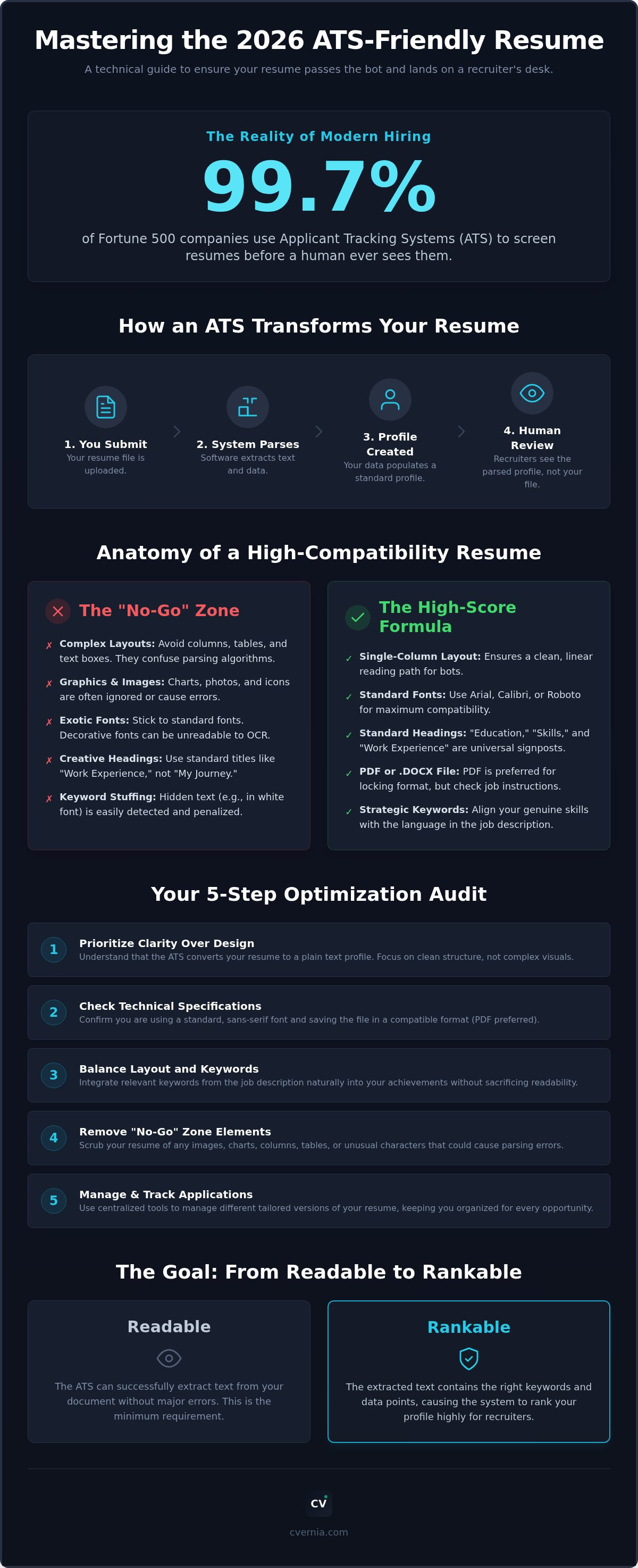
Did you know that 99.7% of Fortune 500 companies now use automated systems to screen your application before a human ever sees it? It's a staggering figure that explains why so many talented professionals feel like their hard work is vanishing into a digital black hole. You've likely spent hours tweaking every word, only to be met with total silence. We understand how exhausting it is to face conflicting advice about whether to use columns or which fonts are truly safe for a modern ats resume format. You deserve a clear path that removes the guesswork and restores your confidence.
This definitive guide will help you master the technical formatting rules required to pass the bot and land on a recruiter's desk. We'll show you how to align your experience with the latest 2026 hiring standards, focusing on high-impact layouts and strategic keyword placement. You'll learn exactly which technical no-go zones to avoid so your CV remains readable and ranks high in search results. We will break down the return to single-column layouts, the rise of skills-first screening, and the most reliable file types for seamless parsing.
Key Takeaways
- Understand how recruitment systems transform your document into a digital profile so you can prioritize clarity over complex design.
- Learn why specific fonts and file types are non-negotiable for a high-compatibility ats resume format that bots can actually read.
- Master the balance between layout and keyword integration to rank higher in recruiter searches without compromising your professional integrity.
- Follow a streamlined five-step audit to remove invisible formatting "no-go" zones that often trigger automated rejections.
- Discover how to efficiently manage multiple tailored applications using centralized tracking tools to stay organized and ready for every interview.
What is an ATS Resume Format and Why Does It Matter in 2026?
An ats resume format is a technical framework designed to ensure your professional data is correctly extracted by hiring software. Think of it as a bridge between your career history and a recruiter's database. By 2026, almost every major employer uses an Applicant Tracking System (ATS) to manage the thousands of applications they receive. If your document doesn't follow these structural rules, the system may fail to "read" your qualifications. This often leads to candidates being ghosted before a human ever sees their name.
When a recruiter opens their dashboard in a system like Greenhouse or Workday, they aren't usually looking at your original designed PDF. They see a standardized digital profile created from your parsed text. A poor layout makes this transformation messy. Dates might move to the wrong jobs, or your contact information might vanish entirely. Mastering this format ensures your profile remains accurate and professional in the eyes of the hiring team. It's about moving from uncertainty to readiness by respecting the technology that guards the gate.
The Role of Parsing in Modern Recruitment
Parsing is the process where an algorithm "reads" your career history to identify key details. Modern AI-driven systems in 2026 are more sophisticated than ever, but they still rely on a clear structural hierarchy to function. They look for standard headings like "Work Experience" or "Education" to know where to pull data. There's a vital difference between being "readable" and "rankable." A readable file allows the system to see your text, while a rankable candidate has aligned their skills with the job description. At CVernia, we believe truthful representation is the only sustainable strategy. Avoid the temptation to inflate your experience. Focus instead on aligning your genuine achievements with the technical needs of the bot to gain a strategic advantage.
Common Myths About "Beating the Bot"
You've likely heard advice about "white fonting" or stuffing keywords into invisible sections. These "black hat" tactics are outdated and dangerous in 2026. Modern systems easily detect hidden text, and recruiters will see right through a list of irrelevant buzzwords. Don't mistake "simple" for "unprofessional" for human readers. A clean, single-column layout actually demonstrates high-level digital literacy. It shows you understand how modern hiring technology works. The reality of 2026 recruitment is that clarity wins every time. Forget the hacks. Build an ats resume format that respects the technology while honoring your actual professional journey.
The Technical Anatomy of a High-Compatibility Resume
Building a document that survives the initial scan requires a shift in how you view design. You aren't just creating a page for a person, you're structuring data for an algorithm. By 2026, the standard for a high-performance ats resume format has shifted toward technical precision rather than visual flair. Choose a standard, sans-serif font like Arial, Calibri, or Roboto. These fonts are mandatory because they ensure high readability for Optical Character Recognition (OCR) software. When you use exotic or decorative fonts, the parser may see your text as a series of garbled symbols, leading to an immediate rejection.
The debate between .docx and .pdf has a clear winner in 2026. While .docx was once the safer bet, modern systems now prefer high-quality PDFs because they lock your formatting in place. This prevents your text from shifting when it's opened on different operating systems. However, always check the job description for specific instructions. If you're unsure about your document's current health, you can use CV compatibility and ATS analysis to identify hidden structural errors before you hit submit. This proactive step transforms your application from a gamble into a strategic move.
Clarity is your goal. Use standard labels for your sections to guide the parser effectively. Stick to "Work Experience," "Education," and "Skills" rather than creative titles like "My Professional Path" or "Where I've Been." These standard headings act as digital signposts. If the bot can't find your experience section, it won't be able to rank your seniority or tenure correctly. Avoid the "No-Go" zone entirely, which includes images, charts, and complex graphics. Most systems see these as blank blocks or, worse, they scramble the surrounding text during extraction. Focus on optimizing a resume for applicant tracking systems by keeping the layout clean and text-based.
Layout Best Practices: Single Column vs. Two Column
Stick to a single-column layout for maximum safety. While some modern systems can handle simple two-column designs, the risk of a "reading order" error remains high. Bots typically read from left to right. If you use columns, the system might read the first line of the left column followed by the first line of the right column, creating a nonsensical sentence. Never use tables to organize your layout. Tables often break the data extraction process, causing your skills to be associated with the wrong dates or job titles.
Contact Information and Header Optimization
Place your contact information at the very top of the page, but avoid using the actual "Header" tool in Microsoft Word. Many older systems skip the header and footer sections entirely, meaning your phone number and email could be invisible to the recruiter. State your location clearly using a "City, State" format to help with local SEO filters. Use clean, clickable URLs for your LinkedIn profile and portfolio. Remove the "https://" prefix if you need to save space, but ensure the link remains active for the human reviewer who will eventually see your profile.
ATS Format vs. Strategic Tailoring: Why Layout is Only Half the Battle
While a clean ats resume format ensures the system can process your data, it doesn't guarantee you'll reach the top of the recruiter's list. The layout is simply the technical foundation. To actually rank well, you must focus on the content match. Most modern systems use a ranking algorithm to compare your document against the job description. If the software doesn't find a high percentage of the requested skills, your profile remains hidden at the bottom of the pile. You need to move beyond mere readability and focus on strategic alignment.
Contextual relevance is the key to passing more advanced AI filters in 2026. These systems don't just look for keywords in a vacuum; they look for them within your work history. If "Project Management" is a requirement, the bot expects to see it mentioned alongside specific dates and achievements. We call this the "Truthful Tailoring" mandate. It's about highlighting the genuine parts of your experience that matter most to a specific employer. This approach builds trust with the hiring manager while satisfying the technical requirements of the software.
Identifying High-Value Keywords in a Job Description
Read the job posting carefully to distinguish between "must-have" requirements and "nice-to-have" bonuses. Focus your efforts on the core competencies mentioned in the first few bullet points of the requirements section. You can use a tailored CV generator to quickly identify alignment gaps between your current document and the role. CV Compatibility is the mathematical match between your experience and the JD. By closing these gaps, you increase your chances of being flagged as a top-tier candidate.
Structuring Your Skills Section for Bots and Humans
Create a dedicated "Skills" or "Core Competencies" section to help the parser categorize your technical abilities quickly. This list should focus on hard skills, such as specific software, languages, or industry certifications. For soft skills like leadership or communication, integrate them directly into your professional experience bullet points. This provides the human recruiter with the context they need to see your value. To ensure your skills are being parsed correctly, consult our ATS Resume Checker Guide 2026 to select the most reliable tools for your audit.
5 Steps to Optimize Your Resume Format for 2026
Transform your document from a visual project into a high-performance data file by following a systematic workflow. While earlier sections focused on the theory of keywords, these steps provide the technical execution needed for a flawless ats resume format. High-compatibility resumes don't happen by accident; they're the result of intentional stripping and restructuring. Start by removing the "fluff" that confuses modern parsers. This includes social media icons, skill bars, and complex graphics that often render as gibberish in a recruiter's dashboard. Your goal is a clean, text-based hierarchy that rewards the bot for finding your information quickly.
- Step 1: Strip non-standard characters. Remove all icons, tables, and images. These elements often break the data extraction process, causing the system to skip entire sections of your history.
- Step 2: Audit your headings. Use standard terminology like "Work Experience" and "Skills." Creative titles may look unique to a human, but they prevent the system from categorizing your data correctly.
- Step 3: Map your experience chronologically. This remains the preferred structure for 2026 because it allows the software to calculate your total years of experience with mathematical precision.
- Step 4: Perform a compatibility analysis. Compare your formatted document against the specific job posting to ensure your skills align with the employer's requirements.
- Step 5: Test the "Parse-ability." Use a dedicated scanner to see exactly how the system interprets your file. If the output looks scrambled, your formatting still needs work.
The Chronological Format Advantage
The reverse-chronological format remains the gold standard for 2026 recruitment technology. Algorithms are programmed to calculate "years of experience" by subtracting your start dates from your end dates. If you use a functional or "skills-based" layout, the bot may struggle to assign a duration to your expertise, which can lower your overall ranking. When handling career gaps, be honest and brief. Use years instead of specific months if it helps create a cleaner timeline, but never invent experience to hide a hiatus. Truthful representation ensures that once you pass the bot, you can confidently stand by your record during the interview.
Final Formatting Checklist Before Hitting Send
Complete a final sweep for hidden text or "ghost" formatting before you upload your file. Ensure you haven't used white fonting or text boxes, as modern systems flag these as suspicious "black hat" tactics. You should also verify your ATS score to ensure you're ranking high enough to be seen. Finally, pay attention to your file naming conventions. A professional name like "FirstName_LastName_Role.pdf" is far better than "Resume_Final_v2.pdf." It helps recruiters find your file easily once it's been downloaded from the system. If you want to be certain your document is ready for the most rigorous screening, check your compatibility score today to gain an immediate strategic advantage.
Beyond the Format: Managing Your Application Journey with CVernia
Perfecting your ats resume format is a massive win, but it's only the first step in a sophisticated 2026 job search strategy. The real challenge often shifts toward version management once you begin tailoring your CV for different roles. Managing 20 or 30 different tailored resumes manually is a recipe for burnout and confusion. It's not just about the files; it's about the context behind each one. You need a centralized system to handle the complexity of a modern career transition without losing your mind in a sea of folders and confusing file names.
CVernia acts as your digital mentor, providing a Career Application Management Platform that replaces outdated, messy spreadsheets. Our smart reapplication detection helps you optimize your approach if you target the same company twice, ensuring your strategy remains fresh and aligned with their evolving needs. This technology allows you to see your career history as a living asset rather than a static document. By moving to a professional dashboard, you gain a strategic advantage that keeps you organized, efficient, and highly dependable throughout your professional journey.
Tracking Applications and Interview Notes
Centralize your efforts to reduce application fatigue and stay focused on your goals. Our application tracking dashboard allows you to store every version of your CV alongside specific interview notes and attachments in one secure place. This organization is vital for a high-volume search where details can easily blur between different companies. When you have all your data at your fingertips, you can walk into every interview feeling prepared and empowered. For a deeper dive into scaling your career efforts, check out The Ultimate Job Search Management System Guide.
Continuous Improvement via CV Compatibility Analysis
Use data to refine your search and understand your performance with mathematical precision. By reviewing your CV compatibility analysis, you can see exactly why certain versions of your ats resume format rank higher than others. This transparency allows for continuous improvement, turning every application into a learning opportunity that brings you closer to your goal. You can also leverage our Career Academy for advanced professional growth resources and specialized guidance. This support ensures you aren't just applying for jobs, but actively building a resilient career. Start optimizing your application journey today with CVernia to turn your uncertainty into total readiness.
Secure Your Place in the 2026 Hiring Landscape
Your professional journey is too valuable to be lost in a digital void. You now have the technical blueprint to build a high-compatibility ats resume format that satisfies both the bot and the human recruiter. Remember that a clean, single-column layout is your technical foundation, while strategic tailoring is your competitive edge. By aligning your genuine achievements with specific job requirements, you ensure your profile ranks high in every search.
Managing this process shouldn't feel like a second full-time job. You can streamline your efforts by using a centralized platform designed for modern recruitment. Join CVernia to optimize your ATS score and manage your career journey with confidence. Benefit from advanced CV Compatibility and ATS Analysis that highlights exactly where you stand. Our Smart Version Management helps you track tailored applications without the stress of messy folders, all while maintaining a commitment to truthful representation.
You've already done the hard work of building a great career. Now, it's time to ensure the world sees it. Take these steps today and move forward with the self-assurance that comes from being perfectly prepared. Your next opportunity is waiting, and you're ready to claim it.
Frequently Asked Questions
Can ATS systems read two-column resume formats?
Some modern systems can process them, but it remains a high-risk strategy for 2026. Parsers typically read from left to right across the entire page. If you use two columns, the system might blend the text from both sides into a single, nonsensical line. Stick to a single-column layout to ensure your data remains perfectly organized. This technical choice prioritizes reliability over visual style, ensuring the bot extracts your experience exactly as intended.
Is PDF or Word better for ATS compatibility in 2026?
PDF is generally the superior choice in 2026 because it preserves your document's structural integrity across all platforms. While .docx files are still widely accepted, PDFs prevent your text from shifting or becoming garbled during the upload process. Always check the specific job posting for instructions. If no file type is specified, a high-quality PDF ensures your professional presentation remains consistent for both the system and the human recruiter.
How do I know if my resume is ATS-friendly?
Test your document using a professional compatibility checker rather than guessing. You can use CVernia's CV Compatibility and ATS Analysis to see exactly how a parser interprets your data. This tool identifies hidden formatting errors and measures how well your keywords align with the job description. Seeing a "plain text" version of your resume is the most reliable way to verify that your contact info and work history are being extracted correctly.
Do I need a different resume for every job application?
Yes, tailoring your content is essential for ranking highly in automated searches. While you don't need to rebuild the entire document, you must adjust your skills and achievements to match the job description's specific language. Using a centralized platform makes managing these versions much easier. Our smart reapplication detection ensures you don't repeat past mistakes when applying to the same company, allowing you to refine your approach for every new opportunity.
What fonts are most ATS-friendly?
Use standard, sans-serif fonts like Arial, Calibri, or Roboto for maximum readability. These "web-safe" fonts are easily recognized by Optical Character Recognition software. Avoid decorative or serif fonts like Times New Roman in a modern ats resume format because they can sometimes cause parsing errors in older systems. Choosing a clear, professional font ensures the bot reads every word of your achievements without technical interruptions, moving you closer to an interview.
Will images or icons automatically cause an ATS to reject my resume?
Images and icons won't always trigger an automatic rejection, but they often result in missing data. Most parsers can't "see" images, so any text contained within a graphic is lost. Icons for phone numbers or emails can also appear as strange characters, confusing the system. Strip these elements to ensure your contact information remains visible. Focus on a clean, text-based design that empowers the technology to rank your profile accurately and with total clarity.
How does an ATS calculate my years of experience?
The software calculates tenure by identifying the start and end dates associated with each role in your work history. It typically searches for a "Month, Year" or "Year" format to perform this math. If your dates are missing or formatted inconsistently, the system might underestimate your total experience. Use a reverse-chronological layout to help the algorithm verify your seniority and tenure with precision, ensuring you meet the required qualifications for the role.
What happens if my resume format is not ATS-compatible?
A non-compatible format often leads to a "parsing error" where your profile appears blank or scrambled to the recruiter. If the system can't extract your skills or contact info, you'll likely be filtered out before a human ever sees your name. This is why following a standardized ats resume format is vital. It guarantees that your qualifications are searchable in the database, giving you a fair chance to compete for the position and secure an interview.


