

What if the "black hole" of online applications isn't a heartless robot, but a simple filing cabinet waiting for the right label? You've likely felt that familiar sting of anxiety after hitting "submit," wondering if a single font choice or missing keyword triggered an instant, automated rejection. It's exhausting to follow conflicting career advice and common ats myths while feeling like your professional future is at the mercy of an algorithm. We understand that stress. Your real-world experience is far more valuable than a document designed to "game" a system.
You deserve to move from uncertainty to readiness with a clear, tech-backed strategy. We promise to provide the actionable steps you need to optimize your CV for semantic alignment and strategic advantage. You'll explore how systems like Workday function under 2026 regulations like the Colorado AI Act, ensuring your truthful experience is finally seen by a human recruiter. Transform your application process today and gain the confidence you need to land your next role.
Key Takeaways
- Recognize that 2026 recruitment technology focuses on semantic understanding rather than simple keyword counting to rank your experience.
- Stop fearing the "black hole" by identifying the specific knockout questions that actually trigger automated rejections.
- Debunk common ats myths regarding formatting to create a modern, professional CV that parses perfectly every time.
- Shift your focus from "gaming the system" to strategic application management and version tracking for long-term career success.
Understanding the Applicant Tracking System (ATS) Landscape in 2026
Think of an ATS as a high-powered digital library rather than a heartless robotic gatekeeper. At its core, What is an Applicant Tracking System? It's a sophisticated database designed to collect, sort, and rank thousands of candidates so recruiters can find the right fit quickly. Many job seekers feel ignored by these systems, which has led to a rise in common ats myths about instant, automated rejections. It's completely valid to feel frustrated when you spend hours on an application only to receive a generic email. However, the primary goal of these tools is organization, not exclusion. Understanding how they function allows you to stop guessing and start applying with confidence.
How Modern ATS Parsers Read Your Resume
Hiring technology has moved far beyond simple keyword matching. In 2026, systems use Natural Language Processing (NLP) to understand the context of your career history. Instead of just scanning for specific words, modern parsers identify "entities" like technical skills, leadership levels, and industry certifications. CV Parsing is the process of converting unstructured document data into a structured candidate profile. This structured data allows a recruiter to see a clean summary of your experience without opening every individual file. Use standard headings and clear dates to help the parser map your journey accurately. When the machine reads your document correctly, the human recruiter sees your value immediately.
The Role of AI in 2026 Recruitment
AI now acts as a digital assistant that helps recruiters prioritize their workflow. These tools assign a relevancy score to your profile based on how well your experience aligns with the job requirements. While the AI suggests which candidates are the strongest matches, humans still make the final interview decisions. This shift is partly driven by new legal standards. For instance, the Colorado AI Act now requires employers to use "reasonable care" to prevent algorithmic discrimination in hiring. This means companies are under more pressure than ever to ensure their systems are fair and transparent. Focus on truthful representation of your existing skills. AI-driven verification is highly sophisticated, and your genuine achievements are your greatest strategic advantage in a competitive market.
Myth #1: The "Black Hole" Theory—Do Robots Really Reject You?
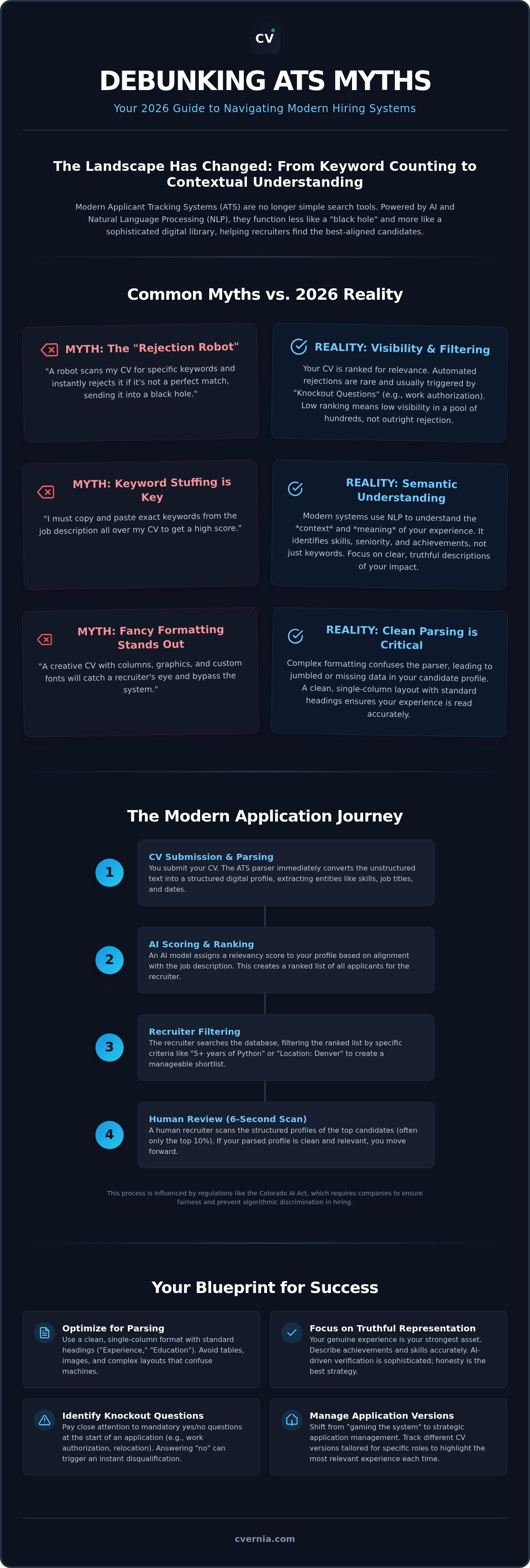
One of the most persistent common ats myths is the idea of a "rejection robot" that scans your resume and instantly hits a delete button. This simply isn't how the process works in 2026. Aside from specific "Knockout Questions," which are binary filters for things like work authorization or relocation, a human is nearly always the one making the final call. If you've ever received an automated rejection within minutes, it's likely because you answered "No" to a mandatory requirement set by the hiring team. For everything else, the system acts as a filter, not a judge. Being ranked low in a database feels like rejection, but it's actually a visibility issue that you can fix.
The Reality of Recruiter Filtering
Recruiters don't have time to read every single submission from start to finish. Instead, they use search parameters to create a shortlist from the database. They might filter for "5+ years of Python experience" or "Location: Denver" to narrow down a pool of 1,000 applicants. Ensuring you have an ATS compliant resume means your data is correctly categorized so you appear in these targeted searches. Once you're in the shortlist, the recruiter performs a quick 6-second scan of the profile the ATS generated from your file. If that profile is messy or missing dates, they move to the next candidate. You can use CVernia's compatibility analysis to see exactly how your data maps to these filters before you hit submit.
Why Your Application Status Might Get "Stuck"
Your application often feels "stuck" because of sheer volume. With 97.4% of Fortune 500 companies using these systems as of August 2026, a single role can attract thousands of applicants. Understanding how applicant tracking systems work helps you realize that being ranked lower in a list of 500 people isn't the same as being rejected. Recruiters typically only view the top 10% of ranked candidates before they find enough people to start the interview process. If you haven't heard back, try sending a brief, professional follow-up to the hiring manager on LinkedIn. This direct outreach can pull your name out of the "pending" pile and into their direct line of sight. It's a proactive way to bypass common ats myths and prove you're a serious contender.
Myth #2: The Formatting Trap—Fancy Designs vs. Plain Text
Many job seekers believe they must strip their CV of all personality and design to survive a digital scan. This is one of the most persistent common ats myths circulating in 2026. You don't need to submit a document that looks like a 1995 text file to be successful. Modern systems are highly capable of reading multi-column layouts, simple graphics, and standard PDFs. The goal isn't to avoid design entirely, but to ensure your design doesn't obstruct the text layer that the machine needs to read. A clean, hierarchy-based layout actually helps both the parser and the human recruiter identify your key achievements faster.
You can also stop worrying about using specific "safe" fonts like Times New Roman or Arial. While you should avoid overly decorative or "script" fonts that are difficult to read, modern parsers handle most standard sans-serif and serif fonts with ease. Focus on professional clarity. The real "formatting killers" aren't your font choices or a splash of color; they are structural elements like tables, text boxes, and placing critical contact information inside headers or footers. Most parsers still struggle to extract data from these areas, which can lead to a profile that looks empty to a recruiter even if your document is full of great experience.
PDF vs. Word: The 2026 Verdict
In 2026, PDF has become the gold standard for applications. It preserves your visual layout perfectly across different operating systems while still providing a clean text layer for the ATS to parse. However, how you create that PDF matters. Always use the "Save As" or "Export" function in your word processor. Avoid using "Print to PDF," as this often flattens the document into an image, making the text invisible to the parser. Follow this checklist for a parser-friendly structure:
- Use standard H1 and H2 headings for sections like "Work Experience" and "Education."
- Keep your contact information in the main body of the document rather than the header.
- Avoid using tables to align text; use tabs or columns instead.
- Ensure your dates follow a consistent format (e.g., MM/YYYY) throughout the file.
Avoiding the "Invisible Text" Hack
You might have heard advice to paste the entire job description into your CV in a tiny, white font to "trick" the system. Don't do it. Modern ATS are designed to flag this as a major red flag. Recruiters see the raw text layer that the parser extracts, meaning your "invisible" text appears as a giant, suspicious block of keywords at the bottom of your profile. This instantly damages your credibility and often leads to an immediate manual rejection. If you're worried about missing keywords because you're moving into a new industry, use a career change resume structure instead. This allows you to highlight transferable skills truthfully without resorting to outdated tricks that could cost you the interview.
Myth #3: Keyword Stuffing is the Key to Success
Robotic repetition won't get you hired in 2026. One of the most damaging common ats myths is that stuffing your resume with every single keyword from the job description guarantees a top ranking. While keywords are important, modern systems now use "Semantic Search" to understand the relationship between terms. For example, if a job posting asks for "Account Management," the ATS recognizes that your experience in "Customer Success" or "Client Relations" is directly relevant. Overloading your CV with identical phrases doesn't just look suspicious to a recruiter; it often provides zero extra value to a sophisticated algorithm.
Shift your focus toward contextual keywords. Instead of a standalone list of skills at the bottom of your page, weave those terms into your achievement-based bullet points. When you describe how you "increased retention by 15% using CRM tools," you provide the proof a recruiter needs to trust your expertise. Truthful tailoring is about demonstrating your impact, not just matching a list of requirements. This approach ensures your application remains readable for humans while satisfying the machine's need for data. A list of 50 keywords is a poor candidate experience, but a well-told story of success is universal.
Tailoring Your CV for Relevancy, Not Robots
Start by identifying the hard skills (technical abilities) and soft skills (interpersonal traits) within the job post. Use the "Rule of Three" to match your top three career achievements to the company's most urgent needs. This creates a narrative of alignment that resonates throughout your entire application. You can even use a tailored cover letter generator to reinforce these key themes in a narrative format. This ensures that your technical skills and personality are presented in a way that feels cohesive and professional.
The Danger of Inventing Skills
Skill Alignment is the honest mapping of your professional history to a job's requirements. We stand firmly behind truthful representation because inventing skills is a short-term gamble that leads to long-term failure. AI-driven interview tools in 2026 are designed to probe specific keywords found in your CV. If you claim expertise you don't actually possess, the follow-up questions will quickly expose the gap during the initial screening call. Build a foundation of trust from the very first scan. Optimize your CV for truthful alignment today to ensure your real skills are getting the attention they deserve from hiring teams.
Strategy Over Myths: Managing Your Application Journey
Stop treating your job search like a game of cat and mouse with an algorithm. Success in 2026 requires you to shift your focus from "beating one system" to managing a comprehensive career campaign. While common ats myths suggest you need a secret code to get noticed, the real advantage comes from organization and consistency. Centralized management is the ultimate "ATS hack" because it allows you to approach every application with precision and data-backed confidence. You aren't just a document in a database; you are a professional managing a strategic transition.
Many applicants believe the myth that reapplying to the same company is a waste of time. In reality, modern systems use smart reapplication detection. If you've updated your skills or applied for a different department, the system recognizes your growth and persistence. Instead of firing off a single document and hoping for the best, treat your search as an evolving project. Every submission is a chance to showcase your current value. This mindset shift alleviates the stress of the "one and done" approach and positions you as a persistent, high-value candidate.
The Power of Version Management
You need a specific CV version for every job title you target. A document optimized for a "Marketing Manager" role shouldn't be the same one you use for a "Brand Strategist" position. This isn't about being untruthful; it's about highlighting the specific achievements that matter most to that particular hiring team. Staying organized is the hardest part of this high-volume process. Use a job interview tracker to ensure you always know which version was sent to which company. Storing your interview notes alongside specific CV versions prevents confusion when you finally get the call. It allows you to speak directly to the achievements the recruiter has right in front of them, ensuring your interview performance is as polished as your application.
How CVernia Simplifies the ATS Reality
CVernia simplifies this complex reality by providing a centralized home for your professional journey. Our Application Tracking Dashboard gives you a bird’s-eye view of every submission, status update, and follow-up task. Before you hit submit, our CV Compatibility & ATS Analysis tools provide a vital "pre-flight check" to ensure your document parses correctly. You don't have to navigate these technical hurdles alone. Visit our Career Academy for ongoing 2026 hiring insights and expert guidance to stay ahead of common ats myths as they evolve. We are your digital mentor, turning technical confusion into a clear roadmap for success. Start managing your applications with CVernia today and take control of your professional future.
Take Control of Your Career Journey in 2026
You've moved beyond the fear of the unknown. By debunking these common ats myths, you've gained the clarity needed to present your professional history with total confidence. Remember that hiring technology is simply a tool for organization; it's your truthful experience and strategic alignment that ultimately win the interview. Stop worrying about "beating the bot" and start focusing on managing a high-impact career campaign. You deserve an application process that honors your hard work and highlights your genuine skills without the anxiety of conflicting advice.
Leverage modern tools to give yourself a competitive edge in a crowded market. Our platform provides the technical precision of ATS Compatibility Analysis and the strategic advantage of Smart Reapplication Detection. You can maintain a bird's-eye view of every opportunity through our Comprehensive Application Tracking Dashboard. This centralized approach ensures you never lose track of a single CV version or important interview note. Master your job applications with CVernia’s centralized platform and transform your search from a source of stress into a streamlined path to success. You're ready to show the world what you can do.
Frequently Asked Questions
Do ATS automatically reject resumes with low scores?
No, a low score simply means you appear lower in the recruiter's search results. While common ats myths suggest a robot makes the final decision, humans almost always review the candidate pool. The only exception is knockout questions, such as work authorization. If you meet the basic requirements, your profile stays in the database for the recruiter to find during their search. Focus on alignment to improve your visibility.
Can an ATS read my resume if it is in a two-column format?
Yes, modern systems in 2026 can parse standard two-column layouts without issues. The problem arises when you use complex tables or text boxes to create those columns. Stick to standard page layouts to ensure the parser reads your experience in the correct order. Use clear headings so the system can easily categorize your skills and work history into your digital profile for recruiters to see.
Is it better to apply via LinkedIn or the company’s ATS portal?
Apply through the company portal whenever possible. While LinkedIn is convenient, the direct portal ensures your data maps perfectly into their specific system. Some third-party integrations can strip away formatting or miss custom screening questions that are vital for your ranking. Direct applications give you more control over how your professional brand is presented to the hiring team and ensures your full document is preserved.
How many keywords do I need to pass the ATS screening?
Focus on relevancy rather than a specific count. One of the common ats myths is that more keywords always lead to a higher rank. Modern semantic search technology understands the context of your skills, so stuffing is no longer effective. Instead, use natural language to describe your achievements. Aim to include the core hard skills mentioned in the job description while maintaining a professional narrative that resonates with recruiters.
Will an ATS reject me if I reapply for the same role after three months?
No, reapplying is often seen as a sign of persistence. Modern systems use smart reapplication detection to link your new submission to your previous profile. If you've gained new skills or certifications in those three months, the updated data can actually improve your ranking. Use this as an opportunity to show professional growth and a continued interest in the organization's mission and specific team goals.
Does the ATS look at my cover letter as well as my resume?
Yes, most systems parse your cover letter to gather extra context about your career goals and intent. While your resume provides the structured data, the cover letter adds a narrative layer that can help with semantic matching. Ensure your cover letter is tailored to the specific role to reinforce the keywords and achievements found in your CV. This creates a cohesive and authoritative application that machines and humans value.
Should I use a "functional" or "chronological" resume for ATS compatibility?
Choose a chronological or hybrid format for the best results. Functional resumes often hide the timeline of your career, which confuses many ATS parsers. A chronological structure allows the system to easily tie your skills to specific dates and job titles. This clarity is essential for the recruiter to understand your career progression and verify your years of experience in key areas before they call you.
Is it true that ATS can’t read images or charts?
Yes, this is largely true. While technology has improved, many parsers still struggle to extract text from images, icons, or complex charts. If you place critical information like your contact details or key skills inside a graphic, the system may ignore it entirely. Use plain text for all essential data to guarantee that every part of your professional story is visible and searchable for the hiring team.


